

Ring Types and Styles: Purpose, Design, Settings and Fit

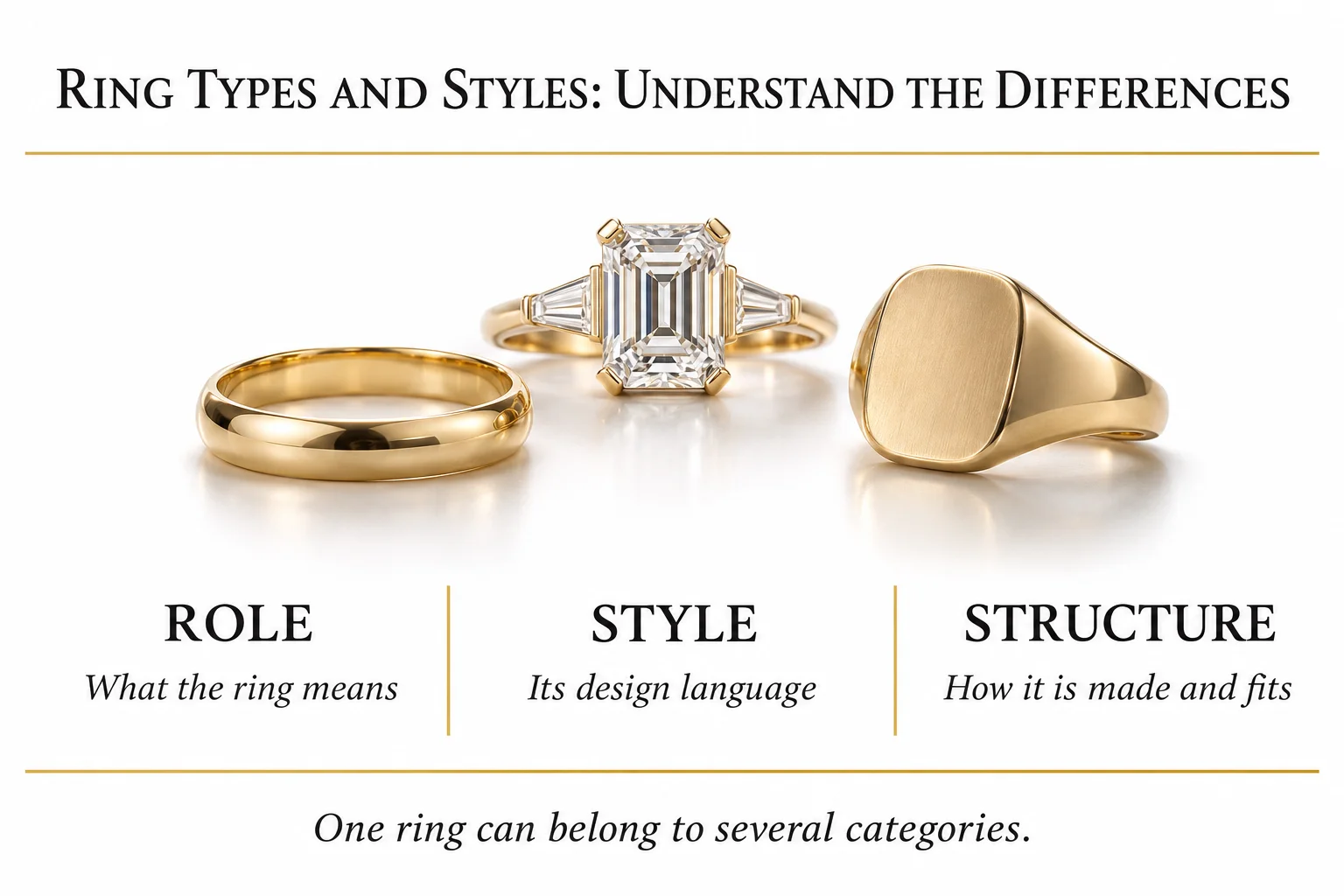
Ring names describe different things: purpose, historical inspiration, construction, gemstone outline or fit. One ring can belong to several categories at once—for example, an engagement ring with an Art Deco-inspired design, an emerald-cut center and a bezel setting. This reference helps separate those labels so a design conversation becomes clearer.
Separate what the ring means from its style and construction. One ring can belong to several categories. Describe purpose, design inspiration, actual gemstone, retention method and fit separately to make the specification clear.
At a glance · Start with the purpose: engagement, wedding or everyday jewelry · Recognize personal, family and ceremonial references · Distinguish historic objects from modern interpretations · Separate Victorian, Edwardian, Art Nouveau and Art Deco language
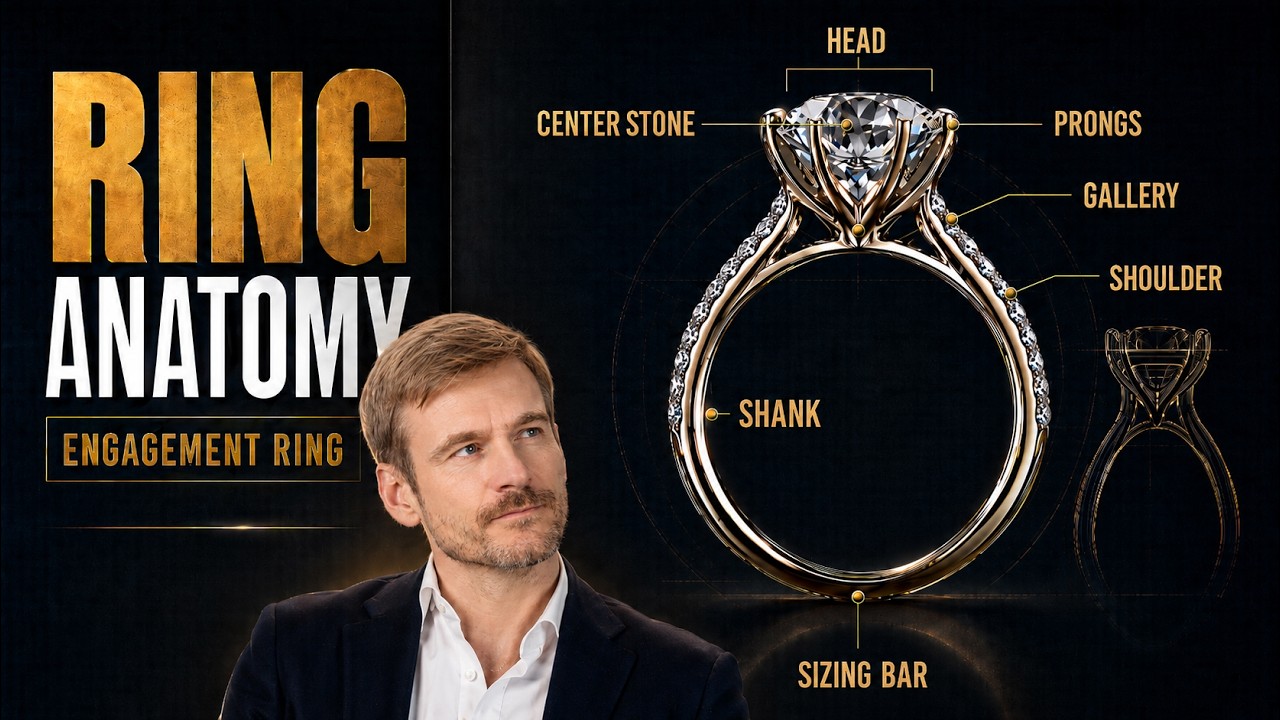
Watch the NinaVova discussion
Watch the original NinaVova video on YouTube.
The NinaVova ring-anatomy discussion accompanies the vocabulary and construction guide. Use it alongside the written distinctions between purpose, composition, setting and fit.
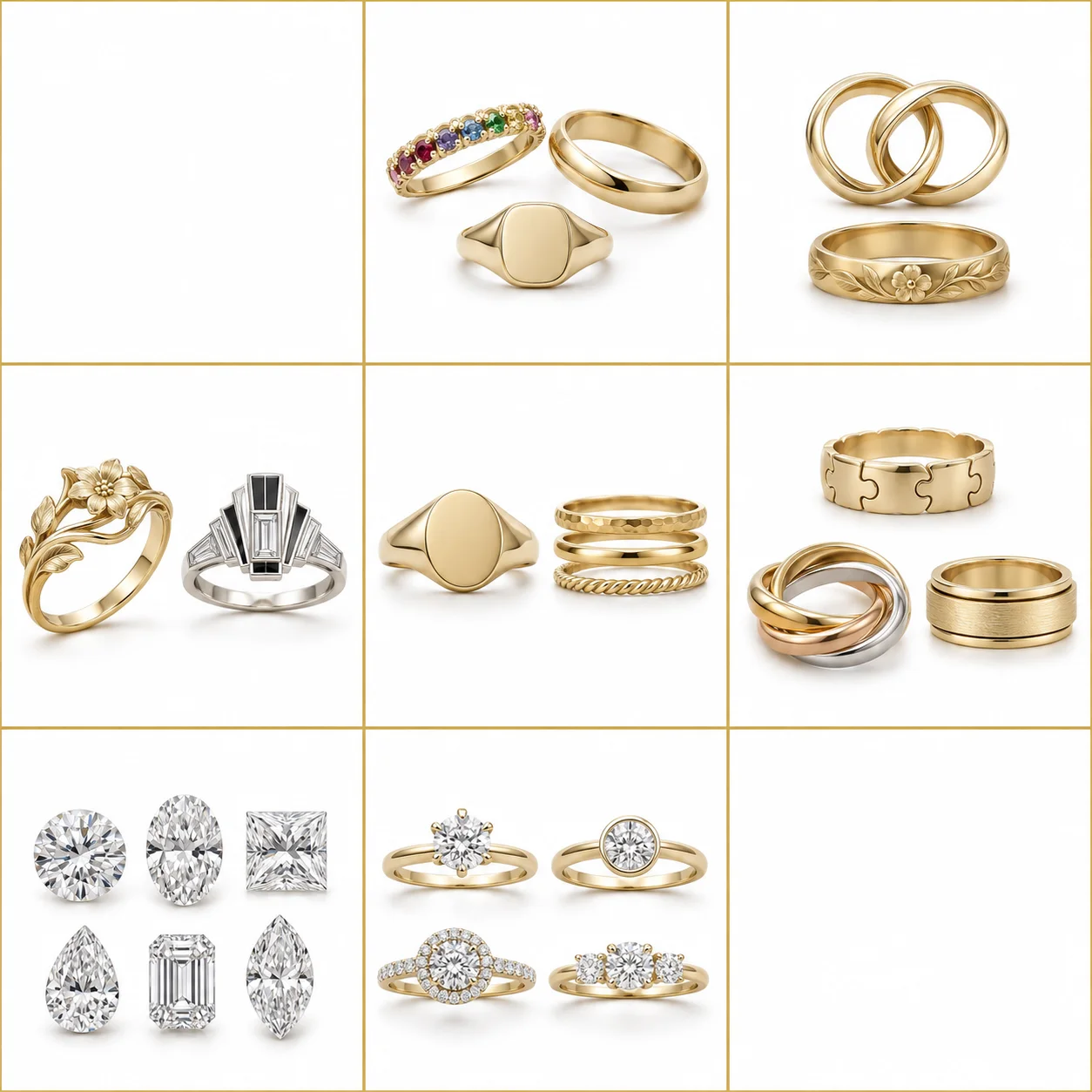
Ring labels: what each category describes
| Category | Examples | Question it answers |
|---|---|---|
| Purpose | Engagement, wedding or fashion | Why it is worn |
| Personal reference | Promise, family or birthstone | What it means to the wearer |
| Design inspiration | Art Nouveau or Art Deco | Its visual language |
| Construction | Signet, linked or spinner | How its parts are arranged |
| Gemstone outline | Round, pear or emerald cut | The stone’s silhouette and faceting style |
| Setting and fit | Prongs, bezel, pavé and interior profile | Retention and wearing experience |
Start with the purpose: engagement, wedding or everyday jewelry
An engagement ring commonly marks an intention to marry, while a wedding ring commonly marks the marriage ceremony. Either can be plain or gem-set, and neither is limited to one gender.
A coordinated engagement ring and wedding band may be called a bridal set, but the wearer can choose one piece or another arrangement. The name does not impose a universal wearing order.
Fashion and statement rings are chosen primarily for personal styling. A cocktail ring commonly suggests a substantial visual feature, rather than one compulsory stone or dimension.
Purpose does not establish materials, quality or price. Identify the role, then describe the actual construction and appearance.

Recognize personal, family and ceremonial references
A promise ring can represent an agreed commitment without necessarily announcing an engagement. Its meaning should be clear between the people involved.
A birthstone or family ring can use colors associated with months or particular people. These associations are personal references rather than guaranteed effects.
Religious rings, class rings and professional rings carry meanings tied to particular communities or institutions. Confirm those meanings with the relevant people rather than assuming one universal interpretation.
Personal engraving can connect an otherwise restrained design with a private story. Exact wording, available space and future service need to be discussed.
Distinguish historic objects from modern interpretations
Antique commonly describes an object at least a century old, while vintage is used more variably in the trade. Ask for an actual date or period rather than treating either word as precise evidence.
A newly made historically inspired ring is different from a genuine period object. An antique-looking surface does not establish age, provenance or condition.
Gimmel rings use linked or interlocking hoops; museum records document historical examples associated with marriage. They should not be treated as identical to every modern stack.
Posy rings carry inscriptions, while the Claddagh design is associated with hands, a heart and a crown. Galway City Museum provides a specific historical reference for the latter.
A traditional motif can inspire a new piece without claiming that all modern meanings or legends are verified history.
Separate Victorian, Edwardian, Art Nouveau and Art Deco language
Historical periods contain varied designs, so a single flower, geometric line or material does not conclusively date an object.
Victorian-inspired jewelry may draw on sentimental motifs and decorative detail, while Edwardian references often suggest delicate openwork and a different visual balance.
Art Nouveau commonly draws on flowing organic lines. Art Deco is associated with a different design language that can emphasize geometry, symmetry and contrasting elements.
An original contemporary design can use those references without becoming a genuine antique. Describe the inspiration and actual date accurately.
Choose the feature you enjoy and explain it through references. A modern jeweler can discuss feasible proportions and materials rather than promising every period technique in every design.
Describe signet, stackable and coordinated forms
A signet commonly presents a broad face that can carry initials, an emblem or an unmarked surface. It can be personal jewelry without a claim of inherited status.
Stackable rings are separate pieces planned to sit together. They may share a finish or color while differing in width and detail.
Check the combined fit and actual contact between pieces. Rings that look coordinated in a photograph can still rub or feel uncomfortable together.
A single ring can also have several visually divided sections without being a true set of separate bands. Describe what moves or separates rather than relying on the appearance alone.
Understand linked, puzzle and moving structures
A puzzle ring uses multiple parts arranged to form a complete ring. Its practical assembly is different from simply wearing several unrelated bands together.
Interlocking three-band designs are another construction. Cartier’s named Trinity design has its own history; the brand name should not be applied indiscriminately to every generic arrangement.
A spinner ring includes a moving element around or within another structure. Kinetic jewelry can introduce other forms of movement.
Moving parts create service and cleaning questions. They should not be sold with a medical promise that spinning will treat anxiety.
Ask about pinching, dirt accumulation, wear and resizing in the actual design. An interesting mechanism still needs comfortable edges and a suitable fit.
Name gemstone outline separately from cutting quality
Round, oval, pear, marquise, heart, princess, cushion, radiant, emerald and Asscher are familiar shape or cutting-style names. They describe different silhouettes and facet arrangements.
An emerald-cut diamond is not an emerald gemstone. A princess outline is not simply interchangeable with every square brilliant or step-cut stone.
The same shape name does not guarantee identical proportions, dimensions or light behavior. Compare the actual gem rather than choosing from a diagram alone.
Carat measures weight, so actual length, width and depth are useful when judging the ring’s presence.
Pointed or angular outlines can introduce particular protection questions. The setting should be planned for the actual material and condition.
Separate composition from stone-setting technique
A solitaire describes one principal stone, while three-stone and halo describe other compositions. They do not by themselves establish how every gemstone is secured.
Prongs retain a stone through appropriately designed metal details; a bezel uses a rim around all or part of its edge. Their actual execution matters more than a universal safety ranking.
Pavé uses closely arranged small stones and retaining details, while a typical channel uses continuous metal walls. A ring can combine several techniques.
A hidden halo introduces a surrounding detail below the top view. It may add interest in profile without necessarily changing the face-up outline.
Ask for top, side and underside views and clear material descriptions. Neither a setting name nor prong count guarantees damage can never occur.
Finish with the band profile and practical fit
Comfort-fit commonly refers to a rounded interior profile, while a flatter interior is another option. The name does not guarantee that one profile is best for every wearer.
Band width, thickness, weight and neighboring rings affect how the piece feels. Size with the actual intended arrangement in mind.
Ask about resizing, repair and care for the specific materials and structure. Extensive stone coverage, inlays or moving parts may limit later work.
At NinaVova, a clear brief can combine purpose, design inspiration, gemstone outline and suitable construction. Existing project images illustrate individual combinations.
Use the categories as a vocabulary for choices rather than a test of personality. The final specification should describe the actual ring you want to wear.

Frequently asked questions
Is solitaire the same as prong setting?
No. Solitaire describes a composition, while prongs describe how a stone is held.
Is a new Art Deco-inspired ring an antique?
No. Historical inspiration and actual age are different descriptions.
Does comfort-fit guarantee the best fit for everyone?
No. Compare the actual profile, width and wearer’s preference.
Turn ring vocabulary into a clear personal brief
Bring the features you enjoy. We can separate style references, actual materials and practical construction before developing a feasible design.
Book a NinaVova consultation or explore our custom design process.
Continue reading: Engagement vs wedding · Pavé settings · Bezel settings.
Sources and further reading
- GIA: Setting types and styles
- The Met: Gimmel ring
- Galway City Museum: Claddagh ring
- GIA: Accurate ring sizing
- NinaVova: Current project terms
Confirm the actual materials, condition, evidence and current written terms for the offered ring. Illustrations do not establish identity, provenance, certification or an environmental footprint.