


Morganite Engagement Rings: Pink Color, Treatment and Practical Care

Morganite offers a soft pink or peach direction for an engagement ring, with a different appearance and care profile from diamond. It can be a beautiful personal choice when the actual color, treatment, cutting and setting are understood. Begin with the stone you enjoy, then build a ring around realistic expectations for wear and maintenance.
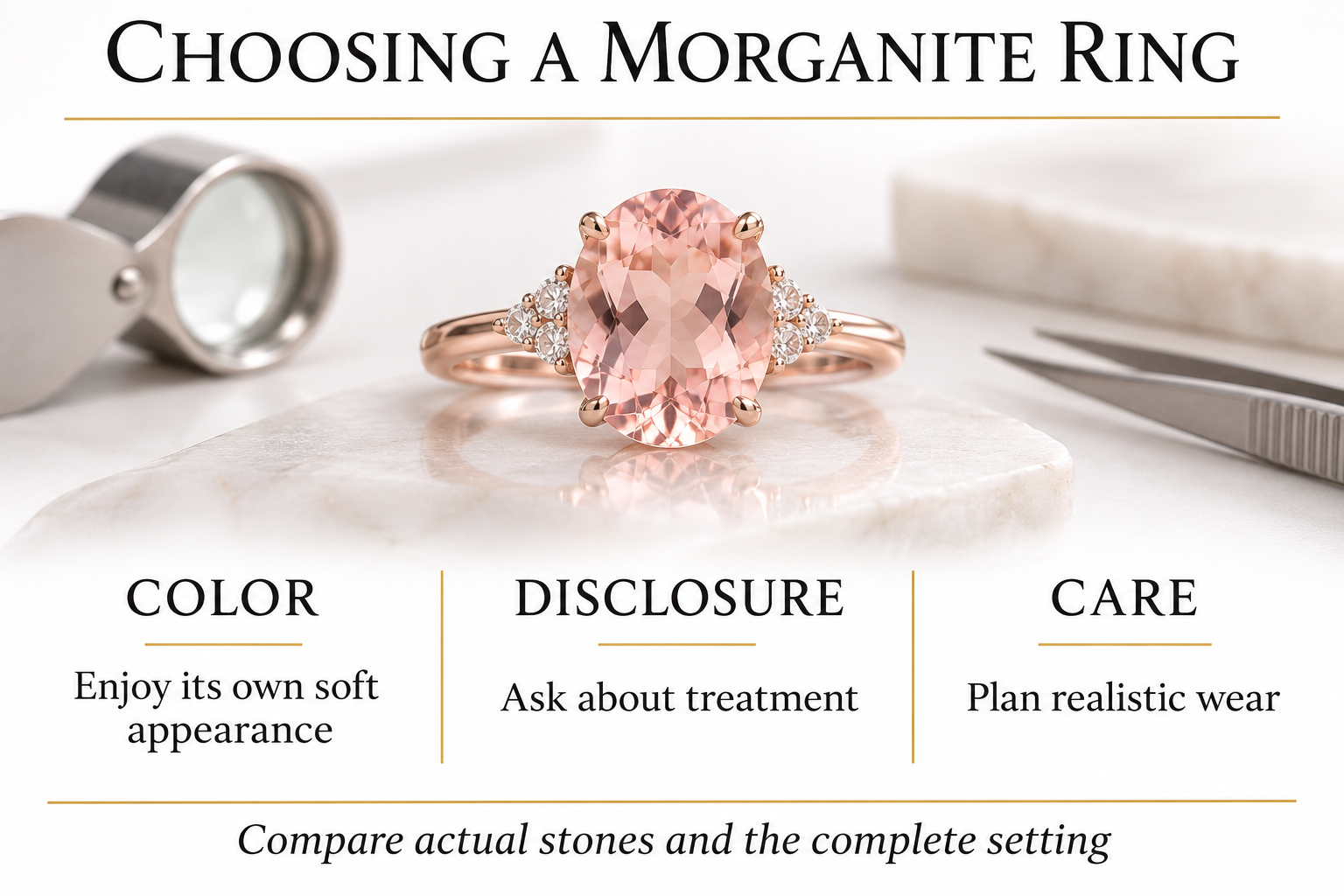
Choose morganite for its own color and appearance. Morganite is pink to orangy-pink beryl, with lower scratch resistance than sapphire or diamond. Confirm treatment, compare the actual stone and plan the setting and care around realistic wear.
At a glance · Morganite in the beryl family · Color and clarity: look at the actual candidate · Treatment and useful disclosure · Design the center and setting together
Watch the NinaVova discussion
Watch the original NinaVova video on YouTube.
Original NinaVova morganite discussion. The written guide clarifies material identity, treatment and care; older price examples and popularity figures are not current offers or rankings.
Morganite: appearance and practical checks
| Consideration | Look for | Ask about |
|---|---|---|
| Color | Pink or peach you enjoy | Useful ordinary-light views |
| Clarity | Actual transparency and condition | Relevant independent evidence |
| Treatment | Clear disclosure | Heat or any filling |
| Setting | Support and comfortable profile | Whole-ring construction |
| Care | A suitable wearing routine | Cleaning and repair limits |
| Alternatives | Other pink materials | Different identity and care |
Morganite in the beryl family
Morganite is the pink to orangy-pink variety of beryl. Aquamarine and emerald are other familiar beryl varieties, while colorless beryl is called goshenite; colorless material is not simply a pink morganite retaining the same variety name.
Manganese contributes to morganite’s color. The appearance may be delicate, peach-like or more distinctly pink, depending on the actual stone.
Pezzottaite is a related mineral species rather than another color variety of ordinary beryl. A mineral-family chart can provide context without making all related pink stones interchangeable.
The name honors J. P. Morgan, an important gem patron and collector. The useful buying question is still the description and appearance of the actual stone, rather than a historical association alone.

Color and clarity: look at the actual candidate
Compare the tone and saturation in useful ordinary light. Very pale material may look nearly colorless in some settings, while a photograph can exaggerate a pink or peach impression.
Morganite is often available with good transparency and few readily visible inclusions, but no variety name guarantees perfection. Assess the individual stone for appearance and condition.
Ask whether the image shows the actual candidate. Useful moving views and consistent lighting help compare color, window-like areas and persistent dark zones.
Its light behavior is different from diamond. Enjoy morganite for its own softer appearance rather than buying it on a promise that it reproduces a pink diamond’s sparkle.
Treatment and useful disclosure
Heating is commonly used to adjust morganite’s color, including reducing yellow or orange components. Ask what is known about treatment instead of assuming every stone has the same history.
Morganite’s color is generally stable in ordinary light; excessive heat is a separate concern. An old warning that simply wearing the ring in daylight will fade it confuses those conditions.
Occasionally, fracture filling may be relevant. That affects care and repair expectations, so obtain the actual disclosure and appropriate advice for the particular stone.
A report can help with identification and detectable treatment within its scope. It does not automatically establish that a stone is flawless, a financial investment or suitable for every wearing routine.
Design the center and setting together
Morganite can suit a solitaire, a halo, a bezel or a composition with diamonds and other gems. Rose gold is an appealing option for some pinks, while white or yellow metal can create different effects.
Choose the actual combination rather than assuming one metal is required. The prongs and nearby metal can influence the overall impression of a pale center.
A protective rim or lower profile may reduce some exposure, but no setting guarantees that the stone will never be hit or scratched. Review support, height, band dimensions and the way a wedding ring will sit beside it.
A custom cut can be explored when useful, but the label alone does not prove better cutting or lower breakage risk. Evaluate the actual outline, light pattern and condition.
Wear and cleaning need realistic expectations
Morganite’s Mohs hardness is about 7.5–8, below sapphire and diamond. That concerns scratching, while impact resistance and treatment-related stability are separate considerations.
It can be used in rings with appropriate care, but it asks for more caution than sound diamond or sapphire. Remove it for rough work, lifting and situations likely to create impact or catching.
Warm soapy water and a soft brush are a cautious cleaning choice when suitable for the whole ring. Have a jeweler assess inclusions, fractures or filling before using ultrasonic or steam methods.
Avoid excessive heat and unsuitable chemicals. Store pieces separately and keep settings checked. No article can promise that a gemstone will remain unchanged for years regardless of how it is worn.
Morganite and diamond compared
Morganite is beryl; diamond is another material. Both can be fashioned in many outlines, but their appearance, scratch resistance and market contexts differ.
A larger morganite may fit a budget that would not buy a particular pink natural diamond. Compare actual complete quotations rather than fixed per-carat prices from an older article.
Natural or laboratory-grown diamond is a separate choice, and a pink diamond needs accurate growth-origin and treatment disclosure. Do not infer identity or rarity from the shade alone.
If you enjoy both materials, morganite can be combined with diamond accents. The ring’s care should follow the more demanding components, not just the hardness of its smallest diamonds.
Pink moissanite: ask how the color is produced
Moissanite offers a different light pattern and greater scratch resistance than morganite. It is silicon carbide rather than diamond or beryl.
For a pink product, ask whether the color involves a coating or another process and how that affects cleaning, wear and repair. Do not assume every pink moissanite has the same stable body color.
Compare the actual stone and setting. A high refractive index or strong fire does not make one appearance universally better; the choice depends on the look you enjoy.
Pink sapphire: another durable color direction
Pink sapphire is corundum and can offer a useful combination of color and durability for a carefully made ring. Natural and laboratory-grown options need distinct descriptions.
Color, clarity, treatment, cutting and actual condition all matter. It is not reliably true that every pink sapphire is cheaper than blue sapphire or more affordable than every diamond.
Compare the particular shade and complete quotation. A fine sapphire and a pale morganite can express quite different pink directions even before the setting is considered.
Pink tourmaline: individuality with a care plan
Tourmaline can show a broad range of pink and red directions, sometimes with more than one color in a stone. Its Mohs hardness is about 7–7.5, so cautious wear matters.
A subtle color difference can affect a market comparison, but there is no universal price rule putting every pink-red above every lighter pink.
Choose actual color, condition and cutting with the intended setting. Tourmaline’s appeal should be weighed alongside the wearer’s willingness to follow suitable care.
Pink topaz: treatment and cleavage matter
Topaz can be offered in pink directions, but ask how the actual color is produced and what treatment or surface coating is involved.
A Mohs hardness of 8 does not remove its cleavage-related vulnerability to impact. A large stone should not be selected solely because its size appears affordable.
Review the actual description, condition and complete design, and follow care appropriate to both the material and treatment.
Pink spinel: compare the individual stone
Spinel can offer delicate through strong pink colors and has a Mohs hardness of 8. It can be considered for a carefully designed ring with appropriate wear and maintenance.
Natural and laboratory-grown material are different purchase descriptions. Ask for clear evidence where origin or treatment affects the decision.
It may offer a useful alternative to a particular sapphire or diamond, but the actual stones determine the price comparison. A color name alone does not establish a bargain.
Peach or pink moonstone: a different optical appeal
Moonstone’s attraction is its shifting glow rather than diamond-like brilliance. Peach or pink material can suggest a softer visual direction, with its own range of transparency and appearance.
It is substantially more vulnerable to scratching and impact than sapphire or diamond. A protective design cannot make it equivalent to those materials for demanding daily wear.
Choose it only with a care routine you are comfortable following. For a multi-stone design, consider whether the more delicate components suit the way the whole ring will be used.
Choose the complete ring, not a price promise
Set a comfortable total and compare current written quotations for actual stones, setting work and service. Older per-carat ranges or popularity surveys are not current offers.
If morganite’s color is the attraction, compare a few real candidates and decide how much presence you want. Color, cutting and the whole composition may matter more than a larger weight.
At NinaVova, we can discuss the center, accents and setting as one design, with clear expectations about treatment, fit and care. Choose the material you enjoy wearing rather than a promise of celebrity-level value or guaranteed investment returns.

Frequently asked questions
Is morganite a pink diamond?
No. Morganite is beryl; diamond is a different material with different appearance and wearing properties.
Will normal daylight fade morganite?
Its color is generally stable in ordinary light. Excessive heat and treatment-specific care are separate concerns.
Does a bezel make morganite damage-proof?
No. A suitable setting reduces some exposure but does not remove scratching or impact risks.
Explore a pink direction that suits your routine
We can compare actual morganite candidates and other pink options, then discuss a balanced ring and the care each material needs.
Book a NinaVova consultation or explore our custom design process.
Continue reading: Morganite and sapphire compared · 15 pink gemstones · Tourmaline buying guide.
Sources and further reading
- NinaVova: Original morganite discussion
- GIA: Morganite identity and qualities
- GIA: Morganite care and color stability
- GIA: Mohs and broader gemstone durability
Based on NinaVova’s original material, with supporting references below. Confirm the actual stone, treatment, condition, complete design and suitable care; concepts are not laboratory identification or current offers.