


Tourmaline Engagement Ring Guide — NinaVova Education
NinaVova · Learn before you choose
The tourmaline
engagement ring guide.
Explore pink, green, blue and bi-color tourmalines, then compare the actual color, cut, treatment and wearing needs before designing her ring.

In this guide Choose a chapter
01 / Start with her color
Start with her color.
A family of possibilities
Tourmaline is a group of related minerals with an unusually broad palette. A ring can begin with forest green, raspberry pink, blue, an almost electric turquoise, or two colors in one crystal. The right starting point is the color she actually enjoys, followed by the way that particular stone looks and wears.
Compare the total ring budget, not just the loose stone. A rare color or a laboratory-supported variety name can change the price dramatically. Ordinary tourmaline, fine rubellite and copper-bearing Paraíba tourmaline are not interchangeable price categories.
Natural, treated and imitation are different questions
A natural tourmaline formed in the earth. It may subsequently have been heated or irradiated. An untreated claim concerns treatment history, not simply natural origin. Glass and other gems can resemble tourmaline; a bright photograph cannot identify the material.
Ask the seller to name the material, variety where supported, and known treatment in writing. Do not assume that a clear, inexpensive or unusually bright stone is laboratory grown. A laboratory identification is more useful than a home scratch test, which can damage the gem.
02 / Color, varieties & bi-color
Color, varieties & bi-color.
Find the color family first
Rubellite is a trade name for pink-to-red tourmaline; indicolite refers to blue tourmaline, sometimes with a green component. Green tourmaline covers many appearances. Chrome tourmaline is a more specific color-caused category that should be supported by appropriate identification. These names help organize a search, but do not guarantee a particular quality.
Tourmaline also occurs in yellow, orange, brown, purple and colorless material. Compare the actual options in the same lighting. A color that is attractive in a large macro photograph may look much darker at hand distance.
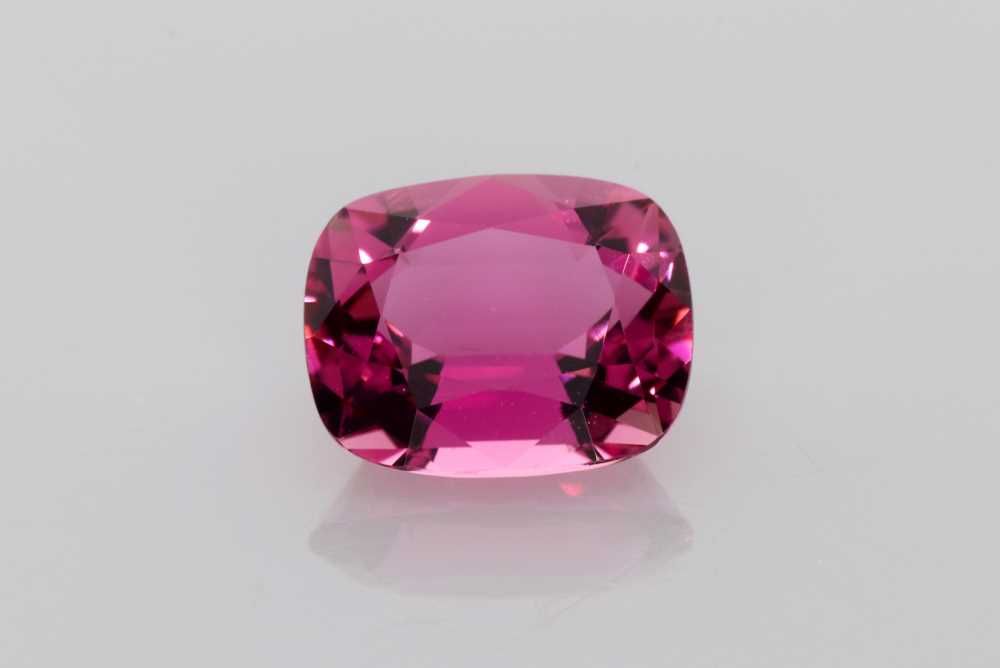
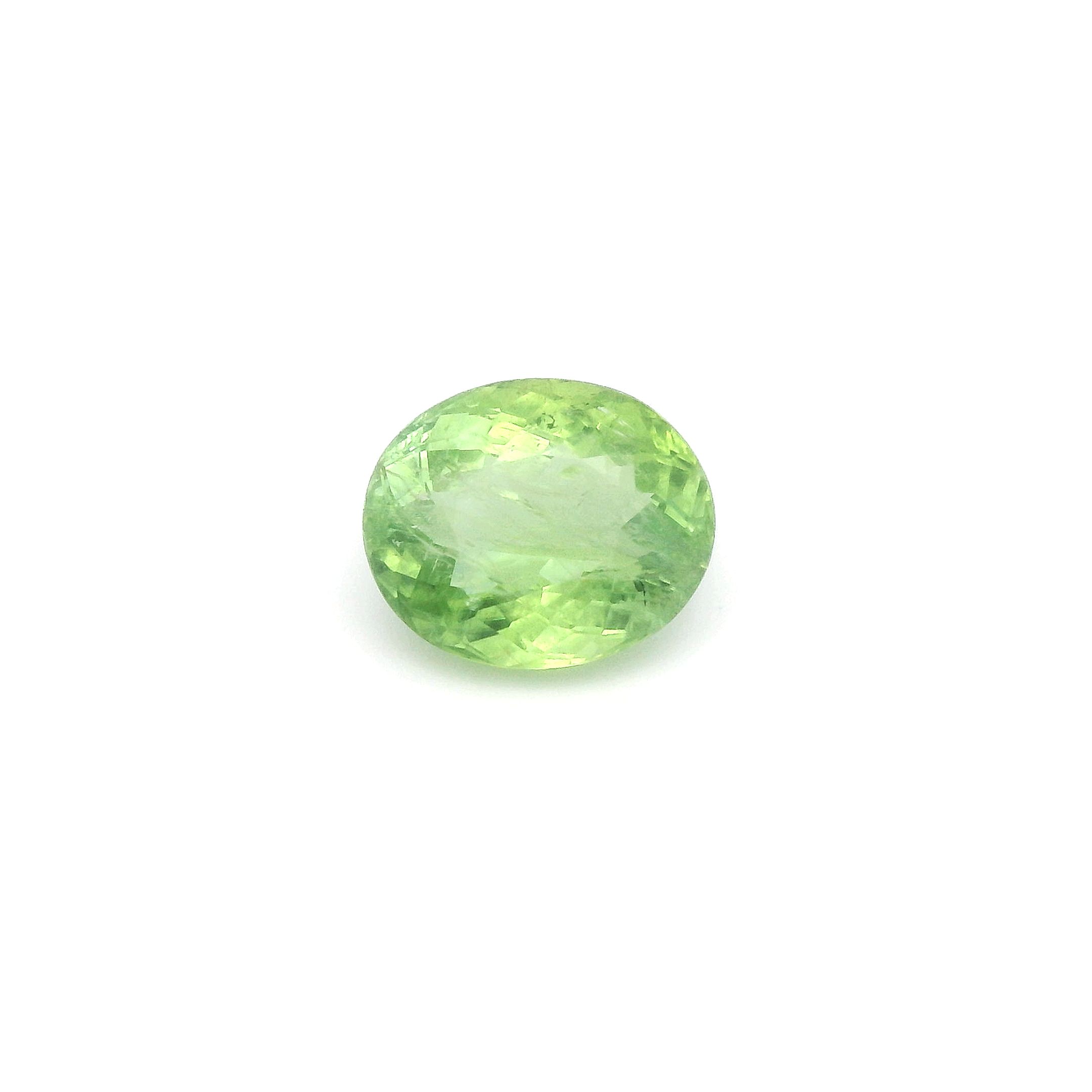
Actual catalog photographs of different stones, generally 1–3 ct. Lighting and scale vary; these are examples, not calibrated color comparisons. Follow a photograph for current availability and the supplier’s details.
Hue, tone and saturation
Hue describes the color family and its modifiers: a blue may lean green, or a pink may lean purple. Tone is how light or dark it looks. Saturation describes color strength rather than darkness. A deep tone can conceal a vivid hue indoors; a pale tone can still have a clean, attractive color.
Look for an enjoyable balance in the actual gem. Very dark ends, a gray cast or a nearly colorless center may distract from the color you wanted. Independent catalog photographs illustrate the range, but cannot serve as calibrated color grades.

Actual catalog photographs of different stones, generally 1–3 ct. Lighting and scale vary; these are examples, not calibrated color comparisons. Follow a photograph for current availability and the supplier’s details.
Paraíba: verify the name behind the glow
Paraíba tourmaline is associated with copper-bearing blue-to-green material and can command a substantial premium. The name began in Brazil, but copper-bearing tourmaline is also found in Mozambique and Nigeria. A Paraíba description does not by itself prove Brazilian origin.
A neon-looking photograph, turquoise color or seller label is not enough to establish copper-bearing identity. For a significant purchase, request a suitable laboratory report and read the exact variety and origin conclusions. Judge beauty and transparency separately from rarity.
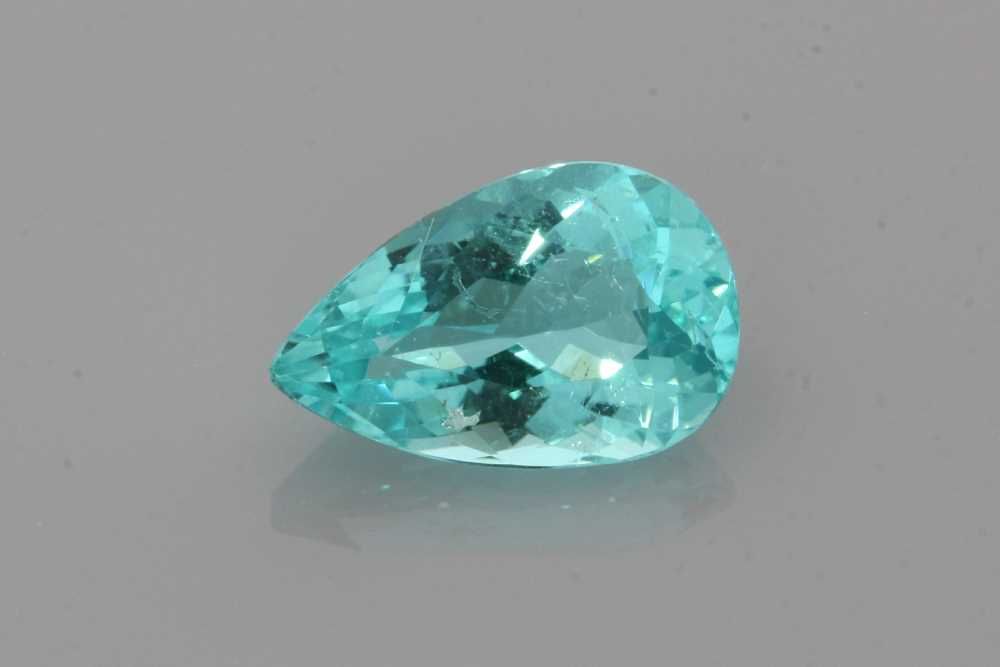
Actual catalog photographs of different stones, generally 1–3 ct. Lighting and scale vary; these are examples, not calibrated color comparisons. Follow a photograph for current availability and the supplier’s details.
Bi-color and watermelon tourmaline
Bi-color tourmaline has distinct color regions within one stone. Pink and green combinations are familiar, but other combinations exist. Watermelon material typically has a pink interior and a green outer region in the crystal; a faceted gem may expose that arrangement differently from a slice.
Check whether the transition is visible face-up and after setting. An elongated step cut can emphasize a color boundary, while another orientation can mix the colors. A transparent area between zones is not automatically a defect. Decide whether you like a clear division, a gradual blend or a more organic pattern.
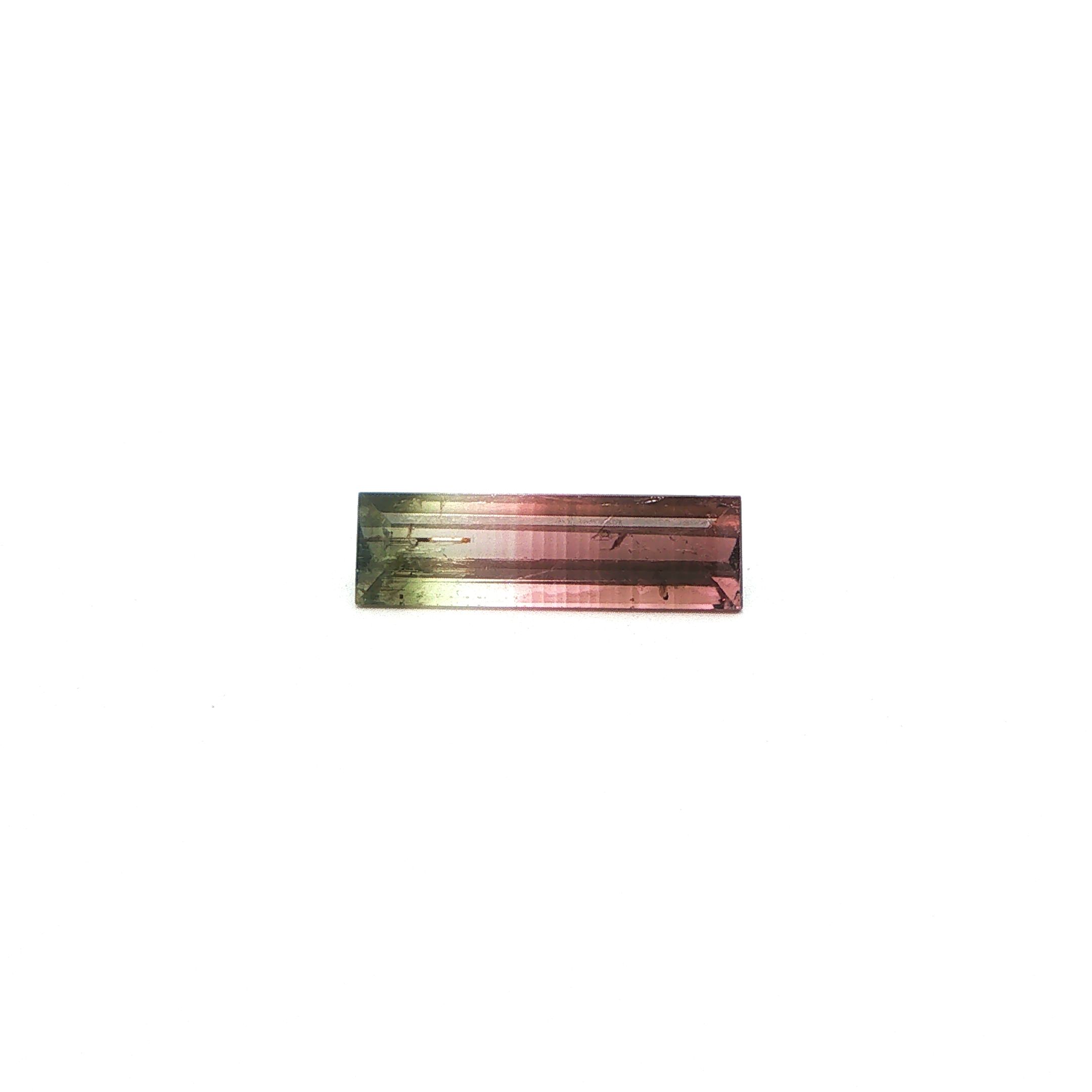
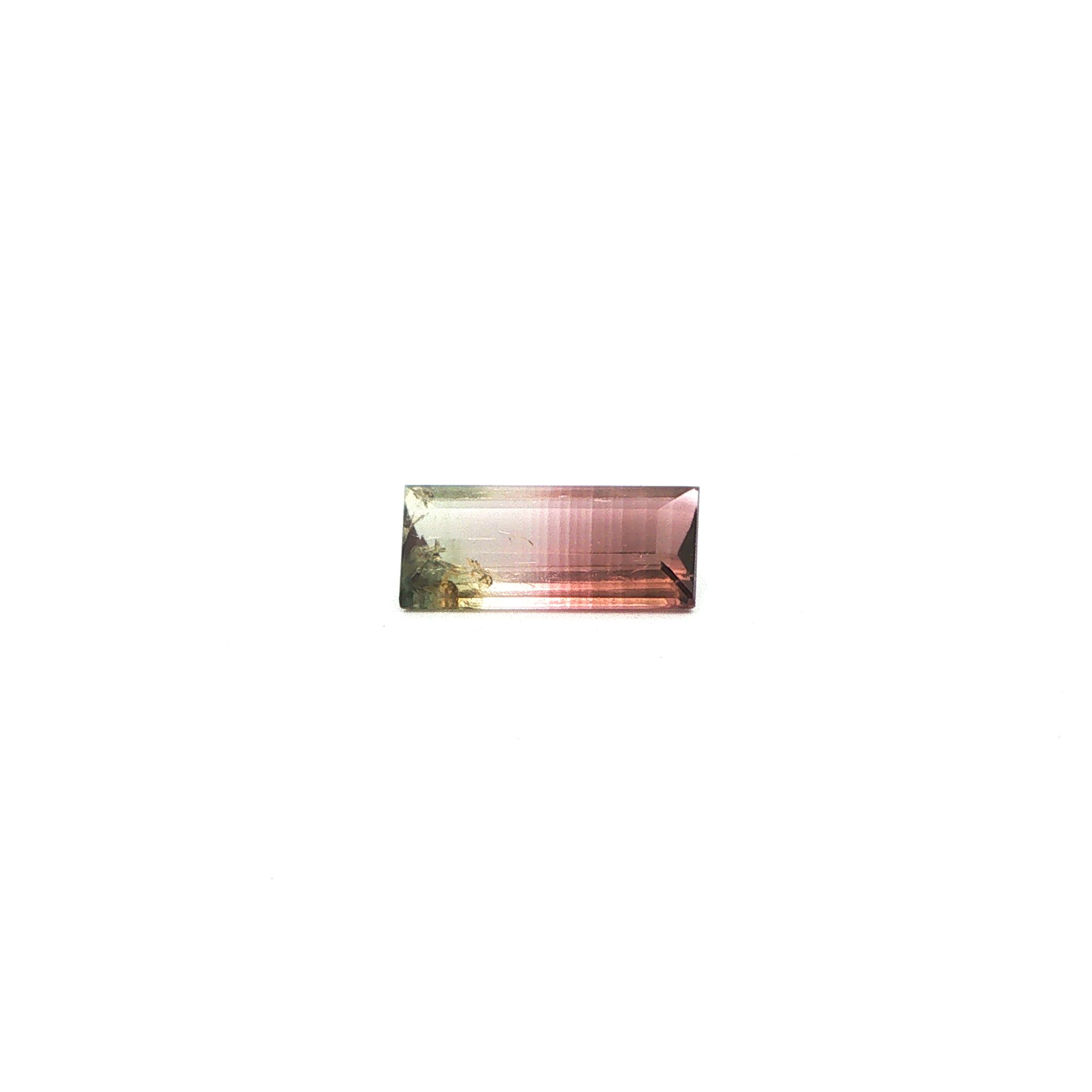
Actual catalog photographs of different stones, generally 1–3 ct. Lighting and scale vary; these are examples, not calibrated color comparisons. Follow a photograph for current availability and the supplier’s details.
03 / Lighting, pleochroism & cut
Lighting, pleochroism & cut.
One stone, several viewing conditions
Tourmaline is pleochroic: different crystal directions can show different colors or strengths of color. Turning the stone may therefore change its appearance even under the same light. This is different from seeing fixed color zones in a bi-color gem.
Ask for a continuous video in indirect daylight and ordinary room light, with a face-up view and gentle tilts. A color change caused by changing the lamp is a different observation from a change caused by turning the gem. Neither should be exaggerated through camera exposure or filters.
Look through the center—and around it
A window is a see-through region caused by light escaping instead of returning toward the viewer. Extinction describes dark areas. Some contrast is normal and creates movement; a large persistent empty or dark region can make the stone less enjoyable.
There is no single ideal depth percentage for every tourmaline color, shape and crystal orientation. Compare brightness, color distribution, symmetry, polish and face-up dimensions together. A step cut can show broad flashes and the color structure; a brilliant-style cut creates a different pattern of smaller reflections.
01 / Same light
Rotate the actual stone gently. Notice changing reflections and, for suitable materials, directional color.
02 / Same stone
Keep the stone and background consistent. Change from indirect daylight to ordinary room light.
03 / Real scale
Look at hand distance and over skin. Keep camera exposure steady and avoid filters.
A comparison method, not a prediction that every stone changes color in the same way.
04 / Clarity & individual character
Clarity & individual character.
Inspect features for both beauty and condition
Tourmaline may contain liquid-filled tubes, crystals, healed fractures or other inclusions. Expectations vary by color and variety: attractive pink and red tourmalines may show more visible inclusions than some green examples. Eye-clean does not mean flawless.
Look at the stone at normal viewing distance, then ask for magnified views of the table, girdle, corners and any surface-reaching features. A safely enclosed crystal is a different concern from a fracture near a vulnerable point. Have the jeweler assess whether the particular stone is suitable to set.
Cat’s-eye tourmaline is a different look
Closely aligned inclusions can produce a moving band of light when suitable material is cut as a cabochon. That cat’s-eye effect is assessed by the strength, sharpness and movement of the eye and the body color.
A cabochon should not be judged by the sparkle expected from a faceted stone. Ask for movement under an appropriate point light, plus an ordinary-light view. A photograph of a bright line alone does not establish how consistently the effect appears.
05 / Treatments, origins & reports
Treatments, origins & reports.
Heat and irradiation need clear disclosure
Some tourmaline is heated to alter color, and irradiation is used for certain pink and red appearances. Treatment does not turn a natural gemstone into an imitation. It can change value comparisons and, in some cases, color-stability expectations.
Not every treatment can be conclusively identified. Ask what the report establishes and what remains a seller disclosure. Do not turn “no evidence detected” into a promise that every possible treatment has been excluded. Avoid strong heat during repair, and discuss color stability for the offered stone.
Origin is context—not a beauty grade
Tourmaline comes from several regions, including Brazil, Mozambique, Nigeria, Afghanistan, Pakistan, Madagascar and the United States. Source can matter for rarity, provenance or a personal connection, but it does not guarantee a particular hue or quality.
For an important variety or origin premium, check the scope of an independent laboratory’s service. A country opinion is not a complete mine-to-market record. Keep the report, treatment disclosure and exact stone description with the invoice.
06 / Carat, dimensions & value
Carat, dimensions & value.
Carat is weight, not size
One carat is 0.2 grams. Two tourmalines of the same weight can have different length, width and depth, especially when one is a long rectangle and another a deep cushion. A large carat number may hide weight below the setting.
Ask for millimeter dimensions and an on-hand scale reference. Review the side profile and wedding-band clearance before deciding that a bigger stone is a better choice. Do not use a diamond size chart as an exact conversion for tourmaline.
Pay for the differences you can explain
Color, transparency, cutting, size, treatment, variety, condition and documentation can all influence price. A Paraíba premium should not be confused with a guarantee that the wearer will prefer it to a less costly green tourmaline.
Compare specific stones under comparable lighting and request a dated complete-ring quotation. Include the center stone, accents, metal, design work, any report, taxes, shipping and service terms. Rarity is not a promise of resale profit.
07 / Durability, setting & care
Durability, setting & care.
A beautiful ring with considered wearing habits
Tourmaline is Mohs 7–7.5 with fair toughness. Scratch resistance and resistance to breaking are different properties. Inclusions, thin edges, exposed corners and temperature changes can create additional vulnerabilities.
A lower profile, protected points and suitable edge support can reduce exposure. They cannot make the stone impact-proof. Remove the ring for gym work, gardening, lifting and other tasks that put pressure or hard knocks on the setting.
Clean gently and plan future service
Use lukewarm mildly soapy water and a soft brush when appropriate for the complete ring. Avoid ultrasonic and steam cleaning for tourmaline. Avoid sudden temperature changes and let a jeweler know the stone’s identity and treatment before repairs.
Store it separately, inspect prongs and arrange an examination after a hard knock. A future replacement may not match a particular bi-color pattern or rare hue. Preserve realistic photographs and documentation for insurance and service discussions.
Read the hardness scale correctly.
- Diamond
- Corundum (ruby and sapphire)
- Topaz
- Quartz
- Feldspar
- Apatite
- Fluorite
- Calcite
- Gypsum
- Talc
Your custom ring
From what you know about her
to a finished ring.
Discovery & Design
The journey begins with understanding your vision and translating it into a unique ring design.
- Personal Consultation: We initiate a detailed conversation to capture the essence of your desired design.
- Design Inspiration: Presenting examples of previous works to showcase what's possible and inspire your selection.
- Sketching Ideas: Our designers sketch several versions of your ring, refining the concept to match your vision.

Gemstone & Metal Selection
Choosing the perfect materials to bring your custom ring to life.
- Choosing the Right Stone: We offer a serious selection process, explaining all gemstone options and providing educational materials.
- Trusted Vendors: We provide multiple options from our reliable vendors with whom we have longstanding relationships.
- Custom Cuts: If your vision includes a unique gemstone shape, we can custom-cut the stone for you.
3D Modeling & Approval
Visualizing your ring in precise detail before it comes to life.
- 3D Presentation: We create a 3D model of your ring, allowing you to visualize and turn it around, ensuring it matches your expectations.
- Design Finalization: We proceed only when you are completely satisfied with every detail of the design and model.


Craftsmanship & Creation
Bringing your ring to life with meticulous attention to detail and quality craftsmanship.
- Wax Modeling: Creating a wax model to capture the intricate details of your design before casting in metal.
- Expert Crafting: Our artisans craft your ring, focusing on alloy creation, meticulous polishing, and precise stone setting.
Delivery
The final step where your custom engagement ring is ready to be delivered and cherished.
- Complimentary Shipping: Your ring is shipped to you for free, anywhere in the world.
- Lifetime Warranty: All our rings come with a lifetime warranty, ensuring your peace of mind (with the exception of accidental damage).

09 / See the choices explained
See the choices explained.
10 / Questions before you choose
Questions before you choose.
Can tourmaline be worn in an engagement ring every day?
It can suit careful wear, but its Mohs 7–7.5 hardness and fair toughness call for more protection than sapphire. Choose the actual stone and setting together, and remove the ring for impact, heavy work and sudden temperature changes.
Does Paraíba tourmaline always come from Brazil?
No. The name is also used for qualifying copper-bearing material from other sources, including Mozambique and Nigeria. Confirm the laboratory’s variety identification and any separately supported geographic-origin opinion.
Is this guide about the actual stones for sale?
The photographs link to real examples, but availability and prices can change. Confirm the current listing, treatment disclosure, measurements and any report for the exact stone before ordering.
Can we choose the stone before finalizing the design?
Yes. We can compare candidates and develop the setting around the chosen stone’s outline, depth, condition and the wearer’s preferences. Bring a color, an idea or simply what you know about her.
What should the complete quotation include?
Identify the actual center stone and accents, metal, design work, relevant reports, known treatments, current price, taxes, shipping, approval stages and delivery. Confirm resizing, return, warranty and aftercare terms for the project.
Does a laboratory report guarantee beauty or future value?
No. It reports the findings within the laboratory’s service scope. Match it to the stone, then assess appearance, physical condition, price and the complete ring separately.
11 / Continue on the NinaVova blog
Continue on the NinaVova blog.
12 / About NinaVova
A name inspired by lasting love.

Guided by your story.
NinaVova is named after founder Sergey’s grandparents, Nina and Vladimir. Their enduring love inspires the rings we create.
Our design, production and client-guidance team helps turn your ideas into a personal ring, from the first conversation to the finished piece.
Meet NinaVova ↗Image credits & gemological references
Real gemstone and jewelry photographs are identified in captions and link to NinaVova examples where available. Illustrations are educational concepts, not identity tests, controlled color grades or promises of an individual stone’s appearance. Catalog availability can change.
Your story starts the design
Let’s create the ring
that feels like her.
Bring a favorite color, a ring idea or simply what you know about her. We’ll help you understand the options and create the ring together.
Talk with Sergey →Explore tourmaline options ↗