


Opal Engagement Ring Guide — NinaVova Education
NinaVova · Learn before you choose
The opal
engagement ring guide.
Explore play-of-color, real opals, solid and assembled construction, treatment and a realistic plan for a beautiful ring worn with care.

In this guide Choose a chapter
01 / Start with appearance & purpose
Start with appearance & purpose.
Decide what role the opal ring will play
An opal ring may be chosen for a ceremony, selected occasions or a personal collection. It should not automatically be promised as a ring for every day and every activity.
GIA describes opal as comparatively vulnerable to scratches and chips. A protective setting can reduce some exposure without removing those limits.
If the intended wearer wants to keep a ring on through demanding hands-on work, discuss another material or a separate occasional-wear opal piece.
The color and personal story can make the choice meaningful without treating the stone’s physical resilience as a metaphorical guarantee about a marriage.

View play-of-color and body tone in motion
Precious opal can show play-of-color that changes as the stone and light move. Body tone, pattern, brightness and transparency all affect the actual appearance.
Compare a moving view and more than one ordinary lighting condition. A single spectacular angle may not show how the stone usually looks on the hand.
Not every opal has the same color phenomenon or appearance. Ask which type is being offered rather than assuming every orange or opaque stone will display rainbow flashes.
Choose the actual pattern you enjoy. A photograph of another ring cannot guarantee a matching opal, particularly where the exact color arrangement is a priority.
Real stones. Different possibilities.
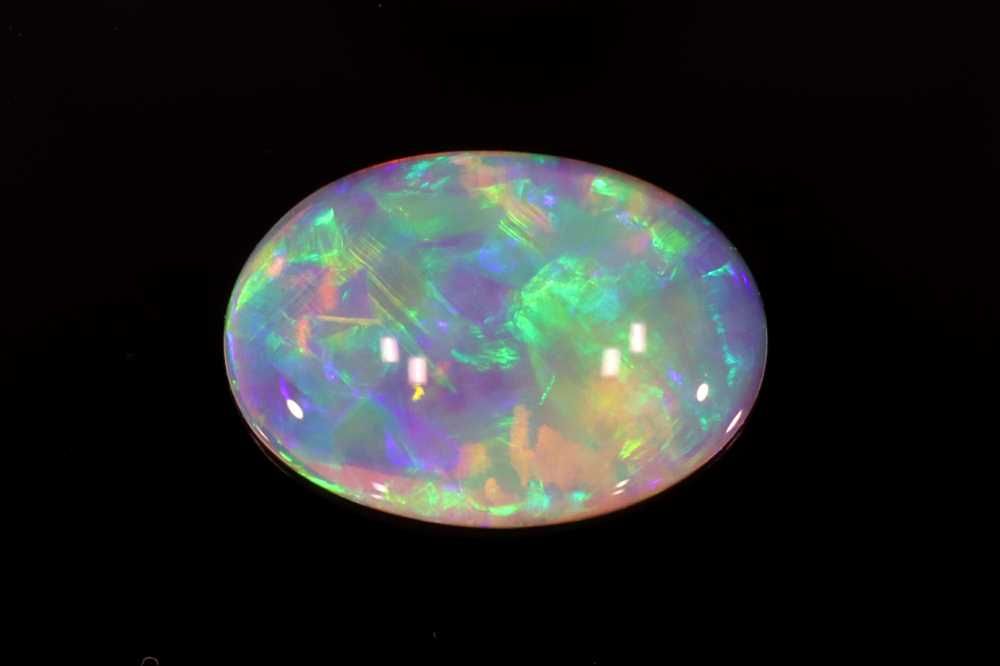
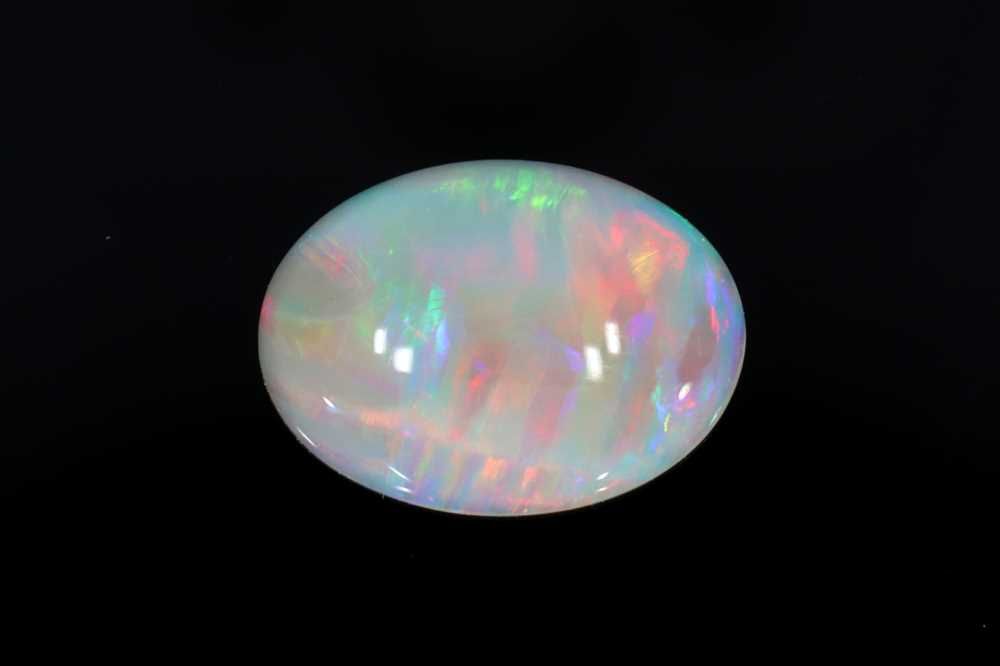
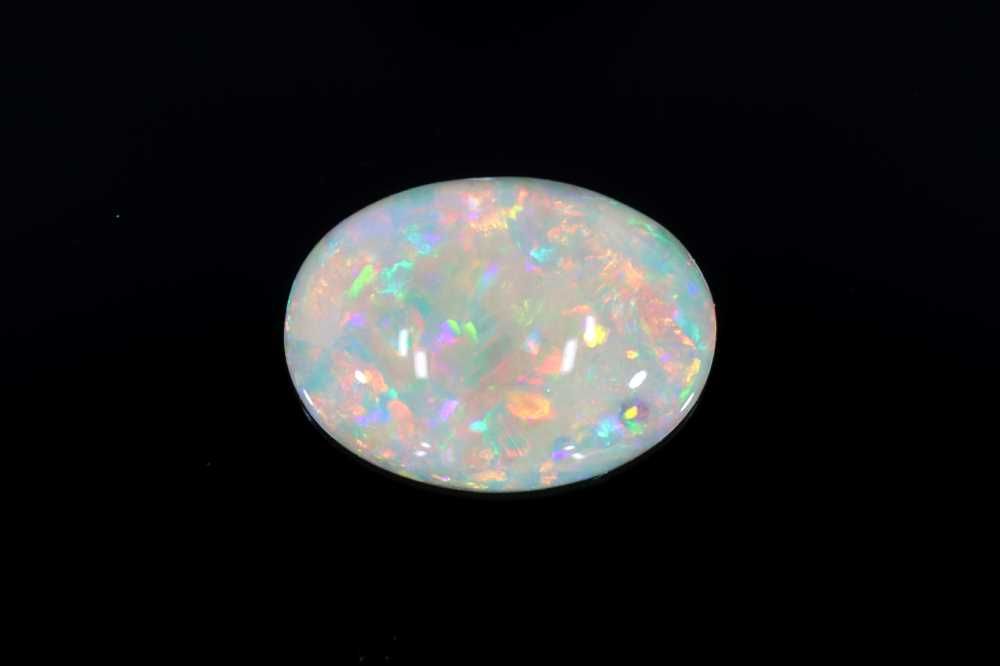
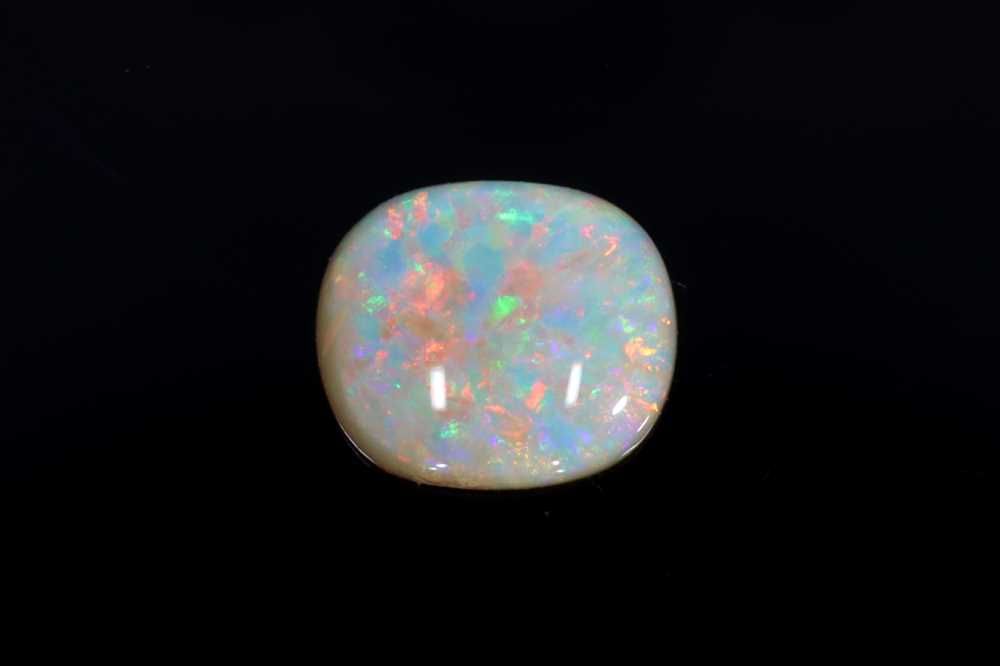
Actual catalog photographs of different stones, generally 1–3 ct. Lighting and scale vary; these are examples, not calibrated color comparisons. Follow a photograph for current availability and the supplier’s details.
Opal types: body color is not play-of-color
Black opal has a dark body tone that can create strong contrast with its color play. White or light opal has a pale body tone; crystal opal is transparent to semitransparent. Boulder opal retains naturally attached host rock, often ironstone. That natural backing is different from a glued doublet.
Fire opal describes yellow, orange or red body color; it may or may not display play-of-color. Common opal lacks the characteristic play-of-color. These categories can overlap in appearance, so describe body tone, transparency, construction and the actual effect separately.
Brightness, pattern and viewing direction
Inspect the strength of the flashes, the colors present, the pattern and how much of the surface remains lively. A patch that lights up only at one steep angle may be less visible in a ring than a broader display facing upward.
Red flashes can influence rarity and value, but one red patch does not automatically outweigh brightness, coverage, condition or a pattern she prefers. View the actual opal from several directions and in ordinary light. Photographs of separate opals cannot demonstrate one stone changing.
Hydrophane opal and treatment
Some opals are porous enough to absorb water; these are called hydrophane opals. Absorption can temporarily alter transparency and appearance. It is a property to understand, not a reliable home test for identity, origin or quality.
Ask whether the stone absorbs liquids and whether it has been smoked, dyed, sugar-treated or impregnated. Keep oils, cosmetics and harsh chemicals away. Do not use soaking as an experiment; follow the maker’s instructions for the actual stone and any adhesive layers.
01 / Same light
Rotate the actual stone gently. Notice changing reflections and, for suitable materials, directional color.
02 / Same stone
Keep the stone and background consistent. Change from indirect daylight to ordinary room light.
03 / Real scale
Look at hand distance and over skin. Keep camera exposure steady and avoid filters.
A comparison method, not a prediction that every stone changes color in the same way.
02 / Identity & construction
Identity & construction.
Confirm natural, laboratory-created and imitation descriptions
Ask what the material is and whether natural origin, laboratory manufacture or an imitation is being claimed. Similar-looking color patterns do not establish identity.
An identification report may be useful for a significant purchase, but understand its scope. It is different from a retail quality label or an insurance valuation.
Treatment should be disclosed where known. Oil, wax, plastic impregnation and color-changing treatments can affect the interpretation and care of an offered stone.
Keep the stone description and relevant documentation. The invoice should explain what was purchased without requiring a future owner to infer it from appearance.
Understand solid stones, doublets and triplets
A solid opal and an assembled doublet or triplet are different constructions. A doublet combines an opal layer with a backing; a triplet adds a transparent top layer.
Ask how the offered piece is built and whether any description or weight refers to the entire assembly rather than the opal portion alone.
An assembled stone can be an intentional option when accurately described. It should not be presented as an indistinguishable substitute with identical care and value implications.
Construction-specific cleaning and repair advice is important. Where adhesives or uncertain treatment are involved, ask the maker before soaking or exposing the ring to a cleaning process.
Origin adds context; inspect the actual opal
Australia, Ethiopia, Mexico and Brazil are important opal sources. Lightning Ridge is associated with black opal, Queensland with boulder opal, and Mexico with fire opal. Each name provides context rather than guaranteeing one appearance or quality.
A country name alone does not establish whether a particular stone is hydrophane, treated, stable or suitable for the planned ring. Ask for the specific description, condition and construction; keep any supported provenance with the invoice.
03 / Durability & care
Durability & care.
Respect hardness, toughness and heat limits
GIA gives opal a variable Mohs hardness of about 5 to 6.5 and toughness from very poor to fair. These properties help explain the need for careful use.
High heat and sudden temperature changes can cause fracture, and intense-light heat can contribute to crazing. The exact stone and condition still need individual assessment.
Examine any visible cracks, chips or other condition concerns before purchase. An attractive color display does not cancel those issues.
A bezel or surrounding design cannot make opal impact-proof. Remove the ring for heavy work, knocks and other unsuitable activities.
Follow gentle, construction-specific care
GIA recommends warm soapy water as the basic safe cleaning approach for opal. The complete piece and any assembled construction still require appropriate maker guidance.
Avoid steam, ultrasonic cleaning, high heat and sudden temperature changes. Do not use strong chemicals or abrasive household polishing methods on an uncertain piece.
For doublets, triplets or uncertain treatment, ask before immersion or soaking. A gentle wipe may be appropriate under the maker’s instructions rather than applying one routine to every opal.
If color, transparency or the surface changes, or a setting becomes loose, arrange an inspection. Cleaning cannot repair cracking or a weakened assembly.
Read the hardness scale correctly.
- Diamond
- Corundum (ruby and sapphire)
- Topaz
- Quartz
- Feldspar
- Apatite
- Fluorite
- Calcite
- Gypsum
- Talc
04 / Setting, value & choosing
Setting, value & choosing.
Plan the setting, metal and wedding-band relationship
A lower, smoothly supported design may be worth considering for the actual stone. The practical solution depends on its dimensions and condition rather than a universal setting formula.
Compare the face and side profile, then check likely contact with a neighboring band. A straight band may leave a gap or rub against the setting.
Choose the metal color and accents for the complete composition. Other gemstones should be identified separately, and the care plan must still respect the opal.
Consider selective wearing and separate storage as part of the design brief. An occasional ring can remain meaningful without being worn through every task.
Compare complete value without a universal grading shortcut
Opal prices vary with the actual material, appearance, condition, dimensions and construction. A named region or one attractive color does not establish the value of every stone.
Ask what a seller’s quality label means. GIA does not apply a universal diamond-style quality grading system to opal, so commercial terms need explanation.
A less expensive assembly and a solid natural stone should be compared as different offers, with their descriptions and ownership implications clear.
Review the complete ring quotation, resizing feasibility and current return and service terms. Do not rely on a claim that a protective setting is necessarily cheaper or that a future matching replacement is assured.
Choose the actual opal with a clear ownership plan
At NinaVova, discuss the desired appearance, intended use and available actual stones. The final design should follow the material rather than promise an exact copy of another opal’s pattern.
Confirm the identity, treatment information, construction, metal and dimensions in writing. Keep the records with photographs and service instructions.
Historical beliefs can be part of a carefully sourced discussion, but opal does not guarantee luck, protection or a relationship outcome. A personal story is enough.
An opal wedding ring is a considered choice when its color, design and wearing expectations fit together. Select the stone you enjoy with a realistic plan for preserving it.

Compare millimeters and construction
One carat equals 0.20 grams, but weight is not the visible size. Compare the opal’s length, width and dome height in millimeters, along with a realistic hand-scale view. A high dome and a thin slab can have very different profiles.
For a doublet or triplet, ask whether the listed weight describes the entire assembly. Backing and cap material should not be mistaken for the weight of solid opal. For boulder opal, naturally attached host rock also contributes to the total weight.
Your custom ring
From what you know about her
to a finished ring.
Discovery & Design
The journey begins with understanding your vision and translating it into a unique ring design.
- Personal Consultation: We initiate a detailed conversation to capture the essence of your desired design.
- Design Inspiration: Presenting examples of previous works to showcase what's possible and inspire your selection.
- Sketching Ideas: Our designers sketch several versions of your ring, refining the concept to match your vision.

Gemstone & Metal Selection
Choosing the perfect materials to bring your custom ring to life.
- Choosing the Right Stone: We offer a serious selection process, explaining all gemstone options and providing educational materials.
- Trusted Vendors: We provide multiple options from our reliable vendors with whom we have longstanding relationships.
- Custom Cuts: If your vision includes a unique gemstone shape, we can custom-cut the stone for you.
3D Modeling & Approval
Visualizing your ring in precise detail before it comes to life.
- 3D Presentation: We create a 3D model of your ring, allowing you to visualize and turn it around, ensuring it matches your expectations.
- Design Finalization: We proceed only when you are completely satisfied with every detail of the design and model.


Craftsmanship & Creation
Bringing your ring to life with meticulous attention to detail and quality craftsmanship.
- Wax Modeling: Creating a wax model to capture the intricate details of your design before casting in metal.
- Expert Crafting: Our artisans craft your ring, focusing on alloy creation, meticulous polishing, and precise stone setting.
Delivery
The final step where your custom engagement ring is ready to be delivered and cherished.
- Complimentary Shipping: Your ring is shipped to you for free, anywhere in the world.
- Lifetime Warranty: All our rings come with a lifetime warranty, ensuring your peace of mind (with the exception of accidental damage).

06 / See the choices explained
See the choices explained.
07 / Questions before you choose
Questions before you choose.
Is a doublet the same as a solid opal?
No. A doublet joins an opal layer to a backing; a triplet adds a clear cap. A solid stone is a different construction, while boulder opal retains naturally attached host rock. Ask which construction is offered because value and care differ.
Can a bezel make opal safe for unrestricted daily wear?
No. A protective setting can reduce exposure, but opal can still scratch, chip or crack. Plan selective wear, gentle care and removal before rough activities. Choose another material if those limits do not fit the wearer’s routine.
Is this guide about the actual stones for sale?
The photographs link to real examples, but availability and prices can change. Confirm the current listing, treatment disclosure, measurements and any report for the exact stone before ordering.
Can we choose the stone before finalizing the design?
Yes. We can compare candidates and develop the setting around the chosen stone’s outline, depth, condition and the wearer’s preferences. Bring a color, an idea or simply what you know about her.
What should the complete quotation include?
Identify the actual center stone and accents, metal, design work, relevant reports, known treatments, current price, taxes, shipping, approval stages and delivery. Confirm resizing, return, warranty and aftercare terms for the project.
Does a laboratory report guarantee beauty or future value?
No. It reports the findings within the laboratory’s service scope. Match it to the stone, then assess appearance, physical condition, price and the complete ring separately.
08 / Continue on the NinaVova blog
Continue on the NinaVova blog.
NinaVova blog
Opal Wedding Rings: Appearance, Construction and Selective Wear – NinaVova
Read the complete article ↗
NinaVova blog
Moonstone vs Opal Engagement Rings: Glow, Durability and Care – NinaVova
Read the complete article ↗NinaVova ring education
Your custom ring guide
Explore settings, metals and design ↗09 / About NinaVova
A name inspired by lasting love.

Guided by your story.
NinaVova is named after founder Sergey’s grandparents, Nina and Vladimir. Their enduring love inspires the rings we create.
Our design, production and client-guidance team helps turn your ideas into a personal ring, from the first conversation to the finished piece.
Meet NinaVova ↗Image credits & gemological references
Real gemstone and jewelry photographs are identified in captions and link to NinaVova examples where available. Illustrations are educational concepts, not identity tests, controlled color grades or promises of an individual stone’s appearance. Catalog availability can change.
Your story starts the design
Let’s create the ring
that feels like her.
Bring a favorite color, a ring idea or simply what you know about her. We’ll help you understand the options and create the ring together.
Talk with Sergey →Explore opal options ↗