

Moonstone vs Opal Engagement Rings: Glow, Durability and Care

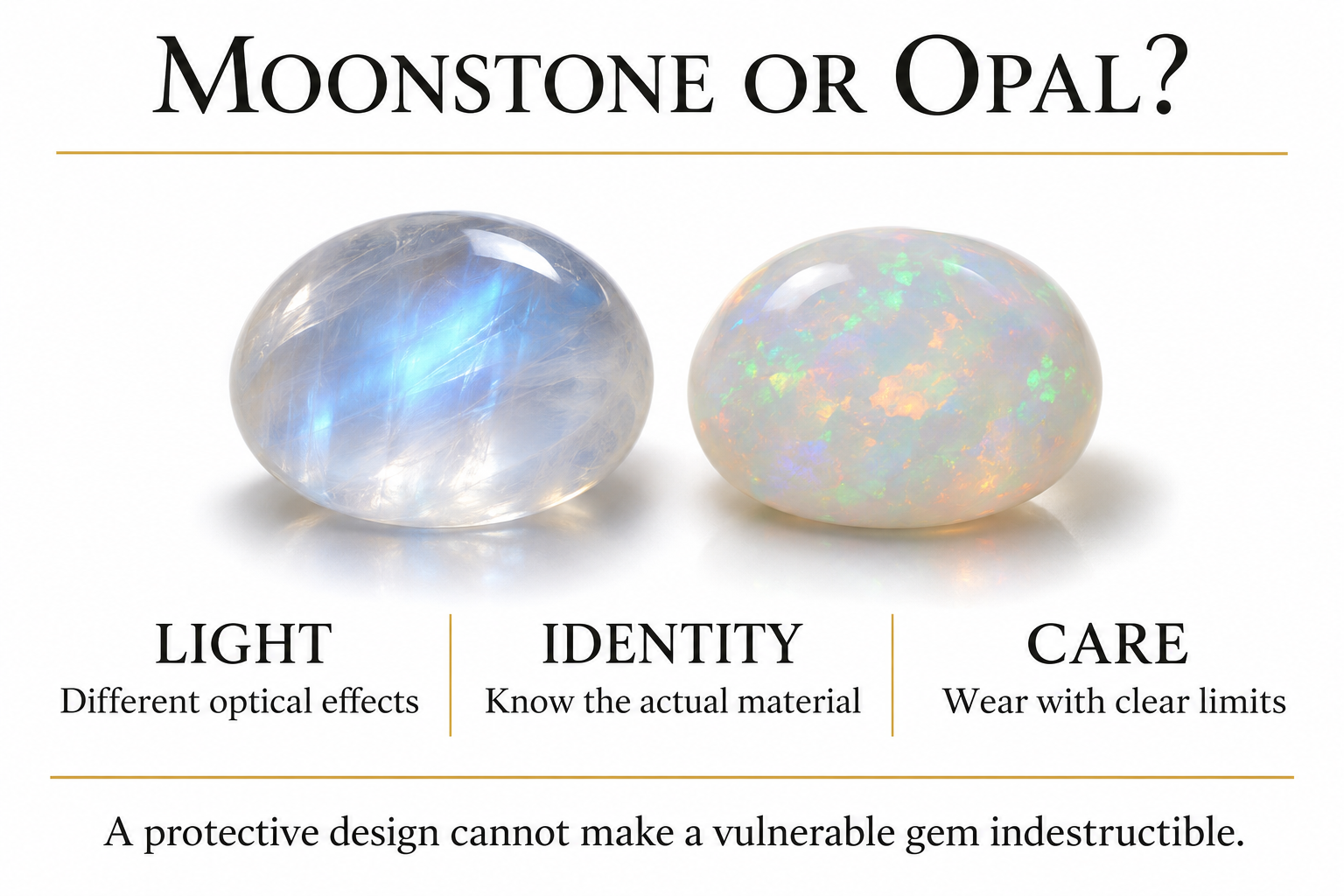
Moonstone and opal can both offer shifting light effects, but they are different materials with different structures and care considerations. Choose the appearance you love, then decide whether the stone and the intended wearing routine fit one another. A beautiful photograph is not a promise of everyday durability.
Choose the light effect with realistic care expectations. Moonstone’s adularescence and precious opal’s play-of-color are different phenomena. Both require careful wear, clear identification and stone-specific cleaning advice.
At a glance · What moonstone is · Color, transparency and the floating glow · Cabochons, faceting and proportions · History and design inspiration
Watch the NinaVova discussion
Watch the original NinaVova video on YouTube.
The original NinaVova moonstone discussion accompanies the moonstone guide and opal comparison. The photographs below are actual NinaVova opal designs, clearly distinguished from generated moonstone concepts.
Moonstone and opal: different materials
| Question | Moonstone | Opal |
|---|---|---|
| Characteristic effect | Adularescence: floating glow | Precious opal: play-of-color |
| Identity | Feldspar gems; clarify trade variety | Natural, synthetic, imitation or assembled |
| Mohs hardness | 6–6.5 | 5–6.5 |
| Toughness | Poor; cleavage matters | Very poor to fair |
| Cleaning | Gentle warm soapy water | Gentle warm soapy water; check construction |
| Wearing plan | Protect from abrasion and impact | Protect from abrasion, impact and heat |
What moonstone is
Moonstone is a name associated with feldspar gems showing adularescence, the floating glow that moves as the stone or viewing angle changes. Fine internal structures scatter light to create the effect.
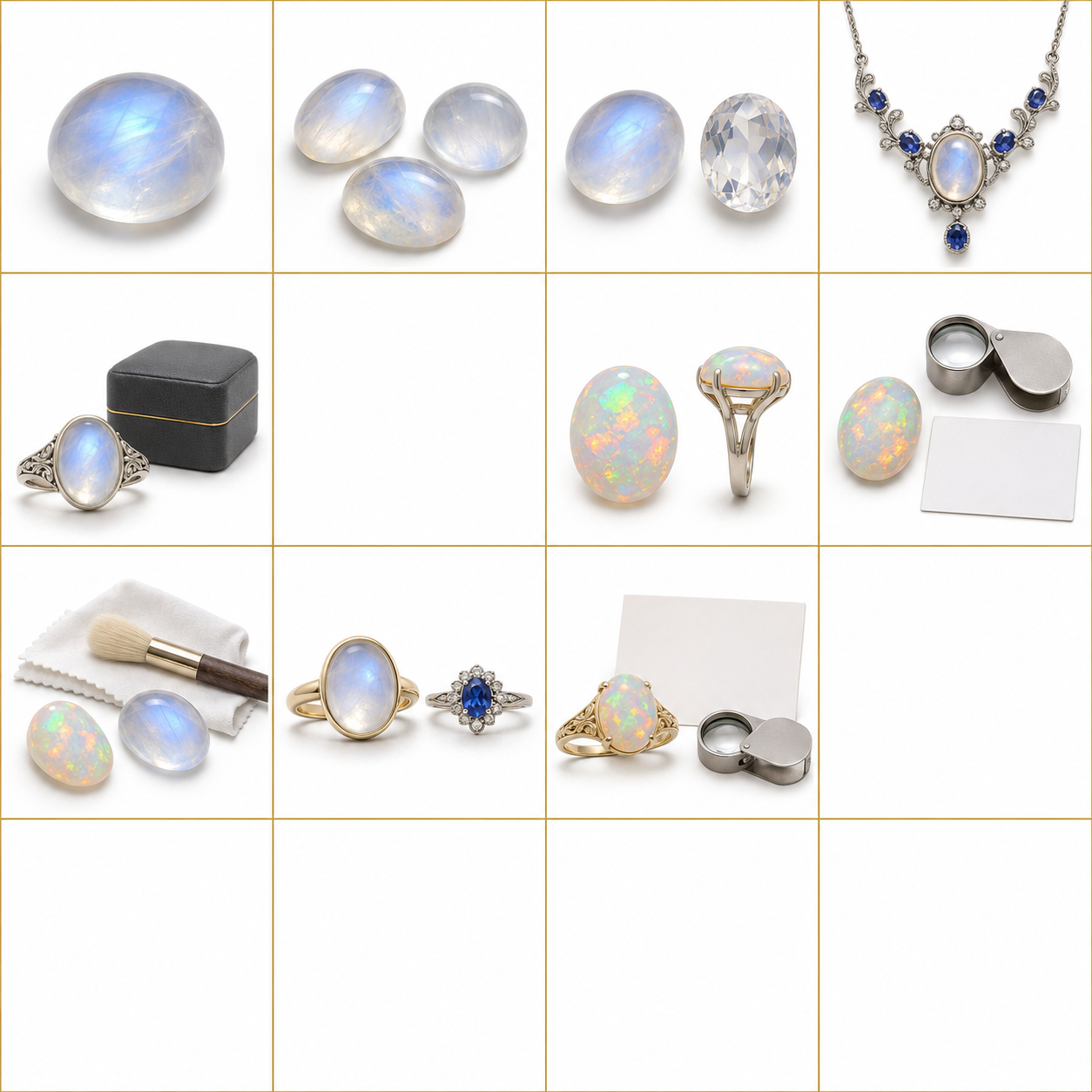
Classic moonstone involves feldspar components such as orthoclase and albite. Other feldspars can show related effects, so the trade name needs to be understood in context rather than treated as a single simple color grade.
Rainbow moonstone is a common trade name for a variety of labradorite, another feldspar. It is not the same material as classic orthoclase-based moonstone, even when the appearance overlaps.
Ask for a clear description of the actual gem and any treatment. A blue glow or a familiar sales name alone does not establish origin, condition or identity.
Color, transparency and the floating glow
Moonstone can have different body colors and degrees of transparency, from pale translucent material to examples with a clearer body. The adularescence may appear whitish, blue or in other effects depending on the material.
A pleasing blue glow in a relatively transparent stone is valued in parts of the market, but that preference should not become a universal rule for every buyer or variety.
View the effect as the stone moves in ordinary light. One carefully selected photograph can emphasize an angle that is difficult to see consistently in person.
Inspect the actual condition and ask about internal features or surface-reaching fractures. A soft optical effect is not proof that the stone has a flawless interior.
Cabochons, faceting and proportions
A cabochon has a smooth domed surface rather than a pattern of flat facets. This form is often used to display moonstone’s moving glow.
Faceted and other shaped moonstones also exist. The best form depends on the individual material and the visual result, not a rule that one cutting style is always superior.
Consider the height and outline as well as the face-on glow. A tall dome may stand farther above the finger, while a shallow or poorly oriented cut may not show the desired effect well.
Ask for measurements and several views of the actual stone before designing around it. Shape names and carat weight alone do not show how it will sit in a ring.
History and design inspiration
Moonstone has appeared in historical jewelry and continues to interest designers for its understated light effect. Historical use can inspire a contemporary composition without determining the quality of a newly offered stone.
The Metropolitan Museum of Art documents a Louis C. Tiffany necklace combining moonstones, Montana sapphires and platinum. It is a useful example of different gems working together through color and surface character.
You can draw on an antique atmosphere, flowing lines or a quieter modern design without copying a museum piece. The stone’s actual proportions and practical needs should guide the new setting.
Celebrity stories, auction figures and dated trend claims are not necessary to appreciate the material. Choose the individual gem and design rather than treating publicity as a grading standard.
Moonstone durability: hardness is only part of the story
GIA lists moonstone at Mohs hardness 6 to 6.5, with poor toughness and two cleavage directions. It can therefore be scratched and can also chip or break under unsuitable contact.
Those properties matter for a ring, which usually experiences more exposure than a pendant or earrings. A protective-looking setting cannot remove the underlying material limitations.
Remove the ring for lifting, impact, machinery and substantial manual tasks. If you want to wear one ring through nearly every activity, discuss whether another material or a separate occasion ring better fits that expectation.
Anecdotes about a careful phone owner or a ring that survived a fall do not predict another stone’s future. Assess the individual condition and use rather than relying on a toughness promise.
Opal: a different kind of light effect
Opal is not moonstone. Precious opal shows play-of-color created by light interacting with its organized internal silica structure, while common opal does not show that effect.
Body color, transparency, pattern and the way the color appears across the stone influence its visual character. No photograph of one bright patch represents every opal or every viewing angle.
Natural opals come from different sources, and laboratory-grown, imitation and assembled products also exist. Ask what the actual stone is and what disclosures apply.
The NinaVova opal designs shown here illustrate real compositions from our work. They are not moonstone examples, laboratory identifications or proof of a particular source.

Natural, synthetic, imitation and assembled opal
Natural opal formed through geological processes. Synthetic opal is manufactured material intended to reproduce relevant properties of opal; some products contain additional compounds or polymers.
Plastic or glass imitations are a separate category. It is incorrect to call every synthetic opal plastic or to assume every bright-looking opal must be natural.
Doublets and triplets combine layers, often including a thin opal component, a backing and sometimes a protective top. These assembled products should be identified as such, because construction affects care and value comparisons.
Treatments also need disclosure. Appearance alone, a very low price or a seller’s claim that a piece is real is not a complete determination.
For a consequential purchase, use clear written material and treatment information and appropriate professional identification. Avoid unsupported estimates about what percentage of an entire market is fake.
Water absorption and hydrophane opal
Some opal is porous and can absorb water; hydrophane is the term commonly used for this behavior. Absorption can temporarily change appearance and weight.
Such a change does not by itself prove an opal is imitation. Conversely, a lack of an obvious change in a home experiment does not prove natural origin.
Do not use soaking, household chemicals or other improvised tests to establish identity. They can affect the stone, treatments, adhesives or the complete piece.
Ask the supplier about the actual material’s care and what to do if its appearance changes. Source names are not a substitute for stone-specific information.
Compare durability and cleaning requirements
GIA lists opal at Mohs hardness 5 to 6.5, with very poor to fair toughness. Moonstone’s 6 to 6.5 hardness does not turn the comparison into a universal ranking of which stone will survive every event.
For both materials, appropriate gentle care matters. GIA recommends warm soapy water for cleaning and advises against ultrasonic and steam methods.
Avoid high heat and abrupt temperature changes. Opal can be vulnerable to crazing, and moonstone can also be damaged under unsuitable conditions.
A shower or household chemical exposure should not be advertised as automatically safe. The actual opal construction, treatments and setting may impose additional limitations.
If the material is unknown, assembled or treated, obtain specific instructions before cleaning. Do not assume advice for an untreated loose stone applies unchanged to every finished ring.
Settings, accent stones and alternatives
A bezel or other protective design may reduce contact with some exposed edges, but it cannot make a vulnerable stone impact-proof. A halo is not a cushion guaranteed to absorb a blow.
Accent stones add their own care requirements. The complete ring should be cleaned and worn in a way that suits its most vulnerable components.
If you love the glow but need a more demanding wearing routine, consider a separate moonstone or opal piece for selected occasions. Another engagement-ring material may be a more practical daily choice.
Sapphire and other options have different looks and tradeoffs rather than reproducing the same effect. Compare actual stones and decide which compromise you enjoy.
A sentimental ring can be meaningful even when it is not worn for every task. Planning when to remove it is part of ownership, not a failure of the design.
Price, documentation and service
Price depends on the actual material, appearance, size, condition, treatment and construction, alongside the metal, labor and service in the finished ring. Old fixed price bands should not be treated as current quotations.
Compare identified stones and complete designs on like-for-like terms. A synthetic product, imitation or assembled opal is not an equivalent price comparison to every natural solid opal.
Keep clear documentation and ask about replacement and repair options. Matching a distinctive light effect later can be difficult, so no exact replacement should be assumed.
If insurance is relevant, review actual policy terms and valuation requirements with the provider. There is no universal premium percentage or automatic coverage promise for every ring.
Choose the effect and the ownership expectations together
Moonstone’s floating glow and precious opal’s shifting play-of-color offer different kinds of beauty. View the actual stone, understand what it is and discuss its condition before committing to the design.
At NinaVova, we can consider proportions, accent stones, profile and care beside your visual preferences. Practical limits should be clear before production.
You may choose a careful-wear engagement ring, an occasion piece or a different daily material. The goal is an informed choice whose appearance and maintenance expectations fit the wearer.

Frequently asked questions
Is rainbow moonstone the same as classic moonstone?
Rainbow moonstone is a trade name commonly used for labradorite, another feldspar. Ask for the actual material description.
Does an opal changing appearance in water prove it is fake?
No. Some hydrophane opal can absorb water and temporarily change appearance. Home soaking is not a reliable identity test.
Does a bezel make either stone indestructible?
No. A setting may protect some edges but cannot remove the material’s underlying vulnerabilities.
Design around the actual gem and wearing plan
We can discuss the desired glow, proportions, accent stones and practical limitations before deciding whether moonstone, opal or another material fits the project.
Book a NinaVova consultation or explore our custom design process.
Continue reading: Opal wedding-ring considerations · Gemstone scratches and care · Alternative engagement-ring gemstones.
Sources and further reading
- NinaVova: Original moonstone discussion
- GIA: Moonstone description
- GIA: Moonstone care and cleaning
- GIA: Opal description
- GIA: Opal care and cleaning
- GIA: Hydrophane opal and water absorption
- GIA: Plastic imitation versus synthetic opal
- Metropolitan Museum: Tiffany moonstone and sapphire necklace
Based on NinaVova’s original writing and the supporting references below. Confirm the actual material, treatments, condition and current written project terms. Educational illustrations do not establish gemstone identity or provenance.