

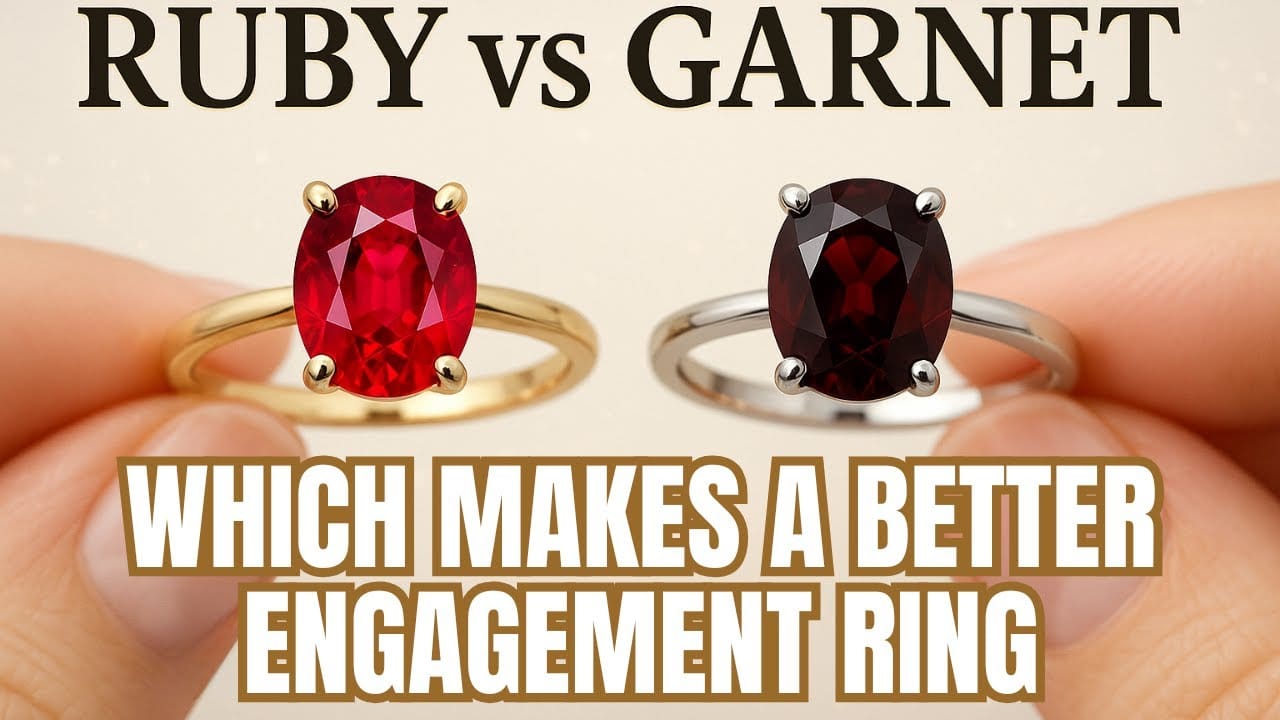
Ruby vs Garnet: The REAL Differences You Must Know Before Buying

Ruby vs Garnet: How to Choose the Perfect Deep Red Gemstone for Your Engagement Ring
If you’ve ever admired a deep red gemstone and wondered whether it’s a ruby or a garnet, you’re not alone. Both gems carry a timeless passion and rich color, but they belong to very different worlds when it comes to value, durability, and everyday wear. In this article, we’ll break down the key factors that distinguish ruby from garnet—covering color and sparkle, lab reports and treatments, durability, cut and brightness, and pricing—so you can decide which stone truly suits your style and lifestyle.
Understanding the Minerals Behind the Gems
Ruby is a variety of corundum, the same mineral family as sapphire, with its vivid red color created by traces of chromium. This mineral is dense, tough, and prized for centuries in royal jewelry due to its beauty and durability.
Garnet, by contrast, is not a single stone but a family of minerals including almandine and pyrope varieties, among others. Some red garnets can look strikingly similar to ruby at first glance, especially in photos or candlelight, but chemically, they are very different. Ruby’s crystal structure of aluminum oxide produces a focused beam of red light, giving it a bright, vivid glow. Garnets, made of silicate blends, scatter light more softly, almost like red glass catching the sun.
Color: The Heart of the Difference
Color is where the truth about these stones really shows.
- Ruby glows with a pure, cool red undertone—never orange or brown. Its tone ranges from medium to medium-dark and maintains a rich saturation even in shade. Under open daylight, especially stones from Burma or Mozambique, a ruby shows a vibrant glow caused by chromium atoms absorbing green light and letting red dominate—a physical phenomenon you can actually see.
- Garnet usually shifts towards brown or wine hues under warm light. In daylight, garnets can look beautiful—deep cranberry or pomegranate red—but indoors, they tend to darken into brick red or nearly black at night. This gives garnets an antique, moody charm.
If you want a gemstone with consistent red color in any light, ruby is the clear winner. If you prefer a softer, vintage red that deepens romantically by candlelight, garnet tells a different, more intimate story.
Pro Tip: Two Light Checks Before Buying
Always view both stones in two lighting situations:
- Open shade daylight—to see if the color breathes evenly
- Warm indoor lighting—to check for any brown or dark shifts
The best stones maintain their hue without collapsing into darkness. This simple habit reveals more about a gem’s true color than any photo can.
Lab Reports and Treatments: Authenticity Matters
When investing in your gemstone, certification is key.
For rubies, always trust certified reports from respected labs like AGL, GIA, GRS, or Jubilee. These confirm the stone’s species, origin, and whether it has been heat-treated—a common and accepted practice that enhances color by reducing blue or purplish tones. If a ruby is certified unheated, it’s a premium rarity and priced accordingly.
In contrast, garnets rarely come with official reports, but certifications are available if you want to confirm identity or variety. Most garnets are natural and untreated, making them refreshingly straightforward. However, beware of synthetic or glass imitations marketed as garnet—asking for a lab memo can serve as a passport for your stone’s authenticity and protect your investment.
Cut and Brightness: What to Look For
Neither rubies nor garnets have standardized cut grades, so you must judge the stone visually:
- Look straight at the stone’s face. If you see a pale circle in the center, that’s called a “window,” meaning light is leaking and the stone looks less brilliant.
- Rotate the gem and check whether brightness stays even or if part of it looks dark and dull.
- Rubies are often cut deeper to preserve their rich color saturation.
- Garnets, being less costly, can be cut shallower, which sometimes causes uneven color.
An ideal red stone has a depth between 60% and 70% with balanced light return—no windows or dead centers.
Durability and Daily Wear: Handling Your Gem
Ruby ranks a 9 on the Mohs scale, second only to diamond and equal to sapphire. This makes it highly resistant to scratching and able to hold its polish beautifully for decades, even with daily wear.
Garnets range from 6.5 to 7.5 in hardness depending on variety. They’re fine for daily wear if treated properly but can pick up micro-scratches if worn aggressively. If you work with your hands or wear your ring all day, ruby will gracefully handle that lifestyle—although at a higher price point. For garnets, use protective prongs or a slender bezel setting and handle the ring gently to maintain its beauty.
Both stones deserve care, but ruby simply forgives more of everyday life’s challenges.
Pricing: What Does a 2-Carat Solitaire Really Cost?
Let’s imagine a very simple 2-carat solitaire engagement ring with 14K gold, costing about $950 for the setting alone. The difference comes down to the stone:
- Rubies command a premium for their hardness, rarity, and vivid color. Prices generally start around $3,000 per carat and can increase significantly for the best color and origin.
- Garnets provide that romantic red look at a far gentler price, making them a more accessible choice.
The trade-off isn’t just about price—it’s about longevity. A fine ruby can become a cherished heirloom, while a garnet requires more gentle handling but offers the same emotional impact for a smaller investment.
Remember, choose your gemstone for meaning, not marketing.
Final Thoughts
If you want to compare ruby and garnet stones firsthand or need guidance tailored to your engagement ring, download our free engagement guide linked below. It’s packed with helpful information to turn your love story into a ring that’s truly yours.
If you have questions or want personalized advice, schedule a free consultation with me. I’d be happy to walk you through all the details to find the perfect stone for you.
Thank you for reading, and I look forward to helping you find the gem that fits your heart and your life.
Download our Free Engagement Guide and schedule a consultation to take the next step toward your perfect ring.