

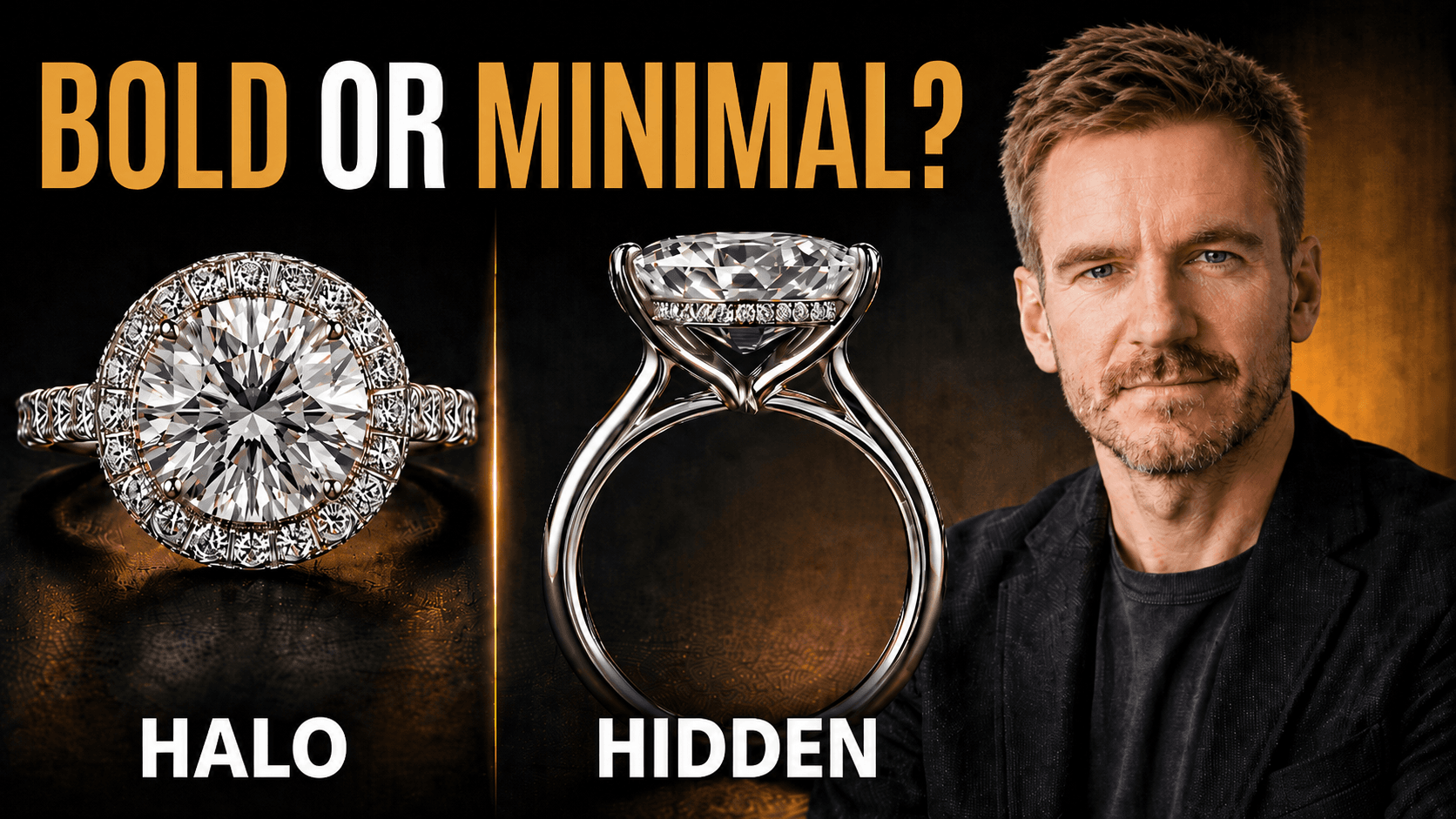

Halo vs Hidden Halo: Understanding Two Distinct Engagement Ring Styles
When it comes to selecting the perfect engagement ring, halos often catch the eye with their dazzling appeal. However, not all halos are created equal. There are two fundamentally different styles you should know about—each with its own distinct aesthetic, construction, and practical considerations. One style boldly encircles the center diamond with smaller accent stones, making it impossible to miss. The other offers a more subtle approach, hiding those accent diamonds beneath the center stone so that the sparkle reveals itself only upon closer inspection.
Understanding these differences will help you choose a ring that not only captivates from across the room but also suits the wearer’s lifestyle, jewelry habits, and personal style. In this article, I will take you through the nuances of traditional halos and hidden halos—explaining their design, sparkle, wearability, and the hidden construction challenges that many are not told about.
What Is a Traditional Halo?
Bold Brilliance That Frames the Center Stone
A traditional halo setting features a ring of small accent diamonds that visibly surround the center stone from top to sides and every angle. These surrounding diamonds are meticulously arranged to reflect light back into the center diamond, amplifying its sparkle and presence. The effect is dramatically luminous: the entire ring appears larger and more brilliant than the center stone alone.
This halo design is unmistakably bold and makes a statement. It proudly announces itself, drawing attention and admiration. The traditional halo is engineered for maximum visibility—it sparkles from every direction, making it a favored choice for those who want their engagement ring to be a dazzling centerpiece.
What Is a Hidden Halo?
Understated Refinement with a Secret Sparkle
In contrast, a hidden halo places those same accent diamonds underneath the center stone. From a top-down view, the ring reads as a clean, elegant solitaire — no distraction from the center diamond’s natural beauty. Yet when you tilt the ring, a hidden layer of diamonds reveals itself, quietly catching the light from beneath.
This design aesthetic has been around since the early 2000s, gaining popularity around 2010 as a subtler, more refined alternative to traditional halos. The hidden halo appeals to those who favor minimalism but appreciate thoughtful detail. It offers a special moment of discovery for the wearer, often seen when looking down at their own hand.
Traditional Halo vs Hidden Halo: A Detailed Comparison
Sparkle and Visual Impact
- Traditional Halo: Designed to maximize sparkle in every direction, visible from across a room. It creates a radiant, eye-catching effect that’s hard to miss.
- Hidden Halo: Adds sparkle primarily from the side profile. Its brilliance is more of a secondary, intimate detail rather than a primary light show. If she values subtlety and elegance over overt flashiness, this can be a genuinely beautiful choice.
Does It Make the Center Stone Look Larger?
- Traditional Halo: The ring of accent diamonds around the center stone serves as a visual frame, making the central diamond appear significantly larger. A well-crafted halo can make a one-carat stone look closer to one and a quarter carats in size.
- Hidden Halo: Because the accent diamonds are underneath, they don’t alter the top view of the ring. The center stone’s size remains true to its actual scale, which means the hidden halo is not the most efficient choice if maximizing visual size is your goal.
Daily Wearability and Practical Considerations
- Traditional Halo: With more exposed prongs and outer-edge accent stones, traditional halos are more prone to snagging on clothing or hair and require more frequent cleaning. A gentle weekly cleaning regimen is recommended to maintain brilliance.
- Hidden Halo: Featuring a smoother, lower profile with fewer exposed elements, hidden halos offer a genuine advantage for active lifestyles or those who work with their hands regularly. The reduced risk of snagging also means less maintenance.
Price Considerations
- Hidden Halo: Generally costs less due to fewer accent stones and less metal. However, precision craftsmanship for setting the hidden diamonds requires complex construction that can narrow the price gap.
- Traditional Halo: While it may involve more accent stones, the straightforward construction can sometimes balance out costs.
Wedding Band Compatibility
- Traditional Halo: Because it sits flush against the center stone, pairing it with a flat wedding band is difficult; most women opt for a curved contour band, which limits style options and may add cost later.
- Hidden Halo: Its design leaves the sides clean, allowing a standard flat wedding band to fit perfectly without gaps.
Unsuspected Challenges: Construction Issues to Watch For
When shopping premade halo rings, subtle construction issues often go unnoticed, yet they can significantly affect the ring’s beauty and durability. These problems largely disappear in well-crafted custom pieces.
Traditional Halo: The Visible Gap
The magic of the traditional halo depends on the accent diamonds sitting flush against the girdle—the widest part—of the center stone.
- Issue: Premade settings are built for standard stone measurements, but every diamond is cut slightly differently. Placing a diamond that isn’t precisely the intended size results in a visible gap between the center stone and the halo. Instead of enhancing the stone’s size, this gap draws the eye away, making the diamond appear smaller and the ring less cohesive.
- Solution: Custom settings are tailored to the exact shape and size of your diamond, ensuring a seamless fusion of stone and halo.
Traditional Halo: Melee Diamond Color Mismatch
Another overlooked detail is the color of the small accent diamonds, known as melee.
- Issue: Most premade halos use melee diamonds in the bright white range (D, E, F color grades). However, many center stones have a slight warmth to their color—H, I, or J shades—which can conflict visually with starkly white melee. This contrast can highlight the center stone’s warmth rather than complementing it, undermining the halo’s unified look.
- Solution: Custom jewelers select melee diamonds that harmonize perfectly with the center stone’s color, crafting a seamless, aesthetically balanced ring.
Hidden Halo: The Solder Joint
Hidden halos often involve a delicate gallery beneath the center stone where the accent diamonds are set.
- Issue: Many premade hidden halo rings are constructed from two separate pieces soldered together—the gallery and the shank (band). This solder joint is the ring’s weakest point, prone to stress fractures and misalignment over time.
- Solution: Custom rings are typically cast from a single wax model, uniting gallery and shank into one continuous piece of metal, thereby enhancing durability and longevity.
Common Myths About Halo Settings
- Myth 1: Traditional halos are outdated.
Reality: They have been consistently popular for over twenty years and remain a timeless choice. - Myth 2: Hidden halos make the ring unique.
Reality: Hidden halos have also become one of the most requested settings in recent years. True uniqueness arises from custom design elements tailored to personal style, not merely from choosing a popular setting.
How to Decide Which Halo Style She Wants
Choosing the right halo style isn’t always about asking directly—it’s about observing and understanding her style instincts.
- If she favors bold, layered, statement jewelry, a traditional halo will align with her aesthetic.
- If she prefers delicate, minimal pieces, often wearing just one ring at a time, the hidden halo will likely resonate.
- Digital footprints like Pinterest boards, Instagram saves, or saved ring photos often reveal clear preferences without having to ask outright.
- Pay attention to her reactions during engagements or weddings in her circle. Does she gravitate toward radiant sparkle or understated elegance?
Combining Both Styles
When preferences are truly unclear or she loves elements of both, a custom ring can blend these styles—a traditional halo encircling the stone from above, paired with a hidden halo underneath. This complex design demands careful craftsmanship, underscoring the value of custom work.
Summary
- Traditional halo: Best for lovers of sparkle, bold presence, and visual drama.
- Hidden halo: Suits those who appreciate subtle elegance, refined detail, and practical wearability.
- Customization: Essential to avoid visible gaps, mismatched colors, and weak construction points.
- Observation: The best insights come from watching her existing jewelry and style preferences.
Before making a purchase, consider exploring the pros and cons of custom versus ready-made rings, and if you need personalized guidance, trusted jewelers like NinaVova offer consultations to find the perfect balance of style and budget.
Choosing the right halo style is about more than what looks beautiful at first glance—it’s about harmony with personality, daily life, and sentimental meaning. Make it right, make it hers.
Frequently Asked Questions
What is the main difference between a traditional halo and a hidden halo?
A traditional halo surrounds the center stone with visible accent diamonds, creating a bold and brilliant frame, while a hidden halo places accent diamonds underneath the center stone, offering subtle sparkle visible mostly from the side.
Does a traditional halo make a center stone look bigger?
Yes, the visible ring of accent diamonds around the stone acts as a frame, making the center appear larger, sometimes by as much as 25%.
Are hidden halos more durable than traditional halos?
Hidden halos generally have fewer exposed elements, reducing snagging risk, but construction integrity depends on craftsmanship—custom one-piece designs are more durable than premade two-piece soldered rings.
Can a hidden halo affect wedding band choices?
Hidden halos leave the ring’s sides clean, allowing a flat wedding band to sit flush, whereas traditional halos often require curved bands for a seamless fit.
Why is melee diamond color important in halo rings?
Matching the color of small accent diamonds (melee) to the center stone ensures visual harmony. Mismatched colors, especially very white melee with warmer center stones, can detract from the ring’s overall beauty.
Is it possible to combine both halo styles in one ring?
Yes, a custom engagement ring can feature a traditional halo around the center stone along with a hidden halo beneath for a unique and complex design, but this requires expert craftsmanship.