
HPHT vs CVD Diamonds: Growth, Treatment and What Buyers Should Check

A claim that CVD is always better than HPHT deserves a closer look. Sales incentives can influence advice, but growth method alone does not prove a seller’s motives or margins. Here is how the two methods work, which claims need evidence, and what matters when choosing the actual diamond.
Neither growth method automatically makes the better diamond. Both produce diamond material. The actual cut, transparency, color, clarity, relevant treatments and documentation matter more than a blanket method ranking. HPHT growth and HPHT color treatment are different processes, and a handheld tester has limits.
At a glance · Hpht — The Original Method · Cvd — Why It Was Even Invented · The Myths That Get Repeated Online · What Actually Matters When You'Re Buying
Watch the NinaVova discussion
Watch the original NinaVova video on YouTube.
Watch the related original NinaVova explanation alongside the article. The written guide qualifies technical statements and updates report terminology where needed.
Separate growth, treatment and buying evidence
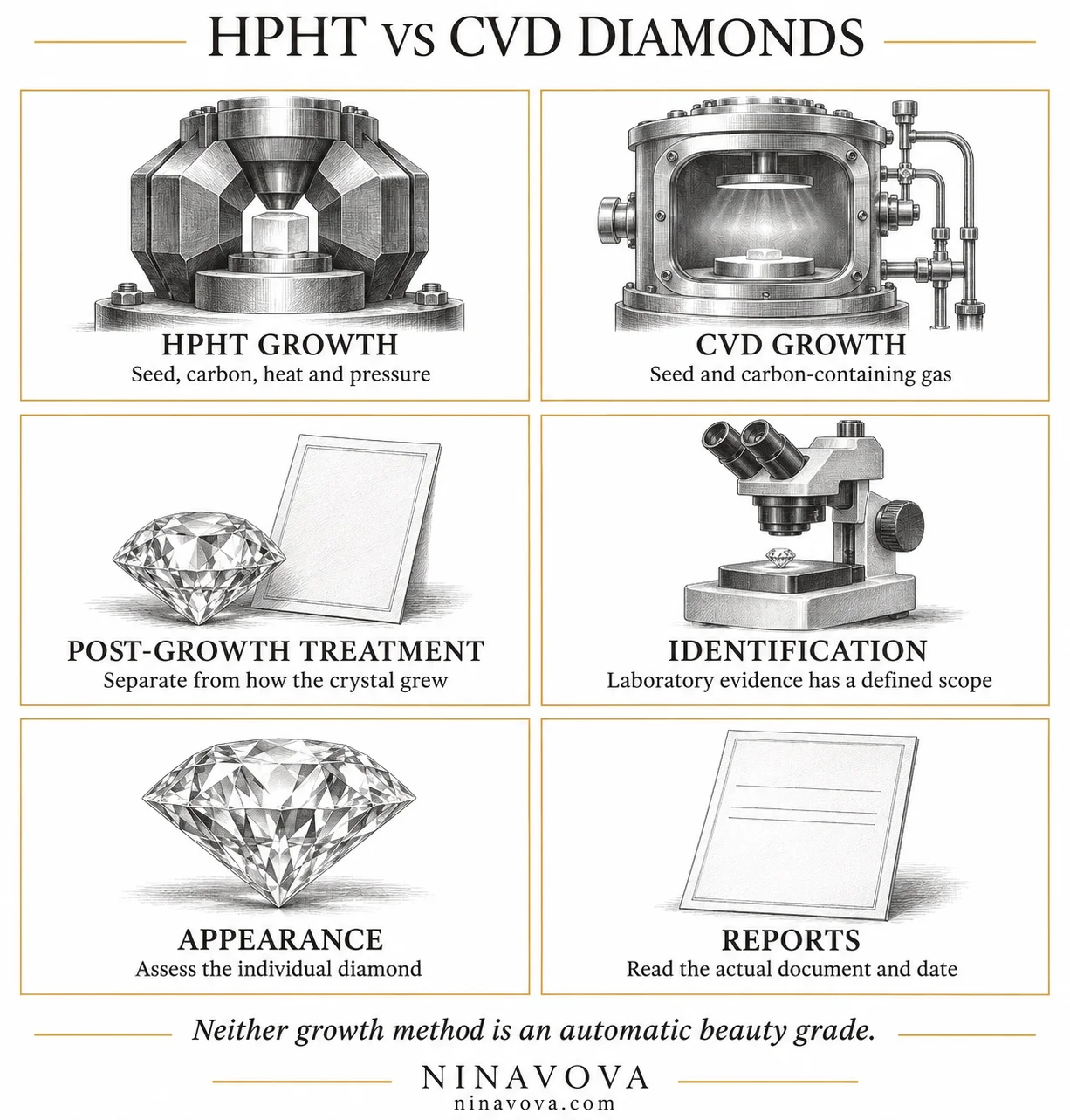
| Question | HPHT | CVD |
|---|---|---|
| How growth happens | Carbon crystallizes onto a seed through a high-pressure, high-temperature process using a metallic solvent/catalyst. | Diamond grows on a seed from a carbon-containing gas in a low-pressure chamber. |
| Color and treatment | High-color material exists; impurities and treatment histories vary. | Some material undergoes post-growth color improvement, including HPHT treatment. |
| Appearance | Evaluate the actual cut, transparency, color and inclusions. | Apply the same individual evaluation. |
| Identification | Laboratory evidence can identify growth-related features. | Specialized analysis also identifies characteristic growth-related features. |
| Reports | Read the actual document, issuing service and date. | Do not assume every report uses identical grades or fields. |
Hpht — The Original Method
HPHT stands for high pressure, high temperature. Successful industrial work in the 1950s led to an important route for growing diamond, and later to gem-quality material. It reproduces some key high-pressure conditions of natural growth through a controlled manufacturing process.
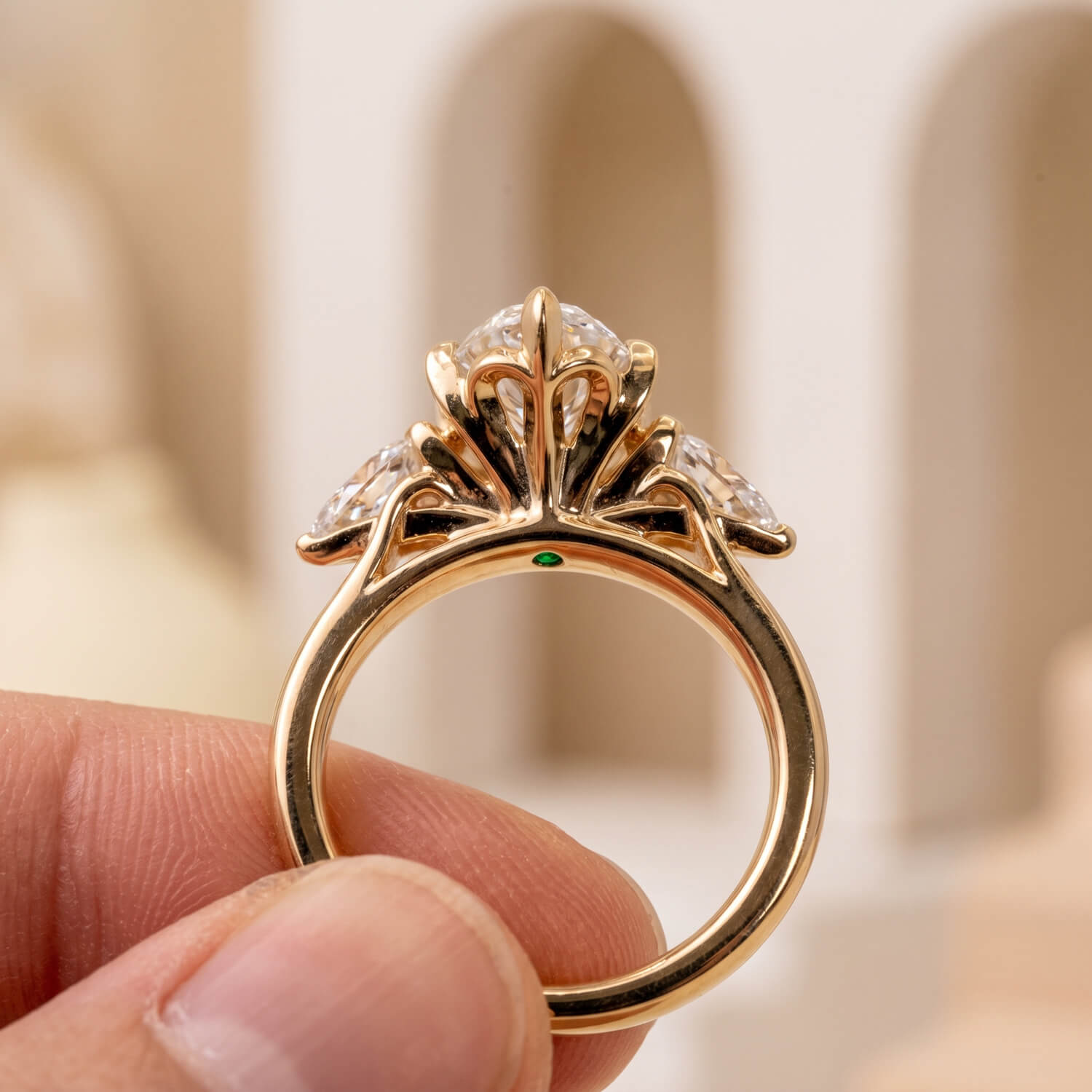
An HPHT assembly includes a diamond seed, a carbon source and a metallic solvent/catalyst. Under extreme heat and pressure, carbon dissolves and then crystallizes onto the seed. The rough crystal is subsequently cut and polished. The equipment and production recipe determine the time and conditions; a dramatic pressure analogy is less useful to a buyer than understanding how the material is identified.
High-color HPHT diamonds are available, including material grown without later color improvement. That does not make every HPHT stone colorless or untreated. Impurities and defects influence color, and some fancy colors also involve post-growth irradiation or heating. Ask about the particular stone rather than assuming one method owns the whole colored-diamond market.
The presses and growth capsules create equipment and production constraints, but large high-quality HPHT diamonds exist. Advances in both methods make a permanent claim that one cannot grow large colorless stones unreliable.
Cvd — Why It Was Even Invented
CVD stands for chemical vapor deposition. Its research history reaches back to the 1950s, rather than beginning as a single 1980s answer to HPHT. Gem-quality production developed later as control over growth improved.
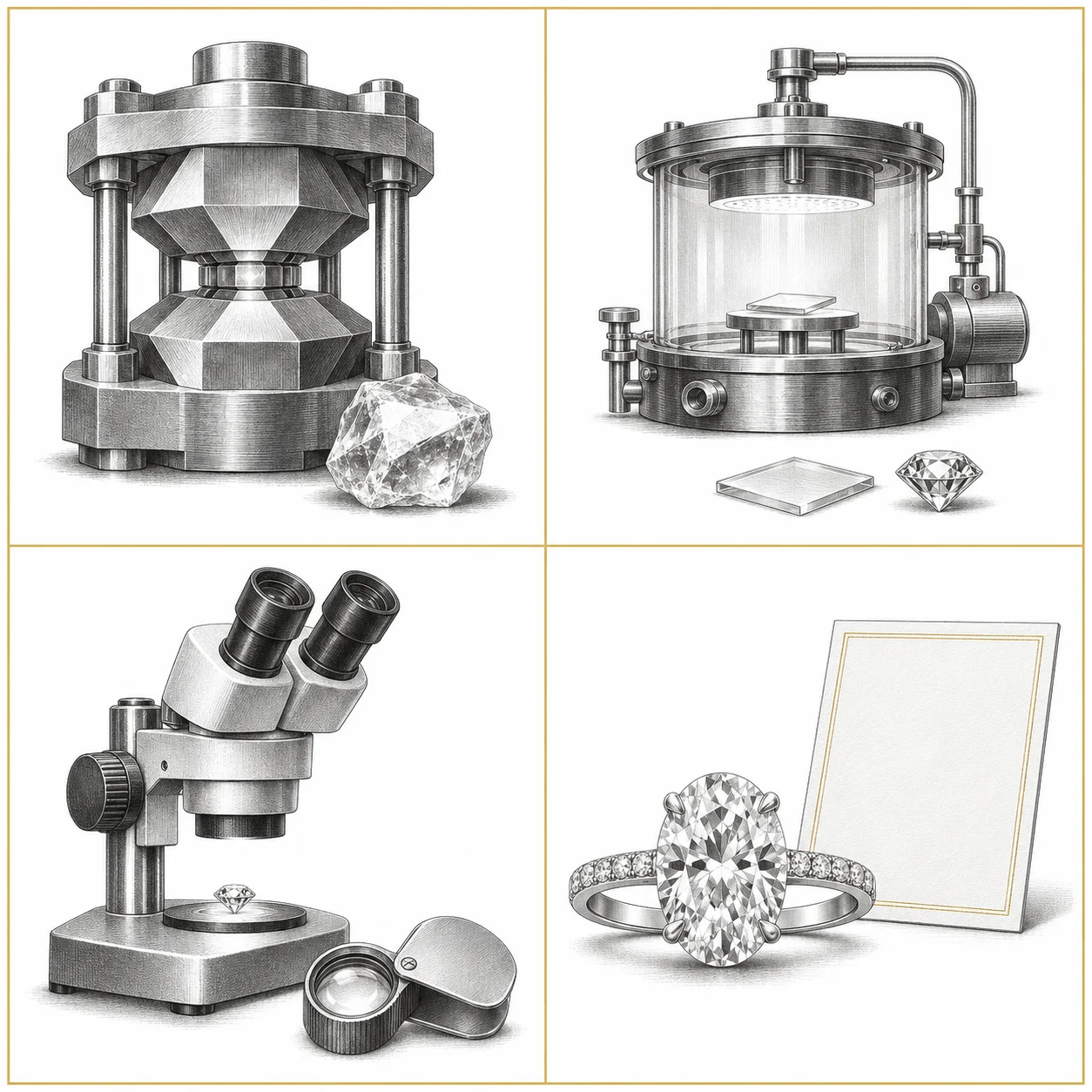
CVD uses a diamond seed in a low-pressure chamber with hydrogen and a carbon-containing gas. Energy creates a plasma, allowing diamond to grow in layers on the seed. It avoids HPHT growth pressure, but lower chamber pressure alone does not establish a lower energy footprint per finished carat. Yield, equipment, electricity source and later processing matter.
Many CVD diamonds are type IIa, a classification associated with very low measurable nitrogen. It is not a beauty grade or a guarantee that a stone has no other defects. Some CVD material has brown or gray coloration and undergoes post-growth treatment, including HPHT annealing. HPHT growth and HPHT treatment are different processes; one creates diamond material, the other changes properties in an existing stone.
Specialized laboratories distinguish growth histories using features such as luminescence patterns, spectroscopy, inclusions and strain. HPHT and CVD can show different growth-related structures, but these are not reliable naked-eye or simple “tree ring” tests for a shopper. A laboratory combines evidence instead of identifying every stone from one ordinary microscope view.
The Myths That Get Repeated Online
There's stuff you'll read in basically every HPHT vs CVD article that I want to address directly, because it doesn't match what I see in real life.
Boron-related behavior and metallic inclusions are real features that may occur in HPHT material. Their presence in laboratory measurements is not the same as a visibly blue or unattractive stone. In my own selection work, I focus on whether any feature actually affects the individual diamond’s appearance or suitability, rather than dismissing a documented feature as a universal myth.
Some handheld testers use thermal or electrical responses and can give misleading or inconclusive readings on particular stones. A newer device is not automatically an instrument that identifies every natural, lab-grown or simulated diamond. Understand its stated scope and use appropriate laboratory documentation and screening for the question being asked.
Growth method alone does not determine sparkle. Cut geometry, transparency, defects, lighting and the way the stone is viewed all matter. Two well-cut diamonds from different methods can both perform beautifully, without a promise that every nominally similar pair looks identical.
What Actually Matters When You'Re Buying
Neither growth method is automatically the better purchase. Both create diamond material, while individual color, clarity, transparency, cut and any relevant treatment history still need review. At NinaVova, we evaluate the actual stone and the ring it will become rather than buying a growth-method slogan.
The familiar 4Cs—cut, color, clarity and carat weight—help organize the evaluation. Of these, cut and observed light performance deserve particular attention.
It makes sense why color, clarity, and carat dominate the conversation. Everyone wants a stone that looks white and clean. Everyone wants it to be flawless. And everyone wants it to be as big as their budget allows. Those are all valid. But cut is what actually controls how a diamond performs — the fire, the brilliance, the way it catches light across a room. A well-cut stone at G color will look more alive than a poorly cut D color stone in many practical comparisons, although the actual stones and lighting must be examined.
This becomes really obvious when you're looking at shapes like ovals. The bow tie effect — that dark shadow that can stretch across the center of an oval — has nothing to do with whether it's HPHT or CVD. It's entirely about cut and proportions. A good oval has minimal bow tie. A poorly cut oval has a dark stripe you can't unsee. Same principle applies across every shape — cut quality is doing most of the work that people credit to color or clarity.
The complete laboratory-grown diamond guide discusses these buying priorities in more detail, including transparency, reports and the need to look beyond a grade label.
Independent documentation matters too. Verify the report number and match the document to the stone. IGI reports and older GIA lab-grown reports may show familiar individual grades; since October 1, 2025, GIA’s revised D-to-Z lab-grown service uses Premium and Standard overall assessments. Read the specific document and its date, including any growth-method or treatment information actually provided.
Prioritize the diamond’s observed appearance and cut, then balance color, clarity, size and budget. Disclosed growth and treatment history support an informed choice without automatically deciding it.

Frequently asked questions
Can a photograph distinguish HPHT from CVD?
No. Evaluate appearance in photographs, but use appropriate laboratory evidence for growth-method identification.
Does type IIa mean a diamond must be beautiful?
No. It is a material classification, not an overall grade for cut, transparency or appearance.
Do all current GIA lab-grown documents use individual natural-diamond grades?
No. GIA’s revised D-to-Z service launched October 1, 2025 uses Premium and Standard overall assessments. Read the actual document and date; other services and older reports differ.
Bring the details into your own ring
We can help compare the actual gemstone, construction, appearance and complete budget for a ring that suits the wearer.
Book a NinaVova consultation or explore our custom design process.
Continue reading: Complete lab-grown diamond buying guide · Diamond budget and origin · Diamond-market snapshot.
Sources and further reading
- GIA: HPHT and CVD growth processes
- GIA: 2024 research on identification and products
- GIA: Laboratory-grown diamond research trends
- GIA: Simulants and laboratory-grown diamonds
- GIA: October 2025 report-service change
Use the linked research to understand material and care questions. AI illustrations are educational concepts, not laboratory evidence, performance measurements or proof of a photographed stone’s treatment or growth history. Actual NinaVova photographs are separately identified.