

The Hope Diamond: History, Science and the Story Behind the Legend

You may come to NinaVova looking for advice on diamonds or custom engagement rings. The Hope Diamond offers a different kind of lesson: how one gemstone can carry an extraordinary history, a scientific identity and a story that changes with every owner.
In the accompanying video, I follow that story through Washington, D.C., using the city’s landmarks as a setting for reflection. The National Mall, the White House, the Octagon House and the Smithsonian help connect a distant royal jewel with a place where people can encounter it today.
The monuments are a narrative framework, not proof that every event happened at the location shown. The documented history matters just as much as the atmosphere. The curse belongs to legend; the diamond’s journey can be explored through records, physical study and the people who owned it.
The Hope Diamond’s documented history is remarkable without a curse. Its royal past, recutting, private ownership and 1958 Smithsonian donation explain its cultural importance. Scientific examination describes the physical gem; the curse is folklore. The original NinaVova video uses Washington landmarks to explore that distinction.
At a glance · From India to a merchant’s ledger · The French Blue and the royal image · Revolution, theft and a missing identity · London, the Hope name and a changed stone
Watch the NinaVova discussion
Watch the original NinaVova video on YouTube.
History, science and legend at a glance
| Topic | What the record supports | What to avoid assuming |
|---|---|---|
| Royal history | The blue diamond was acquired by Louis XIV and recut as the French Blue. | Every royal owner wore it personally. |
| 1792 theft | The French Blue disappeared during looting of the crown jewels. | A fully documented route from the theft to the next known record. |
| 1812 London record | Francillon documented the blue gem associated with Daniel Eliason. | That the exact recutting date and cutter are known. |
| McLean ownership | The sale developed through the early 1910s. | Every summary dates the lengthy transaction identically. |
| 1958 donation | Harry Winston sent it by registered mail to the Smithsonian. | The historical shipping insurance is its present market value. |
| Gem science | 45.52 ct; GIA describes natural Fancy deep grayish blue and VS1. | Flawless, supernatural or the only diamond that can phosphoresce. |
From India to a merchant’s ledger
Long before Washington became the capital of the United States, a remarkable blue diamond began the journey that would eventually bring it there. The early story leads to India and the French gem merchant Jean-Baptiste Tavernier.
Accounts commonly associate the stone with the Golconda region. The exact circumstances of its discovery are less secure than the later ownership record, so I would distinguish that early background from dates supported by written evidence. There is no reason to turn an uncertain mine story into a precise eyewitness account.
The large blue stone is often described using a historical weight of about 112 carats. Those old measurements should not be casually equated with a modern weighing. What matters for the story is the scale of the original gem and the substantial changes made as it was recut.
When I look at Washington’s monumental landscape, the contrast is striking: the jewel’s European royal history began before the United States existed. That does not mean the land was empty or without history. It means the capital and its familiar monuments belong to a later chapter than the diamond’s first documented travels.
The French Blue and the royal image
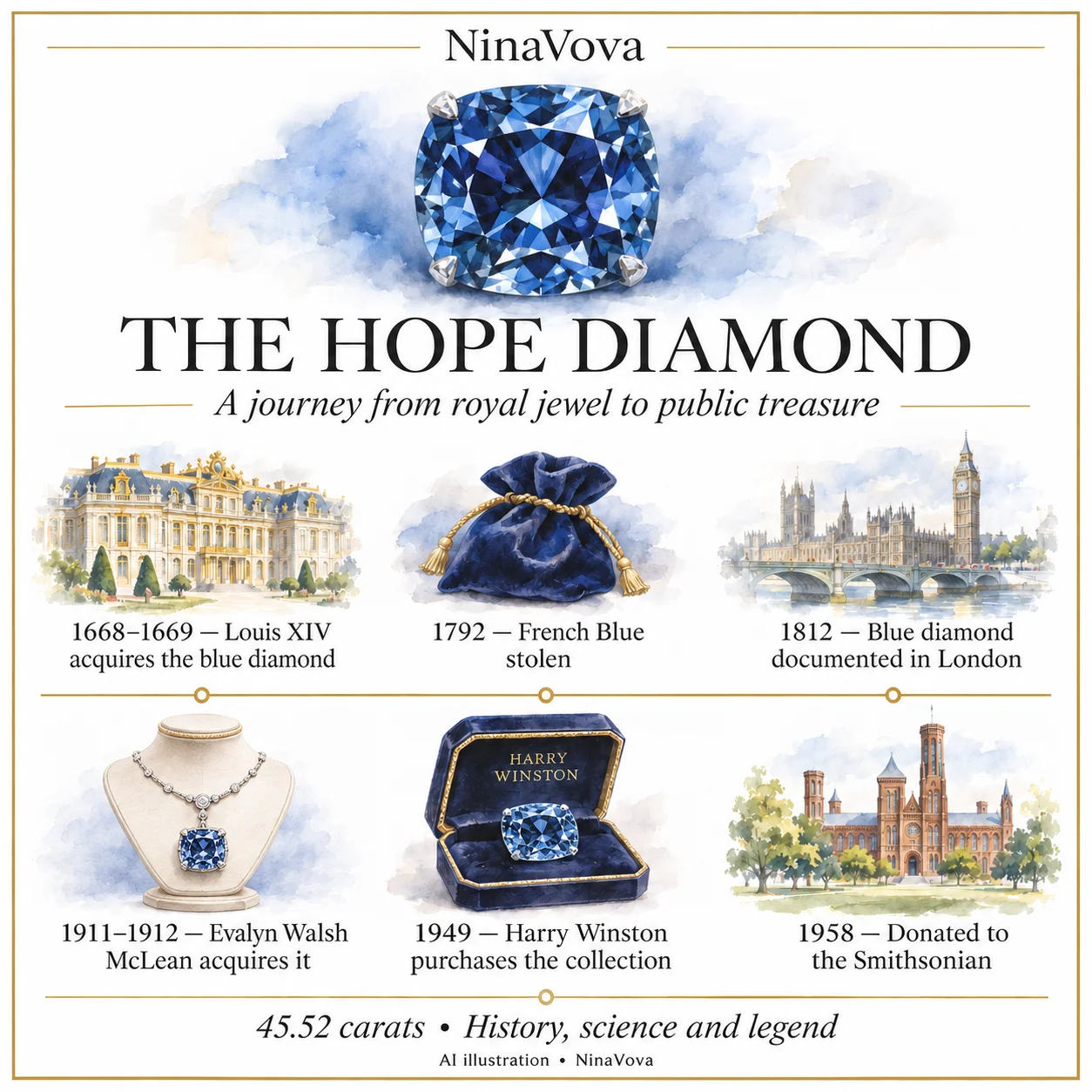
Tavernier sold the blue diamond to Louis XIV in the late 1660s. It was subsequently recut into the stone now known as the French Blue. A remarkable natural object became part of a deliberate royal presentation.
The name evokes more than color. In the French court, an exceptional gem could communicate power, wealth and the ability to obtain something few others could possess. The cutting and mounting changed how that message was seen.
The diamond later entered the elaborate Order of the Golden Fleece jewel under Louis XV. It is easy to imagine every famous royal gemstone as something a king or queen wore constantly, but that picture is too simple. The Smithsonian’s history cautions against assuming Marie Antoinette wore the French Blue.
That distinction is useful whenever we look at historic jewelry. Ownership, mounting, display and wearing are different claims. A dramatic retelling should not quietly turn one into another.
Revolution, theft and a missing identity
The American Declaration of Independence in 1776 provides one point of comparison in the video: a new republic defining itself while the blue diamond remained bound to a European royal story. Sixteen years later, the French monarchy was collapsing.
In September 1792, thieves looted the French Crown Jewels from the Garde-Meuble. The French Blue disappeared in that episode. Its later trail would have to be reconstructed from evidence rather than a continuous, fully documented chain.
The same year also saw the beginning of White House construction. Those parallel dates make a powerful narrative contrast: a capital taking physical form while a royal jewel lost its familiar identity. They are a comparison between events, not evidence that the events caused one another.
For roughly two decades, the diamond’s story becomes a gap. That absence is part of what makes it compelling. It also calls for restraint: we should not present an imagined hiding place, cutter or motive as something the surviving record proves.
London, the Hope name and a changed stone
A blue diamond was documented in London in 1812, associated with the dealer Daniel Eliason. John Francillon’s drawing and description are important surviving evidence. The stone was smaller than the French Blue and had a different outline.
The Hope Diamond’s relationship to the French Blue is supported by later research and reconstruction, not simply by repeating a romantic story. A changed cut could obscure a famous identity, but the exact recutting history is not fully known.
The video uses the Octagon House to reflect on survival and transformation. It served as a temporary presidential residence after the White House burned in 1814. That is two years after the London record, so the events belong to the same broad period rather than the exact same moment.
The diamond eventually acquired the Hope name through the family that owned it. Its identity continued to change: a royal blue gem became a celebrated private possession. By the beginning of the twentieth century it had left the Hope family and was moving through the international gem trade.
This is one of the most interesting parts of the story to me. A gemstone can remain physically recognizable while its public meaning shifts completely. The name people remember may come from only one stage of a much longer life.
Cartier, Evalyn Walsh McLean and the curse story
Cartier acquired the diamond in 1910 and sought an American buyer. Evalyn Walsh McLean, whose family wealth came from mining, and her husband Ned, of the newspaper-owning McLean family, were an extraordinary match for an extraordinary jewel.
The sale involved more than simply showing a loose stone. Evalyn initially disliked its setting. A new mounting and the opportunity to spend time with the jewel helped change her reaction. Design could transform the experience of a gemstone whose material identity had not changed at all.
The transaction is often dated 1911 in popular accounts; the Smithsonian’s detailed history places the McLeans’ purchase in 1912. The process extended over time, so this article treats it as a 1911–1912 sale period rather than pretending the accounts are identical.
In Washington society, the diamond became closely associated with Evalyn. She wore it frequently and made it part of a highly public life. The Walsh-McLean House gives the video a setting for that chapter, rather than serving as the location of every anecdote connected with her.
The curse is a different kind of history. Stories of misfortune helped make the jewel famous, and Cartier drew on that fascination while selling it. Those stories reveal something about publicity and the appeal of a legendary object; they do not establish that the diamond caused anyone’s tragedy.
That boundary matters. Real people experienced losses, debts and family difficulties. Turning all of that into a supernatural cause makes a compelling sales story, but it is not a factual conclusion about a mineral.
Harry Winston and the journey by registered mail
Evalyn Walsh McLean died in 1947. In 1949, Harry Winston acquired her jewelry collection, including the Hope Diamond. Its next chapter brought it before audiences beyond the circle of a private owner.
The diamond became part of the Court of Jewels exhibition. To me, that move illustrates how display changes a jewel’s meaning: something once associated with exclusive ownership could become an object people traveled to see.
In 1958, Winston donated the Hope Diamond to the Smithsonian. It arrived by registered mail in a plain brown package, insured for one million dollars. The contrast between the modest wrapping and the remarkable object inside remains one of the story’s most memorable details.
The mailing is documented; it is not just a colorful tale invented for a video. But the insured amount was a historical shipping arrangement, not a reliable current market valuation. The diamond’s significance cannot be reduced to a price casually carried forward from that moment.
The gift also connected Winston’s name with a public collection. Generosity, publicity and cultural legacy can coexist in the same act. The result was a different kind of ownership story: a famous jewel made available for public encounter and scientific study.
What science tells us about the blue diamond
The Hope Diamond weighs 45.52 carats. GIA’s account of its 1988 examination describes a cushion brilliant cut, natural Fancy deep grayish blue color and VS1 clarity. Those specific observations are more useful than calling it simply flawless or perfect.
The stone is also known for its red phosphorescence after ultraviolet excitation. The distinction between the exciting source and the lingering glow matters: the afterglow is a physical phenomenon, not evidence of a curse.
Other natural blue diamonds can phosphoresce too. The Hope’s behavior has been studied in that wider context, so I would not claim it is the only diamond capable of a red glow. Scientific interest comes from measuring and comparing real properties.
Research into historical drawings, a surviving lead cast and three-dimensional reconstructions has strengthened the link to the French Blue. The relationship was developed through successive studies, rather than one single moment when technology suddenly answered every question.
The diamond has also appeared in different settings, including the temporary Embracing Hope mounting introduced in 2010. That display followed the fiftieth anniversary of the 1958 donation; 2010 itself was not the fiftieth anniversary year.
A public treasure rather than a private myth
The Smithsonian’s National Museum of Natural History is the home of the Hope Diamond. The Castle in the video represents the institution’s larger story; it should not be mistaken for the museum building that houses the gem.
What draws people to it is a combination of qualities: the blue color, the unusual scale, the history and the legends surrounding it. A family visiting a museum can approach the same object that once expressed royal power or private social standing.
I find that transformation more interesting than a curse. The jewel has moved from India to France, through London and the international trade, and into an American public collection. Its story is still being interpreted, researched and shared.
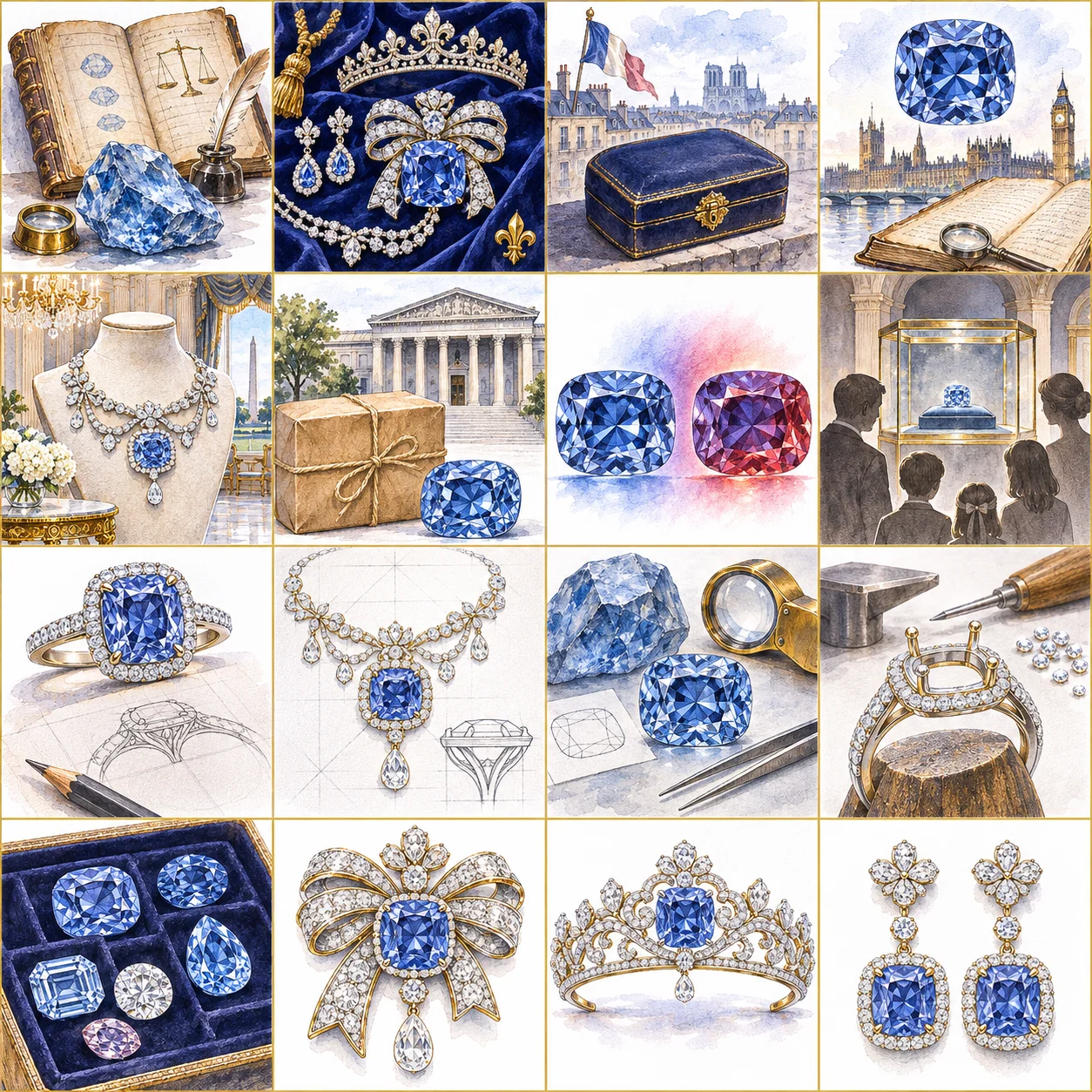
The illustrations here are AI interpretations of those themes, not photographs of the actual diamond, authenticated reconstructions or evidence of how a particular historic scene looked. The source links lead to museum records and the real object.
What this story means for a personal ring
The video ends at the Lincoln Memorial with a quieter thought. Gemstone value is not only a matter of carats, color or clarity. Meaning can come from the people connected with a piece, the decisions behind it and the memories it carries.
An engagement ring does not need a royal provenance to be important. Its story can begin with the person who chooses it: a favorite color, a detail from a shared place, an unexpected pairing of stones or a design developed around someone’s life.
That is the connection I see between an extraordinary museum jewel and a custom ring. They are very different objects, but both show how material and human meaning become intertwined. A personal design can hold thoughtfulness without needing to imitate the size, status or mythology of a famous gem.
You can appreciate the Hope Diamond’s history and still create something entirely your own. Let the lesson be the importance of a story that is true to the people involved, rather than the need to borrow someone else’s legend.
Frequently asked questions
Is the Hope Diamond curse a scientific fact?
No. It is a cultural legend shaped by retelling and publicity, not evidence that a gemstone caused misfortune.
Are the illustrations actual photographs of the Hope Diamond?
No. They are clearly identified AI interpretations. The linked Smithsonian collection pages show the actual object and historical documentation.
Create a story that belongs to you
A personal ring can carry a favorite color, a shared memory or a meaningful detail. We can help turn those choices into a custom design without borrowing a famous jewel’s mythology.
Book a NinaVova consultation or explore our custom design process.
Continue reading: Designer vs custom engagement rings.
Sources and further reading
- Smithsonian National Museum of Natural History: Hope Diamond collection
- Smithsonian: Detailed history of the Hope Diamond
- GIA: Famous diamonds examined by GIA
- Smithsonian: Research into the red phosphorescence
- Smithsonian Archives: History and the curse legend
Historical certainty varies, and the linked museum and research sources distinguish evidence from legend. AI illustrations are interpretations rather than documentary photographs.