Skip to navigation Skip to main content
  • Design Process
    • Create a Custom Engagement Ring for Your Partner
    • Design an Engagement Ring Together
    • Create Your Own Custom Engagement Ring
    • Success Stories
  • Ring Gallery
  • Diamonds
    • Natural diamonds
    • Lab-grown diamonds
    • Round
    • Oval
    • Cushion
    • Emerald
    • Pear
    • Radiant
  • Gemstones
    • Sapphire
    • Ruby
    • Emerald
    • Spinel
    • Aquamarine
    • Tourmaline
    • Tanzanite
    • Morganite
NinaVova
  • EDUCATION
  • NinaVova Reviews
  • Book Consultation
0 items / $0.00
Menu
NinaVova home
0 items
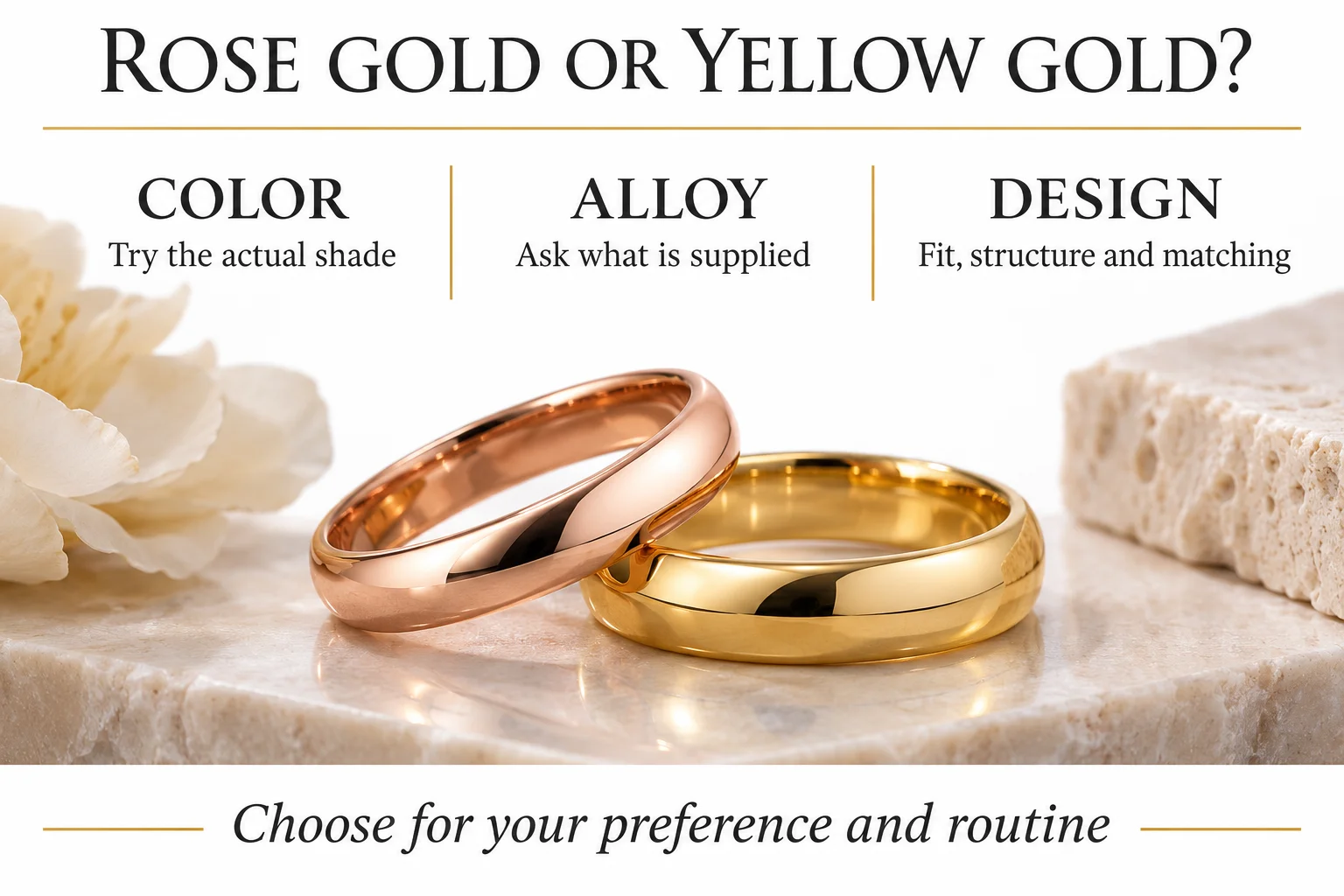
Original NinaVova video thumbnail: Rose Gold or Yellow Gold? How to Choose the Right Metal
Engagement Ring Guide

Rose Gold vs Yellow Gold: Color, Alloys and Everyday Wear

Posted by author-avatar Sergey Degtyarenko
06.11.2026
On 22.06.2026

By Sergey Degtyarenko, founder of NinaVova

Rose gold and yellow gold are both genuine gold alloys. Their different colors can change the mood of an engagement ring, but the best choice also depends on the exact alloy, construction, maintenance, comfort and the wearer’s preference.

The short answer

Choose the actual shade and alloy, not a skin-tone rule. Try rose and yellow gold with your stone under everyday lighting. Karat describes gold content, while the precise recipe, construction and finish determine more of the practical comparison.

At a glance · Gold content and alloy color · A short history and the look on the hand · Shade variation and matching a wedding band · Pairing with diamonds and colored stones

Watch the NinaVova discussion

Watch the original NinaVova video on YouTube.

The original NinaVova rose-gold and yellow-gold comparison accompanies this written guide.

Rose and yellow gold at a glance

Both colors contain a range of actual alloys; confirm what will be supplied.
ConsiderationRose goldYellow gold
ColorBlush to coppery red; recipe mattersPale to rich yellow; recipe matters
Alloy directionCopper contributes to pink tonesOften silver and copper in different proportions
KaratGold content, not one fixed shadeGold content, not a durability guarantee
WearActual alloy and construction matterActual alloy and construction matter
MatchingCompare wedding band and ring togetherCompare wedding band and ring together
ChoicePreference, stones, fit and servicePreference, stones, fit and service
NinaVova educational overview: Rose Gold vs Yellow Gold: Color, Alloys and Everyday Wear
Illustrated educational concepts. These are not actual historic artifacts, laboratory identifications, radioactive-material samples or inventory. Open at full size.

Gold content and alloy color

Karat describes the proportion of gold. Eighteen-karat gold contains 75% gold; fourteen-karat is mathematically about 58.3%, while 585 is a common fineness standard used for 14K jewelry. The remaining metals help determine color and working properties.
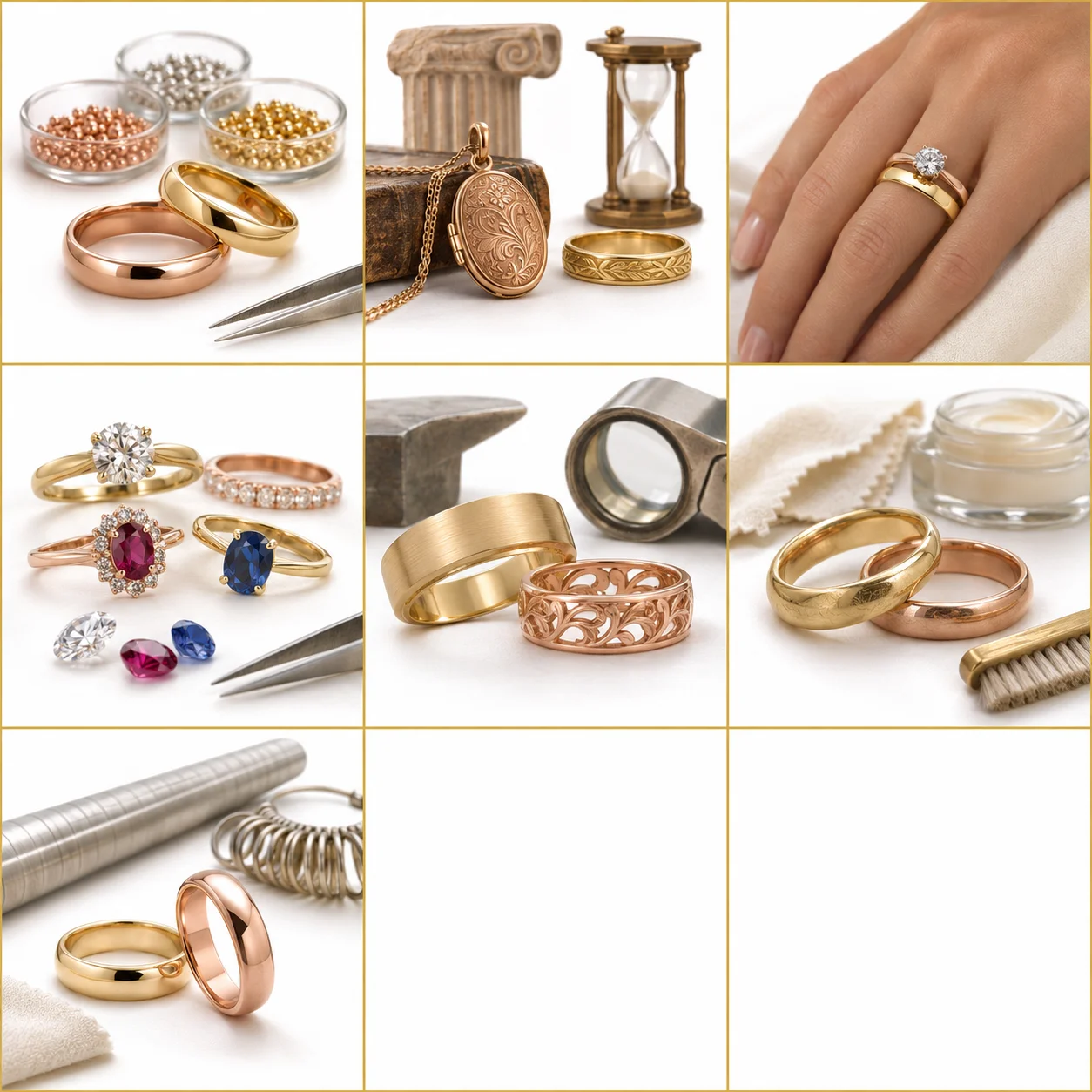
Gold content and alloy color
Gold content and alloy color.

Yellow-gold recipes commonly combine gold with silver and copper. Rose-gold recipes generally use a greater copper contribution to create pinker or redder tones. Neither color is one universal formula, and karat alone does not identify every ingredient.

For the same design, a higher gold content can affect cost, but a fixed 10–30% increase is not a reliable quotation rule. Compare actual current prices for the specified alloy, dimensions, weight, design and services.

A short history and the look on the hand

Yellow gold has a long history in adornment and can give a ring a sunny, familiar warmth. Rose gold became especially associated with nineteenth-century Russian luxury and Fabergé, followed by later mixed-metal and fashion revivals; that association does not mean the alloy was invented there.

A short history and the look on the hand
A short history and the look on the hand.

Yellow gold may read as bold or classic, while rose gold can feel softer, romantic or vintage-inspired. These are descriptions of a possible visual effect, not requirements about the personality or gender of its wearer.

Skip rigid skin-tone rules. Try both colors in daylight and warm indoor lighting, with the actual or comparable stone. Choose the combination you enjoy rather than the one a chart says you are allowed to wear.

Shade variation and matching a wedding band

Gold’s palette extends beyond a single yellow or rose. Pale yellow or greenish alloys may be described with names such as lemon gold, while rose shades range from a light blush to a more coppery red. The actual composition and finish determine the result.

Shade variation and matching a wedding band
Shade variation and matching a wedding band.

A rose engagement ring from one maker may not match a rose wedding band from another. If an exact-looking pair matters, discuss both rings together, ask about the alloy and compare samples or finished pieces.

Ordering from the same maker and specified alloy can help consistency, but it should not be framed as an unconditional guarantee of a perfect match. Surface finish, wear, lighting and later refinishing can also affect what you see.

Pairing with diamonds and colored stones

A yellow- or rose-gold setting can contribute warm reflections around a diamond. White-metal prongs on a warm-gold shank are one design option if you prefer that contrast. They do not automatically improve the intrinsic cut or brightness of the diamond.

Pairing with diamonds and colored stones
Pairing with diamonds and colored stones.

Rose gold can complement morganite, pink sapphire, ruby, red spinel and peach or champagne tones. Yellow gold can make an appealing contrast with emerald, blue sapphire, tourmaline and rich reds. These are starting points, not exclusive combinations.

Compare the particular gem and metal together. A stone’s tone, saturation, cut and changing light can matter more than a rule about which color is supposed to pair with its name.

Durability depends on the actual alloy and design

Pure gold is soft, and alloying changes its mechanical properties. Many 14K recipes can be harder than some 18K recipes, but karat and color alone cannot establish the strength or scratch resistance of every finished ring.

Durability depends on the actual alloy and design
Durability depends on the actual alloy and design.

Copper-rich rose gold may work differently from a yellow alloy. Heat treatment, manufacturing method, band dimensions and setting structure also matter. Avoid treating every rose alloy as tougher than every yellow one or prescribing 14K as automatically best for all active wearers.

Ask the maker what suits the proposed construction and future service. Resizing and prong repairs depend on the complete design, gemstone setting and actual alloy; neither color guarantees that every ring can be altered without limitation.

Surface wear, patina and maintenance

Rose and yellow gold normally have their color through the alloy rather than relying on rhodium plating for that color. Confirm the actual finish, however, because a piece may also have surface treatments or decorative coatings.

Both can collect scratches and change their surface appearance with wear. Some rose alloys may develop a changed tone at the surface over time; the extent depends on the alloy and conditions, rather than a guaranteed aging effect for every ring.

Refinishing can change the appearance but removes some metal. Discuss maintenance and avoid assuming that repeated heavy polishing is the answer to every small mark. Check the structure and setting as well as the shine.

Actual NinaVova rose-gold laboratory-grown diamond ring with a shaped band
Actual NinaVova rose-gold laboratory-grown diamond ring and shaped band. This is a contemporary design example, not a historic artifact or a sample of a different metal. Photograph: NinaVova.

Sensitivities, fit and the final choice

If you have a known sensitivity, ask for the actual alloy ingredients and discuss suitable options with the maker. A higher karat, a color name or a nickel-free description is not a universal guarantee that no person will react.

Comfort also depends on sizing, band width, thickness, interior profile and neighboring rings. A comfort-fit interior is an option to try rather than a promise that one profile feels best to everyone.

Choose yellow gold if you enjoy its particular warmth and contrast; choose rose gold if you prefer its blush against your skin and stones. Then confirm the actual alloy, structure, wedding-band relationship and current written terms so the appearance and practical plan agree.

Actual NinaVova yellow-gold bands
Actual NinaVova yellow-gold bands show a contemporary jewelry application. The photograph does not establish raw-metal prices or technical properties of another element. Photograph: NinaVova.

Frequently asked questions

Does a material name settle the whole decision?

No. The actual composition, condition, application and evidence matter. Jewelry also needs an appropriate design and service plan.

Are the illustrations actual historical objects or material samples?

No. Generated concepts are labeled as such; actual NinaVova photographs are separately captioned.

Are prices or fashion permanence guaranteed?

No. Compare actual current written quotations, and choose an appearance and practical plan that suit the wearer.

Choose a material for your own story

Bring the color, proportions and design references you enjoy. We can discuss actual jewelry alloys, construction and the complete quotation for your ring.

Book a NinaVova consultation or explore our custom design process.

Continue reading: Rose-gold history · Ring metals and alloy questions.

Sources and further reading

  • NinaVova: Original gold comparison
  • World Gold Council: Color, carat and purity
  • The Perth Mint: Colored-gold recipes

Based on NinaVova’s original writing, with the primary and institutional references linked above. Historical associations and material properties are separated from current quotations; generated concepts and actual NinaVova photographs are identified in their captions.
Custom Engagement RingsGemstone Buying AdviceGemstone History
Newer
The History of Rose Gold: Fabergé, Art Deco and Modern Rings
Back to list
Older Ruby vs Garnet for Engagement Rings: Identity, Color and Care

Related Posts

Original NinaVova video thumbnail: Green vs Teal Sapphire Engagement Rings: Color, Cut and Lighting
13 Nov
Engagement Ring Guide, Gemstones

Green vs Teal Sapphire Engagement Rings: Color, Cut and Lighting

Posted by author-avatar Sergey Degtyarenko
06.11.2026
Compare mint, seafoam, olive, forest-green and teal sapphire directions, and learn how lighting, cutting, trade names and origin affect the buying decision.
Continue reading
Original NinaVova video thumbnail: 7 Lab-Grown Gemstones for Engagement Rings: A Practical Comparison
12 Nov
Engagement Ring Guide, Gemstones

7 Lab-Grown Gemstones for Engagement Rings: A Practical Comparison

Posted by author-avatar Sergey Degtyarenko
06.11.2026
Compare seven lab-grown gemstone options for engagement rings, including diamond, sapphire, alexandrite, ruby and emerald, with practical guidance on appearance and identity.
Continue reading
Original NinaVova video thumbnail: 25 American Gemstones for Engagement Rings: Origin, Color and Care
11 Nov
Engagement Ring Guide, Gemstones

25 American Gemstones for Engagement Rings: Origin, Color and Care

Posted by author-avatar Sergey Degtyarenko
06.11.2026
Explore 25 gemstones associated with U.S. localities, from Montana sapphire and Oregon sunstone to American aquamarine, turquoise, red beryl and Arkansas diamond.
Continue reading
Original NinaVova video thumbnail: 22 Yellow Gemstones for Engagement Rings: Color, Durability and Care
10 Nov
Engagement Ring Guide, Gemstones

22 Yellow Gemstones for Engagement Rings: Color, Durability and Care

Posted by author-avatar Sergey Degtyarenko
06.11.2026
Compare 22 yellow gemstone options, including sapphire, chrysoberyl, citrine, pearl and diamond, with practical advice on color, durability, treatments and design.
Continue reading
Original NinaVova video thumbnail: 25 Purple Gemstones for Engagement Rings: Color, Care and Buying Choices
09 Nov
Engagement Ring Guide, Gemstones

25 Purple Gemstones for Engagement Rings: Color, Care and Buying Choices

Posted by author-avatar Sergey Degtyarenko
06.11.2026
Compare 25 purple gemstones for engagement rings, from amethyst and spinel to sapphire and alexandrite, with practical guidance on appearance, care and verification.
Continue reading
Original NinaVova video thumbnail: Montana Sapphire Engagement Rings: Color, Yogo, Treatment and Cut
08 Nov
Engagement Ring Guide, Gemstones

Montana Sapphire Engagement Rings: Color, Yogo, Treatment and Cut

Posted by author-avatar Sergey Degtyarenko
06.11.2026
Choose a Montana sapphire by real-world color, cut and treatment. Understand Yogo, parti-color stones, size tradeoffs and the documentation behind origin claims.
Continue reading
Original NinaVova video thumbnail: Spinel Engagement Rings: Colors, Cut, Durability and Buying Advice
07 Nov
Engagement Ring Guide, Gemstones

Spinel Engagement Rings: Colors, Cut, Durability and Buying Advice

Posted by author-avatar Sergey Degtyarenko
06.11.2026
Choose a spinel engagement ring by color, cut and real-world appearance. Compare pink, lavender, red and blue, and learn which claims need a laboratory report.
Continue reading
NinaVova video thumbnail for Royal Blue vs Cornflower Blue Sapphire: Color, Price and Everyday Wear
06 Nov
Engagement Ring Guide, Gemstones

Royal Blue vs Cornflower Blue Sapphire: Color, Price and Everyday Wear

Posted by author-avatar Sergey Degtyarenko
06.11.2026
Compare royal blue and cornflower blue sapphires, understand trade color names, and learn how lighting, cut and the setting affect the finished ring.
Continue reading
NinaVova video thumbnail for Heated vs Unheated Sapphire: Color, Value and What to Verify
05 Nov
Engagement Ring Guide, Gemstones

Heated vs Unheated Sapphire: Color, Value and What to Verify

Posted by author-avatar Sergey Degtyarenko
06.11.2026
Compare heated and unheated natural sapphires: learn how treatment affects appearance, rarity and value, and what to verify on an independent laboratory report.
Continue reading
NinaVova video thumbnail for Which Two-Color Gemstones Are Actually Good for Engagement Rings?
04 Nov
Engagement Ring Guide, Gemstones

Bi-Color and Color-Change Gemstones: 20 Options for Engagement Rings

Posted by author-avatar Sergey Degtyarenko
06.11.2026
Compare 20 bi-color and color-change gemstones for engagement rings, including parti sapphire, alexandrite and tourmaline, with practical buying advice.
Continue reading
NinaVova video thumbnail comparing luxury designer and custom engagement rings
03 Nov
Engagement Ring Guide

Designer vs Custom Engagement Rings: Value, Quality & Fit

Posted by author-avatar Sergey Degtyarenko
06.11.2026
Compare designer and custom engagement rings, including stone quality, design freedom, pricing and aftercare, to choose what matters most to you.
Continue reading
Original NinaVova video thumbnail: Sapphire Engagement Ring Guide (No Regrets) – Real Prices, Origins & What to Avoid
23 Jun
Engagement Ring Guide

Natural Sapphire Engagement Ring Guide: Quality, Origins and Reports

Posted by author-avatar Sergey Degtyarenko
06.11.2026
Choose a natural sapphire through actual color, cut, treatment, six source profiles, laboratory-report scope, useful videos and a considered ring design.
Continue reading
    YouTube
    Shop Book Virtual Consultation About Blog Ethics + Sustainability Lifetime WarrantyEmail Sergey
    Ordering + Shipping Resizing + Returns Reviews Financing FAQ

    Love defines
    our journey.

    NinaVova logo
    © 2026, NinaVova®
    Custom pieces currently take 6–8 weeks unless otherwise stated. Rush orders must be requested before ordering.

    © 2026 NinaVova. All rights reserved

    payments
    • Home
    • Ring Gallery
    • Diamonds
      • All diamonds
      • Natural diamonds
      • Lab-grown diamonds
      • Round
      • Oval
      • Cushion
      • Emerald cut
      • Pear
      • Radiant
    • Gemstones
      • All gemstones
      • Sapphire
      • Ruby
      • Emerald
      • Spinel
      • Aquamarine
      • Tourmaline
      • Tanzanite
      • Morganite
    • Create a Custom Engagement Ring for Your Partner
      • Create a Custom Engagement Ring for Your Partner
      • Design an Engagement Ring Together
      • Create Your Own Unique Engagement Ring
    • Success Stories
    • NinaVova Reviews
    • Contact NinaVova
    • Engagement Ring Guides
    • EDUCATION
    • Custom Engagement Ring FAQs
    Shopping cart
    Close