
Engagement Ring Guides
Choosing an Engagement Ring for Someone Who Never Wears Jewelry

Your girlfriend never wears jewelry. Maybe you've never seen a ring on her finger. And now you're trying to choose something she might wear for the rest of her life.
So you think about getting a tiny diamond, a plain band, something she'll barely notice. But that assumes you know why she avoids jewelry.
She might dislike the feeling of rings, worry about attracting attention, or think engagement rings all look the same. She might also be thrilled by a traditional diamond solitaire, even if she doesn't own another piece of jewelry.
I'll show you how I'd approach this at NinaVova: discover what would make her excited to wear a ring, and then make the design genuinely comfortable. Those are two different problems, and we need to solve both.
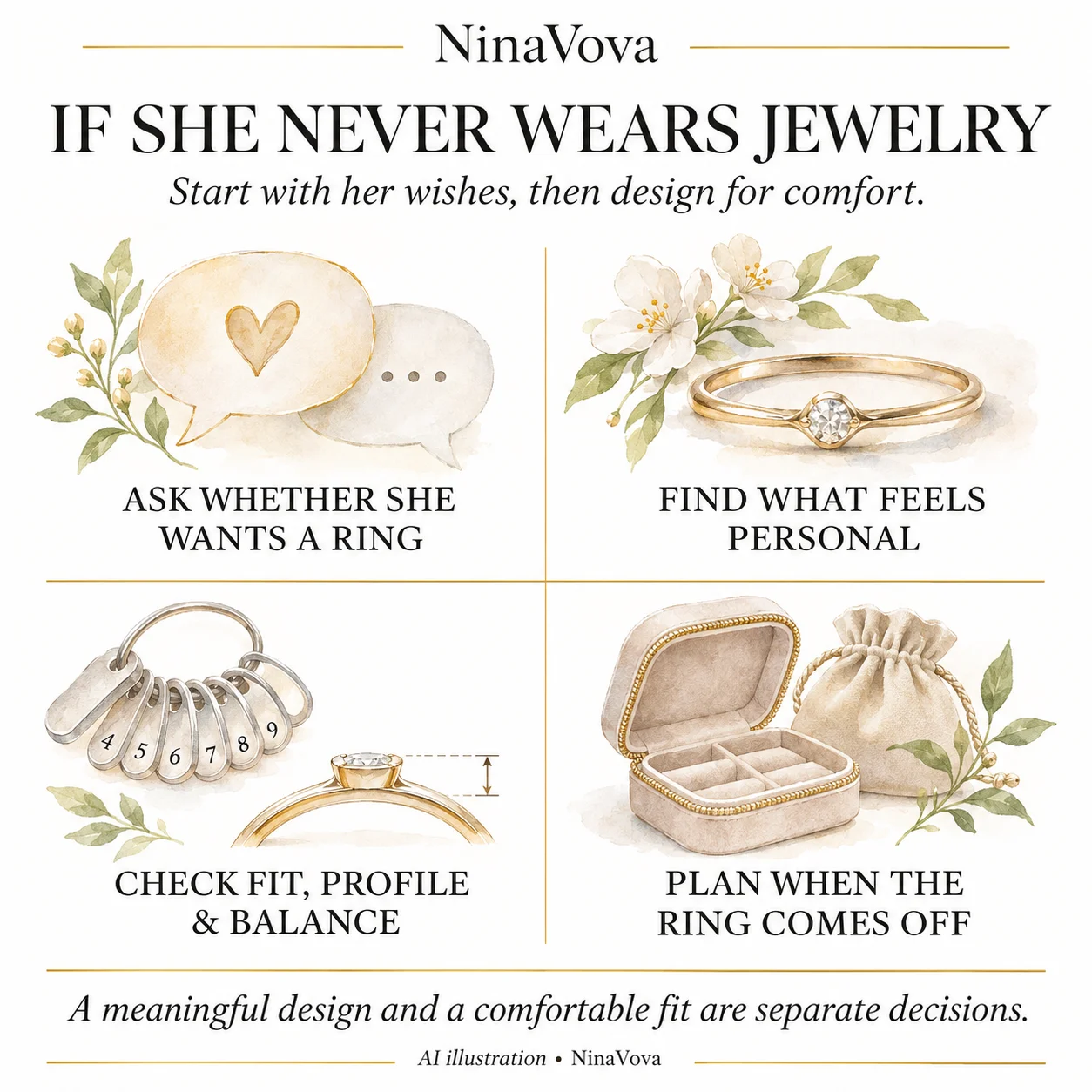
Find out whether they want a ring, then separate style from comfort. Rarely wearing jewelry does not tell you why. A meaningful design can address taste, while fit, profile, balance and finishing address how the ring feels. If your partner does not want a ring, respect that preference. Where a ring is wanted, choose a practical wearing plan alongside the design.
At a glance · Why doesn't she wear jewelry? · Find something she'll be excited about · What actually makes a ring comfortable? · Does she have to choose a bezel?
Watch the NinaVova discussion
Watch the original NinaVova video on YouTube.
Related NinaVova video: choosing the wrong ring explores preference and personal meaning. This article focuses on a partner who rarely wears jewelry.
Turn the concern into a useful design question
| Concern | Useful question | Possible direction |
|---|---|---|
| No interest in rings | Does your partner actually want one? | A ring, another meaningful object or no jewelry, according to their wishes. |
| Conventional styles feel generic | What do they already find beautiful? | A classic or personal design they are excited to wear. |
| Pressure or rubbing | Which surfaces and proportions feel intrusive? | Appropriate size, interior profile, smooth contact areas and balanced dimensions. |
| Spinning | Is size, knuckle shape or a top-heavy head involved? | Measure and assess balance before adding sizing features. |
| Snagging | What projects or catches in the actual design? | A smoother outline, well-finished details and appropriate maintenance. |
| Work and activities | When should it be removed? | Follow workplace rules and use secure storage rather than promise indestructibility. |
Why doesn't she wear jewelry?
Before we discuss diamonds, I'd want to know whether she's actually said she doesn't want an engagement ring, or whether you've simply noticed she never wears jewelry.
Some women don't buy jewelry for themselves but have thought about their engagement ring for years. Others like the idea but worry about daily wear. In discussions among women about rings, common complaints include pressure between the fingers, a stone turning sideways, prongs catching on sweaters, and having to think about an expensive object all day.
There are also women who don't want a flashy diamond or questions about how much it cost. Some work with gloves, exercise regularly, or fear losing a ring they'll need to remove.
And some simply find conventional engagement rings uninteresting. They may love beautiful objects and personal details, but not the usual diamond on a plain band.
Those aren't interchangeable concerns. A low bezel can help with snagging; it won't make an ordinary design exciting. A hidden personal detail might make a ring special; it won't solve a bad fit.
One question settles whether we should design a ring at all: does she want one? If she's clearly told you no, respect that. Ask whether she'd prefer a pendant, a wedding band, another meaningful gift, or no jewelry. Don't turn the proposal into an obligation to wear something she dislikes.
But if she's open to a ring, there's a lot we can do.
Find something she'll be excited about
I would start with what she already finds beautiful, even outside jewelry. Does she love nature, vintage illustration, fantasy stories, architecture, or a particular place you share? A custom ring can borrow a small detail from that world while still looking like an elegant engagement ring.
Suppose she enjoys a particular fantasy world. A subtle geometric pattern on the shoulders, a leaf or a tiny personal motif beneath the stone might carry that reference without turning the ring into a large literal symbol. The detail can be private while the overall design remains elegant.
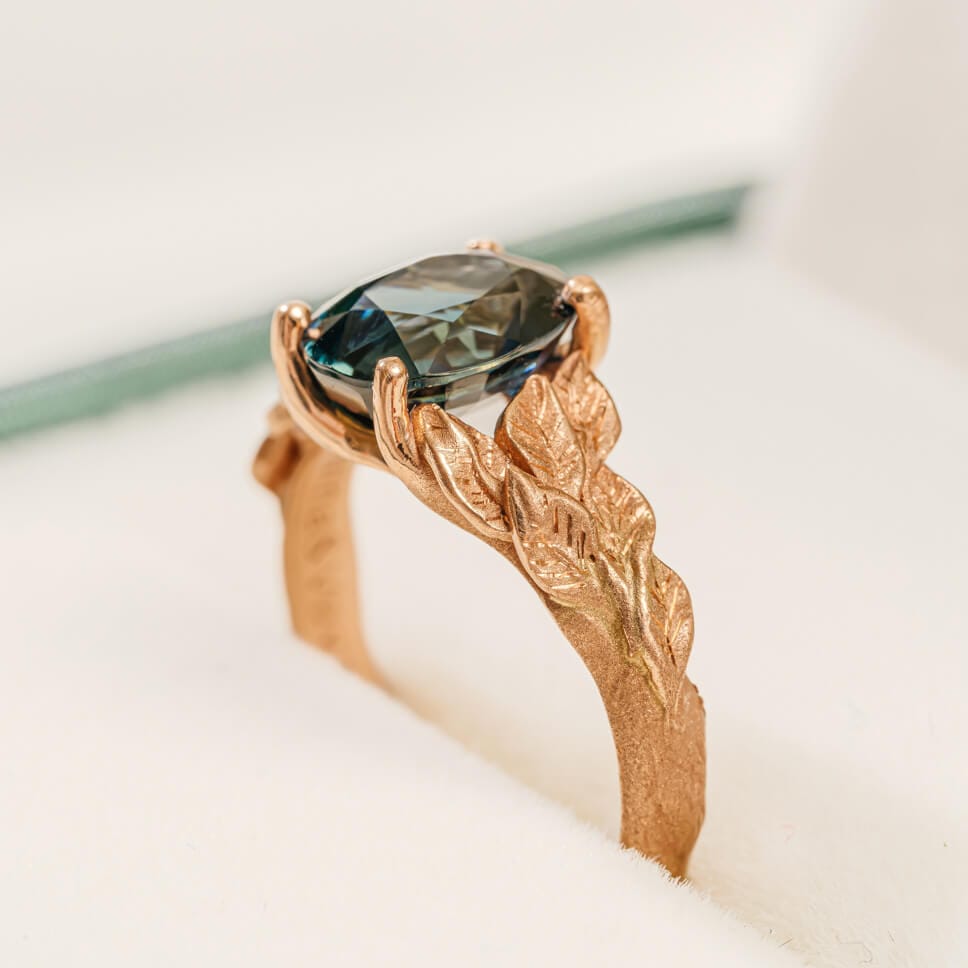
We have a real NinaVova project inspired by a couple's forest hikes. The ring featured a blue-green sapphire, a branch-like gold band, leaves, and a matte finish. Its design came from something important to them, not from adding decorations to a standard setting.
But personalization works only if she likes the result. Maybe she loves a particular fantasy world but doesn't want it referenced in her engagement ring. I'd rather learn that early than spend money making a clever design she never asked for.
So ask what she likes. A classic solitaire, a ring with nature-inspired engraving, a colored gemstone, or something minimal and modern? Show her a few different directions, or ask what she would change in the images she likes. The proposal can still be a surprise even if you know her taste.
If she's private, the personal reference can sit inside the band or beneath the center stone. If she wants the whole ring to be artistic, it can shape the shoulders or the way the metal curves. I generally prefer one meaningful detail executed well over five symbols competing for attention.
For an online custom project, you can send me reference images and describe what she responds to. You don't need to draw a ring yourself. We can work out which ideas translate into a beautiful, wearable design, and which would become bulky or fragile.
What actually makes a ring comfortable?
Now, what if she tells you she avoids rings because they're uncomfortable? Maybe rings she's tried felt bulky, spun around her finger, rubbed against the next finger, or caught on a sweater.
That gives me specific problems to address before we design anything. If she wants an engagement ring, comfort should be one of our priorities from the beginning.
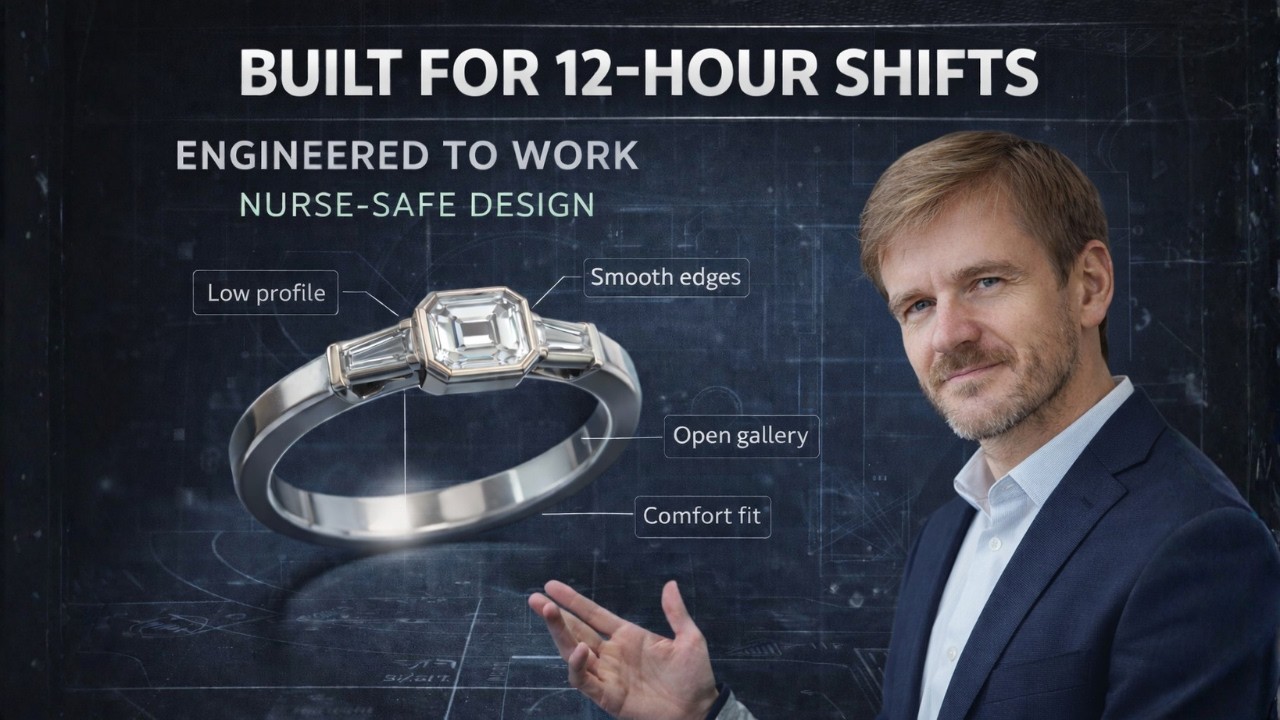
A custom ring can feel remarkably comfortable when several details work together: a rounded comfort-fit interior, a low-profile setting, smooth sides, correct sizing, and a light but strong construction. None of these features does the whole job alone.
Start with the inside of the band. Comfort fit means a gentle interior curve instead of a flat surface with pronounced edges. It can reduce pressure along the edges and make the ring feel smoother over the knuckle. But it won't fix the wrong size, and excessive band thickness can still feel bulky.
I'd also look at what touches her neighboring fingers. Exposed side diamonds or raised leaves may look beautiful from above but rub against adjacent fingers. We can keep the contact areas smooth and place personal details on the visible shoulders instead.
Band proportions matter too. For a simple solitaire around 1 ct, I might explore a band about 2 mm wide, assuming adequate thickness and support. With a 2–3 ct center stone, perhaps 2.2–2.5 mm or a band that widens near the head. These are starting points, not universal minimums. The stone, metal, finger size, and construction determine the final dimensions.
A big center stone on an extremely thin band can make the ring top-heavy and more likely to rotate. Just making everything thicker isn't a solution; I'd aim for balanced proportions.
For someone worried about snagging, I'd often start with a low-profile bezel setting. The metal protects the gemstone's edge without protruding prong tips, giving us a smoother outline. Combined with a properly sized comfort-fit band, this can make a ring much less intrusive during ordinary daily wear.
But a bezel isn't automatically low. The stone has depth, and we can't sink it arbitrarily close to the finger. In our CAD model, I can evaluate the setting height, band profile, balance, and areas that might cause discomfort. We can refine all these details before production to make the finished ring as comfortable as possible.
If she can tell you what specifically bothers her—pressure, spinning, or snagging—share that with me. We can design around the concern rather than hope she'll get used to it. If she dislikes any contact with her skin, though, I wouldn't promise that even a custom ring will change that.
Does she have to choose a bezel?
That smooth, low bezel is my practical starting point, but what if she loves the look of a traditional solitaire? Comfort shouldn't mean giving up the ring she wants. I'd rather make her prong design properly than talk her into a bezel she dislikes.
Prongs show more of the diamond's outline. They should be smooth, secure, and neatly finished against the stone. Their disadvantage is that the edge is more exposed, and a bent or damaged prong can catch on fabric. That's a maintenance issue we should acknowledge, not a reason to dismiss the entire style.
A half-bezel gives an open, modern look while leaving sections of the stone's edge exposed. A flush setting places a small stone within the band, so very little projects above the finger. But that needs enough metal around and beneath the stone and may require a wider, thicker shank.
If she loves a pear or marquise diamond, the pointed tips deserve additional protection. A properly designed prong or shaped bezel can cover those vulnerable areas without changing the shape she loves. I wouldn't rule out her favorite diamond shape because she's active; I'd first ask whether the setting protects it appropriately.
Whichever setting we choose, I would consider access for cleaning and future maintenance. Daily wear leaves lotion and dirt around a gemstone, especially underneath it. A design that allows the underside to be cleaned is more practical than an elaborate enclosed gallery with inaccessible corners. That's one of those details that rarely appears in a beautiful top-view picture, but matters once she owns the ring.
I'd choose the style she loves, then make the most comfortable version that the construction allows.

Stop the ring from spinning
There's another annoyance a smooth setting won't solve: the whole ring keeps turning on her finger.
It can be loose, the knuckle may be wider than the finger beneath it, or the center setting may be too heavy for the band.
I'd check the size and balance before adding anything. For certain fingers, sizing beads or a modified shank can help, but beads can be irritating to someone sensitive to jewelry. They're a tool, not my standard recommendation.
Because she owns no rings, you may not know her size. Don't guess using string or someone else's ring. We'll need reliable measurements with proper ring gauges, preferably close to the finished band's width and interior shape.
She should check how the gauge passes over the knuckle and how it sits at the base of her finger. If her hands swell noticeably with heat, one measurement may not reflect the whole day. Tell me about that before we settle on the final size. I can guide you through what measurements to obtain for our online design process.
If a proposal must be a complete surprise and the size is truly uncertain, consider a temporary proposal ring and finalize the permanent one once she has been sized. That also avoids committing to stones all around the band or continuous engraving that makes future resizing difficult.
There's a related decision: does she want to wear a wedding band alongside the engagement ring? Two bands change the overall width and feel, and a very low setting may leave a gap beside a straight band. We can design a contoured match, an intentional gap, or a single ring if that's her preference.
Keep it light, strong, and true to her style
Once the proportions and fit are settled, the metal itself can affect how noticeable the ring feels.
For someone sensitive to weight, I would compare suitable 14k gold designs with platinum options rather than choosing by prestige. Platinum alloys are generally denser than common gold alloys, but actual ring mass depends on the alloy and the amount of metal in the design. Compare the complete pieces or an informed weight estimate.
That does not mean removing metal until the band becomes weak. Keep enough support for the gemstone and intended wear. If the wearer has a known sensitivity to a metal, verify the actual alloy composition; a broad color or metal label is not enough information.
And if she dislikes flashy jewelry, we can keep the design visually restrained without making it generic. A smaller well-cut diamond, subtle engraving, or a personal motif could be much more meaningful than a large halo. If she loves a substantial traditional diamond, though, I wouldn't shrink it simply because she doesn't normally wear jewelry.
The gemstone also affects how high the finished design must sit. Two diamonds can have similar face-up widths but different depths. If the deeper one pushes the head higher, it may be the wrong choice when we're trying to keep the ring close to the finger. That's why I'd compare both the length and width and the depth of the actual stone before finalizing the setting, rather than relying on one attractive photo.
We choose the stone by how it looks in the planned ring, not by carat alone. Face-up dimensions in millimeters tell us more about visible size.
Reports provide measurements and grading details, while actual-stone photos and video help assess appearance. A close-up video can make a diamond look enormous, so I compare actual dimensions and how the stone sits in the design rather than relying on camera scale. If we're considering a colored sapphire, I also want to understand how its color appears under different lighting, not just one flattering image.
A report cannot tell you whether she'll find the diamond exciting. Natural and lab-grown diamonds, or sapphire if she genuinely likes color, are all possibilities.
Where I'd put the money is into the design she wants, a well-chosen center stone, comfortable proportions, and good finishing. I'd avoid paying for side diamonds, extra carat weight, or a heavier metal simply to make the ring sound more impressive.
Ask for a current written quote for the complete project, including the center, metal, setting work and any special details. An old starting price or an average cannot tell you what this particular design will cost.
Here's a useful way to think about that. With a $5,000 total budget, one direction could put roughly $1,000 into a simple setting and $4,000 toward the center diamond. Another could allocate around $2,000 to a more involved custom setting and $3,000 to the stone.
These are illustrations, not fixed quotes. Neither is automatically better. If what excites her is a recognizable personal design, I'd seriously consider the second approach. If she loves a classic solitaire and cares most about its diamond, the first may suit her better.
Your budget helps us decide which design and gemstone combination is realistic; individual quotes depend on the actual choices.
When she can't wear it all day
One last distinction matters. Comfortable doesn't mean suitable for every activity.
Healthcare workplaces have different jewelry rules, and rings must be removed for surgical hand preparation. Climbing, contact sports, heavy lifting, and work around machinery can also be situations where she should remove a ring rather than rely on a protective setting.
If she'll take it off at work anyway, I wouldn't compromise the appearance she loves to solve a problem no ring design can fully solve. She may happily wear it outside work, on weekends, or on special occasions.
Frequent removal brings a different risk: loss. A consistent secure place at home and a protective case when removal is unavoidable are worth planning. Don't leave an expensive ring beside a sink or loose in a pocket.
If she removes the ring several times a day, ask whether she'd be happier leaving it safely at home during those activities. Trying to design an indestructible ring for a situation where she shouldn't wear jewelry may cost more and still fail to solve the problem.
Jewelry insurance may be useful, provided the coverage actually includes the risks you're worried about.
How i'd help you design it
So if you contact me because your girlfriend never wears jewelry, don't worry about arriving with the perfect diamond specifications.
Tell me why she avoids rings. Is it comfort, attention, her job, or just a lack of interest in traditional designs? Tell me what she's genuinely excited by, show me any images she likes, and share your total budget and proposed date.
We can discuss the design remotely, narrow the stones I can source and work through the details together. You review the CAD before production. Confirm the current sourcing and production schedule, and leave time for decisions and revisions rather than assuming a fixed delivery interval.
For me, the goal is simple: she should be excited when she opens the box, and the ring should be comfortable enough that she enjoys putting it on. If she hasn't seen a ring that feels like her yet, that's precisely the kind of custom-design problem I'd love to help you solve.
Frequently asked questions
Does rarely wearing jewelry mean my partner wants a tiny diamond?
No. It can reflect comfort, attention, work, personal style or simply not buying jewelry. Ask what they would actually enjoy rather than inferring a preference from the absence of rings.
Will comfort fit solve the wrong ring size?
No. A rounded interior can change the feel, but size, width, thickness, balance and the wearer’s finger shape still need assessment.
Make the ring feel like the person
Tell us what your partner enjoys, what they find uncomfortable and how the ring would be worn. We can explore the style, stone and proportions together before production.
Book a NinaVova consultation or explore our custom design process.
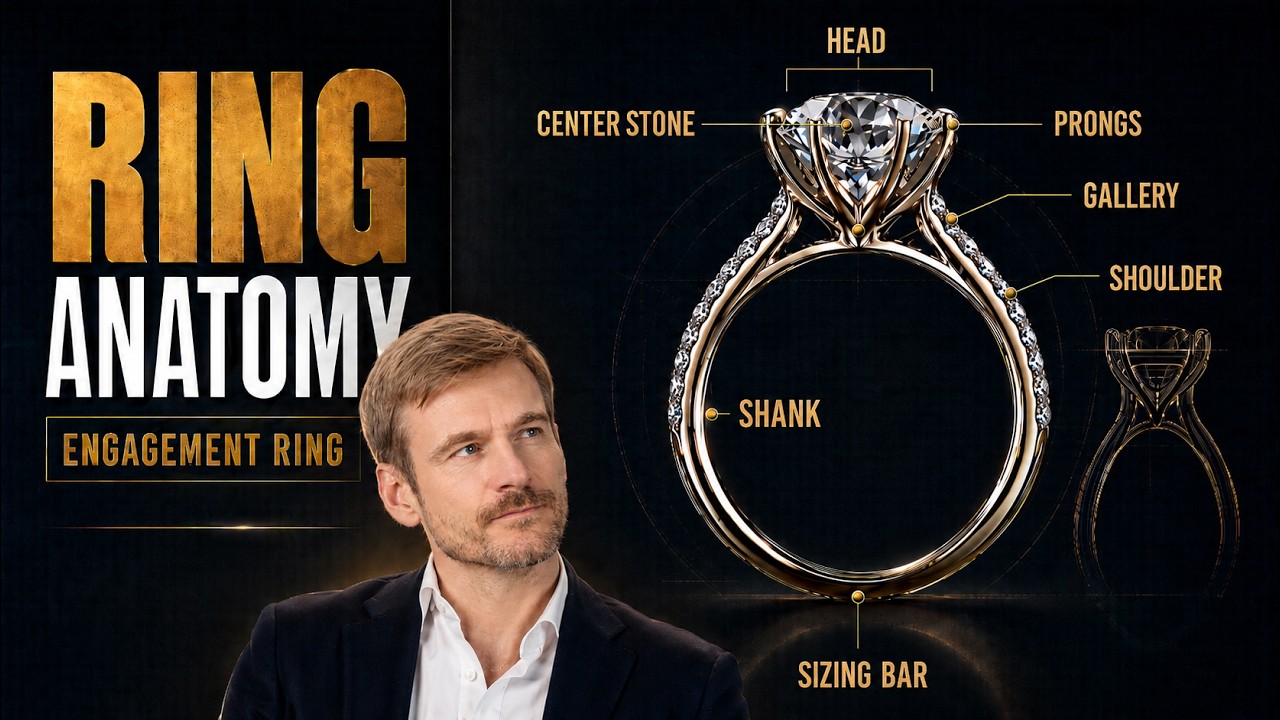
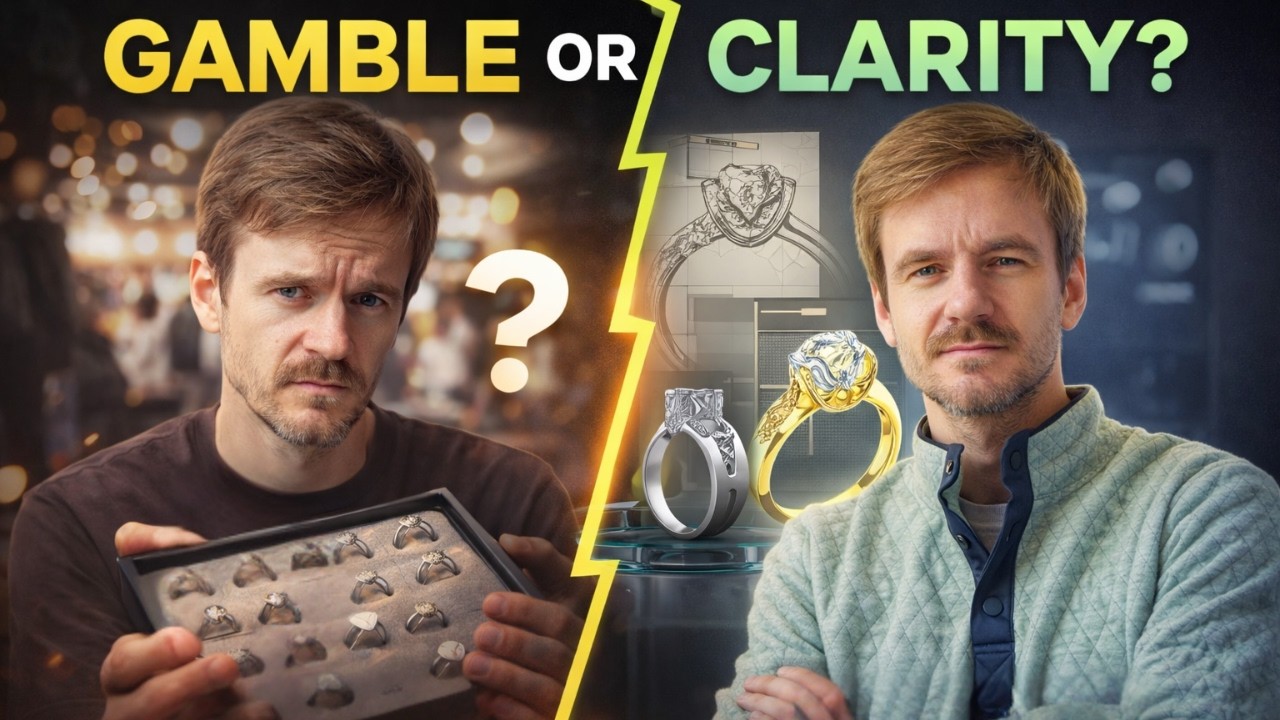
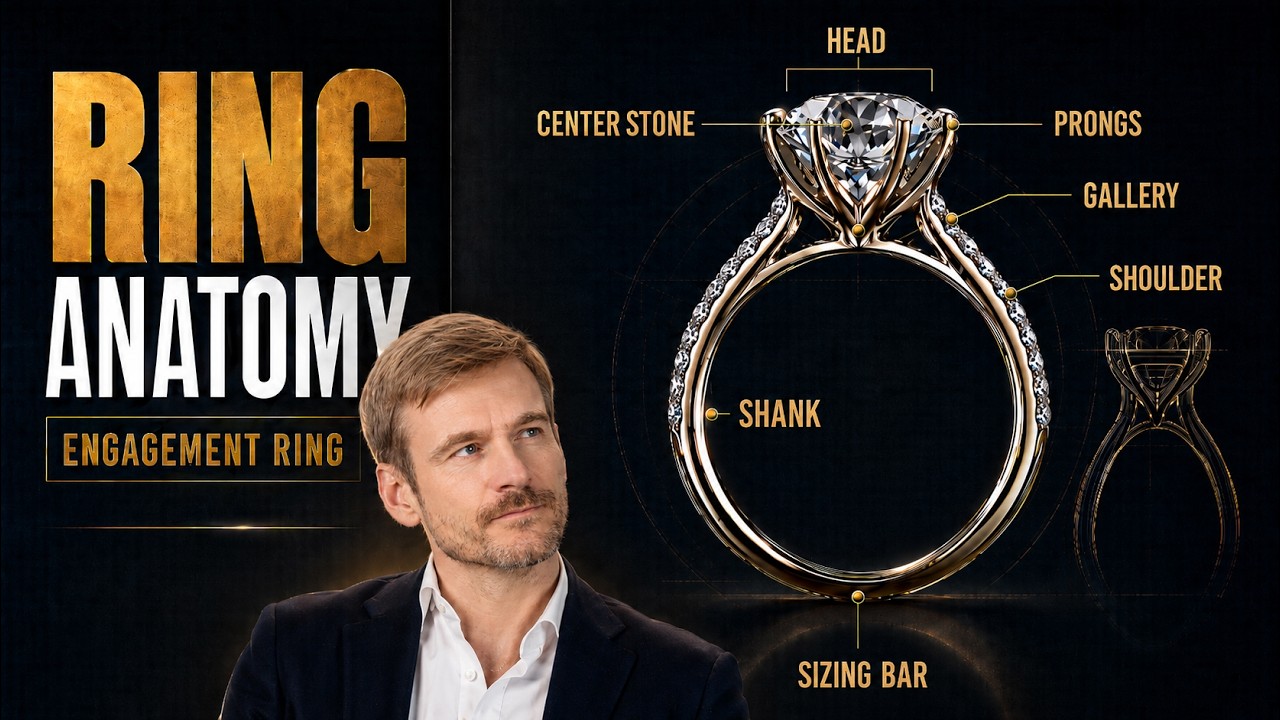
Continue reading: Engagement rings for nurses and workplace rules · Engagement ring anatomy · Designer versus custom rings.
Sources and further reading
- GIA: Accurate finger and ring sizing
- GIA: Ring size guide
- GIA: Setting types and styles
- GIA: Ring materials for everyday wear
- CDC: Clinical hand-hygiene safety
Budget allocations in the text are illustrations, not current fixed quotes. Confirm the actual alloy, fit, design scope, workplace rules and production timeline for the particular project.
Contact Sergey.
Have a question about ring settings, gemstones, or creating a custom ring? Send me a message and I’ll be happy to help.
Book a time to talk through the ring.
Meet remotely for a focused 30-minute call about your design, stones, timeline, and budget. No jewelry terms needed.
When you schedule the meeting, you can also include a short message before the call — the idea, budget, timeline, saved links, or anything you want us to know first.