
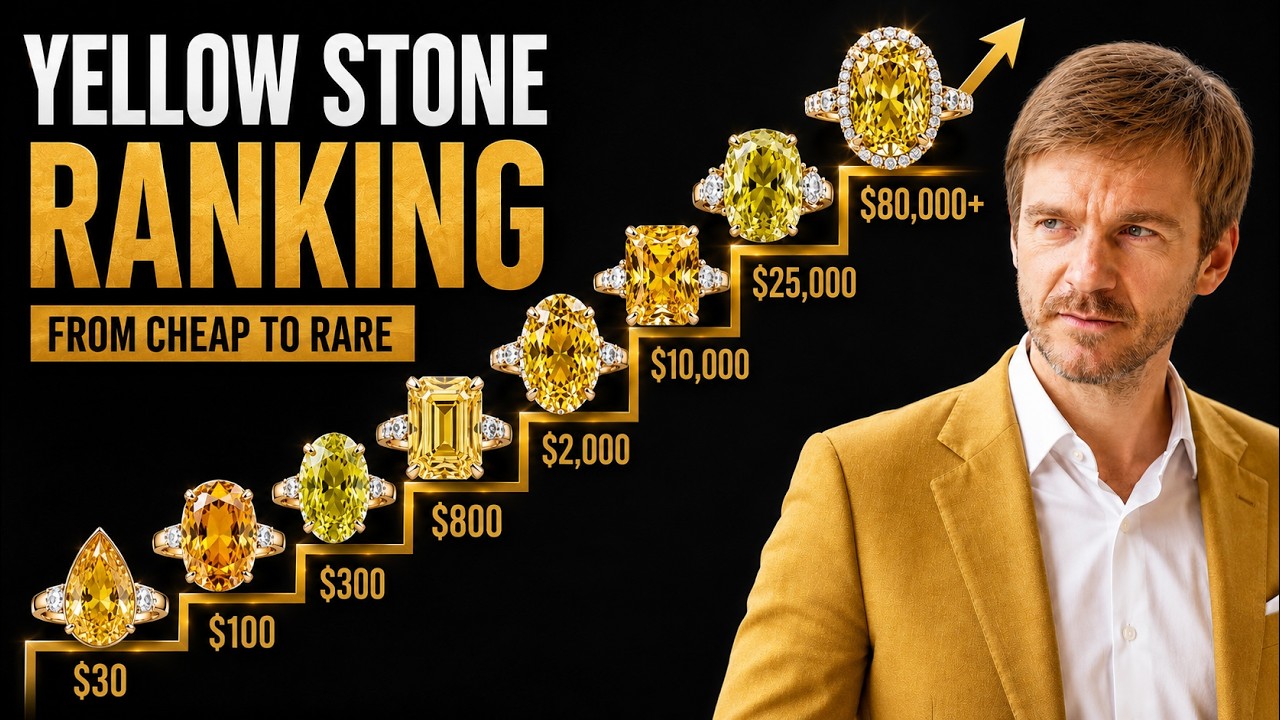
22 Yellow Gemstones for Engagement Rings: Color, Durability and Care

Most people think yellow engagement rings basically mean yellow diamond or yellow sapphire.
But yellow gemstones are a much wider category than that.
Some look like lemon light.
Some look like honey.
Some look like warm gold.
Some look slightly greenish, champagne, or golden-brown.
And some yellow stones can lean orange, especially in certain varieties.
This guide focuses on the yellow family.
Orange, peach, and champagne gemstones deserve their own separate video, so they call for a different comparison.
This guide compares 22 yellow gemstone options across a wide range of budgets and care requirements. It is not a fixed current price ranking; obtain current offers for the individual stones you are considering.
Including natural stones, artistic choices, collector gems, lab-created options, sapphires, and diamonds.
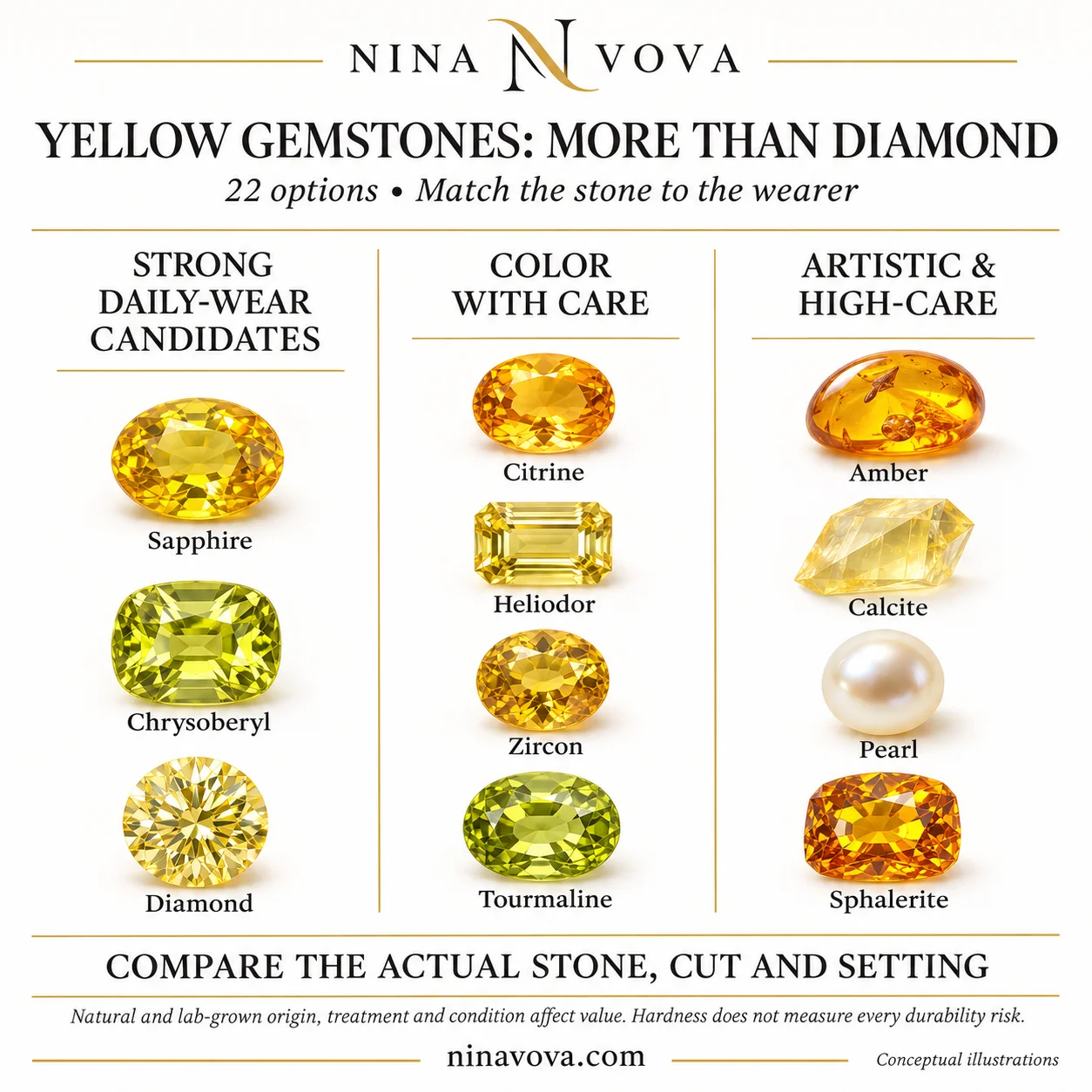
Similar yellow colors can demand very different care. Sapphire, chrysoberyl and diamond are strong starting points for many daily-wear designs. Citrine, heliodor, zircon and tourmaline bring other appearances and compromises. Amber, calcite, pearl and very soft collector gems suit more careful or occasional use.
At a glance · Honey Calcite · Citrine · Amber · Sunstone
Watch the NinaVova discussion
Watch the original NinaVova video on YouTube.
Compare yellow gemstone choices at a glance
| Direction | Examples | What to investigate |
|---|---|---|
| Stronger daily-wear candidates | Sapphire, chrysoberyl, diamond | Individual condition, cutting, treatment and secure setting. |
| Warm transparent color | Citrine, heliodor, yellow tourmaline | Color in everyday light, care habits and treatment disclosure. |
| Lively fire | Zircon, moissanite, sphene, sphalerite | Sparkle does not guarantee toughness; these materials differ greatly in wearability. |
| Soft glow and organic character | Amber, golden pearl, honey calcite | High care, protection from chemicals, heat and abrasion as appropriate. |
| Patterned diamond | Yellow-bodied salt-and-pepper diamond | Inspect transparency, fractures, points and color-treatment claims. |
| Lab-created options | Yellow sapphire, moissanite, yellow diamond | Verify identity and disclosure; buy for the ring rather than assuming resale gains. |
Honey Calcite
Honey calcite has a warm translucent glow.
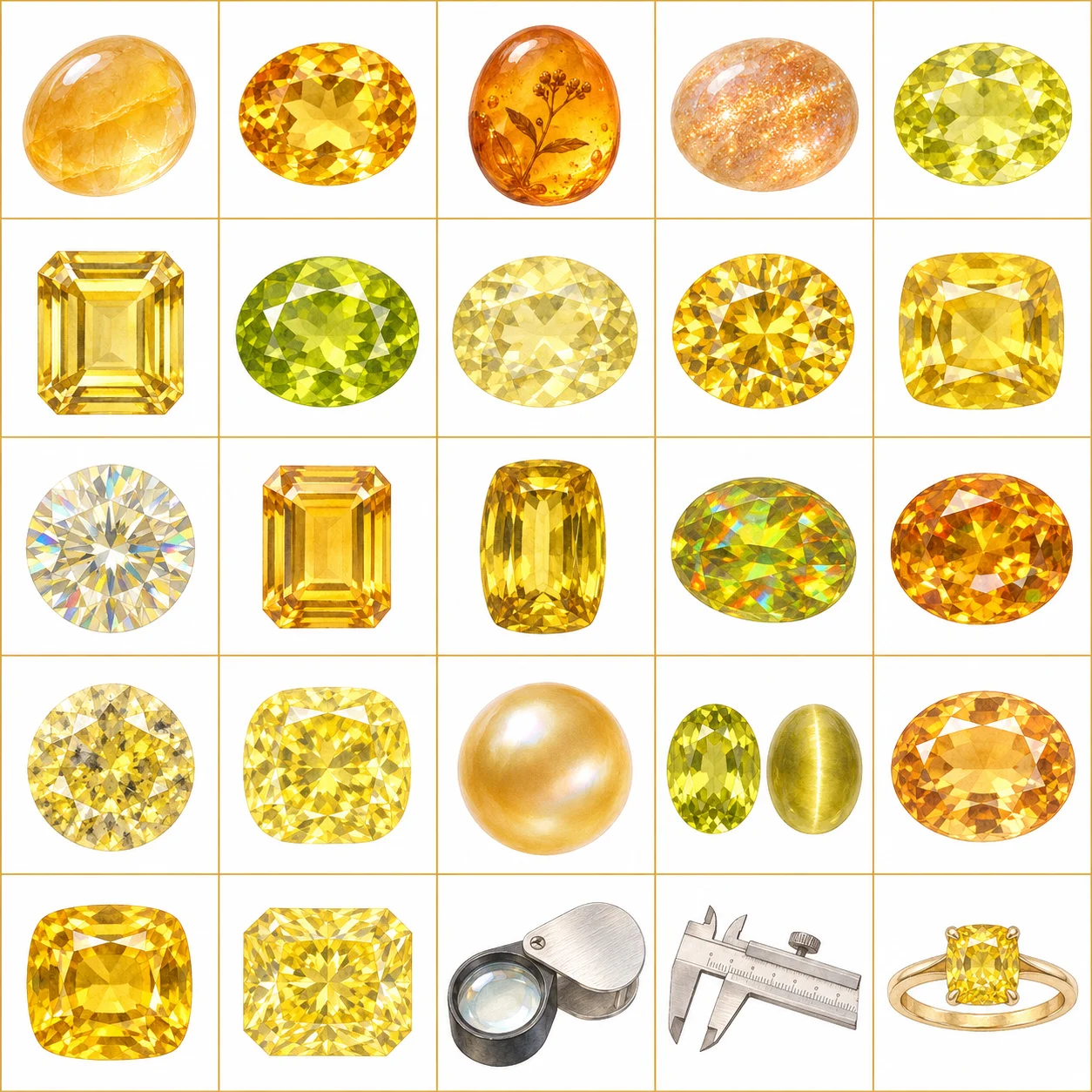
Good pieces can look almost like amber syrup inside the stone.
That is the attraction.
It gives you a soft honey-yellow feeling at a very low price.
But calcite is extremely soft, around 3 on the Mohs scale.
So this belongs here as a visual reference and an artistic choice.
If someone loves that honey glow, I would keep the design very protected and treat it like special-occasion jewelry.
Citrine
Citrine is probably the best-known affordable yellow gemstone.
It belongs because buyers actually see it everywhere.
The color can go from pale lemon to golden yellow, honey, and deeper Madeira tones.
Some citrine leans orange, but for this guide, we’re focusing on the yellow and golden side.
One thing buyers should know:
Natural citrine exists, but much of the citrine on the market is heat-treated amethyst.
That does not automatically make it bad.
It just means the price should make sense.
Citrine’s strength is simple:
warm color, large sizes, and accessible pricing.
Amber
Amber is not a mineral.
It is fossilized tree resin, sometimes tens of millions of years old.
That alone makes it different from most stones in this guide.
The most famous sources include the Baltic region and the Dominican Republic.
And the most fascinating pieces can contain ancient insects, plants, or organic remains trapped inside.
Those pieces feel almost like tiny paleontological objects.
Amber is soft and heat-sensitive, so I would be careful with it in a ring.
But historically, it is one of the most important golden materials ever used in jewelry.
Sunstone
Sunstone has one of the best names in the yellow gemstone world.
The beauty comes from internal flashes called aventurescence.
In Oregon sunstone, copper inclusions can create a glittering effect that almost looks metallic in the light.
That gives the stone a very different feeling from citrine.
Citrine is warm and clean.
Sunstone can look alive from inside.
Some sunstones lean peach, copper, or orange.
For engagement rings, sunstone needs more care than sapphire, but the visual effect is very distinctive.
Yellow Apatite
Yellow apatite can be surprisingly vivid.
Some stones have a bright lemon or neon yellow color that looks much more expensive than the price suggests.
That is why buyers notice it.
The tradeoff is durability.
Apatite is around 5 on the Mohs scale, so it scratches more easily than classic daily-wear ring stones.
I would think of yellow apatite as a color stone first.
It can be beautiful in a protected or occasional-wear design, especially if the buyer loves that electric yellow look.
Heliodor / Yellow Beryl
Heliodor is the yellow to golden variety of beryl.
And beryl is a very important gemstone family.
Emerald is green beryl.
Aquamarine is blue beryl.
Morganite is pink to peach beryl.
Heliodor is the golden member of that family.
The name means “gift of the sun.”
Visually, heliodor can feel clean, elegant, and warm without becoming too orange.
For engagement rings, this is one of the more serious affordable yellow options.
It has better durability than many stones before it, and large clean stones can still be relatively accessible.
Peridot
Peridot is usually treated as a green gemstone.
But many peridots sit right on the yellow-green border.
That is why it belongs here.
The color can feel like olive oil, lime, gold-green, or sunlight through leaves.
Peridot is also one of the few gems whose color comes from its own chemical composition.
And it has one of the best origin stories in gemstones.
Peridot has been found in lava, deep mantle rocks, meteorites, and even comet dust.
For rings, it is moderate-care.
But visually, it brings a natural yellow-green warmth that very few stones can copy.
Yellow Scapolite
Yellow scapolite is a quiet collector stone.
Most buyers have never heard of it.
The color is usually soft lemon, golden yellow, or slightly honey-toned.
It can be pretty, but it is not a mainstream engagement-ring stone.
The hardness is around 5.5 to 6, so I would keep expectations realistic.
It belongs here because yellow gemstone lovers may come across it in collector inventories.
For daily wear, I would put more trust in stronger stones later in the list.
Yellow Zircon
Yellow zircon is one of the most misunderstood stones in jewelry.
First:
Zircon is not cubic zirconia.
Natural zircon is a real gemstone, and yellow zircon can be beautiful.
The appeal is fire.
Good zircon has strong brilliance, strong dispersion, and double refraction.
That can make the stone look energetic, almost like liquid gold with extra movement inside.
Zircon is also one of the oldest minerals on Earth.
For engagement rings, I like zircon more than many people expect.
But I would still use care, especially around facet edges, because zircon can abrade over time.
Lab Yellow Sapphire
Lab yellow sapphire is real sapphire grown in a lab.
The important point is durability.
Sapphire is 9 on the Mohs scale, so this is one of the stronger yellow stones in the list.
Lab growth also makes clean, bright yellow material easier to find at a lower price.
The tradeoff is origin.
It is not a rare natural stone.
But if someone likes the yellow sapphire look and wants durability with better value, lab yellow sapphire can make sense.
It is especially useful when the design needs a specific size, shape, or clean color.
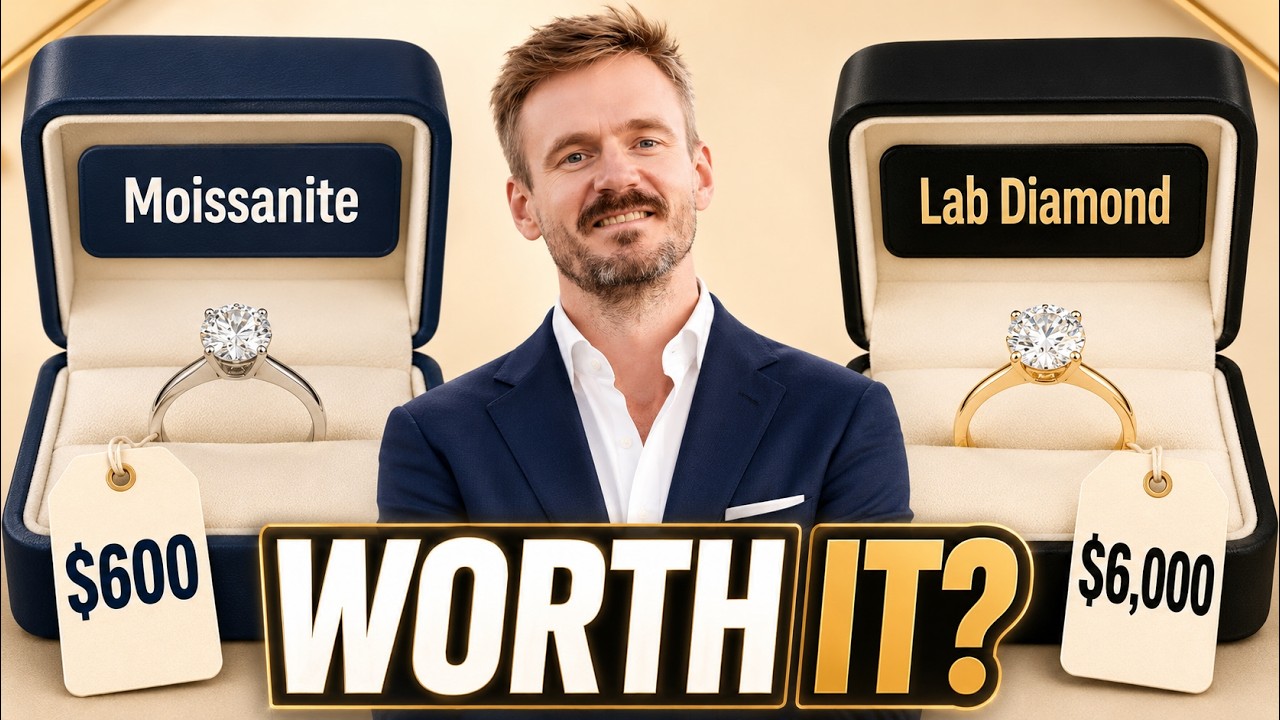
Yellow Moissanite
It is lab-created, durable, and very sparkly for the price.
Moissanite often shows strong rainbow fire, and in yellow material that can become very noticeable.
Some buyers love that bright effect.
Others prefer a softer natural gem look.
So I would not choose yellow moissanite just because it is affordable.
I would choose it if the buyer specifically likes strong sparkle, lab-created origin, and a contemporary style.
Yellow Topaz
Yellow topaz is separate from imperial topaz.
That distinction matters.
Many buyers know blue topaz, but topaz can also appear in warm yellow and golden tones.
Yellow topaz can look clean and bright.
It also has Mohs 8, so the scratch resistance sounds strong.
But topaz has cleavage, which means it can split from a hard blow in the wrong direction.
So the buyer takeaway is simple.
It can work, but the setting and lifestyle matter.
I would not treat Mohs 8 as the whole durability story.
Yellow Tourmaline
Yellow tourmaline is rare compared with pink, green, and blue tourmaline.
That makes it interesting.
The best stones avoid muddy brown or overly dark modifiers.
They feel golden, bright, and unusual.
Tourmaline has decent durability, around 7 to 7.5, so it can work with care.
The main appeal is personality.
Yellow tourmaline does not feel as formal as sapphire or diamond.
It feels more organic and individual.
For someone who already likes tourmaline as a gem family, this can be a very interesting warm-color choice.
Sphene / Titanite
Sphene, also called titanite, is one of the wildest sparkle stones in this guide.
Its dispersion is higher than diamond.
That means when it moves, it can throw strong rainbow flashes.
The colors usually sit between yellow-green, honey, golden, olive, and sometimes chrome green.
So why is it not everywhere?
Durability.
Sphene is soft for a ring, around 5 to 5.5 on Mohs.
It belongs here because the light performance is genuinely exciting.
But I would treat it as a collector or special-occasion stone, not a low-maintenance engagement-ring material.
Sphalerite
Sphalerite takes the fire conversation even further.
Its dispersion is extreme.
In some stones, the flashes can look almost unreal.
Colors can be amber, cognac, caramel, golden brown, or honey.
But sphalerite is even softer than sphene.
Around 3.5 to 4 on Mohs.
So this is not a practical daily ring stone.
It belongs because it shows how dramatic yellow collector stones can become.
For a ring, I would only consider it in a very protected, occasional-wear design.
Salt and Pepper Yellow Diamond
Salt and pepper yellow diamond is a very different kind of yellow diamond.
This is not the clean, bright, fancy yellow diamond most people imagine.
The beauty comes from the inclusions.
Black, white, gray, and sometimes cloudy internal patterns can give the stone a smoky, earthy, one-of-a-kind look.
When the body color is yellow, the result can feel warm, antique, and very personal.
Almost like a tiny landscape inside the stone.
The advantage is price and character.
You can get a natural diamond with a yellow tone for much less than a fine fancy yellow diamond.
But the tradeoff is important.
The inclusions are the look, but they can also affect transparency, sparkle, and sometimes durability.
So I would not buy one only because it says diamond.
I would look at the actual pattern, the surface-reaching inclusions, and how the stone will be protected in the setting.
For the right person, salt and pepper yellow diamond can be a beautiful custom-ring stone.
Not because it is perfect.
Because it is interesting.

Lab Yellow Diamond
Lab yellow diamond gives buyers access to the fancy yellow diamond look at much lower pricing than natural fancy yellow diamond.
The diamond is grown in a lab, so the origin and value logic are different.
But the practical appeal is clear.
You can get strong color, diamond hardness, and often more size for the money.
One issue to consider is resale uncertainty.
I would buy a lab-grown diamond for its appearance and the ring itself, rather than assuming it will retain a particular resale value. Confirm any actual buyback offer or written terms separately.
If the goal is a bright yellow diamond look with moderate pricing, lab yellow diamond is a practical option.
Golden South Sea Pearl
Golden South Sea pearl is one of the most luxurious organic materials in the yellow family.
It is not priced by carat.
It is priced by size, shape, luster, surface quality, and color.
The natural golden color comes from the gold-lip variety of the Pinctada maxima oyster.
The best sources include the Philippines and Indonesia.
Large round pearls with rich golden color can become very expensive.
For engagement rings, the logic is similar to white pearl.
Beautiful.
Romantic.
Special.
But high-care.
It works best when the wearer understands pearl jewelry is delicate.
Chrysoberyl
Chrysoberyl is one of the strongest yellow-golden stones in the list.
Most buyers know alexandrite, but alexandrite is actually a variety of chrysoberyl.
Normal yellow to golden chrysoberyl is far less famous.
And that is why it is interesting.
It can be lemon yellow, honey, golden, or greenish yellow.
It has excellent hardness at 8.5 on Mohs.
That makes it more practical than many yellow stones buyers usually hear about.
Cat’s-eye chrysoberyl is especially famous because of the sharp glowing line that moves across the stone.
If someone wants a durable natural yellow gem that still feels uncommon, chrysoberyl deserves attention.
Imperial Topaz
Imperial topaz is one of the richest-looking stones in the warm yellow family.
The color can be golden, honey, peach, orange, pinkish orange, or even reddish.
For this guide, the important part is the golden-yellow side.
That is where imperial topaz can feel warm, elegant, and almost glowing, especially in yellow gold.
Historically, the finest material is associated with Brazil, especially the Ouro Preto area.
And unlike most blue topaz, where the color is usually produced by treatment, fine imperial topaz is valued for its natural warm color.
The practical note is durability.
Topaz has good scratch resistance, but it also has cleavage.
So for an engagement ring, I would avoid overly exposed settings and make sure the design protects the stone properly.
Yellow Sapphire
Yellow sapphire is one of the major serious choices for yellow engagement rings.
It has the durability that many softer yellow stones do not.
And the color range is wide.
Some stones are pale lemon.
Some are golden.
Some are deep canary yellow.
Sri Lanka has historically been one of the most important sources.
Treatment matters a lot here.
Heat treatment is common.
Beryllium diffusion can also create or alter yellow and orange colors.
So if the stone is expensive, or sold as untreated, I want a respected lab report.
For daily wear, yellow sapphire is one of the most practical natural yellow stones.
Yellow Diamond
And finally, yellow diamond.
This is the classic expensive yellow benchmark.
The color comes from nitrogen in the diamond crystal structure.
And intensity matters.
A light yellow diamond and a Fancy Vivid Yellow diamond are not the same market.
Fancy Intense and Fancy Vivid yellows can become dramatically more expensive, especially in larger sizes.
The most famous example is the Tiffany Yellow Diamond.
A 128.54-carat yellow diamond that became one of the most recognizable colored diamonds in the world.
For engagement rings, yellow diamond offers durability, brilliance, and prestige.
But I would still focus on the actual color and cut, not just the word “yellow.”
That is why yellow diamond stays at the end of this list.
Not because every yellow diamond is automatically the best choice.
But because it is still the main reference point for rarity, durability, sparkle, grading, and long-term tradition in yellow engagement rings.
Choose the stone for the person and the design
And that brings us to the real point of the video.
The better question is not only:
which yellow stone is best?
The better question is:
which one fits the person and the design?
In a custom engagement ring, the stone is not just a material.
It becomes part of the design language.
It should fit the lifestyle, the setting, and the personality of the person wearing it.
Citrine, sunstone, pearl, chrysoberyl, sapphire, topaz, moissanite, and diamond can all be yellow stones.
But they do not tell the same story.
Some feel soft and golden.
Some feel bright and clean.
Some feel artistic.
Some feel modern.
Some feel rare and formal.
Some feel warm, personal, and quiet.
So I would not choose only by price, hardness, or popularity.
Those things matter.
But they are not the whole decision.
Choose the stone that makes sense for the ring you are actually creating.
Before you buy, learn how that specific material behaves in real life.
Because yellow gemstones can look close in a simple chart.
But on the hand, they wear differently, glow differently, sparkle differently, and create very different rings.

Frequently asked questions
Is the hardest yellow gemstone automatically the safest choice?
No. Scratch resistance, resistance to chipping or splitting, stability, existing fractures and the setting all contribute to durability.
Should every yellow diamond be treated as a Fancy Yellow diamond?
No. A warm yellow body color, an included yellow diamond and a laboratory-graded natural fancy-color diamond can belong to different value categories. Verify the specific identity and color claims.
Choose the yellow that belongs in the finished ring
We can help compare the glow, sparkle and practical care of different materials, then design around the color and character you want.
Book a NinaVova consultation or explore our custom design process.
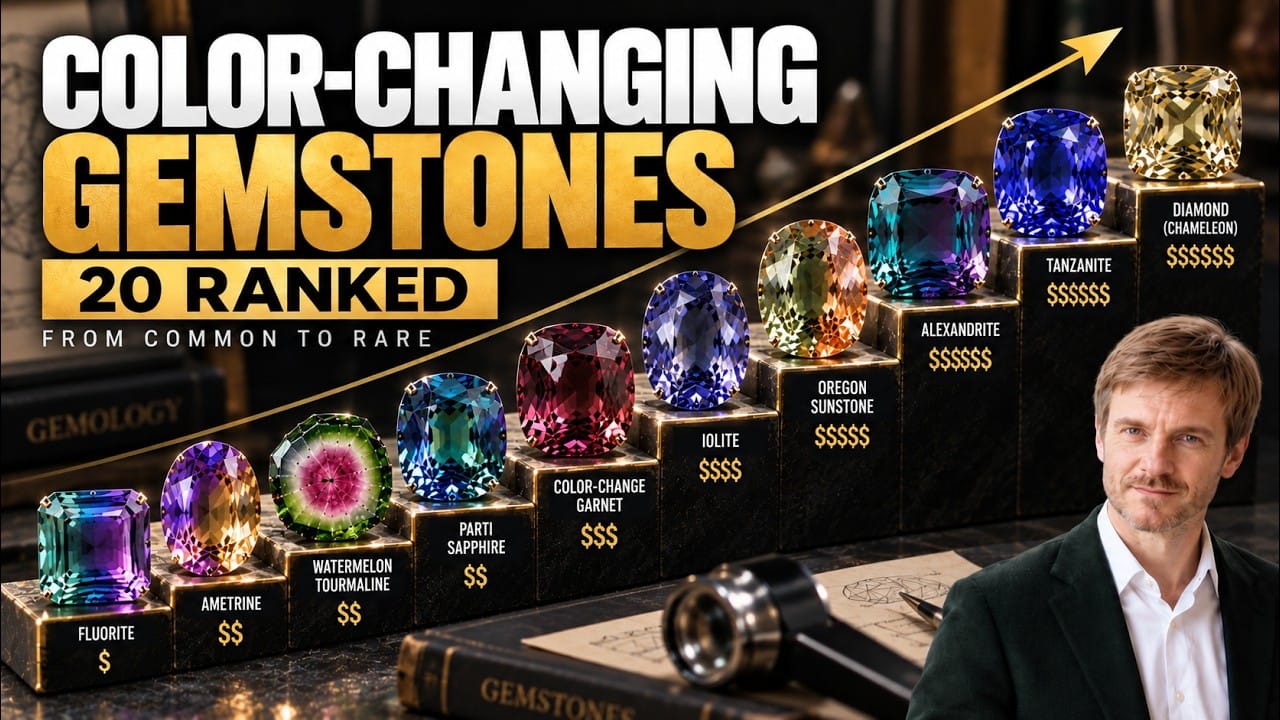
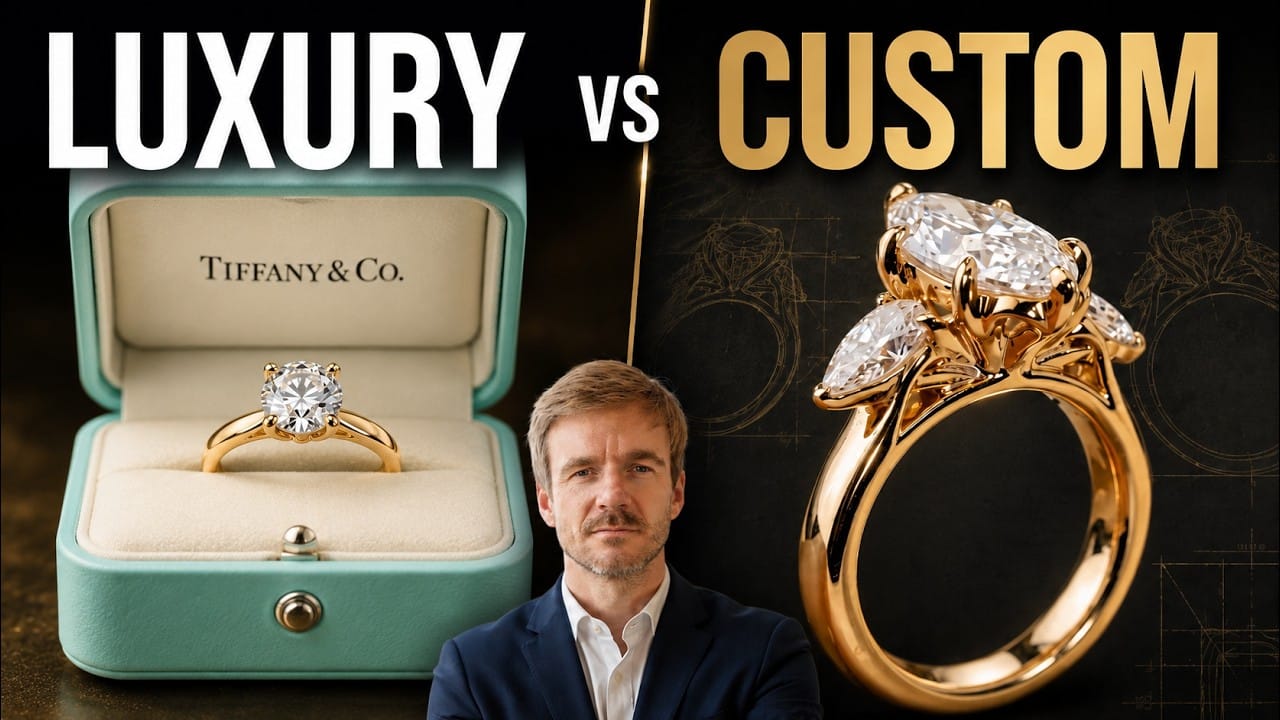
Continue reading: Bi-color and color-change gemstones · Designer vs custom engagement rings.
Sources and further reading
- GIA: More than the Mohs scale
- GIA: Introduction to gem treatments
- GIA: Colored gemstone engagement rings
- GIA: Protecting diamonds from chipping
- GIA: Diamond treatments
- Smithsonian: Sunstones
Availability, prices and service terms can change. Evaluate the individual stone and confirm the current written terms before ordering.