
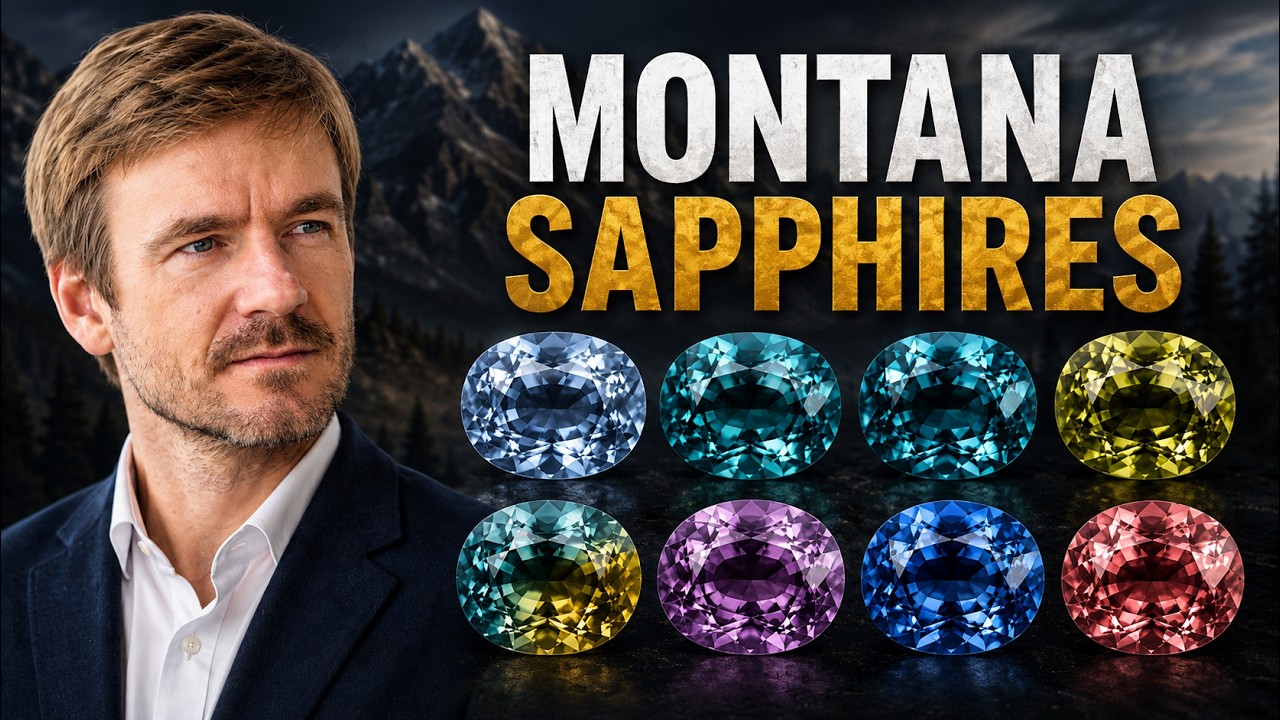
Montana Sapphire Engagement Rings: Color, Yogo, Treatment and Cut

Most buyers come to Montana sapphire for one reason: color.
Not just blue.
Montana sapphire can be teal, blue-green, gray-blue, yellow-green, lavender, purple, yellow, orange, pink, or parti-colored.
That color range is what makes these stones interesting for engagement rings.
It can help you design around a place, a memory, a specific eye color, or a more natural-looking ring.
But it also makes shopping more confusing.
Two stones can both be called Montana sapphire, and one can be bright, lively, and beautiful, while the other is dark, gray, poorly cut, or overpriced.
So the real question is not, “Is Montana sapphire good?”
The real question is, “Which Montana sapphire is actually good enough for an engagement ring?”
Here is how I would approach choosing one.
Color, treatment, cut, durability, price, Yogo sapphires, and the real situations where Montana sapphire makes sense for an engagement ring.
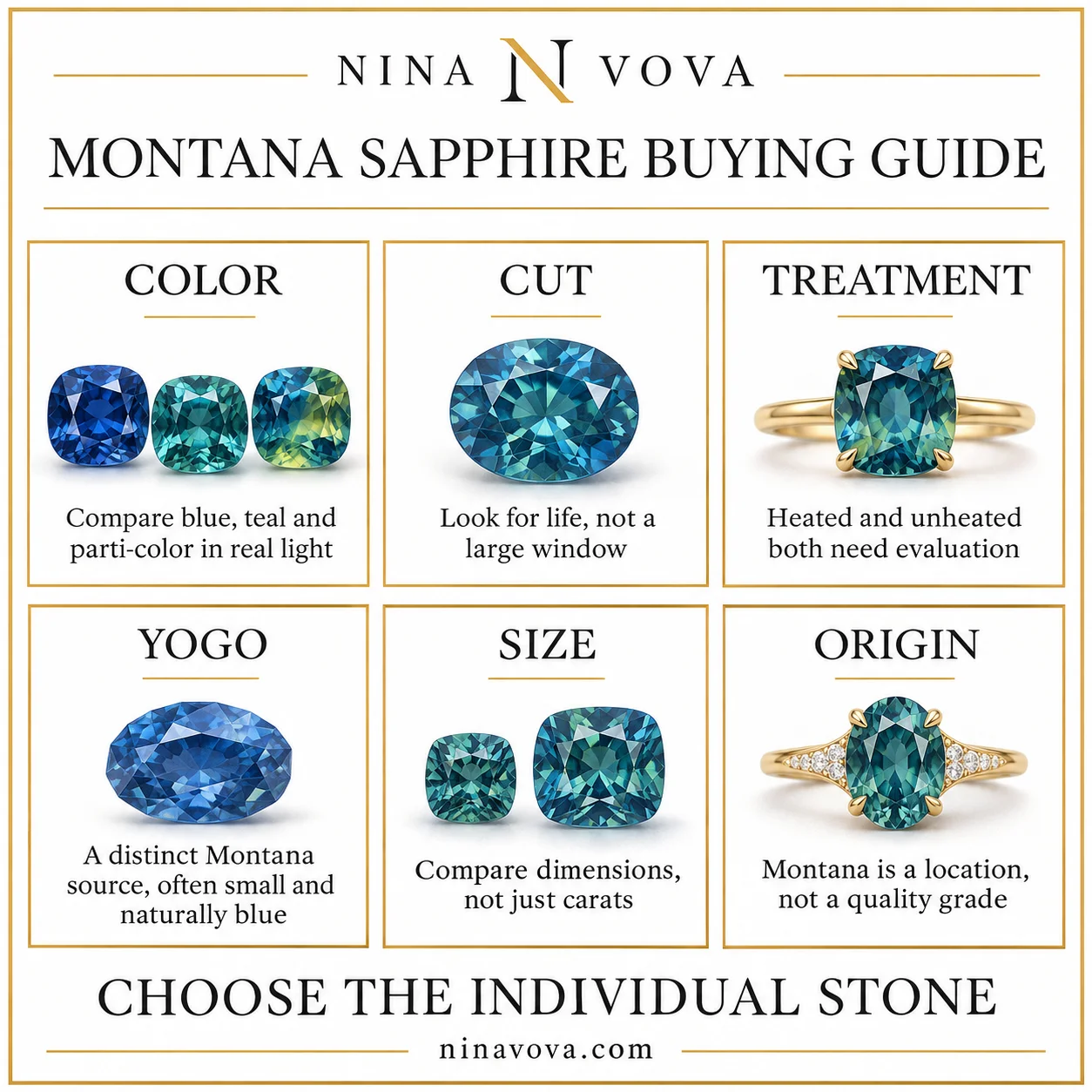
Montana is an origin, not a quality grade. Start with the color and cut in ordinary lighting. Then consider treatment, size and documented origin. Yogo is a distinctive Montana source, with attractive naturally blue material commonly found in smaller sizes.
At a glance · What “Montana sapphire” actually means · Color is the main reason to choose Montana sapphire · Yogo sapphire: the famous Montana sapphire, but not the same thing · Heat treatment: why the label is not enough
Watch the NinaVova discussion
Watch the original NinaVova video on YouTube.
Montana sapphire choices at a glance
| Choice | Why consider it | What to verify |
|---|---|---|
| Teal or blue-green | Nature-inspired color and personal associations | Enough brightness and saturation in indoor light. |
| Light blue or gray-blue | A quieter blue appearance | The balance of blue and gray after setting. |
| Parti-color | Two or more visible color zones | Attractive face-up zoning, movement and ordinary lighting. |
| Yogo | A distinctive Montana origin and often even blue color | Documented source and realistic finished-size expectations. |
| Heated | Color improvement may make a strong ring stone | Clear treatment disclosure and quality of the actual result. |
| Unheated | Documented rarity may matter to some buyers | An attractive stone first, with a premium justified by evidence. |
What “Montana sapphire” actually means
When most buyers hear Montana sapphire, they imagine one specific stone.
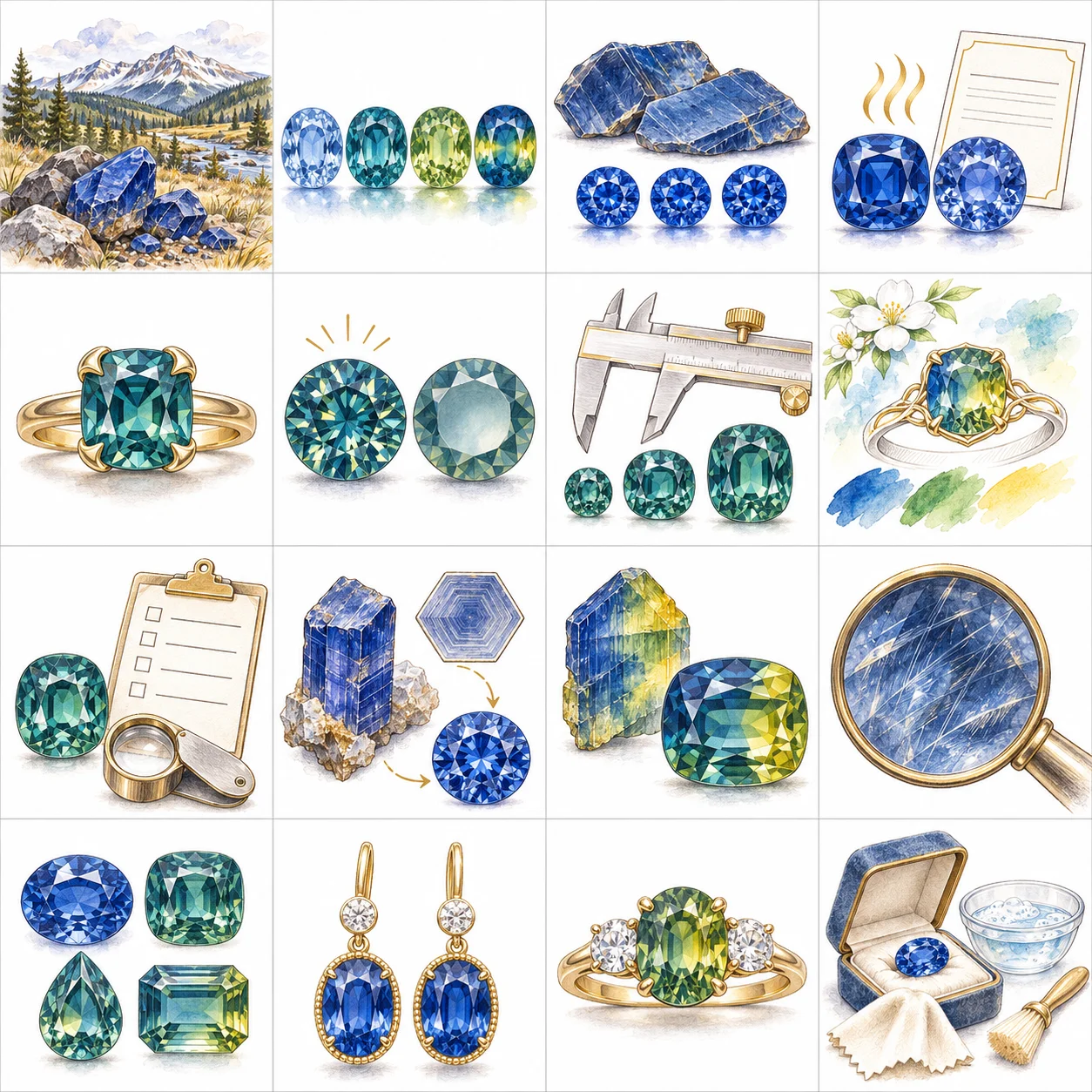
But Montana sapphire usually refers to sapphires mined in Montana from areas like Rock Creek, Missouri River, and Dry Cottonwood Creek.
Yogo sapphire is also from Montana, but Yogo is its own separate category.
That distinction matters.
Not every Montana sapphire is Yogo.
Not every Montana sapphire is unheated.
And not every Montana sapphire has the same value.
This is where buyers get confused.
Montana is the origin.
It is not a quality grade.
It does not automatically tell you the color is beautiful.
It does not tell you the stone is well cut.
It does not tell you the price is fair.
You still have to judge the actual sapphire.
And the first thing I would judge is color.
Color is the main reason to choose Montana sapphire
Color is where Montana sapphire becomes interesting.
If you want classic blue, Montana can give you softer blues and gray-blues.
These are not always the deep royal blues people imagine with traditional sapphire.
They can feel lighter, quieter, and less formal.
That can be a good thing.
For someone who wants a blue engagement ring but does not want it to feel too traditional, a softer Montana blue can work beautifully.
Then you have teal and blue-green.
This is probably the color range most people now associate with modern Montana sapphire rings.
A good teal Montana sapphire can feel like mountain water.
It can look incredible in yellow gold.
It works very naturally with hand engraving, leaves, branches, floral details, and organic custom designs.
But I would be careful with the word “teal.”
Teal can be beautiful.
Teal can also be too dark, too gray, too green, or flat in normal lighting.
The color name does not choose the stone for you.
Then there are green and yellow-green Montana sapphires.
These can be earthy, unusual, and very personal.
But this range can also become muddy if the color is weak.
A green-yellow sapphire can be beautiful if it has life.
If it turns too olive, gray, or dull, I would not force it just because it is Montana.
Parti-color Montana sapphires are another reason buyers love this material.
A parti sapphire can show more than one color in the same stone.
Blue and green.
Blue and yellow.
Green and yellow.
Sometimes the color changes depending on the angle.
That can make the stone feel very personal.
But with parti-color stones, I never want to judge from one perfect photo.
I want video.
I want different lighting.
I want to see how the colors move.
Because a parti sapphire can look magical.
Or it can look confused if the color zones are poorly placed.
Yogo sapphire: the famous Montana sapphire, but not the same thing
Yogo sapphire is the famous name inside the Montana sapphire world.
It is called Yogo because it comes from Yogo Gulch in central Montana.
And it is different from most Montana sapphires buyers see on the market.
Most Montana sapphires come from gravel deposits, where the crystals were carried and rounded by water over time.
Yogo is different.
The sapphires were traced back to their original hard-rock source: an igneous dike near Yogo Gulch.
That is one reason Yogo gets separated from the broader Montana sapphire conversation.
The other reason is color.
Yogo sapphires are known for blue to violet-blue color that often comes out of the ground already attractive.
With many sapphires, heat treatment is used to improve the color.
With Yogo, the gem-quality stones are generally not heat treated because the color is already there, and the material usually does not respond much to heat treatment anyway.
That is a big part of the appeal.
A Yogo sapphire is usually not about wild teal, green-yellow, or parti-color personality.
It is more about a clean, even, naturally blue Montana sapphire.
That sounds perfect, but here is the tradeoff.
Yogo rough is often thin and flat.
That means cutters usually cannot get large finished stones from it.
So if you want a small blue sapphire with Montana history, Yogo can be very interesting.
But if you want a large engagement-ring center stone, especially 1.5, 2, or 3 ct, Yogo becomes difficult very quickly.
The size is limited.
The supply is limited.
And the price can rise fast because the story is strong and larger stones are rare.
So I would not treat Yogo as “the best Montana sapphire” for every ring.
It is more specific than that.
Choose Yogo if you want a smaller, historic, naturally blue Montana sapphire and that origin story is part of the reason you want the ring.
But if you want a larger center stone, a teal color, a blue-green color, a parti-color stone, or more design flexibility, I would look at other Montana sapphires first.
Heat treatment: why the label is not enough
With Montana sapphire, treatment matters, but it should not become the whole decision.
A lot of Montana sapphires are heated because the rough often comes out lighter, greener, or less attractive than the finished stones people want in engagement rings.
Heat can improve the color and make the sapphire more marketable.
That is normal in the sapphire world.
But it also means the buyer has to separate two things:
the beauty of the stone
and the story being sold around it
Unheated Montana sapphire can be more desirable when the color is already strong, the stone is well cut, and the price reflects genuine rarity.
But “unheated” alone is not enough.
An unheated stone can still be gray.
It can still be too dark.
It can still have a window.
It can still look flat once it is set.
On the other side, a heated Montana sapphire can be a very strong choice if the color is beautiful, the treatment is disclosed, and the price is honest.
So I would not start with heated versus unheated.
I would start with the stone.
Does it have a color you actually want?
Does it stay attractive in normal lighting?
Does it have life when it moves?
Is the cutting helping the color, or fighting it?
After that, treatment becomes part of the value conversation.
For an expensive Montana sapphire, especially one sold as unheated, Yogo, or with a specific origin premium, I want a respected lab report.
Durability: good for daily wear, but design still matters
One of the strongest reasons to choose Montana sapphire and sapphire overall is durability.
Sapphire is corundum.
It is one of the best colored stones for engagement rings.
Compared with softer stones like morganite, opal, moonstone, tanzanite, or many other alternatives, sapphire is much more practical for daily wear.
But durability does not mean the ring can be careless.
The stone is durable.
That does not mean every setting is durable.
If the sapphire has sharp corners, protect them.
If it is an elongated cushion, hexagon, kite shape, or unusual cut, think carefully about prong placement.
With Montana sapphire, I would build the setting around the actual stone.
If the sapphire is bright and lively, you have more freedom. A bezel or partial bezel can still work beautifully.
But if the stone is on the darker side, I would avoid a heavy, closed setting.
With a darker sapphire, I would compare proposed settings carefully and test how the stone faces up in each. An open gallery can support cleaning and inspection, but it does not cure an overly dark tone or poor cutting.
The stone’s tone, cut and surrounding metal must work together.
So the setting is not just a design choice. It has to support the specific stone you chose.

Cut and brilliance: where many pretty stones fail
Two Montana sapphires can have the same color name, but one looks alive and the other looks flat.
That usually comes down to cut, tone, and how the color sits inside the stone.
A sapphire can have a beautiful listing description and still look sleepy because of windowing.
A window is when you can see through the middle of the stone instead of seeing color and reflection.
It can also look dead because of extinction.
That means areas of the stone go too dark or almost black.
Too much gray can make the color feel weak.
Too dark of a tone can make the stone lose life.
Poor cutting can make the stone look flat.
Uneven color placement can make the face-up view feel unbalanced.
Some Montana sapphires also show color zoning.
That can be beautiful when the cutter uses it well.
For example, some heated Rock Creek stones can show brighter color concentrated toward the center.
In the right stone, that gives personality.
In the wrong stone, it can look uneven.
This is why I do not want to buy Montana sapphire from one perfect photo.
I want video.
I want different lighting.
I want to see the stone moving.
A good Montana sapphire should not only have a pretty color name.
It should look alive on the hand.
Size and price: where expectations need to be realistic
Montana sapphire pricing can vary a lot.
A small heated stone with softer color is not the same category as a fine unheated stone with excellent color.
A regular Montana sapphire is not the same thing as Yogo.
A poorly cut teal stone should not be priced like a beautifully cut teal stone just because both listings use the same color word.
Price depends on color, size, cut, clarity, treatment, origin documentation, and rarity.
For most engagement rings, the realistic sweet spot is often around 1 to 2 ct.
Above 2 ct, the search becomes more selective.
Above 3 ct, you should expect more compromise, a much higher price, or both.
That does not mean larger Montana sapphires do not exist.
They do.
But if you want large size, strong color, good cut, clean appearance, and a fair price all at the same time, the search becomes harder.
This is where I would be practical.
I would not overpay for the word “Montana” if the stone itself is dark, gray, poorly cut, or lifeless.
And I would not reject a heated stone if it looks better, the treatment is disclosed, and the price makes sense.
When Montana sapphire makes real sense
Montana sapphire makes the most sense when the color and origin both support the ring’s story.
We had a ring where the couple met in Yellowstone.
That detail mattered.
So we were not looking for a random pretty sapphire.
We wanted the stone to connect to Yellowstone and Montana at the same time.
The color direction came from the Grand Prismatic Spring.
Blue, green, yellow, orange, and earthy mineral tones.
That is exactly where Montana sapphire becomes useful.
A standard blue sapphire would not carry the same idea.
But a Montana sapphire with blue-green and yellow sections could connect to the colors of the spring and to the Montana origin.
That is not generic symbolism.
That is a real design reason.
We had another ring where the idea came from eye color.
Again, not just “blue eyes.”
The goal was blue with yellow sections.
That is very specific.
And Montana sapphire can work for that because some stones sit between blue, green, gray, and yellow. Some have zoning. Some shift in different light.
For custom work, that irregular color can be the whole reason the stone belongs in the ring.
Some clients also want Montana sapphire because it is American-mined.
That does not automatically make the stone better, but it can make the origin feel personal and intentional.
But the stone still has to be good.
If it is too dark, too gray, poorly cut, or dead in normal lighting, the story is not enough.
The best Montana sapphire ring is when the color, origin, story, and actual beauty of the stone all work together.

Quick decision guide
Choose teal or blue-green Montana sapphire if you want the classic modern Montana look and a nature-inspired engagement ring.
Choose lighter blue if you want something soft, clean, and more traditional.
Choose parti-color if you like personality and do not need the stone to look identical from every angle.
Choose Yogo if you want a smaller, fine, blue Montana sapphire and the origin story matters enough to pay for it.
Choose unheated if the color is beautiful and the premium makes sense.
Choose heated if the stone looks better, the treatment is disclosed, and the price is fair.
I would focus first on color, cut, and how the stone looks in real life.
Then I would care about treatment and origin.
Not the other way around.
Montana sapphire can make an incredible engagement ring because it is durable, personal, and visually interesting.
But you have to choose it stone by stone.
The best Montana sapphire is not the one with the most romantic description.
It is the one that still looks beautiful when the marketing words are removed.
Frequently asked questions
Is every Montana sapphire a Yogo?
No. Yogo is a distinctive source at Yogo Gulch. Other Montana sapphires include material from Rock Creek, the Missouri River and Dry Cottonwood Creek.
Is unheated always the better engagement-ring choice?
No. Beauty, structural condition, cut and the price matter alongside documented treatment status. A well-chosen heated sapphire can be the stronger practical choice.
Connect the stone’s story with its actual appearance
We can help compare color directions, discuss the documentation behind an origin claim and develop a design around the stone you would enjoy wearing every day.
Book a NinaVova consultation or explore our custom design process.
Continue reading: Designer vs custom engagement rings · Sapphire engagement ring guide.
Sources and further reading
- GIA: Montana sapphire from secondary deposits
- GIA: Sapphires from Yogo Gulch
- GIA: Sapphire care and cleaning
Availability, prices and service terms can change. Evaluate the individual stone and confirm the current written terms before ordering.