
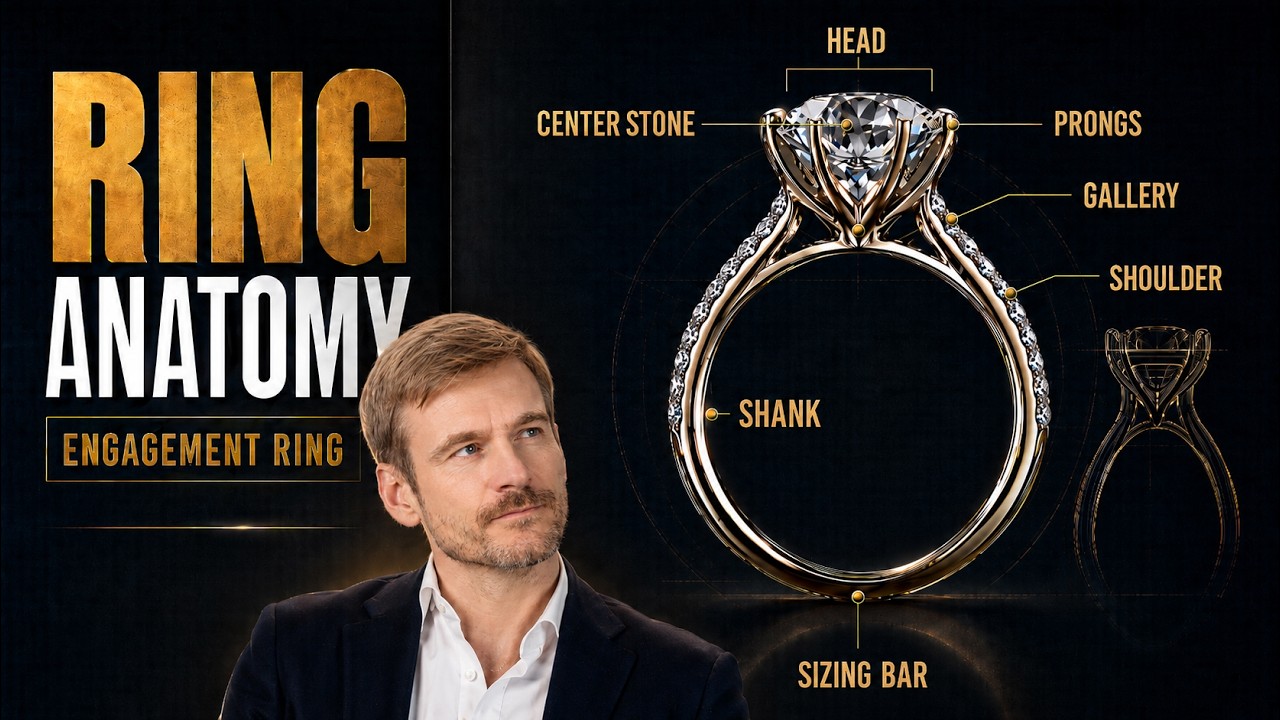
Engagement Ring Anatomy: Shank, Setting, Gallery and More

Understanding engagement ring anatomy makes the design process much easier. Once you can separate the shank, setting, gallery, center stone and accent details, a complicated ring becomes a series of understandable choices.
It also helps you speak the same language as your jeweler. In consultations, I often pause to explain a term before discussing what we can change. A client should be able to understand the proposal, ask useful questions and know which part of the ring we are actually talking about.
This guide follows the original NinaVova discussion of the parts of an engagement ring. The goal is not to memorize a vocabulary list. It is to see how those parts work together and how they can be developed around the person who will wear the ring.
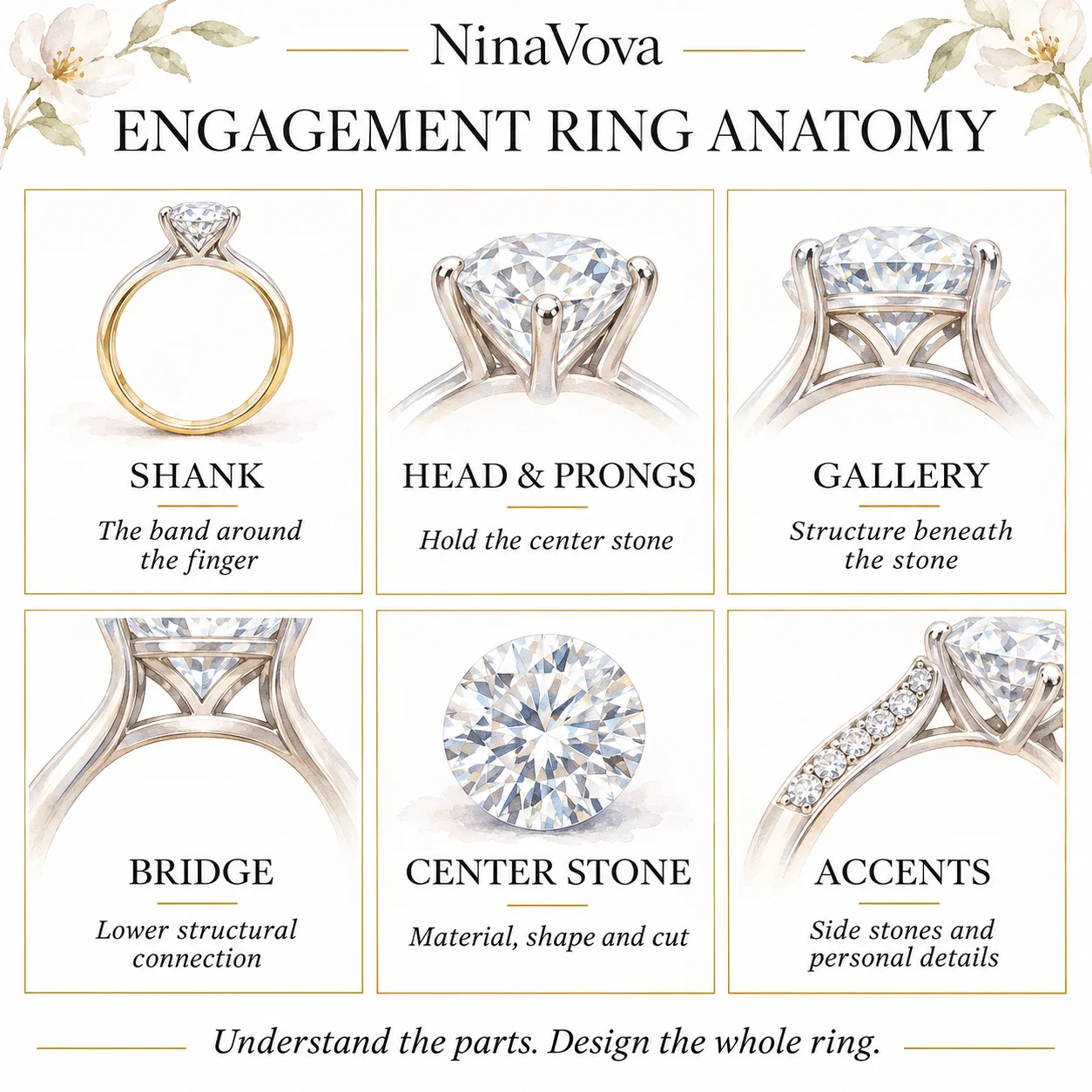
Learn the parts, then judge how they work together. The shank surrounds the finger; the head secures the center stone; the gallery and bridge contribute support beneath it. Material, proportions, accents and workmanship determine whether the complete design fits the wearer’s life.
At a glance · The shank: plain, pavé, split and cathedral · Band profiles and comfort fit · Choosing the metal · The setting, head and prongs
Watch the NinaVova discussion
Watch the original NinaVova video on YouTube.
The parts of an engagement ring at a glance
| Part | What it describes | What to discuss |
|---|---|---|
| Shank | The band around the finger | Width, thickness, profile, stone coverage and future sizing. |
| Head and prongs | The upper assembly and supports holding the stone | Contact, protection of points, workmanship and inspection. |
| Gallery | Structure beneath or around the center | Side view, support, cleaning access and decorative details. |
| Bridge | A lower structural connection beneath the head | Construction and compatibility with a wedding band. |
| Center stone | The principal gemstone | Material, dimensions, shape, cut, condition and care. |
| Accents | Side stones, small gems and metal details | Balance, maintenance and personal meaning. |
The shank: plain, pavé, split and cathedral
The shank is the band that goes around the finger. A plain band is a timeless starting point: it keeps the surrounding metal visually simple and directs attention toward the center stone. It can suit someone who enjoys restraint, or a design in which the gemstone already provides plenty of character.
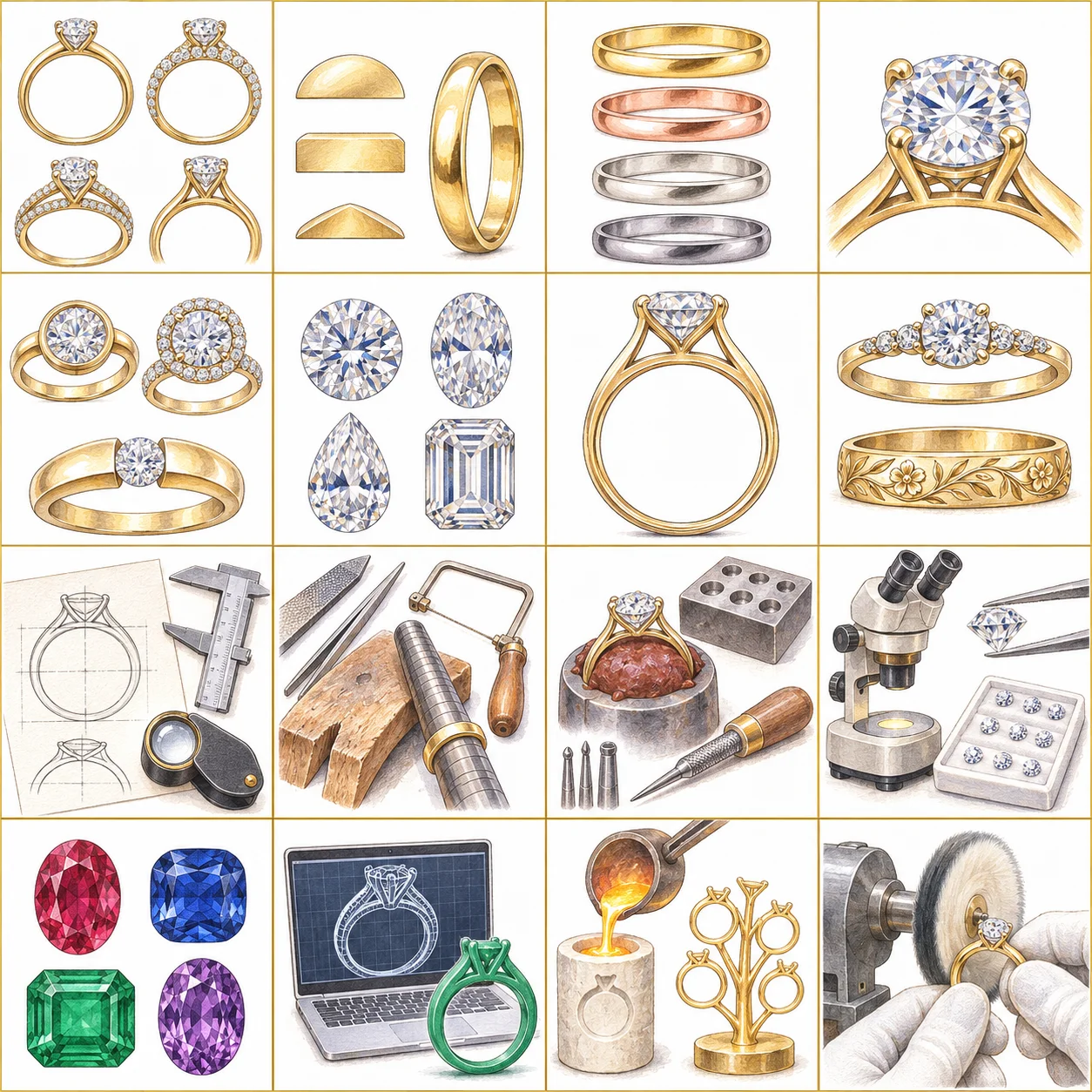
A pavé band adds small stones along the surface. Those stones might cover a short section, much of the visible band or continue around it. The amount of coverage changes the appearance, budget and maintenance discussion. A fully stone-set band also needs a more careful conversation about future sizing than a band with an accessible plain section.
A split shank divides into two branches as it approaches the setting. That can make the upper part of the ring look wider or more dramatic while keeping an open space between the branches. Their proportions and connection to the head matter as much as the name of the style.
In a cathedral design, the shoulders rise toward the center setting, rather like the sweeping supports of an arch. It is a familiar, classical silhouette that can make the center feel prominent. The actual height depends on the complete design; cathedral does not describe one fixed measurement.
Custom work allows us to combine or reinterpret these ideas. A botanical shank, an Art Deco outline or a personal motif does not have to fit one standard name. Even so, construction, available space and a workable budget place real limits on what can be made and worn comfortably.
Band profiles and comfort fit
Two bands can have similar widths from above and feel quite different on the hand. The cross-section describes that difference: a rounded exterior gives a softer outline, while a flatter top can look cleaner, bolder and more architectural.
A knife-edge band has a raised ridge along its outside. That creates a sharper visual line without meaning the ring should have an uncomfortable cutting edge. The ridge and transitions need to be finished for the intended wearer.
Comfort fit usually refers to a rounded interior surface. It is useful to distinguish the inside profile from the shape visible on top, because they can be chosen separately. A comfortable interior does not automatically make every width, thickness or ring size suitable.
I would compare real samples where possible. Notice the feel between the fingers, the weight, the way the ring comes over the knuckle and how a wedding band sits beside it. The most attractive profile on a screen is not always the one you enjoy wearing.
Choosing the metal
Yellow gold, rose gold, white gold and platinum offer different visual directions. The same gemstone can feel warmer or cooler depending on its surroundings, so metal selection belongs in the design discussion from the beginning.
Karat and alloy matter too. Comparing 14k with 18k gold, or white gold with platinum, involves more than the color name. Ask about the actual alloy, finish, maintenance, weight and suitability for the proposed construction. No precious metal is immune to wear.
Silver is also a precious metal and is used in jewelry. Alternative metals exist as well. My preference for many custom engagement-ring projects is gold or platinum, but suitability depends on the complete design, wear needs and repair options rather than whether a material feels special enough.
This is an overview of anatomy, so I would keep the first decision practical: choose a material you like that can support the proposed ring, then discuss its specific care and long-term service requirements with the jeweler.
The setting, head and prongs
The word setting can describe the mounting as a whole or the structure that holds a particular stone. The head is the upper assembly around the center. The gallery and prongs are parts of that construction, so ask your jeweler to point to the feature if a term is being used differently.
Prongs are small metal supports that secure a gemstone. Four- and six-prong arrangements are familiar, but the number and placement depend on the stone’s outline, dimensions and the design. Side stones can have their own prongs too.
Rounded prong tips give one familiar appearance. Longer claw tips can create a more pointed, dramatic line. Shorter claws fall between those looks, and tab-like forms can suit geometric or Art Deco designs. These details are small, but they can change the character of the finished ring.
Do not choose by silhouette alone. A prong needs enough substance and appropriate contact with the stone. Exposed points on pear, marquise and other shapes deserve particular attention. Workmanship and regular inspection matter alongside the decorative choice.
When reviewing a proposal, ask how the stone is supported, where the tips will sit and how the setting can be maintained. The first style shown to you is one possibility, not the full range of options.
Bezel, tension, halo and custom approaches
A bezel surrounds all or part of a stone’s perimeter with a rim of metal. It can offer useful edge protection and a smoother outline than some exposed-prong designs. That makes it worth discussing for a person who knocks jewelry against things, but it does not make the stone or ring damage-proof.
A tension setting uses engineered pressure to secure the gem. It needs appropriate materials, a suitable stone and specialist construction. Some rings only look like tension settings while using an additional support. A photograph alone does not tell you which method is holding the stone.
A halo describes a surround of smaller stones around the center. It can broaden the visual outline and add sparkle. It does not replace the need for a secure center setting: the central gem still needs its own support, whether that involves prongs, a bezel or another structure.
Custom settings may reinterpret familiar principles. Leaves can become part of the visible support, or an infinity-inspired structure can connect the head to the band. I like developing those ideas around a client’s story, while making the underlying method of securing the stone clear.
A unique name is not the objective. The setting should achieve the desired look, support the actual gemstone and remain workable for wear, inspection and future service.
The center stone: material, shape and cut
Diamond is one choice among many. Sapphire, emerald, morganite and aquamarine each bring different color, optical properties and care requirements. Natural and laboratory-grown options also need to be identified accurately. Choosing the material is a separate decision from choosing the shape.
Round, oval, pear, princess, cushion and emerald-cut outlines are familiar examples. Custom outlines and unusual faceting can take a design in another direction. The stone’s actual dimensions need to guide the setting rather than forcing it into a generic drawing.
Shape and cut quality are related but different ideas. Shape refers to the outline; cut can refer to the faceting style and also to how well the stone has been fashioned. Terms such as emerald cut describe more than just a rectangle, so it helps to be precise about which meaning is intended.
Depth affects the relationship between carat weight and face-up size. A deeply cut stone can carry weight below the visible surface; a very shallow stone may spread wider but sacrifice an attractive appearance. The right proportions depend on the material and faceting style, rather than a single perfect depth for every gem.
Compare millimeter measurements, face-up appearance and movement in useful lighting. A bigger outline is not automatically a better-cut stone. The best center is one whose appearance, condition and proportions support the ring you want to create.
The gallery and bridge
The gallery is the supporting structure beneath or around the center stone. An open gallery leaves areas accessible and creates a lighter side profile. Decorative galleries introduce additional lines, motifs or small stones. A hidden halo is one possible side-view detail, rather than another name for every gallery.
It is tempting to assume that a more open gallery always makes a stone sparkle more. In practice, light return depends heavily on the gem’s optical properties and cutting. The side opening is also a design, cleaning-access and structural decision; it is not a substitute for choosing an attractive stone.
At NinaVova, we often use this space for floral, streamlined or geometric details. The side view can carry something personal that is barely visible from above. This is a good reason to review a ring from several angles rather than judging only the top view.
The bridge is a lower connection beneath the head, commonly joining the upper sides of the shank. Terminology and construction vary, so identify the actual connection in the proposed design. Its relationship to the gallery affects support and may affect how a straight wedding band fits alongside.
Some designs use another structural solution instead of a conventional bridge. That can work when deliberately engineered; it should not be assumed safe simply because an unsupported-looking rendering is attractive. Ask the jeweler how the load is carried and what keeps the assembly stable during everyday use.

Accent stones and personal details
Side stones, pavé, engraving and decorative metalwork give you more ways to make a ring personal. You might begin with a familiar overall silhouette, then change the accents until the composition feels distinctive.
A contrasting gemstone can introduce a favorite color. A leaf motif can connect the piece to nature. Repeated geometric lines can give it an Art Deco character. The important question is whether the details support the whole design rather than compete with the center.
Accent choices also affect care and service. Small settings need inspection, an intricate underside may need more cleaning attention, and a fully decorated band can limit simple sizing options. Beauty and practicality need to be considered together.
Our photographs offer examples of what custom design can look like. Use them as starting points for a conversation about proportions, materials and construction, rather than assuming every detail can be transferred unchanged to a different stone.

Use the parts to plan the whole ring
Choosing an engagement ring can feel overwhelming at the beginning. Breaking it into the shank, head, gallery, center, accents and material gives you a more manageable brief. You can discuss one decision at a time while keeping the overall result in view.
I would start with the wearer: their preferred colors, daily habits, comfort and the story you want the ring to carry. Then select the actual gemstone and build a compatible setting around it. Check the top view, side view and relationship to a future wedding band.
Before production, make sure you understand what the proposal promises. Confirm the material, measurements, visible details and construction questions in writing. The anatomy vocabulary is useful because it makes those questions specific.
You do not need to arrive at a consultation knowing every technical term. Bring your priorities and ask the jeweler to explain the parts. A thoughtful design process should make the ring easier to understand as it develops.
Frequently asked questions
Are the setting and gallery the same thing?
Usually setting is a broader term, while gallery refers to supporting structure beneath or around the center. Usage varies, so ask the jeweler to point to the exact part.
Does an open gallery guarantee more sparkle?
No. Cutting and the gemstone’s optical properties strongly affect light return. Gallery openings also influence side appearance, access and construction.
Turn the parts into a personal design
We can compare the center stone, band, setting and details together, then develop a complete ring around the wearer’s preferences and practical needs.
Book a NinaVova consultation or explore our custom design process.
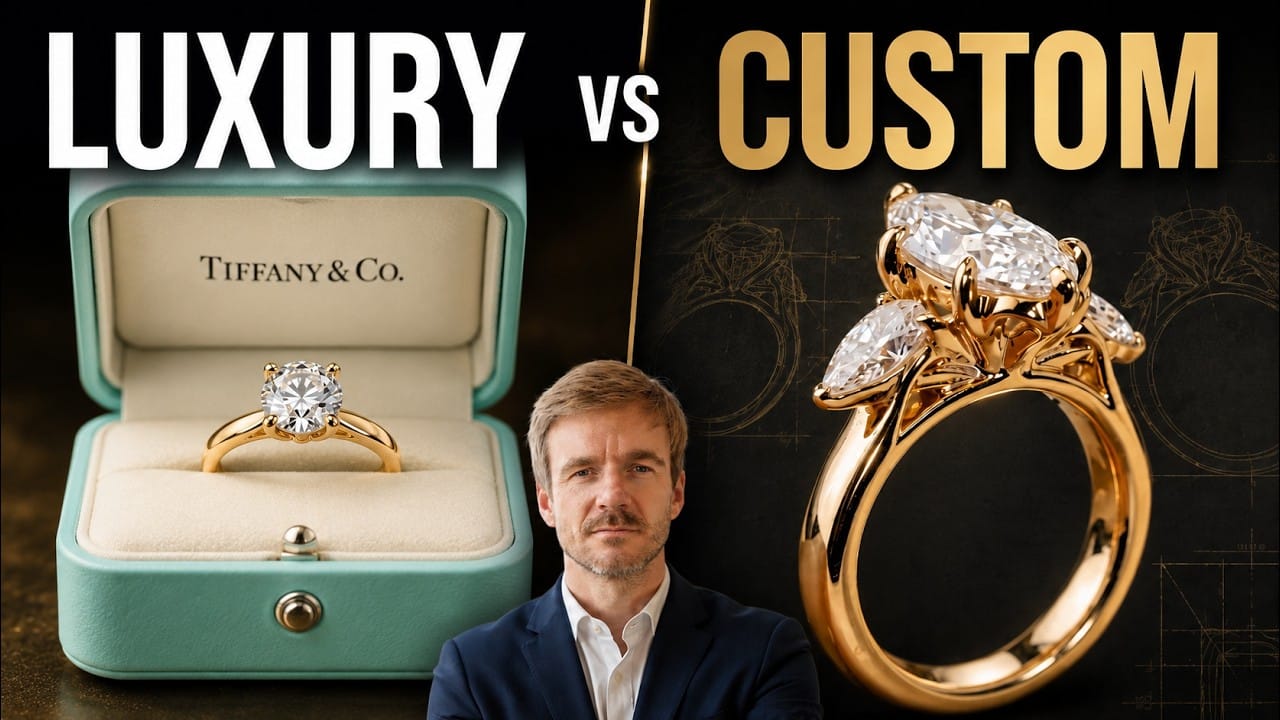
Continue reading: Designer vs custom engagement rings.
Sources and further reading
- Casting House: Anatomy of a ring
- GIA: Choosing a diamond engagement ring
- GIA: Protecting diamonds from chipping
Availability, prices and service terms can change. Evaluate the individual stone and confirm the current written terms before ordering.