
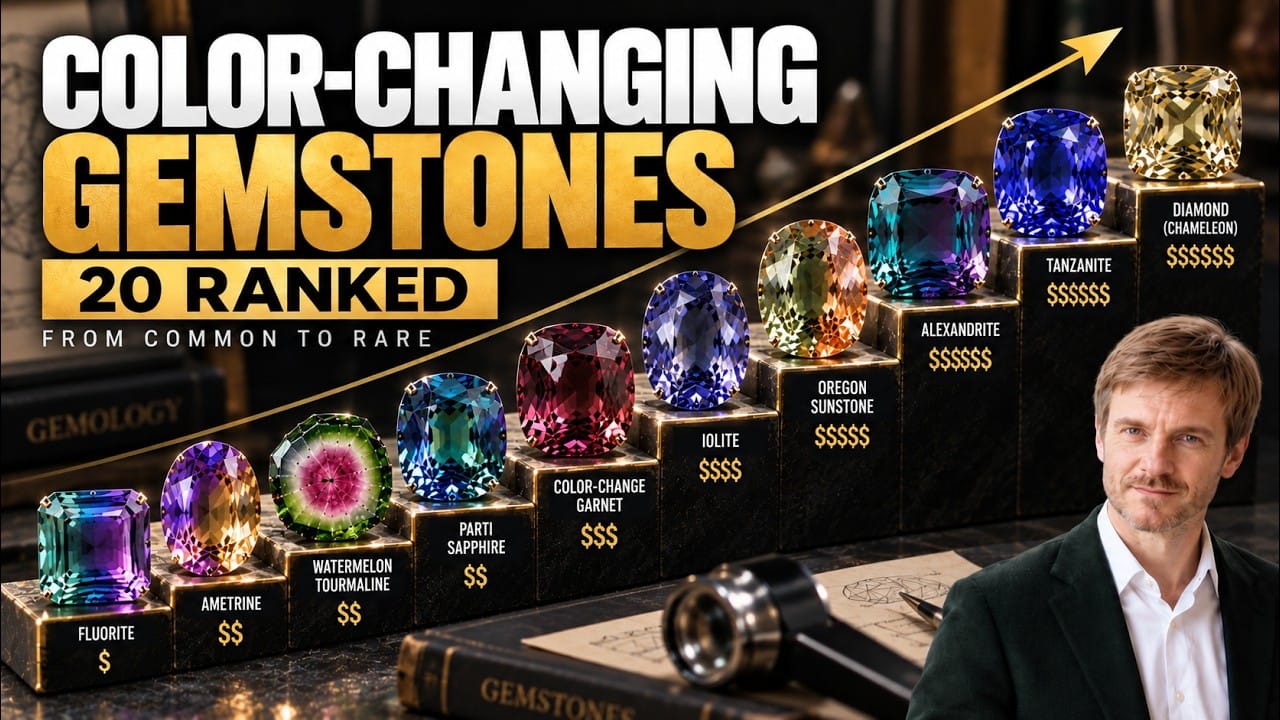
Bi-Color and Color-Change Gemstones: 20 Options for Engagement Rings

Some gemstones show 2 colors at the same time. Others can look blue or green in one room and purple or red in another. A few react to ultraviolet light, prolonged darkness, or even heat.
These effects are often grouped together, but they do not describe the same thing. The difference affects how the stone looks in real life, how it should be photographed, and what the rarity premium represents.
We researched a much larger group and selected 20 bi-color and color-changing gemstones worth knowing.
I divided them into 2 groups: Two Colors Visible at Once and Stones That Change Color. The order gives a broad introduction to different budgets, not a fixed price chart. Quality, size, origin, treatment and availability can change the comparison. Alongside appearance, consider hardness, toughness, care and the actual stone’s condition.
First identify the effect: permanent zoning, light-source color change, directional color or a response to UV exposure or darkness. Then judge both appearance and durability. Two beautiful colors do not automatically make a stone suitable for daily ring wear.
Compare the effects · Understand the effects · Permanent two-color stones · Color-change stones · Use the decision guide
Watch the NinaVova gemstone comparison
Watch the original NinaVova video on YouTube.
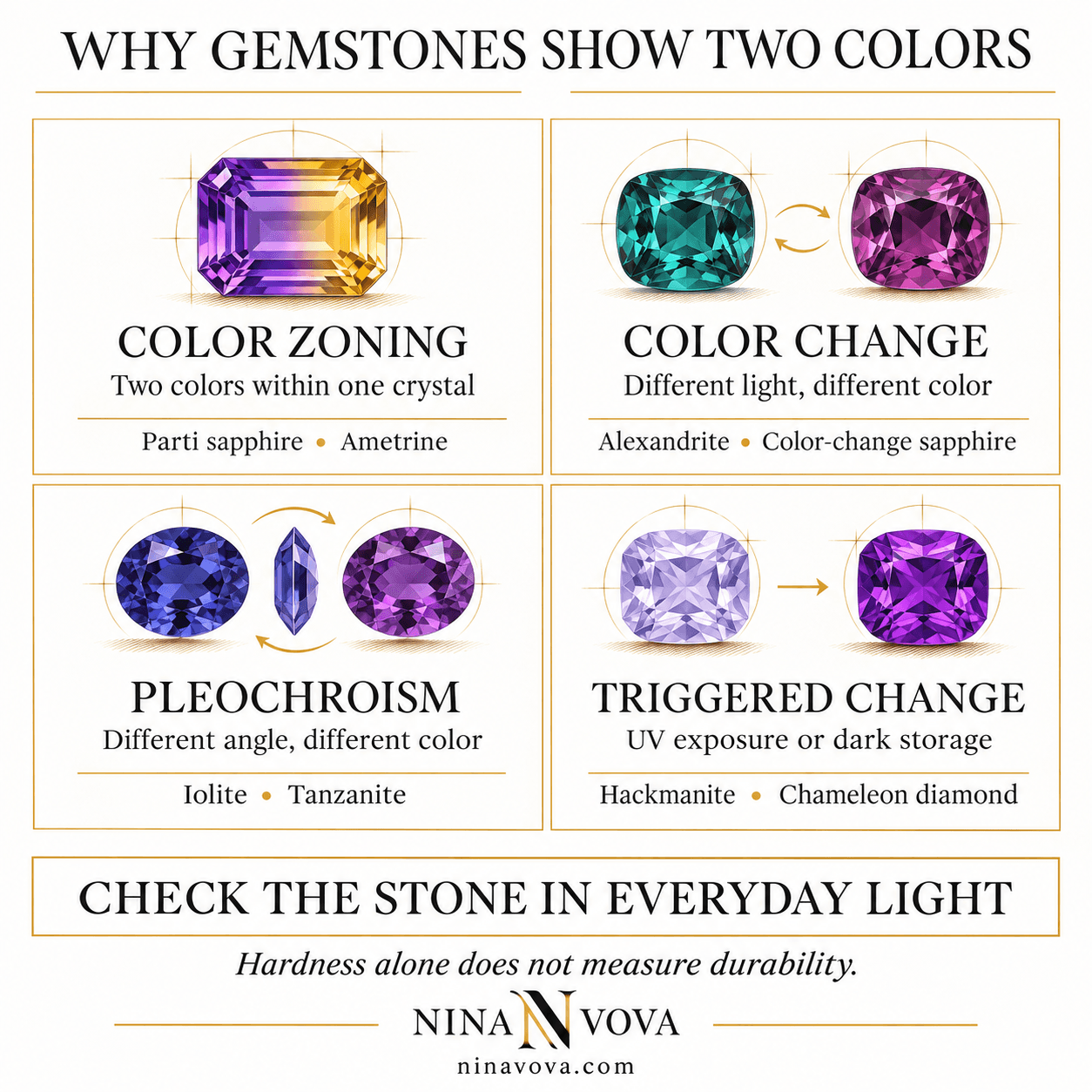
Compare the gemstone color effects at a glance
| Effect | Examples | What changes? | What to check |
|---|---|---|---|
| Permanent color zoning | Parti sapphire, ametrine, watermelon tourmaline | Different parts of the crystal hold different colors at the same time. | Look for both colors face-up under one consistent light source. |
| Light-source color change | Alexandrite, color-change sapphire | The dominant appearance changes with the light source. | Compare lighting while keeping the stone, angle and camera settings consistent. |
| Pleochroism | Iolite, tanzanite, andalusite | Different crystal directions show different colors. | Rotate the stone under consistent lighting. |
| UV-triggered change | Hackmanite | Exposure can activate a temporary color change. | Ask to see the resting color, activation and fading behavior. |
| Darkness or heat response | Chameleon diamond | A temporary change follows controlled conditions. | Request a professional demonstration and laboratory identification; never heat a ring yourself. |
How Gemstones Show More Than One Color
A blue-green parti sapphire makes the distinction easiest to see.
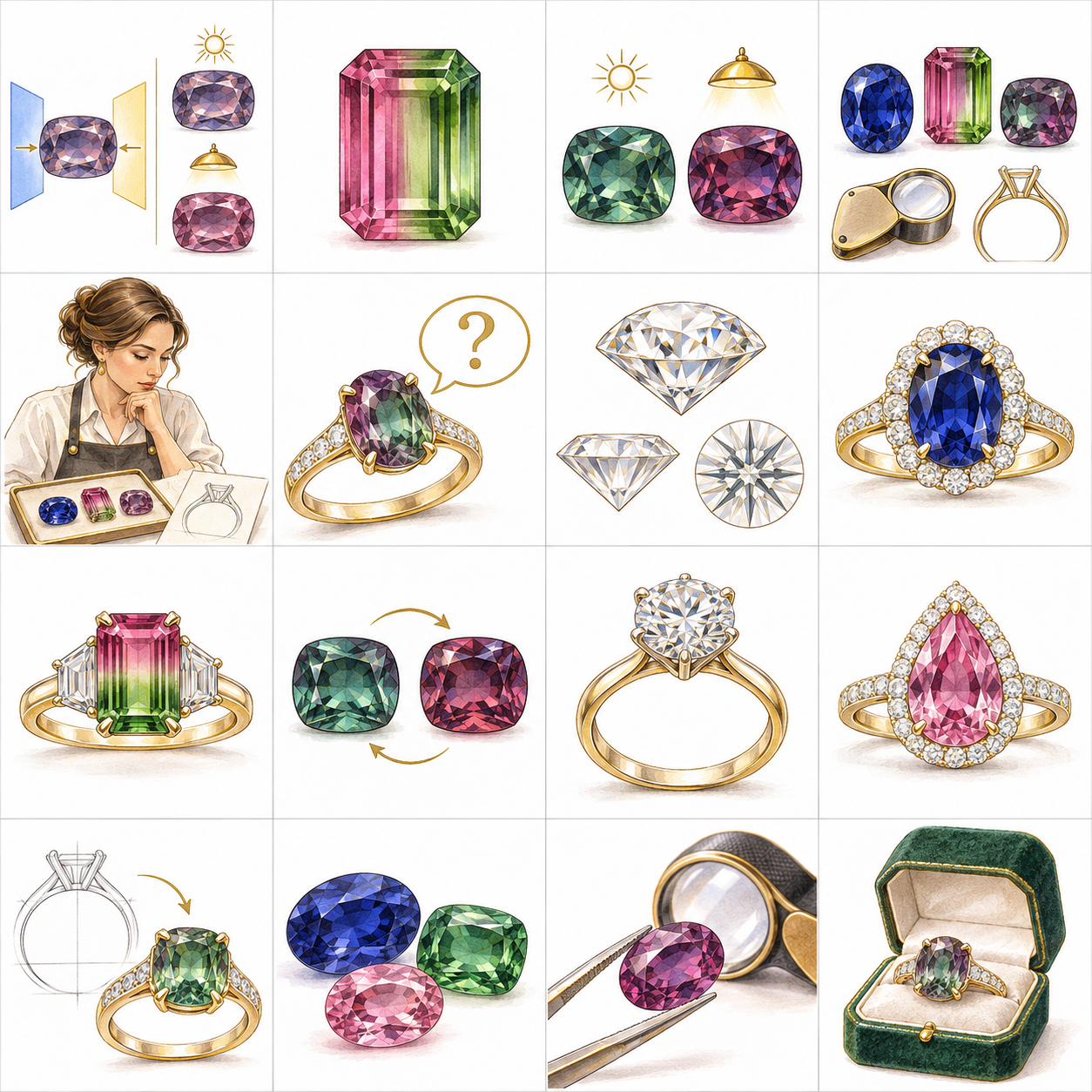
A parti sapphire contains permanent color zones. One part of the crystal may be blue while another is green or yellow. Both colors can appear at the same time, and they remain in the same areas when the lighting changes.
Ametrine, watermelon tourmaline, bi-color topaz, and red-green Oregon sunstone also preserve colors formed in different parts of the growing crystal.
Alexandrite works differently.
A fine alexandrite may appear green or blue-green in daylight-equivalent light and red or purplish red under warm incandescent light. The stone remains still; the light source changes which part of the spectrum dominates what we see. That is true color change.
Color shift usually describes a weaker movement between related colors, such as blue-gray to violet, rather than alexandrite’s dramatic green-to-red transformation. Sellers use these terms inconsistently, so the videos matter more than the label.
Pleochroism is different again. Here, the color follows the crystal direction. Rotate iolite, and it may move from blue-violet toward gray, yellow, or almost colorless. Tanzanite and andalusite also show strong directional colors.
Other stones use different triggers. Hackmanite deepens after UV exposure, while chameleon diamond reacts to prolonged darkness or controlled heating.
Photography can exaggerate every effect. A useful video keeps the stone, angle, background, exposure, and white balance unchanged, then changes only the light. A second video under mixed indoor lighting shows how it looks during normal daily wear.
With those differences clear, we can begin with stones whose colors stay permanently visible inside the crystal.
Two Colors Visible at Once
1. Bi-Color Fluorite
Fluorite can grow with sharp bands, colored cores, and geometric zones that reflect its cubic crystal structure. Purple, green, blue and colorless areas can create striking patterns, but an attractive pattern does not remove the material’s limitations for a ring.
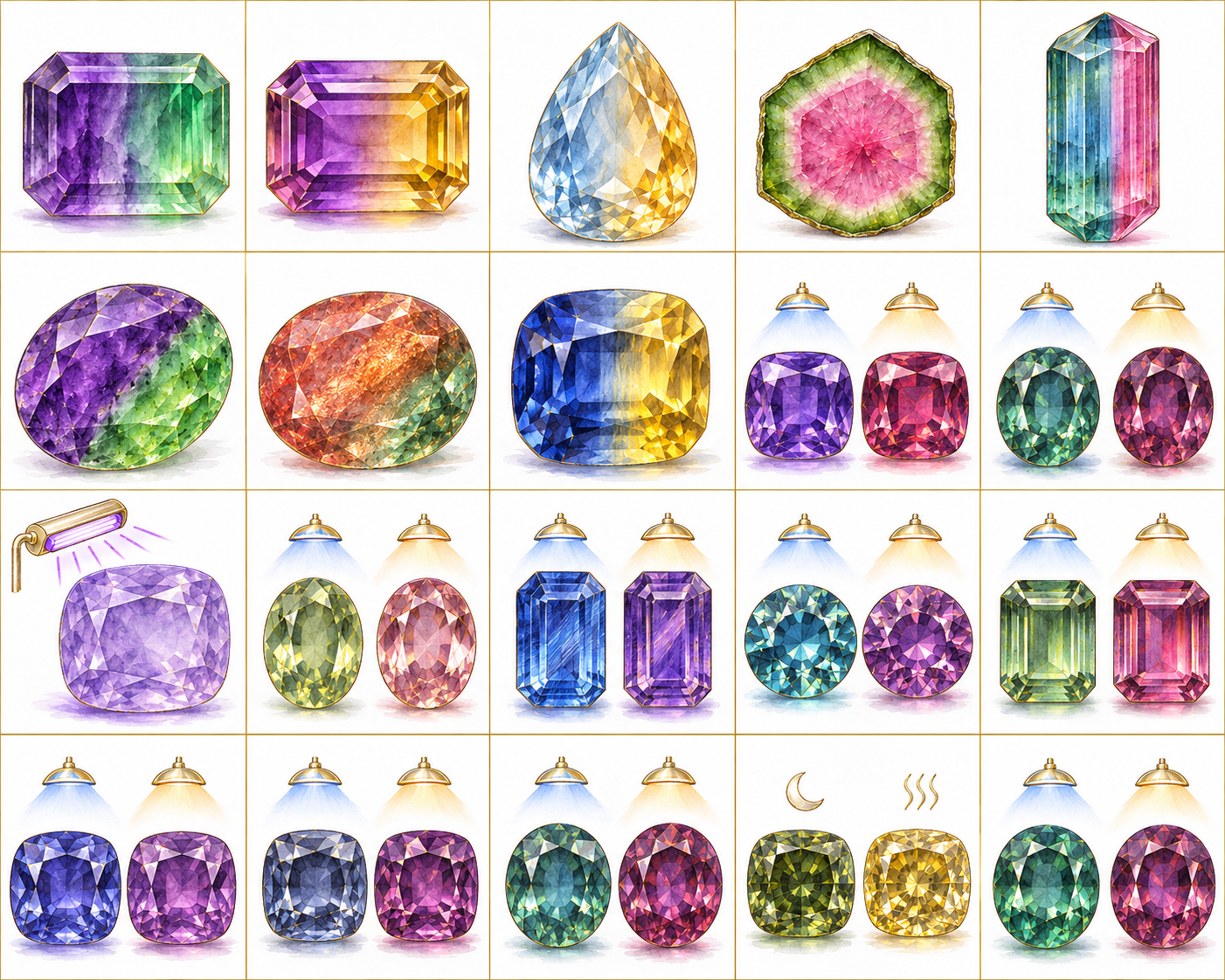
Large faceted fluorites remain inexpensive, but Mohs 4 and perfect cleavage place them in occasional-wear or collector rings.
Color-change fluorite also exists, but it shares the same durability and sourcing issues, so it stays inside this section rather than taking another position in the ranking.
2. Ametrine
Ametrine contains purple amethyst and yellow-to-orange citrine inside one quartz crystal. Bolivia remains its established commercial source, especially material associated with the Anahí mine.
The cut determines how those colors appear. A straight boundary creates the familiar 50/50 division. Rotating the rough can produce diagonal splits, blended reflections, checkerboards, or fantasy cuts.
Large stones remain affordable because quartz crystals provide generous cutting material. Value comes from strong color in both sections and a cut that uses the boundary deliberately.
Synthetic ametrine also exists, so unusually valuable material deserves verification.
3. Natural Bi-Color Topaz
Natural bi-color topaz can also occur in exceptionally large, clean material. Ukraine’s Volyn deposit has produced faceted stones combining blue, colorless, golden, and sherry-toned areas, including one documented example weighing 80.62 ct.
It can produce a huge transparent center with a clear color division at far less than fine tourmaline or sapphire.
Mohs 8 provides good scratch resistance, but topaz has perfect basal cleavage. A hard impact from the wrong direction can split a stone that otherwise looks extremely durable.
Commercial topaz may also be irradiated, heated, or coated to alter color, so valuable bi-color material needs clear treatment disclosure.
4. Watermelon Tourmaline
Watermelon tourmaline grows with a pink or red center surrounded by a green outer zone. Cutters usually slice across the crystal to reveal the full radial pattern, which is why these stones often keep a natural outline and a thin profile.
The strongest examples have a vivid pink center, a clear green rim, enough thickness for setting, and no serious fractures near the edge.
Unlike longitudinal bi-color tourmaline, its zones run from the center outward. That radial pattern naturally supports botanical, asymmetrical, and organic designs.
5. Bi-Color and Parti-Colored Tourmaline
Bi-color tourmaline with one color at each end gives the cutter more freedom. Pink and green are familiar, but one crystal can also combine blue and green, pink and colorless, yellow and green, or several stacked colors created as its chemistry changed during growth.
An elongated emerald cut can place one color at each end. A fantasy cut can follow an irregular transition. A shield or hexagon can turn the zoning into part of the ring’s geometry.
Both colors need to remain visible face-up. One dark end, a large window through the transition, or a weak second color can make impressive rough look disappointing after cutting.
Value depends on both colors and the transition between them.
6. Bi-Color Zoisite
Bi-color zoisite shows a less familiar side of the tanzanite family. Unheated stones can combine green and blue, with other material showing yellow or pink.
Tanzanite is blue-to-violet zoisite, and most blue-violet material in the market has been heated. Unheated green-blue zoisite preserves a different combination of natural body color, zoning, and directional color.
Zoisite is strongly pleochroic, so some color changes as the stone rotates while the permanent zones stay fixed. Seeing it stationary and moving separates those 2 effects.
At Mohs 6 to 7 with cleavage, zoisite needs more protection than tourmaline or sapphire.
7. Red-Green Oregon Sunstone
Oregon sunstone may combine red and green body color, visible zoning, strong pleochroism, and reflective copper. The copper can appear as a fine glow, metallic flashes, or full aventurescence.
Strong transparent red, green, and bi-color stones occupy the top of the market, especially when the copper supports the color rather than covering it.
Cut orientation decides whether body color, red-green pleochroism, or copper shimmer becomes dominant. A cutter may sacrifice weight to keep the best combination visible face-up.
Sunstone is feldspar, around Mohs 6.5 to 7 with cleavage in 2 directions. Few stones combine permanent zoning and metallic light in the same way.
8. Parti Sapphire
Parti sapphire is the strongest daily-wear option in this group. Blue, green, yellow, orange, pink, and violet can appear in separate areas or blend across the stone.
This is where blue-green sapphire fits. The blue and green remain permanently located inside the crystal and can be visible together under the same light. That is fundamentally different from alexandrite, where the dominant color changes when the light source changes.
Orientation determines the finished pattern. A strong cut keeps the zones visible, bright, and intentional. Poor orientation can hide one color, create a dark center, or overlap blue and yellow into an unattractive green.
Australia is especially associated with blue-yellow and green-blue parti sapphire; Montana and other sources also produce zoned material.
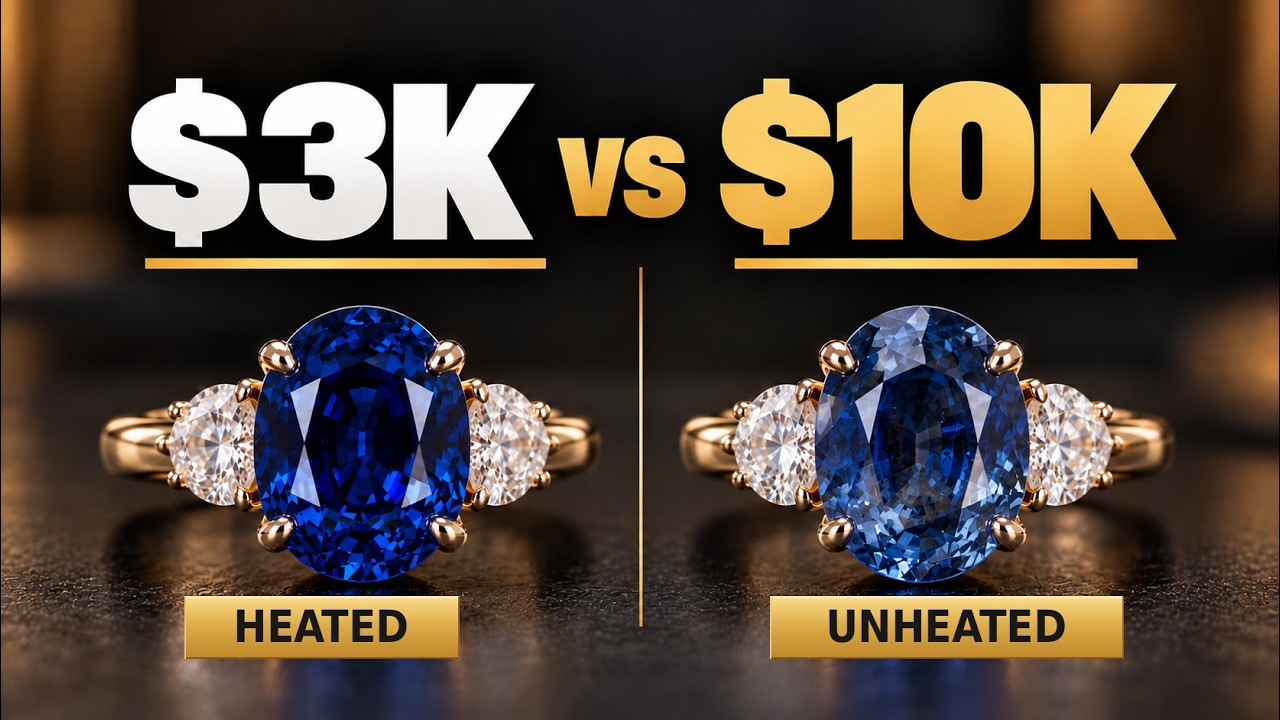
Heat can modify both color and zoning. Heated parti sapphire can still be an excellent ring stone, but treatment should be disclosed.
With Mohs 9, excellent toughness, and useful center-stone sizes, parti sapphire is the easiest natural recommendation for permanent 2-color appearance and daily wear.
In the second group, the stone itself may appear to change as the environment changes.
Stones That Change Color
The first group showed 2 colors held in permanent zones inside the crystal. In this group, the stone can remain in the same position while its appearance changes because the surrounding light or another external condition changes.
9. Synthetic Color-Change Sapphire
Synthetic color-change sapphire has been used to imitate alexandrite since the early 1900s. It is laboratory-grown corundum, not chrysoberyl.
Listings may call it alexandrite sapphire, created alexandrite, or lab alexandrite. A clear description should identify it as synthetic color-change sapphire or laboratory-grown corundum.
It is inexpensive, Mohs 9, and suitable for daily wear. It makes sense when the visual change matters more than alexandrite’s mineral identity or natural rarity.
10. Lab-Grown Alexandrite
True lab-grown alexandrite is synthetic chrysoberyl with the same crystal structure and basic color-change mechanism as natural alexandrite.
It can provide green, blue-green, red, and purple transitions in sizes that would be extraordinarily rare in natural material. Mohs 8.5 and excellent toughness also make it a serious engagement-ring center.
Laboratory growth does not guarantee attractive color; some stones become dark, brownish, or heavily purple. The description should say synthetic alexandrite or laboratory-grown chrysoberyl.

11. Hackmanite
Hackmanite changes through tenebrescence. UV exposure can deepen pale material into purple or pink-purple. The response and fading behavior vary, so ask to see the resting, activated and faded appearance of the actual stone.
Unlike alexandrite, hackmanite must first be activated by UV and then allowed to fade.
A proper demonstration shows the resting color, the UV-activated color, and how quickly it fades—not only the freshly charged stone.
Hackmanite is a variety of sodalite with hardness around Mohs 5.5 to 6, so it belongs in a protected or occasional-wear ring.
12. Color-Change Diaspore
With diaspore, we return to a stone that reacts directly to the light source. It can move through pale green, olive, champagne, peach, pink, and purple.
Zultanite and Csarite are trade names for diaspore, not separate gemstone species.
Marketing often presents a dramatic green-to-red transformation. Many real stones produce a softer champagne-to-pink, olive-to-peach, or yellow-green-to-purple-brown shift.
The price should follow the actual change rather than the trade name.
Diaspore is around Mohs 6.5 to 7, but cleavage is the more important concern for ring wear.
13. Color-Change Kyanite
Color-change kyanite can show a genuine alexandrite-style response between different light sources.
Its most unusual property is directional hardness. Kyanite can measure around Mohs 4.5 in one crystal direction and close to 7 in another.
That complicates cutting, polishing, setting, and long-term facet wear.
Clean color-change material is scarce. Color-change apatite and kornerupine also exist, but their supply is even less dependable.
14. Color-Change Zircon
Color-change zircon combines high dispersion with an unusual response to modern lighting.
One GIA-documented zircon from the Mogok area appeared grayish purple under a cool 6500 K LED and green under a warm 2700 K LED. Standard incandescent light produced little visible difference from cool fluorescent illumination.
That example shows why daylight versus incandescent does not explain every modern color-changing stone; sometimes LEDs create the strongest response.
Some zircons also show tenebrescence after UV exposure or storage in darkness.
Much commercial zircon is heated to modify color. Zircon can be exceptionally bright, but brittleness and facet wear make it a higher-care ring stone than sapphire, spinel, or alexandrite.
15. Color-Change Tourmaline
Color-change tourmaline is far rarer than permanently zoned tourmaline.
Some stones move from a cool daylight color toward a warmer incandescent color. Others reverse that pattern. GIA documented a 5.68 ct copper-bearing Mozambique tourmaline that appeared purple under fluorescent light and grayish blue-green under incandescent light.
Tourmaline can therefore show permanent zoning, strong pleochroism, and true light-source color change.
Heat and irradiation can alter the color, and supply is too limited for a broad selection of shapes and sizes.
A report identifies the material. Controlled videos show whether the actual change deserves the rarity premium.
16. Color-Change Sapphire
Color-change sapphire is the most practical natural center stone in this group.
The typical stone appears blue to violet under daylight-equivalent illumination and shifts toward violetish purple or reddish purple under incandescent light. Rare examples move from green toward reddish brown.
For sapphire, blue-to-purple is much more common than alexandrite’s green-to-red transformation.
Value depends on the beauty of both colors as well as the strength of the change. A complete transformation into a dark or muddy second color is less desirable than a slightly weaker change between 2 attractive colors.
With Mohs 9, excellent toughness, useful sizes, and established laboratory testing, color-change sapphire offers the strongest combination of natural origin, visible change, and daily-wear durability.
Some sapphires also show temporary UV-related color instability. That is tenebrescence, not the repeatable daylight-to-incandescent change described here.
17. Color-Change Spinel
Natural color-change spinel occupies a very small specialty market. Many examples move between blue-gray, violet-blue, lilac, and purple rather than producing a dramatic green-to-red transformation.
With Mohs 8, good toughness, and no cleavage, spinel works well in rings. The question is whether the stone shows a true change or only a mild shift between neighboring shades.
Synthetic color-change spinel also exists, so a laboratory report matters when natural rarity drives the price.
18. Color-Change Garnet
Color-change garnet can produce some of the most unexpected combinations in this guide.
Depending on composition and source, it can move from blue-green to purple, green to red, yellow-green to orange-brown, or purple to pink. Fine blue-green pyrope-spessartine garnets from Madagascar owe much of their alexandrite-like behavior to vanadium.
Garnet is generally untreated. The difficulty appears under mixed lighting. Some stones become gray or brown when daylight and warm artificial light overlap, even though the controlled comparison looks spectacular.
The best examples combine 2 attractive colors, strong change, good brightness, and enough size to show the effect clearly.
19. Chameleon Diamond
Chameleon diamonds react to darkness and heat rather than an ordinary change of room lighting.
Their stable color is usually grayish yellowish green or grayish greenish yellow. After controlled heating, or when first exposed to light following prolonged darkness, they can temporarily appear stronger yellow, orangy yellow, or brownish yellow before returning to the stable greenish color.
Chameleon diamonds are exceptionally rare. Specialist availability, the individual stone’s appearance, the budget and the proposed design need to be discussed before planning a custom ring around one.
The effect should never be demonstrated by heating a finished ring at home. A safer presentation compares the normal color with the appearance immediately after controlled dark storage.
A natural colored-diamond report is essential because greenish diamond color may be natural, treated, or laboratory-grown.
GIA has even documented a natural bi-color diamond where only the greenish zone showed chameleon behavior, combining permanent zoning and temporary color change in one stone.
20. Natural Alexandrite
Natural alexandrite remains the benchmark. Major deposits were discovered in Russia’s Ural Mountains in 1830, and the gem was named after the future Czar Alexander II. Fine material appears green to bluish green in daylight-equivalent illumination and red to purplish red under incandescent light.
Value depends on both colors, strength of change, brightness, clarity, and size. Most cut alexandrites weigh less than 1 ct, and larger stones rise dramatically in price when they retain strong color.
Alexandrite is also strongly pleochroic, so cut orientation affects color, brightness, weight retention, and the strength of the change. No orientation maximizes everything at once.
The market also contains synthetic alexandrite, synthetic color-change sapphire, synthetic spinel, and glass imitations. A respected laboratory report belongs with any natural stone carrying a serious alexandrite price.
Exceptionally rare chrysoberyl can contain an ordinary yellow-green zone beside a true alexandrite zone. Cat’s-eye alexandrite adds another phenomenon by combining color change with a moving band of reflected light.
That combination of transformation, durability, history, and rarity is why alexandrite remains the final standard.
Quick Decision Guide
Ametrine makes sense for a large, affordable purple-yellow stone. Watermelon tourmaline lets the growth pattern define the design, while bi-color tourmaline offers more shapes and color combinations.
Oregon sunstone gives you the most complex mixture of body color, pleochroism, and copper shimmer. Parti sapphire is the strongest natural option for permanent 2-color appearance and daily wear.
Synthetic color-change sapphire provides the lowest-cost durable transformation. Lab-grown alexandrite offers the classic mechanism in a larger stone without the natural rarity premium.
Color-change sapphire is the most practical natural light-changing center. Garnet offers less predictable but sometimes extraordinary color combinations.
A chameleon diamond makes sense when the appeal is its rare reaction to darkness and heat rather than an immediate change between 2 light sources. Natural alexandrite remains the benchmark when classic color change, durability, history, and rarity all need to be part of the ring.
Choosing the right effect for your ring
Bi-color and color-changing stones may look related, but their colors come from completely different events.
A blue-green parti sapphire records changes that happened while the crystal was growing. Alexandrite reveals a different color because the surrounding light has changed. Hackmanite responds to UV exposure, while chameleon diamond reacts to prolonged darkness or controlled heat.
Understanding which effect you are buying explains how the stone will look in real life, what the rarity premium represents, and how the ring should be designed around it.

Frequently asked questions
Is a parti sapphire the same as a color-change sapphire?
No. A parti sapphire has permanent color zones. A color-change sapphire changes its dominant appearance under different light sources. A stone may show more than one optical effect, so inspect the actual example.
Does a high Mohs hardness guarantee a durable ring stone?
No. Hardness describes scratch resistance. Cleavage, toughness, existing fractures, treatment and the setting also affect suitability for a ring.
Can a photograph prove a strong color change?
A photograph alone is not enough. Ask for the same stone under controlled lighting, then inspect it under the mixed lighting in which it will normally be worn.
Build the ring around the actual stone
For a custom engagement ring, start with the effect you love and the care you are comfortable with. Book a NinaVova consultation or explore our custom design process to discuss the stone, setting and design together.
Continue with our sapphire engagement ring guide or custom engagement ring design process.
Sources and further reading
- GIA: Alexandrite buyer’s guide
- GIA: Alexandrite care and cleaning
- GIA: Topaz research and Ukrainian bi-color topaz
- GIA: Zircon with unusual color-change behavior
- GIA: Copper-bearing color-change tourmaline, Fall 2004 Gems & Gemology
- GIA: Apatite in hackmanite and UV-induced color change
- GIA: Uncommon parallel color zoning in a chameleon diamond
Prices and availability vary by stone. Comparisons describe material characteristics, not a guarantee about a particular gem or seller.