
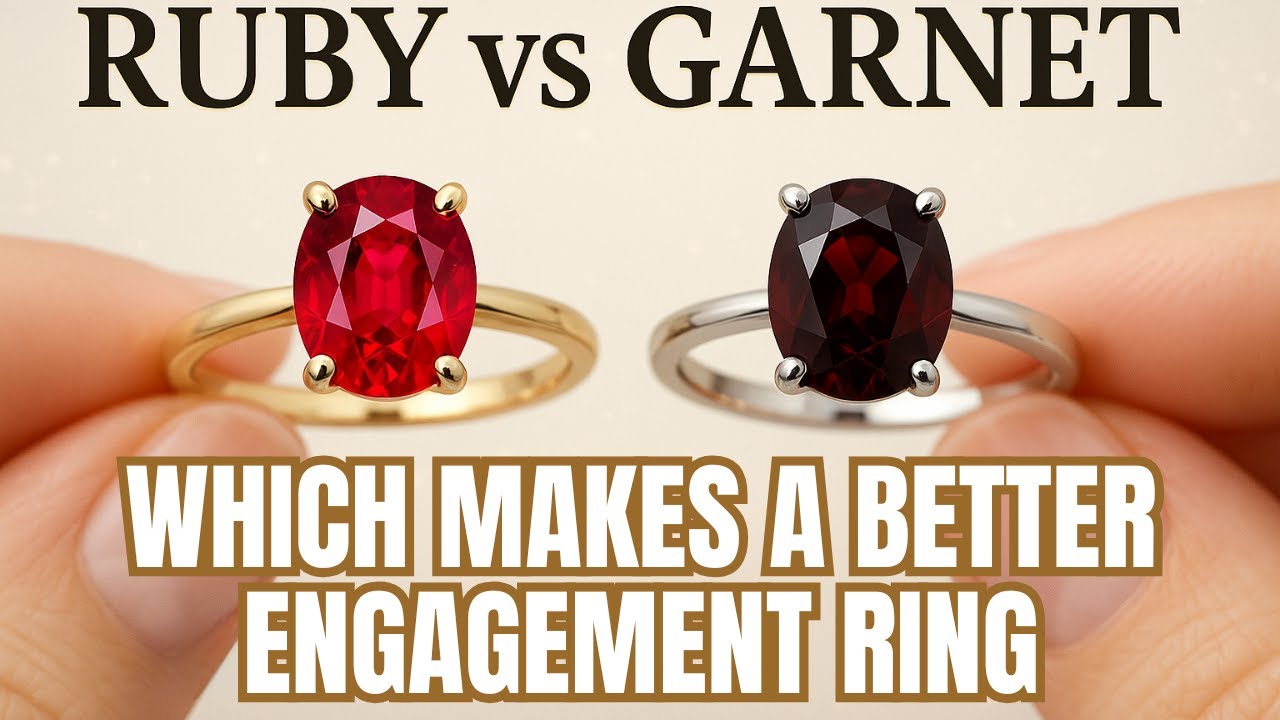
Ruby vs Garnet for Engagement Rings: Identity, Color and Care

If you’ve ever seen a deep red gem and wondered—is that ruby or garnet?—you’re not alone.
Both promise passion and timeless color, yet they live in completely different worlds of value and durability.
Use color to choose what you enjoy, and evidence to identify it. Ruby is corundum, while garnet is a family of different silicate minerals. Compare actual stones in useful light and understand treatment, condition and wearing needs; neither name guarantees one appearance in every environment.
At a glance · Ruby and garnet are different minerals · Color is not an identity test · Compare in daylight and warm light · Identification and treatment disclosure
Watch the NinaVova discussion
Watch the original NinaVova video on YouTube.
The original NinaVova discussion accompanies this guide. Historical price examples are not current quotations, and written material and laboratory disclosures govern the actual stone.
Ruby and garnet at a glance
| Factor | Ruby | Garnet |
|---|---|---|
| Material | Red corundum | A family including almandine and pyrope |
| Scratch hardness | Mohs 9 | Typically Mohs 6.5–7.5, by variety |
| Color | Actual modifiers and fluorescence vary | Red, raspberry and other colors vary by material |
| Disclosure | Natural/lab origin and treatment matter | Identity and any treatment still matter |
| Wearing | Condition, treatment and impact protection matter | Suitable protection and gentle handling matter |
| Value | Compare actual documented stones | No automatic complete-ring saving for every example |
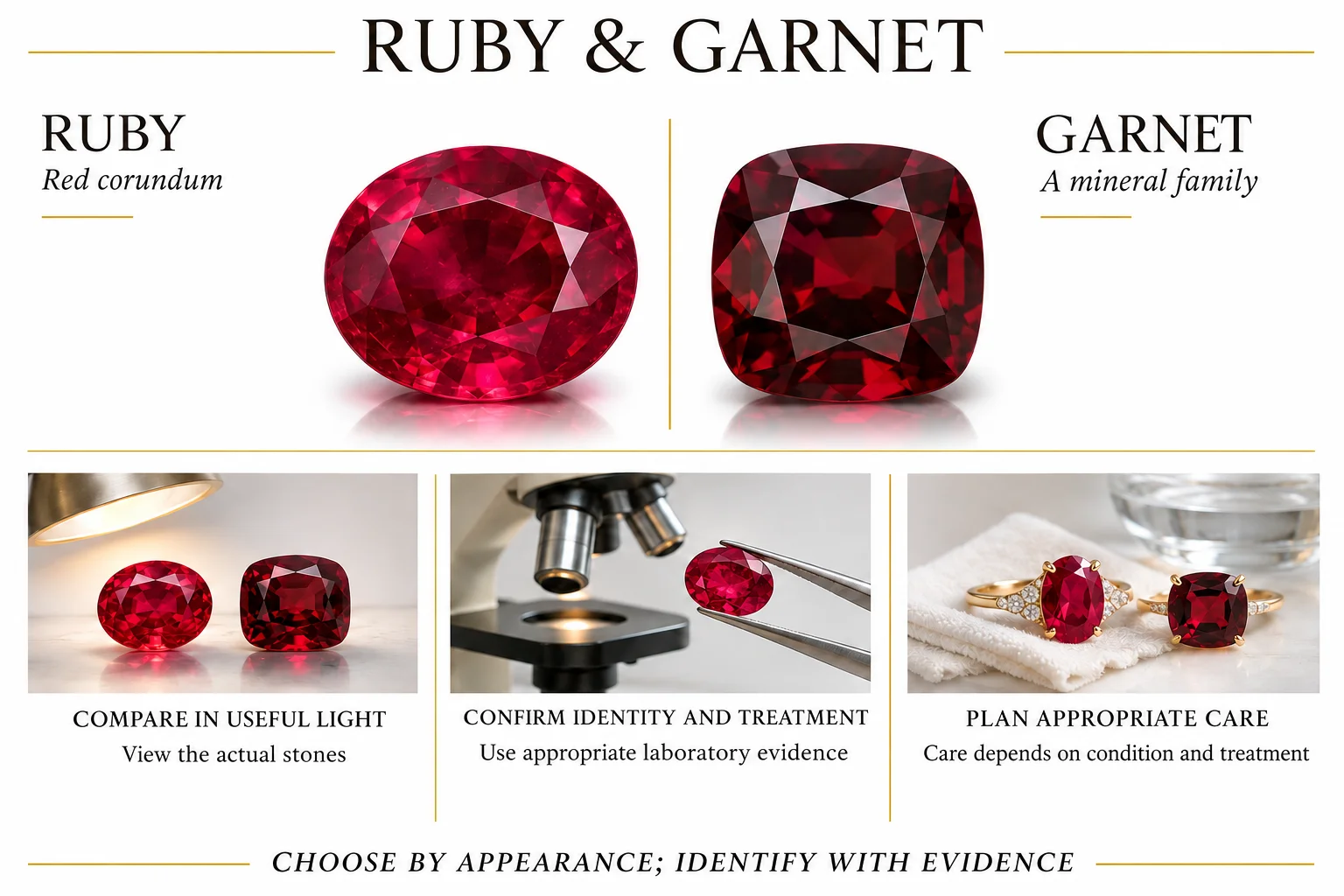
Ruby and garnet are different minerals
Ruby is a variety of corundum—the same mineral as sapphire—with chromium creating that vivid inner glow.
It’s dense, tough, and prized for centuries in royal jewelry.
“Garnet” isn’t one stone, but a family—almandine, pyrope, spessartine, and others.
The red members can look strikingly similar to ruby at first glance, especially in candlelight or photos.
But chemically they’re completely different.
Ruby is aluminum oxide.
Garnets are silicate minerals with properties that vary across the family. A chemistry label alone is not an adequate explanation of sparkle, toughness or practical care.
A fine ruby can show vivid color and strong reflections in suitable light.
An actual garnet may look bright, dark, fiery or subdued depending on variety, color, cut and lighting.
Color is not an identity test
Compare actual color, but do not use appearance alone to identify the material.
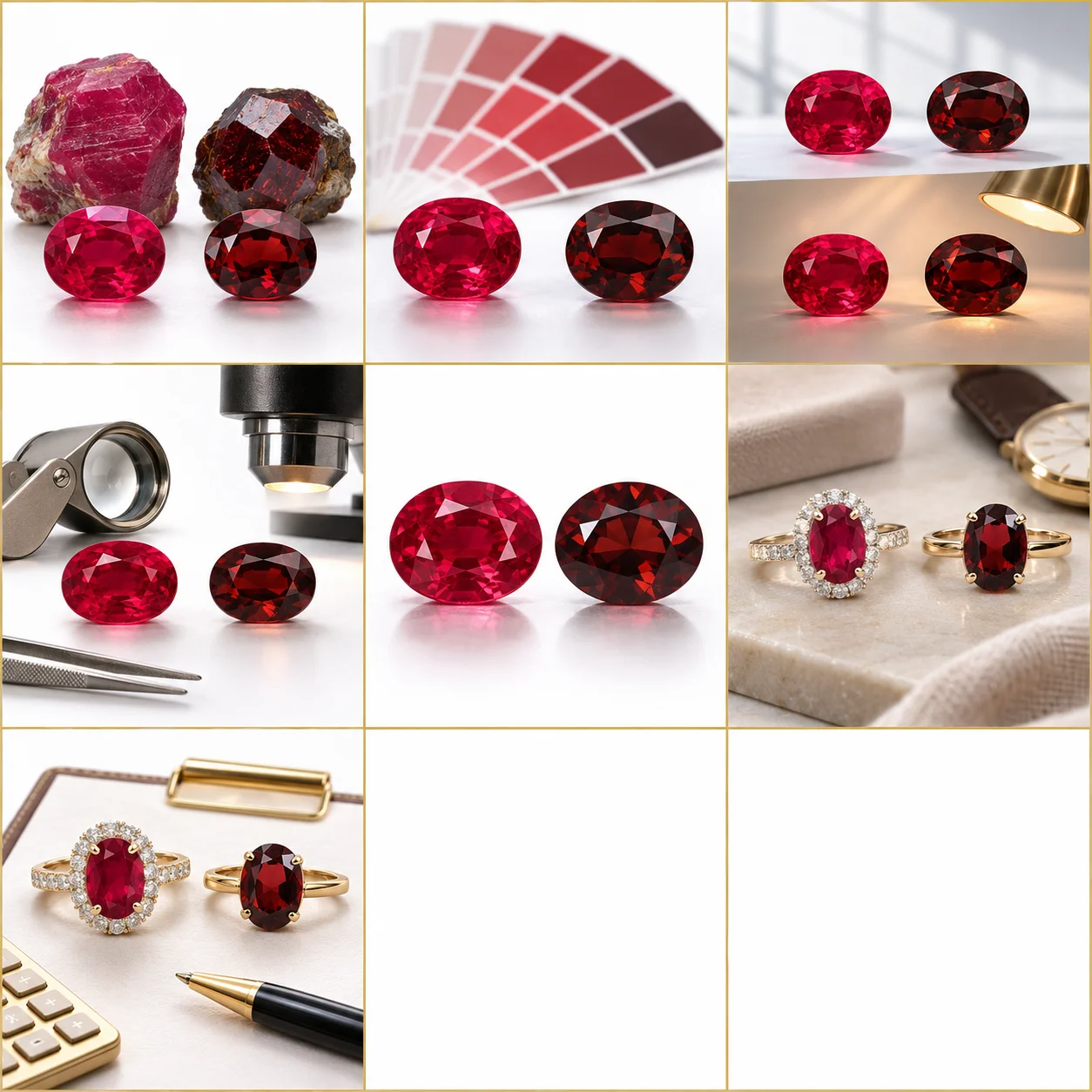
Rubies:
Fine ruby is often valued for vivid red to slightly purplish red, but actual rubies can show modifying colors; appearance alone cannot prove identity.
Compare whether the actual tone and saturation remain appealing in ordinary shade.
Some actual rubies show vivid color in daylight, but a geographic label alone does not establish the appearance.
That glow comes from chromium atoms absorbing green light, leaving red to dominate—it’s physics you can see.
Garnets:
Most red garnets—especially almandine—shift toward brown or wine under warm light.
In daylight, they can look beautiful: deep cranberry, sometimes pure pomegranate red.
Under indoor light, they often darken or go brick-red, sometimes almost black at night.
That change is part of their charm for those who love an antique mood.
Neither name guarantees one unchanging red under every light. Compare the specific stones in the environments where they will be worn.
If you prefer a softer, vintage red that deepens with candlelight, garnet tells a different story.
Compare in daylight and warm light
Before you choose, see both stones in two places.
In open-shade daylight, check how the color breathes.
Under a warm indoor lamp, watch for dulling or brown shift.
The best stones hold their hue without collapsing into darkness.
It’s a simple habit that reveals more truth than any photo ever can.
Identification and treatment disclosure
To be sure of what you’re buying, use the right report.
For a significant ruby purchase, consider an appropriate independent laboratory, such as GIA, AGL, GRS or Gübelin.
Ask which identification, detectable treatment and optional origin opinions the selected laboratory can provide for that material.
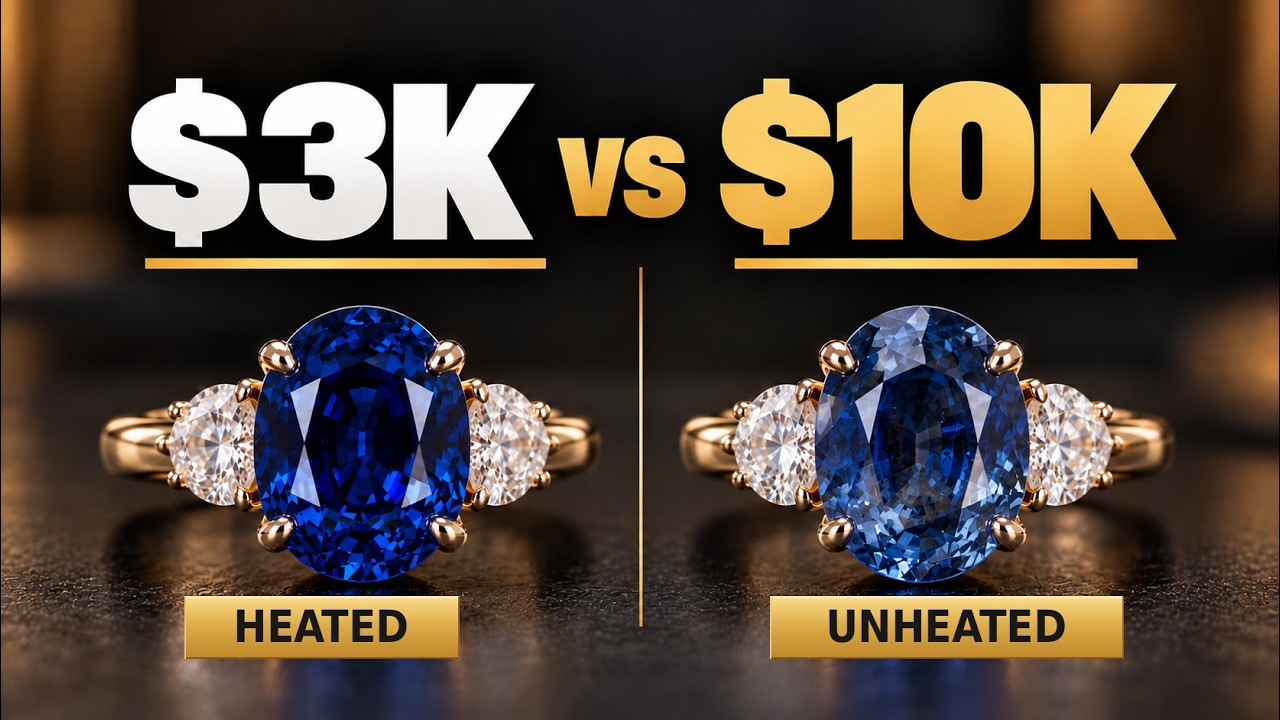
Heat treatment is common and accepted for ruby, and labs will note it as ‘heated.’
Some rubies receive lower-temperature heating that subtly reduces blue or purplish components.
If a stone is labeled ‘unheated,’ that premium reflects rarity, not just color.
For garnets, reports are less common but available if you need identity or variety confirmed.
Most are natural and untreated, which makes them refreshingly straightforward.
A suitable report can help document identity and detectable treatment. It is not an appraisal, resale-price guarantee or proof that all possible treatments are absent.
Read the issuing laboratory’s exact conclusion and match its measurements and report number to the actual stone.
Judge actual cut and brightness
Since neither has an official cut grade, judge it visually.
Face the stone straight on—if you see a pale circle, that’s a window; light is leaking.
Rotate it: does brightness stay even, or does it go dark on one side?
Rubies are often cut deep to preserve saturation.
Garnets, because they’re less costly, are sometimes cut too shallow, which can cause uneven color.
There is no universal ideal depth percentage across all these varieties and shapes. Assess the actual balance of face-up size, color, brightness, windowing and extinction.
Durability and a realistic wearing plan
Ruby ranks 9 on the Mohs scratch-hardness scale.
It resists scratching well, but the actual condition, treatment and use still affect its surface and durability.
Garnet ranges 6.5 to 7.5 depending on variety. Some can be considered for regular wear with suitable protection and care, while rough wearing can abrade the surface.
A ruby ring is still vulnerable to impact and pressure; remove it for rough activities.
For garnet, discuss suitable protection and wearing habits; an especially vulnerable stone may be better reserved for occasional wear.
Both deserve care. Ruby’s greater scratch resistance does not make every ruby or treatment equally robust.

Compare complete ring quotations
The original $950 solitaire mounting example was a historical illustration, not a current offer. Compare dated full-ring quotations with the actual stone, dimensions, condition, treatment, metal, construction and services specified.
Ruby commands a premium for its hardness, rarity, and vividness.
A particular garnet may deliver the red appearance you enjoy at a lower total, but compare actual complete quotations.
Care and construction matter for either material.
A well-chosen ruby can become an heirloom; a carefully chosen garnet may also have lasting personal meaning, with gentler handling and a different price.
Either way, you should feel you chose it for meaning, not marketing.
Frequently asked questions
Can I tell ruby from garnet by how red it looks?
No. Appearance can overlap, and lighting changes what you see. Appropriate identification is needed for certainty about the actual material.
Does ruby stay the same color in every light?
No. The actual stone’s color, fluorescence, cut and lighting all affect its appearance.
Is there a universal ideal depth for both stones?
No. Evaluate the actual shape, color, face-up size and light performance rather than applying one depth percentage to every material and cut.
Compare the actual stones for your ring
Tell us the color, face-up size and wearing needs you have in mind. We can discuss specific stones, their documentation and a considered setting before you decide.
Book a NinaVova consultation or explore our custom design process.
Continue reading: Natural ruby guide · Garnet guide · Treatment and origin questions.
Sources and further reading
- NinaVova: Original discussion
- GIA: Ruby care and treatment limits
- GIA: Ruby buying guide
- GIA: Durability beyond scratch resistance
- GIA: Garnet buying guide
- GIA: Garnet care
- GIA: Lead-glass-filled ruby research
Compare current quotations, actual stone condition, origin and treatment disclosure. Natural and laboratory-grown materials have different growth histories; neither a size formula nor a material name establishes the quality of every ring.