

Israel Diamonds: Trading Location, Quality and Origin Claims

The phrase “Israel diamonds” can refer to diamonds traded, cut or sold through businesses in Israel. It is not a separate diamond species, a universal quality grade or proof of where a stone was mined. A useful buying decision separates the trading location, the individual diamond’s characteristics and the evidence behind any origin or sourcing claim.
Ask which stage the location describes. A trading or cutting location is not a universal quality grade or mining-origin proof. Assess the individual diamond and the evidence for each claim.
At a glance · Clarify what the place-name describes · Separate mining, cutting and selling locations · Understand what a grading report says · Evaluate the individual diamond’s appearance and condition
Watch the NinaVova discussion
Watch the original NinaVova video on YouTube.
Related NinaVova diamond-buying discussion supports asking for evidence about the actual stone. It is a buying companion, not a documentary about the Israeli diamond industry.
Diamond location and evidence: keep the questions distinct
| Claim | What it describes | Evidence to request |
|---|---|---|
| Sold in Israel | A transaction or business location | Seller and invoice details |
| Cut in a location | A manufacturing stage | Records for that stage |
| Mined in a country | Geographic extraction origin | Suitable chain and origin evidence |
| Quality grade | Specified stone characteristics | Applicable laboratory report |
| Responsible sourcing | A defined policy or process | Scope and order-specific records |
| Kimberley Process | Defined rough-diamond trade framework | Relevant records and actual scope |
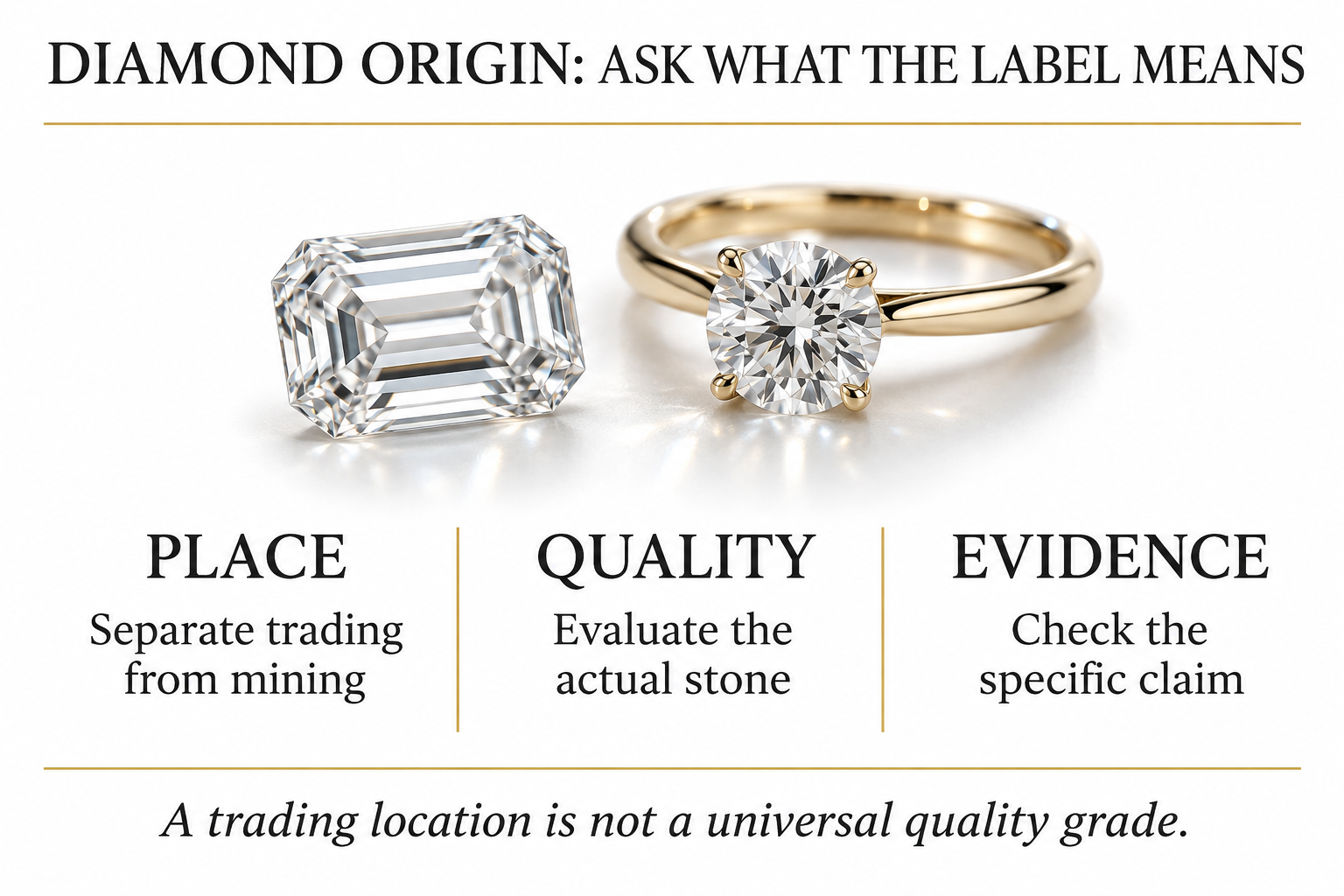
Clarify what the place-name describes
A seller may be describing a business location, a cutting workshop or a trading route. Ask which of these is meant before treating a country name as a statement about the diamond itself.
Israel has an established diamond-trading and manufacturing sector. Its government distinguishes business activities such as trading, manufacturing and setting in the diamond licensing system.
That business context should not become a promise that every stone handled there is more brilliant, clearer or ethically verified than every stone traded elsewhere.
For the actual purchase, request a description of the material, the stone and the seller’s role. A clear invoice is more useful than a broad national reputation.

Separate mining, cutting and selling locations
A diamond can pass through more than one country between extraction, cutting, grading and retail sale. The country where it is purchased need not be where it was mined.

Likewise, a diamond cut in one location can be set into jewelry somewhere else. Ask which stage is documented rather than combining several places into one origin label.
Geographic origin should not be inferred from the stone’s shape, clarity or a claim about a workshop’s craftsmanship. Those observations answer different questions.
If an origin claim matters to you, ask for the records supporting that particular stage and whether they connect the actual stone to the claimed source.
Understand what a grading report says
A laboratory report can describe characteristics such as material identity, weight, color and clarity within the scope of the service used. Read the actual document and verify it through the issuing laboratory’s official service.
An ordinary grading report should not be assumed to identify the country of mining. A report number alone also does not establish every claim made by the seller.
GIA explains that its Diamond Origin program relies on examination of documented rough before polishing and subsequent matching to the polished stone. It is not a retrospective geographic test available for every finished diamond.
A stone without that particular origin service is not automatically irresponsibly sourced. It means the available evidence and the claims being made need to be understood separately.
Evaluate the individual diamond’s appearance and condition
Compare the actual stone’s dimensions, cut-related appearance, transparency, color and visible inclusions in suitable lighting. A trading location does not replace this assessment.
Cutting changes shape and light behavior, and may remove some material, but it does not justify a blanket claim that every inclusion becomes invisible or every stone gains exceptional clarity.
Review the relevant report alongside photographs, video and an appropriate inspection. A high-level description such as “excellent quality” is too broad to explain the purchase on its own.
Establish whether the material is natural or laboratory-grown and whether treatment is disclosed. Neither status can be reliably determined from a country label or a photograph.
Keep ethical and environmental claims specific
Ask what is actually documented: a source, a supply-chain process, an audited business practice or a measured environmental claim. These are different kinds of evidence.
A statement about one supplier should not be expanded to cover every business or stone in a country. Equally, a location alone is not a reason to assume that no responsible practices exist.
If a certification or organization is named, check its scope and the party it covers. Company membership is not automatically an item-specific sourcing certificate.
For environmental comparisons, request the boundaries and basis of any number. Terms such as sustainable or zero-impact should not be treated as self-explanatory quality marks.
Understand the limits of Kimberley Process claims
The Kimberley Process certification scheme addresses international trade in rough diamonds within its defined conflict-diamond framework. Its scope should be read from the scheme’s own current documentation.
It should not be described as a comprehensive certification of every labor condition, environmental impact or finished jewelry item. Those wider questions require their own evidence.
Ask how any accompanying records relate to the offered polished stone. A reference to compliance at an earlier trade stage does not answer every later provenance question.
Use precise language when discussing sourcing. A narrow, supported statement is more informative than claiming that a complete supply chain is guaranteed ethical because a country participates in a scheme.
Compare the complete ring and the seller’s terms
The center diamond is only part of the purchase. Compare the setting, alloy, dimensions, support and finish as well as the stone itself.
Check comfort, ring size and any planned wedding-band pairing. A well-described diamond can still be placed in a setting that does not suit the wearer’s practical needs.
Compare complete quotations and current service terms. A particular trading location does not automatically make the final retail purchase less expensive or provide a resale guarantee.
Keep the invoice, report details and applicable sourcing documentation together. They help distinguish what was stated at purchase from assumptions that might arise later.
Ask for evidence that matches the claim
A concise buying checklist is to ask what the place-name means, what identifies the stone, what describes its quality and what supports any origin or sourcing statement.
At NinaVova, discuss the actual available stone and documentation for the order rather than assuming that an earlier design photograph establishes a source for every future project.
If a statement cannot be supported, describe the uncertainty honestly or choose another option whose documentation better meets your priorities.
A diamond’s trading journey can be interesting, but confidence in a purchase comes from a suitable stone, clear materials, sound construction and evidence appropriate to the claims being made.

Frequently asked questions
Does bought in Israel mean mined there?
No. Trading, cutting and mining locations are separate questions.
Does every grading report show mining origin?
No. Read the scope of the specific report or origin service.
Does a country name guarantee superior clarity or ethical sourcing?
No. Evaluate the actual stone and evidence for each claim.
Choose the stone through clear information
We can discuss the actual diamond, the documentation available for the order and a setting suited to the wearer.
Book a NinaVova consultation or explore our custom design process.
Continue reading: Diamond verification · Ethical sourcing questions · Custom ring process.
Sources and further reading
- Israel Ministry of Economy and Industry: Diamond-business license categories
- GIA: How mining origin is established in its program
- GIA: Origin reports and responsible-sourcing assumptions
- Kimberley Process: What the scheme addresses
Confirm the actual materials, condition, evidence and current written terms for the offered ring. Illustrations do not establish identity, provenance, certification or an environmental footprint.