
Ethical Gemstone Sourcing: Questions, Traceability and Evidence

What supports an ethical-sourcing claim for an engagement gemstone? Responsible sourcing concerns people, environmental impacts and the supply chain. Define the claim, ask for its evidence and understand what remains unknown.
Ask what the claim means and what evidence supports it. Certification, geographic-origin opinions, supplier records and impact studies answer different questions. Check the entity, material, scope and date. A country label, laboratory-grown origin or gemstone identification report alone does not establish a complete ethical sourcing history.
At a glance · Understand the sourcing risks · Define the ethical claim · Check what certification covers · Ask what can actually be traced
Watch the NinaVova discussion
Watch the original NinaVova video on YouTube.
Related NinaVova video: the laboratory-grown ruby discussion includes ethics and quality questions for one material. It does not establish the supply chain of a particular stone.
What each type of evidence can address
| Evidence | What to examine | Do not assume |
|---|---|---|
| Gemological report | Identity, detectable treatments and any stated origin opinion | A mine audit or labor/environmental certification. |
| RJC business certification | Certified entity, activities, standard and validity | Every stone has a complete certified chain of custody. |
| Fairtrade gold documentation | The metal and applicable Fairtrade scope | Any colored center stone is automatically Fairtrade certified. |
| Kimberley Process records | Its defined rough-diamond conflict scope | Coverage of colored gems or every social/environmental concern. |
| Supplier traceability | Which links and transfers are documented | Unbroken mine-to-ring traceability when only country information exists. |
| Impact or community claim | Named project, current records and connection to the purchase | Zero impact or automatic benefit from an attractive story. |
Understand the sourcing risks
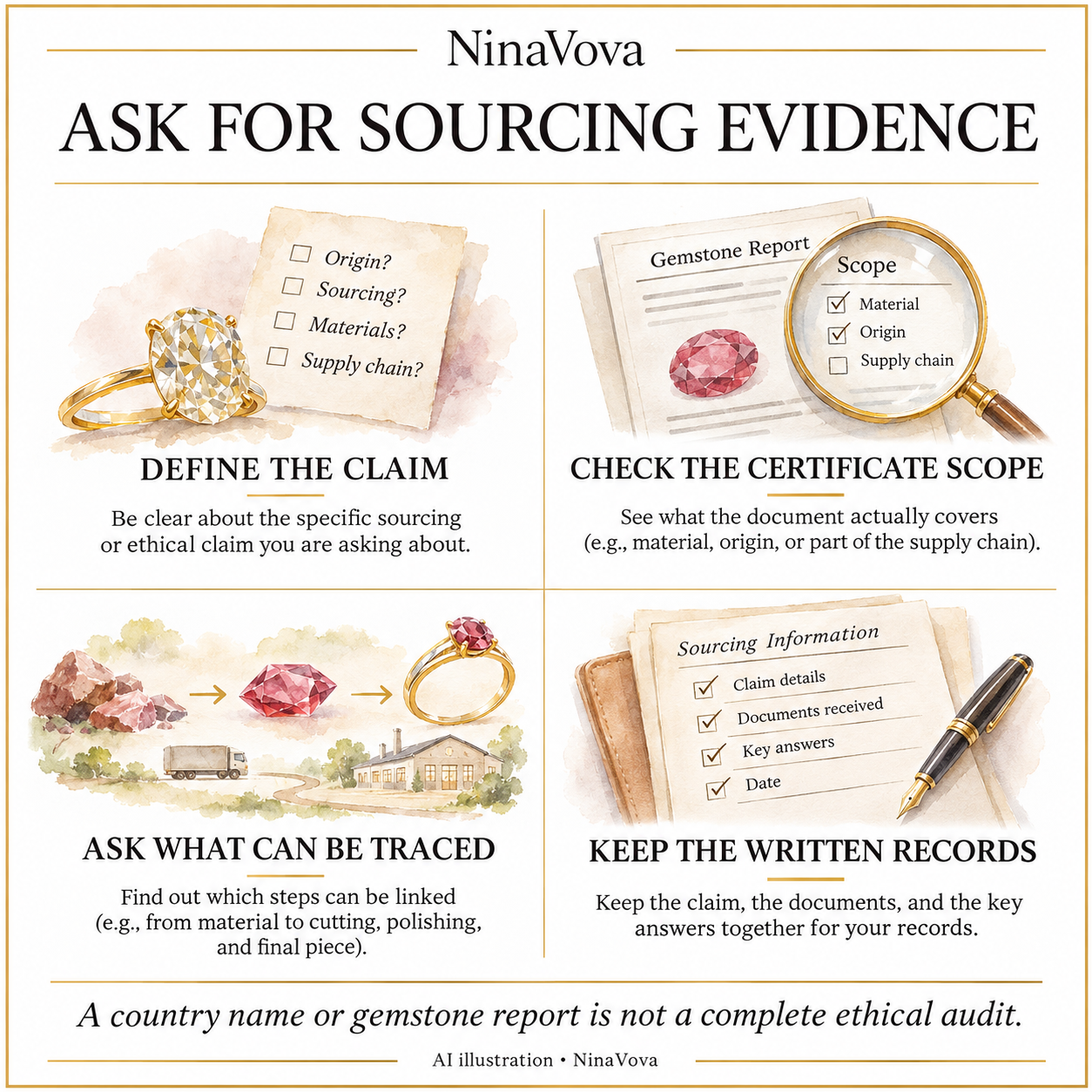
Mineral supply chains can involve unsafe working conditions, forced or child labor, conflict financing, environmental damage and weak oversight. These are risks to investigate, not accusations that every mine, country or supplier behaves the same way. The OECD approach is risk-based due diligence: identify and assess risks, respond to them and document the process. Buyers are not expected to conduct a mine audit themselves. A useful role is to ask the seller specific questions and distinguish a documented practice from a general promise. Avoid assuming that a beautiful finished stone says anything about the conditions in which it was mined or cut.

Define the ethical claim
Ask what “ethical,” “responsible” or “sustainable” means in this particular offer. Is the seller describing labor safeguards, traceability, a certified business, recycled material, energy use or a named community project? Each is a different claim with different evidence. The goal is credible information about the actual material and supplier practices. It is not a promise that a ring has zero impact, that every supply-chain risk has been eliminated, or that a purchase automatically supports a specified charity.
Recycled metal, a reused gemstone, laboratory-grown origin and local fabrication describe different attributes. Ask what proportion of a material is recycled, what records support that description and whether the claim concerns the ring itself or only its packaging. Reuse can be a worthwhile design priority without proving that the entire piece has no environmental impact.
Check what certification covers
Standards and independent audits can help, but their scope matters. The Responsible Jewellery Council’s Code of Practices addresses responsible business practices for certified members within its defined scope. Check the actual legal entity, certification status, dates and covered activities. Membership or a business audit is not automatically a mine-to-ring chain-of-custody certificate for every stone. Fairtrade’s gold standard concerns gold and associated precious metals; it should not be presented as blanket Fairtrade certification of any ruby, sapphire or emerald set into that gold. Likewise, the Kimberley Process concerns rough diamonds and its defined conflict-diamond scope. It is not a certification scheme for colored gemstones or a complete environmental and human-rights audit of a finished ring.
A digital ledger or blockchain can help preserve supply-chain records, but the technology does not independently verify the truth of every entry or audit labor conditions. Check the source of the information, the covered transfers and any independent verification. A seal should identify its actual standard and scope rather than suggest a universal environmental guarantee.
Ask what can actually be traced
Traceability means being able to connect relevant steps in the material’s journey. Ask whether the records identify a country, a mine, a supplier transaction, cutting location or a longer chain, and how that link is maintained. Partial traceability should be described as partial. A laboratory opinion about geographic origin is a different kind of evidence from a supply-chain record or social audit. The lab may identify the likely origin of a gemstone without establishing the working conditions at a particular mine. For a NinaVova project, ask which sourcing information is available for the actual offered stone; this article does not claim complete mine-to-ring traceability for every item.
Country names are only a starting point
A Canadian diamond, Zambian emerald or Australian sapphire can prompt useful provenance questions, but a country name alone does not establish ethical conditions, environmental impact or a complete chain of custody. Treat these as hypothetical examples rather than documented NinaVova inventory or certified sourcing histories. Laboratory-grown origin likewise does not prove zero impact, renewable energy, safe working conditions or the absence of every supply-chain risk. Ask for specific evidence behind those claims.

Questions to ask before paying
Ask where the stone was mined or grown, which parts of that history are documented, who supplied it and what treatments are disclosed. If a certification is cited, request the certificate or verification link and ask exactly what it covers. If a social or environmental benefit is promised, ask who measures it and whether it relates to the offered material. Keep the answers in writing with the order specification. A supplier may have legitimate limits on what can be established. Clear disclosure of those limits is more useful than an absolute “guilt-free” guarantee without supporting records.
Choose transparent communication
A jeweler who takes sourcing seriously should be willing to distinguish known facts, supplier declarations and unanswered questions. Read the stated sourcing policy, ask how it is applied to the particular stone, and choose the level of documentation that matters to you. For NinaVova, bring those priorities into the consultation before selecting a gemstone. Do not infer that a product photograph, a laboratory identification report or this general article proves a specific certification or a complete sourcing audit.

Local manufacture, a small workshop or an artisanal technique does not by itself establish ethical working conditions or a lower total carbon footprint. Ask about the actual practices and evidence. Repairability, appropriate materials, safe care and a design the wearer will continue to enjoy are useful ownership considerations, alongside sourcing information.
Evaluate conservation and community claims
Mine rehabilitation, wildlife protection, water monitoring and community programs should be assessed through current project-specific evidence. Ask who runs a program, what activity and results are documented, and whether any benefit is tied to this purchase. A conservation story is a different question from the source of the actual ring.
Keep the evidence with the ring
A responsible choice starts with a clear question and evidence proportionate to the claim. Keep the material description, treatment disclosure, available origin information and relevant supplier or certification records together. Your priorities can guide the sourcing conversation without turning uncertainty into an unsupported promise.
If considering reclaimed components, organic materials or unusual finishes, review their identity, condition, suitability and future service needs. A biodegradable or natural label is not a complete durability or environmental assessment. Record the specific claims and supporting information rather than relying on a general green promise.
Frequently asked questions
Does a country name prove a gemstone was ethically sourced?
No. It is one piece of information. Ask what records link the stone to the claimed source and what supports any labor, environmental or community statement.
Does a laboratory-grown gemstone automatically have zero environmental impact?
No. Ask for evidence about the actual producer, energy, processes and supply chain. Manufactured origin alone does not establish a complete environmental comparison.
Discuss sourcing priorities before selecting the stone
Tell us which disclosures and records matter to you. Ask what information is available for the actual candidates and which parts of their history remain unverified.
Book a NinaVova consultation or explore our custom design process.
Continue reading: Engagement gemstone overview · Gemstone video and lighting · Ring settings and protection.
Sources and further reading
- OECD: Mineral supply-chain due diligence framework
- Responsible Jewellery Council: Code of Practices
- Fairtrade: Gold and associated precious-metals standard
- Kimberley Process: Scope and conflict-diamond definition
- GIA: Colored-stone report scope
- FTC: Environmental claims and certification scope
Establish any certification, mine-to-ring traceability, producer-energy or project-benefit claim for the actual offer. No blanket certification or zero-impact conclusion follows from a material or country name alone.