

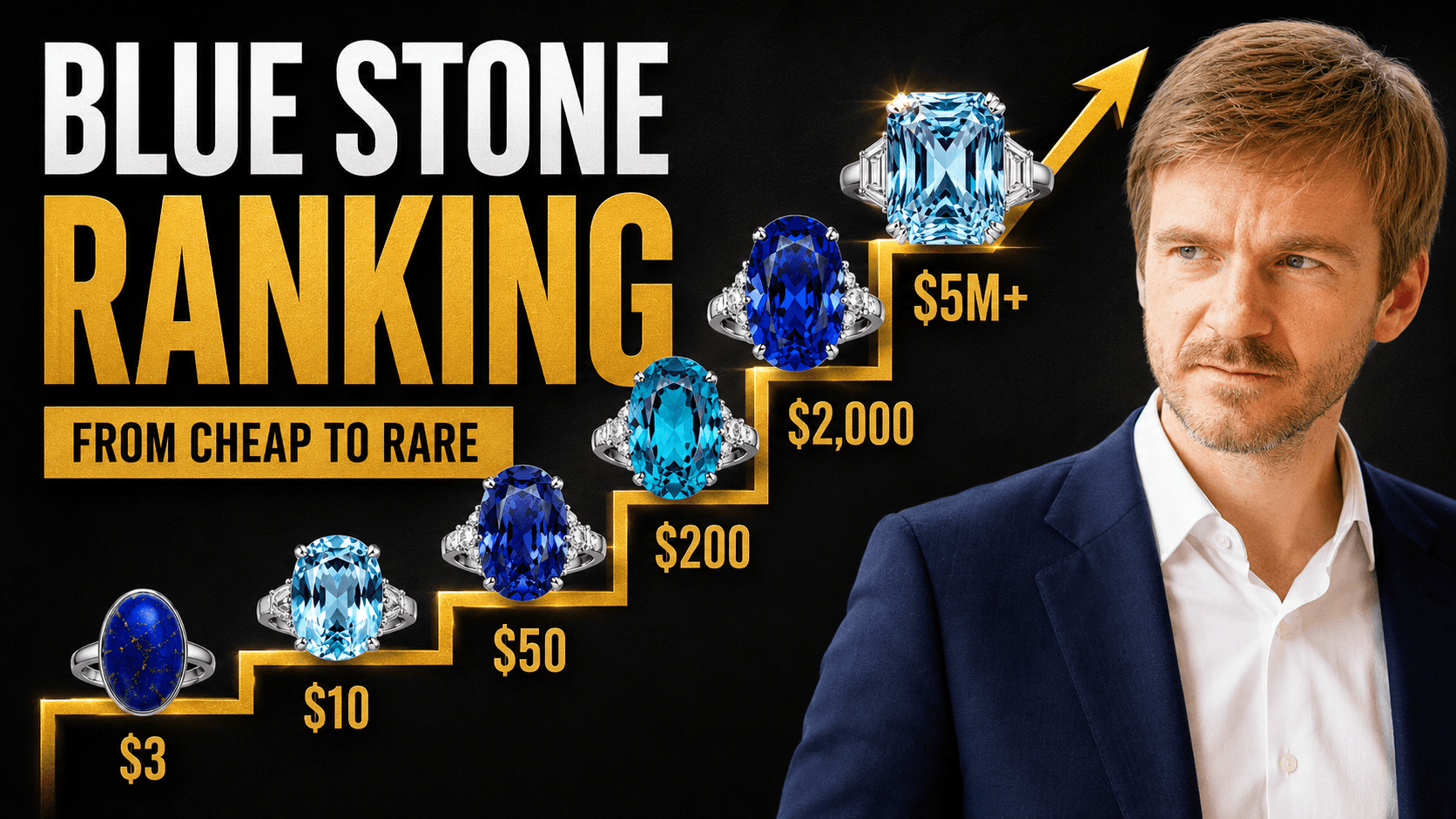
Blue Engagement Ring Stones Ranked From Cheapest to Most Expensive 2

Blue Engagement Ring Stones Ranked From Cheapest to Most Expensive
Most people think blue engagement rings start and end with sapphire. But the truth is that blue is the largest and most diverse color category in the gemstone world. On one end, you can find blue stones costing under a hundred dollars per carat, while on the other, there are rare collector gems that rival fine art in value. Visually, blue gemstones cover a wide range of moods—from tranquil, ocean-like hues to electric, neon brilliances. They can appear royal, stormy, velvety, icy, or even celestial.
Continuing our series on the best gemstones for engagement rings, this article ranks blue engagement ring stones from the least expensive to the most expensive. The list includes natural stones, rare collector gems, artistic alternatives, lab-created options, and finally, blue diamonds. For each gemstone, you’ll find information on:
- Approximate price range per carat for engagement-quality material
- Mohs hardness scale rating (which measures scratch resistance)
- Rarity in terms of gem-quality availability
- Care level needed for daily wear
- A key special trait that makes the stone important in jewelry history or design
Lower hardness stones below a 7 on the Mohs scale generally demand extra care for long-term daily wear.
Without further ado, here are the blue gemstones ranked from most affordable to ultra-rare luxury:
Lapis Lazuli — Approx. $3–40 per carat
One of the oldest blue stones in human history, lapis lazuli has been mined in Afghanistan for over 6,000 years. Ancient Egyptians used it extensively in jewelry, carvings, burial masks, and ceremonial items long before modern engagement rings existed. Later, lapis became crucial in European art due to the ultramarine pigment derived from it, which was once as valuable as gold by weight. Artists reserved lapis pigment for the most important painting details, especially the Virgin Mary’s robes.
Visually, lapis is unlike modern faceted gems. Its deep royal blue mixed with golden pyrite flecks resembles a starry night sky. Lapis lazuli is more of a historical and artistic stone than a traditional luxury choice.
Blue Agate — Approx. $5–50 per carat
Blue agate offers a much softer, calmer atmosphere. Its beauty lies in unique banding patterns and smoky blue-gray tones rather than sparkle. Every agate forms differently, so no two stones are identical. Most cabochon-cut agates appeal to buyers seeking something natural and personal rather than prestigious or formal.
Blue Topaz — Approx. $7–70 per carat
Blue topaz gained commercial importance mainly because it delivers strong blue color at an accessible price. Most blue topaz on the market today is heat-treated; natural blue topaz is extremely rare. Starting as colorless topaz, treatments create popular shades like Sky Blue, Swiss Blue, and London Blue:
- Sky Blue: Icy, bright
- Swiss Blue: Electric and vivid
- London Blue: Darker and moodier
Compared to sapphire, blue topaz feels cleaner and more commercial than luxurious.
Iolite — Approx. $10–100 per carat
Once known as “water sapphire,” iolite’s defining trait is its pleochroism—the way its color shifts between blue, gray, violet, or near colorless depending on the angle. Some historical theories even suggest Vikings may have used thin slices of iolite for navigation by detecting sunlight through clouds. Compared to sapphire, iolite feels more mysterious and less stable.
Moonstone — Approx. $20–300 per carat
Moonstone gained fame for its glowing optical effect called adularescence—a floating blue flash of light beneath the surface. Unlike highly sparkly blue gems, moonstone is soft, atmospheric, and dreamlike. It surged in popularity during the Art Nouveau era, where designers like René Lalique favored glowing organic materials and flowing natural forms. Even today, moonstone retains its artistic and unconventional appeal.
Blue Apatite — Approx. $50–300 per carat
Blue apatite produces vivid tropical colors, sometimes resembling Paraiba tourmaline at first glance—especially material from Madagascar. The colors can appear almost unreal for the price. However, apatite is softer than most expect, making it more suitable for occasional-wear jewelry rather than everyday engagement rings.
Turquoise — Approx. $20–500 per carat
Turquoise is one of the oldest gemstones used in jewelry. Revered by ancient Egyptians, Persian royalty, and made iconic by Native American jewelry, turquoise predates modern gemstone faceting. The pure sky-blue Persian turquoise is historically the most valuable and fine untreated stones with strong color are increasingly rare. Turquoise feels earthy, cultural, and artistic rather than traditionally luxurious.
Kyanite — Approx. $60–500 per carat
Kyanite is unusual due to hardness varying by direction, complicating cutting and setting. Visually, fine kyanite can be striking, especially deep velvety blues that resemble sapphire. However, it is more fragile and much less common in engagement rings compared to sapphire.
Blue Zircon — Approx. $100–1,200 per carat
Blue zircon is often underrated. Despite its similar name, it is completely unrelated to cubic zirconia—blue zircon is a genuine gemstone. Its sparkle is intense, producing more fire than sapphire and sometimes even diamond. It also shows double refraction, where internal facets appear doubled, creating an energetic, almost chaotic brilliance collectors adore. Most come from Cambodia and are often heat-treated to achieve electric blues. Compared to sapphire, blue zircon feels visually explosive and dynamic.
Aquamarine — Approx. $150–1,500 per carat
Aquamarine conveys one of the calmest looks in the gemstone world. Its name means “sea water,” and fine aquamarines embody this serene vibe perfectly. Compared to sapphire, aquamarine is lighter, softer, and more transparent—almost airy. Historically, sailors believed aquamarine provided protection at sea, fitting the stone’s personality. Large, clean stones remain accessible in price, making aquamarine a practical yet elegant engagement ring choice. The most famous source is Brazil, especially deeply saturated “Santa Maria” stones.
Larimar — Approx. $150–2,000+ per carat
Larimar’s appearance is almost unreal, resembling shallow Caribbean waters with white cloud-like patterns. Exclusive to the Dominican Republic, larimar formed through volcanic activity. Its name combines “Larissa,” the discoverer’s daughter, with the Spanish word for sea, mar. Unlike sapphire or zircon, larimar is about calm tropical aesthetics rather than brilliance or sparkle—like carrying a piece of ocean inside your ring.
Blue Moissanite — Approx. $300–1,500 per carat
Blue moissanite presents a radically different look from natural blue stones. It offers intense, not subtle, sparkle with stronger rainbow flashes than diamond, giving it a futuristic vibe under some lights. Opinions vary—some adore its modern look, while others find it too artificial. Blue moissanite is often chosen specifically for its unconventional, contemporary style, unlike sapphire or aquamarine.
Tanzanite — Approx. $350–1,500+ per carat
Discovered in Tanzania in 1967, tanzanite quickly captivated the jewelry world thanks to its extraordinary color shift between blue, violet, and purple. Tiffany & Co.’s promotion helped establish its fame. Compared to aquamarine, tanzanite feels richer, more dramatic, almost like an evening stone. Most tanzanite is heat-treated to attain its famous blue-violet appearance and tends to feel luxurious but less practical than sapphire.
Blue Spinel — Approx. $300–70,000+ per carat
Spinel was long mistaken for other stones, including famous royal “rubies.” Though blue spinel is less renowned than red, fine pieces in gray-blue and cobalt-blue hues can be stunning. Collectors prize spinel because it is usually untreated—an important factor in colored stones. Compared to sapphire, blue spinel often feels cleaner, sharper, and more modern. “Cobalt spinel” derives its vivid electric blue color from cobalt, with the finest Vietnamese stones almost glowing. These are typically small but highly sought-after by collectors.
Indicolite Tourmaline — Approx. $400–3,000+ per carat
Indicolite is the blue variety of tourmaline. Perfectly pure blue stones are extremely rare, with most shifting toward teal, green, or violet, adding visual interest. Compared to sapphire, indicolite tends toward a moodier, more organic feel—less formal and polished. The finest clean and saturated stones command surprisingly high prices due to their rarity.
Benitoite — Approx. $3,000–20,000 per carat
Benitoite remains unfamiliar to many jewelry lovers. Most gem-quality material comes from California, making it the state’s official gemstone. Visually, benitoite can shock with strong fire sometimes exceeding sapphire. Many stones fluoresce under UV light. Sizes are generally small, so larger, clean stones are especially collectible.
Grandidierite — Approx. $1,000–10,000+ per carat
One of the rarest gems here, grandidierite is so scarce that collectors once counted faceted gem-quality stones by hand. Primarily mined in Madagascar, it blends aquamarine’s softness with teal sapphire’s depth. The oceanic, soft, slightly mysterious look makes it a true collector’s stone rather than a common engagement choice.
Paraiba Tourmaline — Approx. $3,000–300,000+ per carat
Paraiba tourmaline rocked the jewelry world when discovered in Brazil in the late 1980s. Its copper content creates a neon glow that looks lit from within—a color many initially thought was artificial. Brazilian Paraiba remains the most coveted, though deposits were later found in Mozambique and Nigeria. Compared to sapphire, Paraiba feels less timeless and more visually extreme.
Blue Sapphire — Approx. $500–200,000+ per carat
Defining blue gemstone engagement rings, sapphire uniquely balances durability, prestige, history, and practicality. It is the benchmark other blue gems are measured against.
- Royal Blue Sapphires: Deep, velvety, rich but still bright enough to shine.
- Kashmir Sapphires: Legendary with softness from microscopic rutile “silk” inclusions; now exhausted and collector-level.
- Sri Lankan Sapphires: Brighter, cleaner, wide range of blue tones.
- Montana Sapphires: Popular for their understated, natural look with denim blues, teal, and stormy gray hues.
- Teal Sapphires: Color-shifting stones with blue-green shades favored for uniqueness.
- Parti Sapphires: Multiple colors inside one stone for one-of-a-kind appeal.
Sapphire’s vast range offers options for nearly every buyer. For deeper detail, we have dedicated videos on sapphires, Montana sapphires, teal sapphires, and sapphire pricing.
Lab Blue Sapphire — Approx. $100–2,000+ per carat
Lab-grown blue sapphires offer excellent value. Chemically, they are real sapphires, produced in controlled environments. Modern labs can create perfectly clean royal blue stones, silky included varieties, teal shades, Montana-like colors, and even antique styles. Lab sapphires appeal especially to buyers seeking sapphire’s look at more accessible prices.
Lab Blue Diamond — Approx. $5,000–30,000+ per carat
Lab blue diamonds open a rarefied category otherwise out of reach. Natural blue diamonds are so scarce that most buyers never seriously consider them, but lab-created versions provide accessible alternatives. Created through HPHT or irradiation, lab blue diamonds can have stronger, more saturated blues than their natural counterparts. This is one of the few practical ways to get the coveted blue diamond look without astronomical collector prices.
Blue Diamond — Approx. $100,000–5,000,000+ per carat
Blue diamonds are among the rarest and most valuable gemstones on Earth. The blue hue comes from boron within the crystal—a rare natural phenomenon. The Hope Diamond, a 45.52-carat blue diamond now at Washington D.C.’s Smithsonian, exemplifies their fame, surrounded by history, legend, and royal intrigue. Blue diamonds regularly smash auction records. At this level, price largely defies rationality as stones move between museums, elite collectors, and auction houses. Unlike sapphire, blue diamonds are prized less for saturated color and more for extreme rarity, making them the perfect grand finale for this list.
From ancient lapis lazuli used millennia ago to the rarest blue diamonds on the planet, the world of blue engagement ring stones is astonishingly broad. If any of these gems caught your eye, we offer in-depth videos exploring many of them—such as sapphires, moissanite, diamonds, Paraiba tourmaline, and engagement ring durability. Before buying an engagement ring, it’s essential to understand your chosen stone’s unique characteristics, as blue gemstones vary greatly in appearance, wearability, and aging.
Thank you for exploring these blue gems with us. We look forward to guiding you in your jewelry journey.