


Salt-and-Pepper Diamond Engagement Ring Guide — NinaVova Education
NinaVova · Learn before you choose
The salt-and-pepper diamond
engagement ring guide.
Choose the exact pattern she loves. Compare transparent, galaxy, icy and colored diamonds, then understand sparkle, structural concerns, treatments and the complete design.

In this guide Choose a chapter
01 / Start with the exact diamond
Start with the exact diamond.
Quick Basics
Before we separate these diamonds into types, we need to understand what the name means.
A salt and pepper diamond is not a separate species. In this guide, we focus on natural diamonds whose visible inclusions are deliberately chosen as part of their appearance.
They may appear as crystals, clouds, feathers, pinpoints, dark areas, white veils, or reflections. “Salt” usually describes lighter features. “Pepper” describes gray or black ones. And not every dark inclusion is carbon.
Salt-and-pepper is an appearance category, not a separate mineral, mine source or official clarity grade. The trade has no universal inclusion threshold for the name.
The term is used when the inclusions stop being something the design tries to hide. They become part of the stone’s pattern and personality.
We will look at them in 3 layers: transparency and pattern, colored crystal inclusions, and the diamond’s underlying body color. One diamond can combine several groups.
Let’s begin with the type closest to the light performance most buyers expect.
Classic Transparent Salt and Pepper
This is usually the best starting point for visible inclusions and recognizable sparkle.
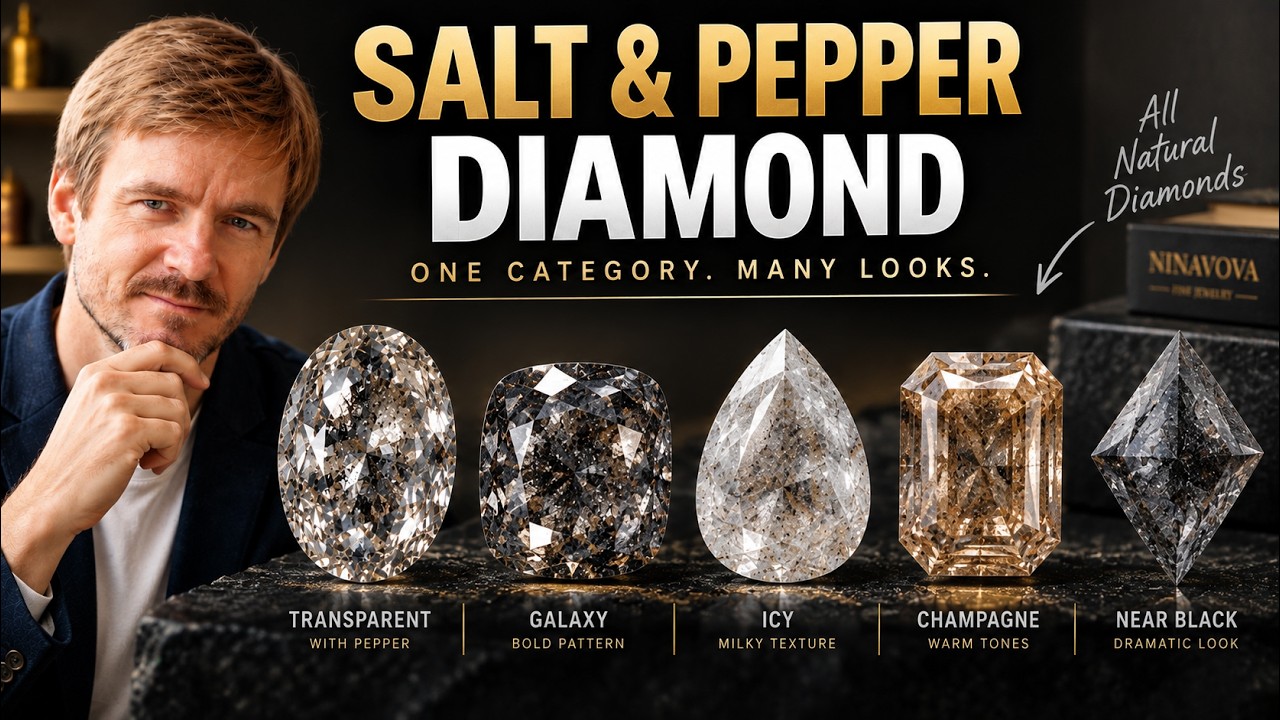
The diamond remains mostly transparent, with black, white, gray, or reflective features suspended inside it. Some have fine pepper. Others have larger crystals or one inclusion repeated through several facets.
Because clear material remains between the inclusions, this type has the strongest potential for brightness. It also exposes poor cutting, dead areas, windowing, and awkward inclusion placement.
Judge it at normal hand distance, not only through a macro lens.


02 / Transparency & inclusion patterns
Transparency & inclusion patterns.
Pepper-Heavy or Galaxy Diamonds
As dark inclusions become denser, the appearance moves into the galaxy family.
These diamonds may contain fine pepper dust, a dark cloud, or dark sections broken by clear openings. Buyers choose them for drama and a celestial appearance.
But “galaxy” is only a visual name. A transparent example may remain lively. A denser one may look detailed under studio lighting but almost black indoors.
See it in daylight, ordinary room light, and while moving. Backlighting can reveal a pattern that disappears once the diamond is set.
Dalmatian or Large-Spotted Diamonds
Some diamonds have fewer, larger crystals, creating what is called the Dalmatian look.
The clear spaces between the crystals may retain good sparkle. A large crystal is not automatically dangerous. The concern is whether it connects to a feather, cavity, or surface-reaching break.
“Dalmatian” describes the pattern. It says nothing about cutting, rarity, or structural safety.
Diamonds with Colored Crystal Inclusions
Not every visible inclusion is white, gray, or black. Some diamonds contain mineral crystals with their own color.
They may appear red, orange, green, brown, or metallic. Red or purplish-red crystals can be garnet. Green inclusions may include olivine or chromium-bearing diopside.
A yellow diamond with red crystals is not simply bicolor. It may be a yellow-bodied diamond containing separate red mineral inclusions. Body color, color zoning, and colored inclusions are 3 different things.
Colored crystals can become the strongest feature in the stone, almost like tiny gemstones suspended inside it. But color alone cannot identify the mineral with certainty.
A fully enclosed crystal may be mainly visual. The concern is whether it reaches the surface or has fractures around it.
Salt-Heavy or White-Speckled Diamonds
In other diamonds, lighter features spread more broadly and begin to dominate.
These stones contain white clouds, pale crystals, feathers, veils, and reflective features. The result can look snowy or frosted, even with reduced transparency.
A cloud may be mainly visual. A feather reaching the surface may matter structurally.
Too much cloudiness can flatten the center, so the stone should still show life, even when that life is glow rather than sharp sparkle.
Icy, Milky, or Opalescent Diamonds
When lighter features spread through most of the diamond, the result becomes icy, milky, or opalescent.
These stones have an overall haze resembling ice or fog. The appeal is atmosphere rather than precision.
But “icy” is used loosely. It may describe attractive translucency, or it may make a dull diamond sound special. It also does not automatically mean Fancy White.
The practical test is whether it glows in ordinary light, not only when light is pushed through the back.
Smoky or Gray Salt and Pepper Diamonds
That hazy appearance can shift into silver, smoke, charcoal, blue-gray, violet-gray, or brown-gray.
Some remain transparent and lively. Others are nearly opaque. The appearance may come from body color, dense inclusions, or both, so an included gray diamond is not automatically Fancy Gray.
The word gray tells you the color impression, not how the diamond handles light.
Rustic Translucent Diamonds
As transparency decreases further, the diamond begins to look more earthy, layered, and organic. This is what the trade usually calls a rustic diamond.
These stones are heavily included and only partly transparent. Their appearance may combine gray, white, brown, yellow, black, or several colors at once.
Instead of separate spots or a clean haze, the inclusions often create broad patches, streaks, clouds, and landscape-like areas.
That mixed appearance is the appeal. A rustic diamond can resemble stone, smoke, bark, or a landscape trapped inside it.
But “rustic” is broad. One stone may have beautiful color transitions and a clear pattern. Another may simply look muddy or flat.

Near-Black and Black Included Diamonds
At the darkest end, inclusions become dense enough that little light passes through the stone.
Some appear charcoal with lighter openings. Others look fully black and rely on polished surface reflections rather than internal brilliance.
This suits someone who wants maximum contrast and does not care about traditional diamond sparkle.
A near-black included diamond can sit within the salt and pepper spectrum. A fully opaque black diamond usually belongs to the wider black-diamond category. Natural and treated black diamonds can look similar, so natural color claims should be verified.
Up to this point, we have looked at transparency and the inclusions themselves.
Now we need to separate that from body color. A yellow diamond may contain red crystals. A champagne diamond may contain black pepper. An icy blue-gray diamond may contain white clouds.
03 / Body colors & color zoning
Body colors & color zoning.
Champagne, Brown, and Cognac
This family ranges from beige and honey to bronze, amber, cognac, and deep brown.
These diamonds feel warm, earthy, and less formal than a white diamond. Their inclusions can add depth, especially in botanical or vintage-inspired rings.
Champagne and cognac are trade descriptions, not separate varieties.
Keep in mind that yellow or rose gold can enrich the warmth. White metal can reveal more gray or brown. I would judge the diamond beside the actual metal.
Yellow and Orange
As the warm body color becomes stronger, champagne and brown can move into yellow, gold, amber, orange-yellow, rust, and brownish orange.
The lightest stones may look pale straw or honey-colored. Stronger examples can appear golden, mustard, amber, or burnt orange. Some stay bright and transparent. Others become deeper, earthier, and more translucent.
The inclusions can make these colors much more complex. Black crystals may create sharp contrast inside a yellow diamond. White clouds can soften the color. Brown or orange zones can make the stone look warmer and more layered.
Blue-Gray and Violet-Gray
On the cooler side, these diamonds can shift into steel gray, blue-gray, lavender, and violet.
They often appear darker indoors. A faint blue cast in an included gray diamond does not automatically make it a rare natural blue diamond.
A stone that looks blue in one photograph and gray everywhere else should not lead a blue-first design.
Green and Blue-Green
The cool spectrum can also move toward olive, moss, forest green, blue-green, or muted teal.
This is one of the strongest families for botanical rings because the color and inclusions can resemble moss, forest, lichen, or water.
Natural and artificially irradiated green can look very similar, so a diamond sold as naturally green should have that color origin confirmed by a respected laboratory.
Pink, Purple, and Reddish
At the softer end of the spectrum, some salt and pepper diamonds show dusty pink, rose, mauve, lavender, purple-gray, or reddish-brown color.
These tones are usually muted rather than vivid. The inclusions can make the color look smoky, layered, or earthy, which gives the stone a more organic appearance than a clean pink diamond.
Some examples have an even body color. Others show darker zones, colored graining, or a mixture of pink, brown, gray, and red across the stone.
The strongest examples still read clearly as pink, purple, or reddish from normal viewing distance. If the color only appears in close-up photography or under one specific light, the name is doing more work than the diamond.
Bicolor and Color-Zoned Diamonds
Some salt and pepper diamonds show more than one color or a clear shift across the stone.
One side may be brown and the other gray. Yellow may collect near one end. A transparent section may sit beside a dense dark cloud.
This can create a layered, almost landscape-like appearance.
Cut orientation matters because the same rough can look completely different depending on which section faces upward.
These stones usually look best when the ring design follows the natural color pattern.

04 / Why buyers choose them
Why buyers choose them.
Why visible inclusions can become the focal point
Buyers may choose an included diamond for its individual pattern, muted color or contrast. Rose cuts and unconventional outlines can emphasize these features, while a custom setting can follow a particular zone or silhouette.
The appeal is personal. A familiar trade name or a trend does not establish rarity, condition or value. Choose the actual pattern she enjoys and check its practical suitability separately.
05 / Sparkle, cutting & shape
Sparkle, cutting & shape.
Do Salt and Pepper Diamonds Sparkle?
Some do. Others produce a soft glow, broad flashes, or almost no internal sparkle.
Transparency makes the first difference. A mostly transparent diamond with isolated crystals can still allow plenty of light to move through it. Dense clouds and opaque areas block more light. Inclusions near the edge may leave the center lively, while a dense cloud beneath the table can suppress brightness.
Cut determines how effectively the diamond uses the transparency it has. A well-cut transparent example can show brightness, fire, and scintillation. A translucent stone gives broader flashes and glow. A nearly opaque diamond relies mainly on polished surface reflections.
Inclusions do not automatically eliminate sparkle, and cut cannot create transparency that the rough never had.
Cut Styles and Shapes
Cutting style determines how the diamond handles light and how clearly the inclusions remain visible.
Brilliant and modified brilliant cuts offer the strongest potential for recognizable sparkle. They work best with transparent and semi-transparent material, although their facets can reflect one inclusion several times and make the pattern appear denser.
Rose cuts have a flat or nearly flat base with a faceted crown. They create broad flashes, show body color and inclusions clearly, and usually appear large for their weight.
Step cuts produce slower mirrored flashes and give a clearer view inside the diamond. They can make a strong pattern look architectural, but they also expose clouds, windows, and dead areas.
Portrait cuts and slices are extremely shallow and prioritize outline and pattern over internal sparkle. Mixed cuts combine several facet styles to preserve the pattern while adding more light movement.
Shape matters differently with salt and pepper diamonds because the cutter is often trying to preserve a particular inclusion pattern, colored crystal, or color zone.
A round or symmetrical cushion works best when the pattern is attractive and reasonably balanced through the center. Brilliant faceting can repeat individual inclusions around the stone, so one dark crystal may appear several times.
Elongated pears, marquises, and ovals can follow long sections of rough or keep a directional cloud, streak, or color transition visible from end to end. But their natural contrast pattern can combine with dark inclusions and create a center that looks heavier or darker than expected.
Kites, shields, hexagons, and irregular outlines are especially useful when the most attractive part of the rough is concentrated in one area or follows an unusual boundary. Instead of cutting that feature away to create a standard shape, the outline can be built around it.
The tradeoff is that points and thin corners need closer inspection. An inclusion or fracture near a point or girdle can create a much more serious durability concern than the same feature safely enclosed near the center.
01 / Same light
Rotate the actual stone gently. Notice changing reflections and, for suitable materials, directional color.
02 / Same stone
Keep the stone and background consistent. Change from indirect daylight to ordinary room light.
03 / Real scale
Look at hand distance and over skin. Keep camera exposure steady and avoid filters.
A comparison method, not a prediction that every stone changes color in the same way.
Weight, dimensions and the complete price
One carat is 0.20 grams. Compare length, width and depth as well as weight: a shallow rose cut may cover more of the finger than a deeper brilliant of similar weight, while giving a different kind of light performance. Ask for a realistic scale reference and the proposed setting profile.
Compare the exact diamonds rather than a generic salt-and-pepper price. Transparency, pattern, body color, cutting, size, condition, treatment and documentation all affect an offer. Include metal, accents, craftsmanship and service terms in the ring budget; the category does not guarantee a discount or future resale value.
06 / Assess beauty & condition
Assess beauty & condition.
How to Recognize a Good Salt and Pepper Diamond
A good salt and pepper diamond is not simply the clearest one or the most included one. The appearance should feel intentional and suit the material.
First decide whether you want sparkle, glow, contrast, body color, or a landscape-like pattern. Check it in daylight, ordinary indoor light, and movement. Look for a lively center, clean polish, a deliberate outline, reasonable symmetry, and no distracting window or dead section unless the cut is intentionally portrait-like.
Finally, inspect the edges, points, cavities, and fractures reaching the surface. Beauty and structural safety are separate questions.
07 / Durability, treatments & reports
Durability, treatments & reports.
Durability, Treatments, and Reports
Diamond resists scratching, but included diamonds do not all have the same resistance to chipping.
The number or darkness of the inclusions is not the main issue. Their type and position matter more. Enclosed crystals, pinpoints, and localized clouds may be mainly visual. Surface-reaching feathers, deep fractures, cavities, existing chips, and fractures crossing the girdle or reaching a point deserve much more caution.
A diamond with many enclosed dark crystals may be structurally safer than a clearer-looking diamond with one deep fracture opening at the girdle.
The setting must follow the stone. Prongs should avoid weak areas, pointed shapes need protection, and a bezel can protect the perimeter. But no setting can make an unstable diamond sound.
Natural diamonds can also be treated after mining. Irradiation or HPHT treatment may change body color, while laser drilling and fracture filling may reduce the visibility of inclusions. These treatments must be disclosed.
There is no special salt and pepper certificate. A laboratory report may document measurements, clarity characteristics, treatments, and whether a claimed color is natural.
A report does not replace your assessment of beauty or a jeweler’s examination of setting safety. Check the laboratory’s service scope: GIA does not issue grading reports for fracture-filled or coated diamonds. The stone still needs direct inspection.
Laboratory-grown salt and pepper diamonds also exist, but this guide focuses on natural diamonds.
Salt and pepper diamonds only make sense once you stop treating them as one look.
A transparent stone can still give you recognizable sparkle. Galaxy and Dalmatian diamonds are about pattern and contrast. Icy and rustic stones are chosen more for glow, texture, and atmosphere. Colored examples can make the body color or the trapped mineral inclusions the main feature.
Whichever direction you prefer, judge the exact diamond in normal lighting, understand what the cut is doing, and make sure the inclusions creating the character are not also creating a structural problem.
The category name should never make the decision. The exact diamond should.
Read the hardness scale correctly.
- Diamond
- Corundum (ruby and sapphire)
- Topaz
- Quartz
- Feldspar
- Apatite
- Fluorite
- Calcite
- Gypsum
- Talc
Clean for the actual inclusions and treatment
A diamond’s Mohs 10 hardness does not make a heavily included stone safe for every cleaning method. For a sound stone and compatible setting, mild soapy water and a soft brush are a gentle starting point. Ask the jeweler for instructions if fractures, filling, coatings or vulnerable accents are present.
Avoid ultrasonic or steam cleaning until the particular diamond and setting have been assessed. Remove the ring for heavy work and impacts, store it separately, and arrange an inspection if a stone becomes loose or the ring receives a hard knock.
Your custom ring
From what you know about her
to a finished ring.
Discovery & Design
The journey begins with understanding your vision and translating it into a unique ring design.
- Personal Consultation: We initiate a detailed conversation to capture the essence of your desired design.
- Design Inspiration: Presenting examples of previous works to showcase what's possible and inspire your selection.
- Sketching Ideas: Our designers sketch several versions of your ring, refining the concept to match your vision.

Gemstone & Metal Selection
Choosing the perfect materials to bring your custom ring to life.
- Choosing the Right Stone: We offer a serious selection process, explaining all gemstone options and providing educational materials.
- Trusted Vendors: We provide multiple options from our reliable vendors with whom we have longstanding relationships.
- Custom Cuts: If your vision includes a unique gemstone shape, we can custom-cut the stone for you.
3D Modeling & Approval
Visualizing your ring in precise detail before it comes to life.
- 3D Presentation: We create a 3D model of your ring, allowing you to visualize and turn it around, ensuring it matches your expectations.
- Design Finalization: We proceed only when you are completely satisfied with every detail of the design and model.


Craftsmanship & Creation
Bringing your ring to life with meticulous attention to detail and quality craftsmanship.
- Wax Modeling: Creating a wax model to capture the intricate details of your design before casting in metal.
- Expert Crafting: Our artisans craft your ring, focusing on alloy creation, meticulous polishing, and precise stone setting.
Delivery
The final step where your custom engagement ring is ready to be delivered and cherished.
- Complimentary Shipping: Your ring is shipped to you for free, anywhere in the world.
- Lifetime Warranty: All our rings come with a lifetime warranty, ensuring your peace of mind (with the exception of accidental damage).

09 / Questions before you choose
Questions before you choose.
Are salt-and-pepper diamonds always natural?
No. Included laboratory-grown diamonds also exist. Salt-and-pepper describes appearance, not growth origin or a laboratory grade. This guide focuses on natural examples; confirm the actual stone’s identity and treatment separately.
Will every salt-and-pepper diamond sparkle?
No. Transparency and cutting determine how much light can return through the stone. A transparent example can sparkle, while dense clouds or opaque material may produce softer glow or surface reflections. View the exact diamond in motion.
Is this guide about the actual stones for sale?
The photographs link to real examples, but availability and prices can change. Confirm the current listing, treatment disclosure, measurements and any report for the exact stone before ordering.
Can we choose the stone before finalizing the design?
Yes. We can compare candidates and develop the setting around the chosen stone’s outline, depth, condition and the wearer’s preferences. Bring a color, an idea or simply what you know about her.
What should the complete quotation include?
Identify the actual center stone and accents, metal, design work, relevant reports, known treatments, current price, taxes, shipping, approval stages and delivery. Confirm resizing, return, warranty and aftercare terms for the project.
Does a laboratory report guarantee beauty or future value?
No. It reports the findings within the laboratory’s service scope. Match it to the stone, then assess appearance, physical condition, price and the complete ring separately.
10 / Continue on the NinaVova blog
Continue on the NinaVova blog.
11 / About NinaVova
A name inspired by lasting love.

Guided by your story.
NinaVova is named after founder Sergey’s grandparents, Nina and Vladimir. Their enduring love inspires the rings we create.
Our design, production and client-guidance team helps turn your ideas into a personal ring, from the first conversation to the finished piece.
Meet NinaVova ↗Image credits & gemological references
Real gemstone and jewelry photographs are identified in captions and link to NinaVova examples where available. Illustrations are educational concepts, not identity tests, controlled color grades or promises of an individual stone’s appearance. Catalog availability can change.
Your story starts the design
Let’s create the ring
that feels like her.
Bring a favorite color, a ring idea or simply what you know about her. We’ll help you understand the options and create the ring together.
Talk with Sergey →Explore salt-and-pepper diamond options ↗