


High vs Low Profile Engagement Rings: Settings, Comfort and Fit

A ring’s profile describes how its center and setting sit above the finger. The setting describes how the stones are held. These choices interact, but they are not interchangeable: a bezel can be raised, and a prong design can be relatively low. Choose the actual side view, dimensions and wearing experience rather than a style name alone.
Compare the side view and dimensions, not the setting name alone. Profile describes height above the finger; setting describes how stones are held. Comfort, band clearance, construction and wearing precautions depend on the actual ring.
At a glance · Setting and profile answer different questions · Compare side views and actual dimensions · Higher profiles: presence, clearance and tradeoffs · Lower profiles: comfort without an all-activity promise
Watch the NinaVova discussion
Watch the original NinaVova video on YouTube.
Related NinaVova custom-design discussion supports choosing profile and construction together; it is not a dedicated demonstration of every setting below.
Profile and setting: questions worth asking
| Question | What to review | Avoid assuming |
|---|---|---|
| Height | Side view and measured reference points | Every bezel is low |
| Brilliance | Actual gem, cut and lighting | Height guarantees more sparkle |
| Band pairing | Underside clearance and contact | High always means flush |
| Daily comfort | Fit, finish and wearing routine | Low is safe for all tasks |
| Security | Actual setting workmanship and condition | One style can never lose a stone |
| Service | Cleaning, inspection and resize limits | Low means maintenance-free |
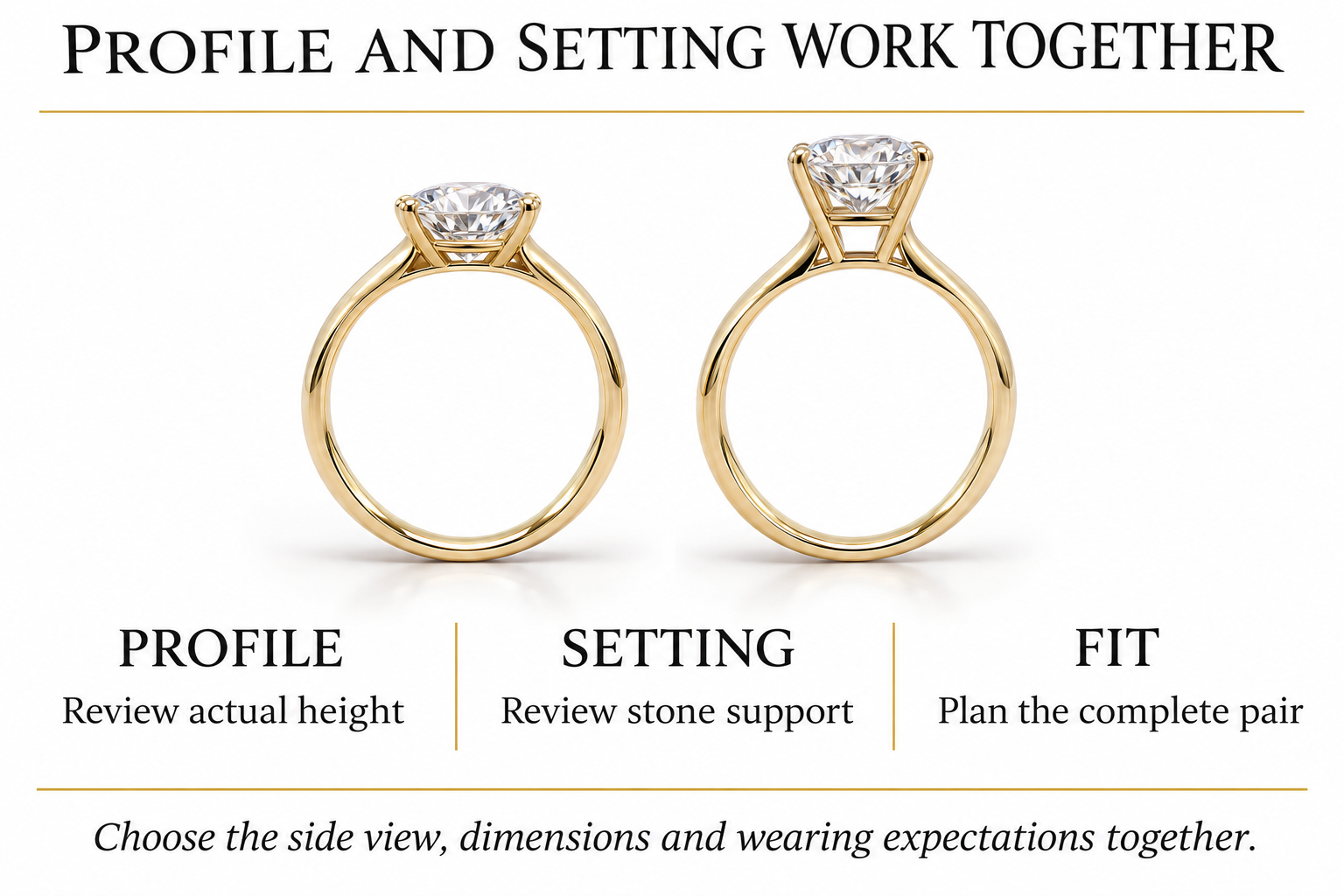
Setting and profile answer different questions
The setting is the structure securing the stone: examples include prongs, a bezel, pavé and channels. A ring may combine several methods, with one around the center and another along the band.
Profile concerns height and shape above the finger. Low, medium and high are useful descriptions, but they are not universal measurement grades with identical boundaries across every maker.
The gemstone’s depth, supporting metal, band dimensions and space beneath the setting all influence the finished profile. Not every combination is feasible at any requested height.
Look beyond a face-on photograph. Two rings with similar outlines may feel and behave differently when their side views and actual construction are considered.

Compare side views and actual dimensions
Ask how the quoted height is measured, preferably with a side view or design drawing. A measurement from the finger-contact level to the highest point is more informative when its reference points are clear.
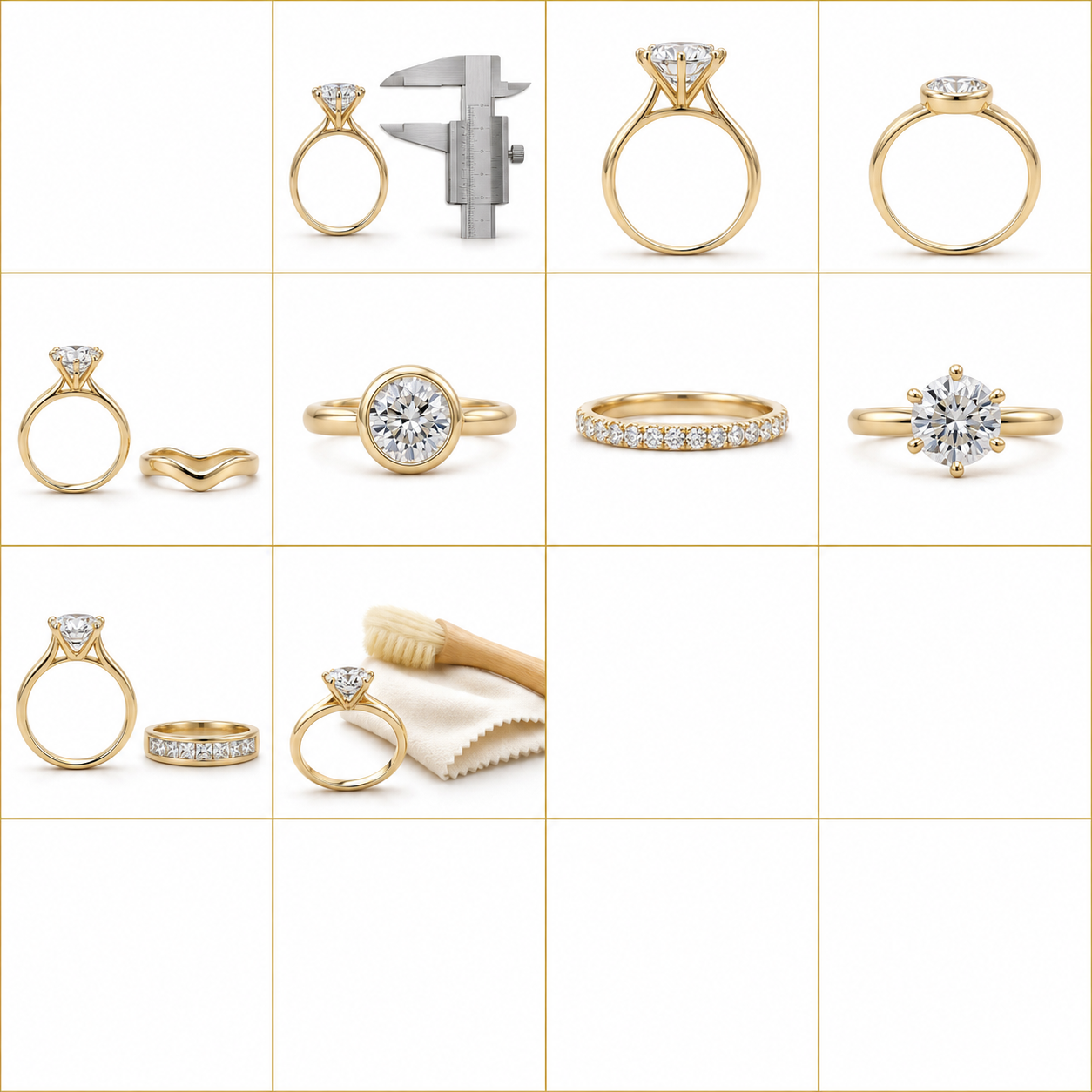
The space below a stone is only one clue. Its depth and the thickness of the supporting structure also affect how far the top rises.
Try comparable samples if possible and consider the ring on the intended finger. A photograph without a scale can make a modest height difference look dramatic or conceal one that matters.
For a custom project, review the profile before approving production. Discuss which details can change and which are constrained by the actual stone and sound construction.
Higher profiles: presence, clearance and tradeoffs
A raised center can create a prominent silhouette and may leave space for a wedding band to sit beside or beneath part of the setting. That clearance depends on the actual geometry.
Height alone does not guarantee more brilliance or make a stone a fixed percentage larger. The gem’s optical properties, cut, cleanliness and viewing conditions remain important.
A taller design can catch on clothing or encounter more contact during hand use. Smooth finishing and good proportions help, but they cannot eliminate every snag or impact risk.
If you enjoy the appearance, assess it with your routine rather than assuming a high ring belongs only to special occasions. Suitable wear and regular maintenance still matter.
Lower profiles: comfort without an all-activity promise
A lower silhouette may feel less obtrusive and can reduce some catching in everyday use. It can be an elegant choice without requiring a particularly small or visually quiet center.
A large stone does need enough room for its depth and support, but that does not mean every substantial gem must use a towering setting. Shape and construction affect the possibilities.
Low profile is not permission to wear a ring for lifting, machinery, climbing or other activities that risk impact, catching or injury. Remove jewelry when the activity calls for it.
Healthcare and other workplaces may restrict rings regardless of height. Follow the actual workplace and glove policies instead of assuming a low setting is automatically suitable.
Low rings still need cleaning and inspection. The label does not guarantee that a stone cannot loosen or that the setting requires less professional attention.
Plan the wedding-band relationship
If two rings will be worn together, review them together. The center basket, shoulders and underside of the engagement ring determine whether a straight band can sit close.
A higher head may provide clearance, but it is not a universal guarantee of a flush fit. A low design may pair well with a shaped, open or deliberately separated band.
Consider contact between the pieces, not just the gap in a photograph. Stones and metal rubbing against each other can create wear.
A bridal stack also changes the feel on the finger. Confirm the combined width, comfortable fit and whether the intended arrangement can be maintained as the rings move.
Bezel settings: a rim around the stone
A bezel uses a metal rim to hold the gem. Full and partial variations can create a clean outline, with different amounts of visible metal and exposed edge.
Many bezels are relatively low, but the setting method does not dictate one height. The gem’s depth and the supporting design still determine the profile.
A well-designed bezel may protect vulnerable edges and reduce exposed prongs. It cannot make an opal, diamond or any other center immune to damage or loss.
Compare how much of the stone is covered, the craftsmanship of the rim and access for appropriate cleaning. A heavy border can change the apparent shape, while a finer one asks for careful engineering.
Choose the look because you enjoy it, with realistic wearing precautions. No bezel design makes motorcycle racing, substantial housework or every manual activity safe for a ring.
Pavé and micro-pavé: small stones across a surface
Pavé describes closely arranged small stones held with tiny beads or prongs, creating a paved effect. Micro-pavé involves very fine work commonly performed with magnification.
These accents can appear along the band or around a larger center. They do not establish the overall height of that center.
A halo or pavé surface can change the visual outline and add sparkle, but there is no universal twenty-percent increase in a center stone’s apparent size. Compare the actual design.
Small settings need sound workmanship, gentle appropriate cleaning and inspection. Losing a small accent is not inevitable, but a delicate appearance should not be mistaken for freedom from maintenance.
Stones extending far around the band may complicate resizing. Confirm the initial size and practical adjustment limits before approving the design.
Prong or claw settings: visible stone and precise support
Prongs hold the stone at selected points, leaving much of it visible. Four- and six-prong arrangements are familiar, while suitable numbers and shapes depend on the gem and design.
More prongs are not automatically better in every case. Position, contact, thickness, finishing and protection of vulnerable points all matter.
A prong setting can be relatively low or high within the limits of the actual stone and structure. The word solitaire describes the composition, not a single mandatory height.
Raised or poorly finished tips may catch on clothing. A qualified jeweler should assess any snagging or movement rather than the wearer bending prongs at home.
Examine security and wear periodically. Even a well-made ring is not guaranteed to retain the center indefinitely without checks or service.
Cathedral and channel details
Cathedral shoulders rise toward the center, forming arches in the side view. They can support or visually frame the head, but the term does not specify one exact height.
A cathedral ring may also use prongs or a bezel around its center. Discuss how the shoulders, head and band work together instead of treating each word as a separate complete design.
In a channel arrangement, stones sit between metal walls along part of a ring. This creates a different outline from pavé and can limit exposed individual prongs.
A channel is not automatically safer than every pavé design. Stone fit, wall thickness, workmanship and wear determine whether the particular construction is sound.
Both approaches can complicate adjustment when decoration extends around the ring. Ask about future work and inspect the actual proposed details.
Maintenance, resizing and the wearing routine
Choose appropriate cleaning for all the stones, treatments and materials in the ring. Open spaces, delicate accents and hidden areas can collect residue even in a low design.
Arrange checks for loose stones, worn prongs and signs of contact with a neighboring band. A smooth exterior alone does not prove every setting remains secure.
Resizing depends on the material and construction as well as profile. Enamel, full-around stones, patterns and unusual mechanisms may limit conventional adjustment.
Explain your normal routine to the maker, including work restrictions and when you remove jewelry. A clear wearing plan is more useful than expecting one setting to suit every activity.
Choose presence, comfort and personal style together
Begin with the wearer’s preferences: a prominent silhouette, a close-to-the-finger feel, a particular stone or the relationship with a wedding band. None of these preferences is more meaningful or sophisticated by default.
Classic prong solitaires, sculptural bezels and unusual custom compositions can all be personal. A familiar design does not make a ring less special, and a unique design does not excuse practical problems.
Review the face-on appearance and side view with the actual measurements, not only a rendered image. Confirm material, fit, stone security and future service alongside the aesthetics.
At NinaVova, we can develop the height, setting and proportions together, explaining the limits of the chosen stone and construction before the design is approved.
The aim is a ring whose appearance you enjoy and whose wearing and maintenance expectations you understand. That is a better basis for choosing than a universal claim that low or high is always best.

Frequently asked questions
Is every bezel ring low profile?
No. A bezel describes the rim holding the stone; its actual height depends on the stone and supporting design.
Does a higher setting guarantee more sparkle?
No. Material, cut, cleanliness and lighting matter; height alone is not an optical-performance grade.
Can a low ring be worn for every activity?
No. Remove rings for unsuitable activities and follow workplace rules regardless of profile.
Develop the setting and profile together
We can review the stone, side view, wedding-band relationship and practical wearing expectations before you approve the design.
Book a NinaVova consultation or explore our custom design process.
Continue reading: Ring anatomy · Ring sizing and resizing · Workmanship checklist.
Sources and further reading
- NinaVova: Custom-design discussion
- GIA: Four and six prong settings
- GIA: Protecting diamonds from chipping
- GIA: Ring sizing
Based on NinaVova’s original writing and the supporting references below. Confirm the actual material, treatments, condition and current written project terms. Educational illustrations do not establish gemstone identity or provenance.