


One-of-a-Kind Engagement Rings: From a Personal Brief to Clear Approvals

A one-of-a-kind engagement ring begins with a specific personal brief rather than a requirement to make every feature unusual. A remembered place, an admired shape or a quiet private detail can guide a design. The finished ring still needs actual material choices, practical proportions and clear approvals.
Turn one meaningful reference into clear design decisions. A personal ring does not need every feature to be unusual. Establish the wearer’s preferences, customization scope, actual materials, approvals and practical service terms.
At a glance · Start with the wearer and a meaningful reference · Choose the right degree of customization · Translate the story into a limited set of design decisions · Use references to communicate priorities
Watch the NinaVova discussion
Watch the original NinaVova video on YouTube.
The NinaVova custom-ring-process discussion supports the project stages and approvals. This written guide focuses on turning a personal reference into an individual brief.
A personal ring brief: decisions that make the difference
| Stage | Decide | Confirm |
|---|---|---|
| Personal reference | The detail that matters | The wearer actually welcomes it |
| Customization | Personalize, modify or develop new | Feasible scope and process |
| Materials | Actual stone and alloy | Identity, treatment and documentation |
| Design review | Proportions and details | What the model and approval establish |
| Practical fit | Width, profile and band relationship | Measurement and alteration limits |
| Ownership | Records and future care | Current price, timing and service terms |
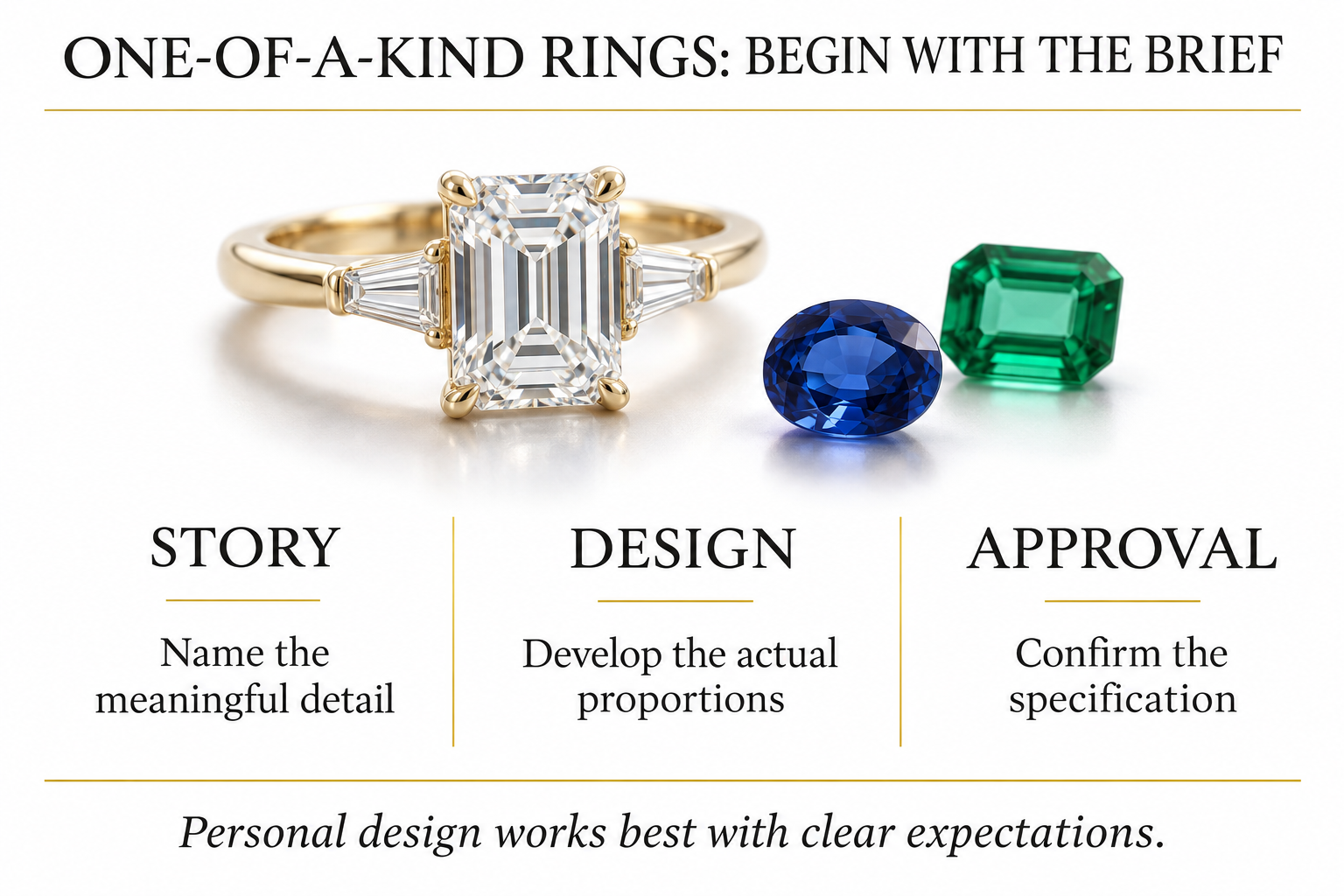
Start with the wearer and a meaningful reference
List the preferences you know: favorite stone shapes, colors, metal tones, comfortable widths and details the wearer dislikes. A personal story works best alongside those practical facts.
A shared place, a flower or an important date can provide a starting point. The reference can remain subtle rather than becoming a literal illustration of every memory.
You do not need to be a designer to explain an idea. A short description and a few chosen images can give a jeweler enough context to explore options.
If preferences are uncertain, choosing together can be appropriate. A surprise should not depend on assuming the recipient wants an unfamiliar style or commitment.

Choose the right degree of customization
Personalizing an available design, substantially modifying one and developing a new composition are different scopes of work.
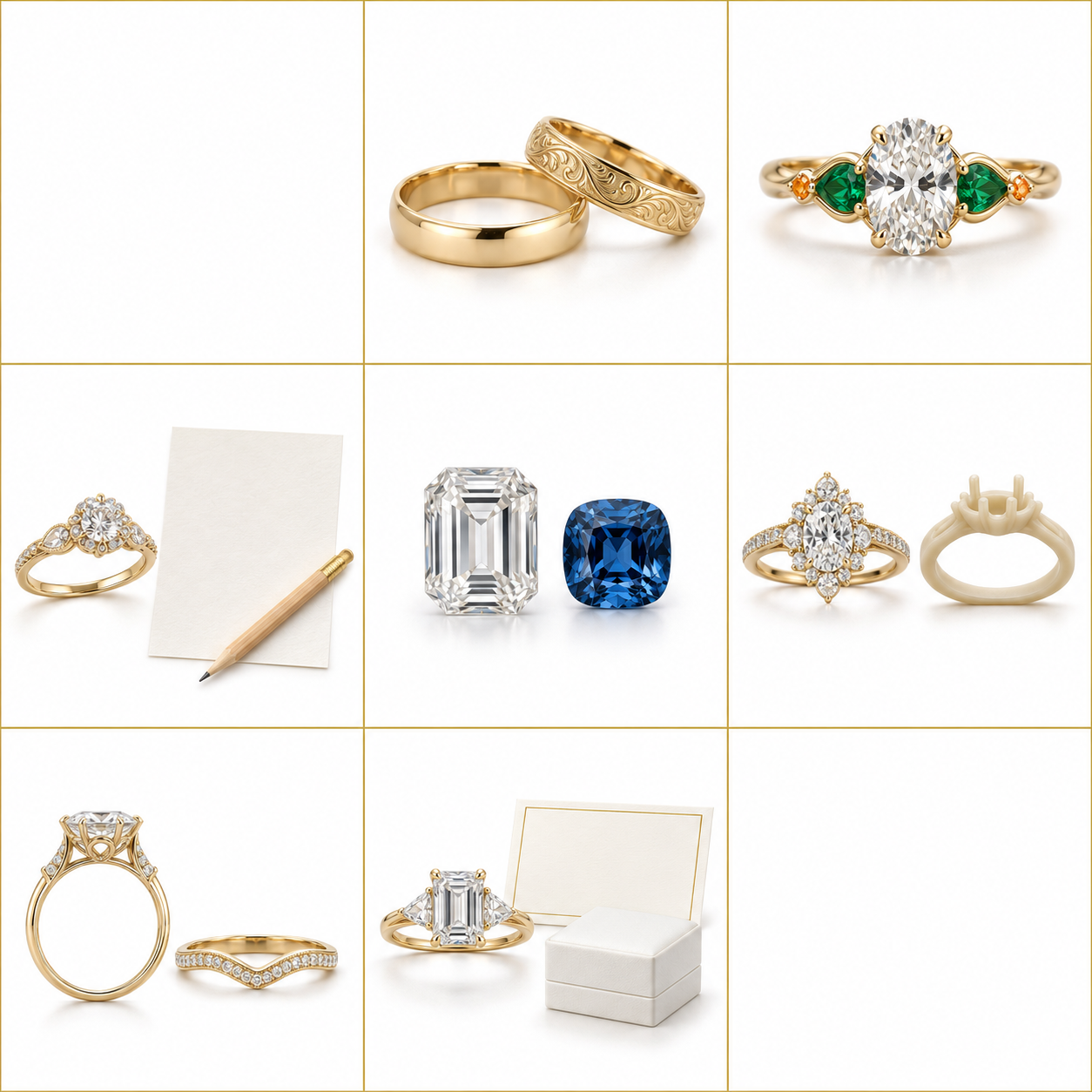
An engraving or small accent may be feasible without redesigning the whole ring. Changing a center stone’s shape, depth or size can require a new setting rather than a simple swap.
Clarify which existing details you want to retain and where the designer can adapt. A reference from another maker can inform a personal direction without promising an exact copy.
Custom does not automatically mean hand-fabricated at every stage or that no similar design exists anywhere. Ask for the process and the intended level of exclusivity to be described clearly.
Translate the story into a limited set of design decisions
A palette can suggest a place, a line can echo architecture, and a hidden detail can carry a private association. Choose the reference that will still be enjoyable to wear.
For example, a green accent and a warm secondary color might express a personal memory without dictating the center stone or every surface of the band.
Compare the symbolic idea with the available space and the actual materials. A tiny detail may be difficult to see or service at its final scale.
Keep interpretation honest. A personally selected color does not need an unsupported claim about an ancient meaning or a gemstone’s supposed influence on a relationship.
Use references to communicate priorities
Choose a small set of images and say what you like about each: the outline, side profile, color relationship or finish. This is more useful than asking to combine many complete rings.
Also identify features you do not want, such as a tall setting, broad shoulders or a particular decorative style. Constraints can help make the brief clearer.
Sketches and renderings can then develop the direction around actual dimensions. They are communication tools rather than exact reproductions of real gemstone optics.
Ask what each drawing or model is intended to confirm. A visual approval should be linked to an intelligible written specification.
Select the actual stone and metal
A stone’s shape, depth, condition and appearance affect the design. Choose the actual offered stone rather than assuming that a matching replacement for a reference photograph will always be available.
Establish material identity, natural or laboratory-grown status and relevant treatment. A laboratory report, sourcing statement and valuation answer different questions.
Ask about the metal alloy, finish and known service considerations. A precious-metal name is not a universal guarantee of comfort or compatibility with sensitive skin.
If sourcing priorities matter, request the evidence available for the project. Custom design and a small workshop do not by themselves establish every condition throughout the supply chain.
Make approvals and revisions clear
Agree on the proposed materials, dimensions and personal details before production proceeds. Confirm who needs to approve the design and what remains open.
Changes can affect cost, feasibility and timing. Ask which revisions are included and which would require another quotation or a revised production plan.
A model can help communicate scale or structure without guaranteeing a perfect final fit or exact surface appearance. Discuss its purpose and limitations.
The dedicated NinaVova process guide explains the broader project stages. For an individual order, current terms and the actual agreed specification should govern expectations.
Review fit and long-term practicality
Measure with attention to the intended width and interior profile. The final ring may feel different from an existing narrow band or a generic sizing sample.
Check the side profile, comfortable contact with neighboring fingers and whether decorative details may catch. The unusual feature should work as part of the whole construction.
If a wedding band is planned, review its likely relationship with the setting. A deliberate gap or shaped band may be preferable to forcing a flush arrangement.
Ask about resizing and repair limits before selecting extensive stone coverage, fine patterns or alternative materials. A personal design should include an ownership plan.
Set a complete budget and preserve the project records
Compare quotations for the actual materials, fabrication and included services. A custom ring can fall within different budgets, but there is no guarantee it will cost the same as a branded ready-made option.
Clarify delivery expectations, current return conditions and aftercare. Avoid relying on an old general statement about free design work or unlimited changes.
Keep approved images, specifications, correspondence and stone records. They can make the ring’s story more accurate and help with future service.
A piece may become an heirloom, but that future depends on care, continued use and later preferences. Documentation is useful without promising that descendants must value it in one particular way.
Let personal meaning remain the guiding detail
At NinaVova, a personal brief can develop around the actual stone, the wearer’s preferences and practical proportions. Earlier projects illustrate individual solutions rather than a mandatory formula.
Celebrity examples can offer visual inspiration, but reported prices or speculative stories should not set the budget or authenticate a private person’s jewelry.
A conventional shape with one welcome detail may feel more personal than a complex design chosen for novelty. The wearer’s enjoyment matters more than a claim to uniqueness everywhere.
A considered one-of-a-kind ring connects a clear reference with feasible materials, documented approvals and realistic care. Its individual story comes from those choices.

Frequently asked questions
Do I need to know how to draw jewelry?
No. A clear description and a few explained references can start the brief.
Does custom mean unlimited free revisions?
No. Agree on the current scope, fees and approvals for the order.
Is a ready-made ring necessarily less meaningful?
No. Personal meaning depends on the wearer and the story, not only the production route.
Bring a specific story into the brief
A remembered place, color or quiet detail can begin the conversation. We can develop it around actual materials and comfortable proportions.
Book a NinaVova consultation or explore our custom design process.
Continue reading: The custom process · Unusual material choices · Design consultation.
Sources and further reading
- NinaVova: Custom design process
- GIA: Buying an engagement ring
- GIA: Accurate ring sizing
- NinaVova: Current project and service terms
Confirm the actual materials, condition, evidence and current written terms for the offered ring. Illustrations do not establish identity, provenance, certification or an environmental footprint.