


Mall Jewelry Stores and Independent Jewelers: 7 Questions Before Buying

A mall jewelry store, online retailer and independent workshop can each offer different combinations of selection, design and service. The useful comparison is the actual seller and ring. These seven questions help assess quality, materials, price and ownership without assuming every chain is poor or every small workshop is automatically better.
Compare the particular ring and seller. Store size and location do not guarantee quality or service. Ask for clear materials, an equivalent complete quotation, suitable fit and written ownership terms.
At a glance · 1. Can I inspect the actual quality of the ring? · 2. Are the materials and documents clearly described? · 3. What is included in the complete price? · 4. Will the fit and design suit the wearer?
Watch the NinaVova discussion
Watch the original NinaVova video on YouTube.
The original NinaVova online-versus-retail discussion accompanies the buying comparison. The written guide uses seven questions rather than blanket claims about every seller.
Seven questions for comparing jewelry sellers
| Question | Evidence to request | Decision it supports |
|---|---|---|
| Actual quality? | Finished examples and inspection options | Construction and condition |
| Materials clear? | Alloy, gemstone and relevant records | What is actually being purchased |
| Complete price? | Equivalent specifications and included work | Useful cost comparison |
| Suitable fit? | Dimensions, profile and sizing | Comfort and band relationship |
| Customization scope? | Feasibility, fees and approvals | A realistic personal design |
| Who provides service? | Written repair, return and warranty terms | Ownership support |
| Fits my priorities? | Specific answers about the offer | A considered seller choice |
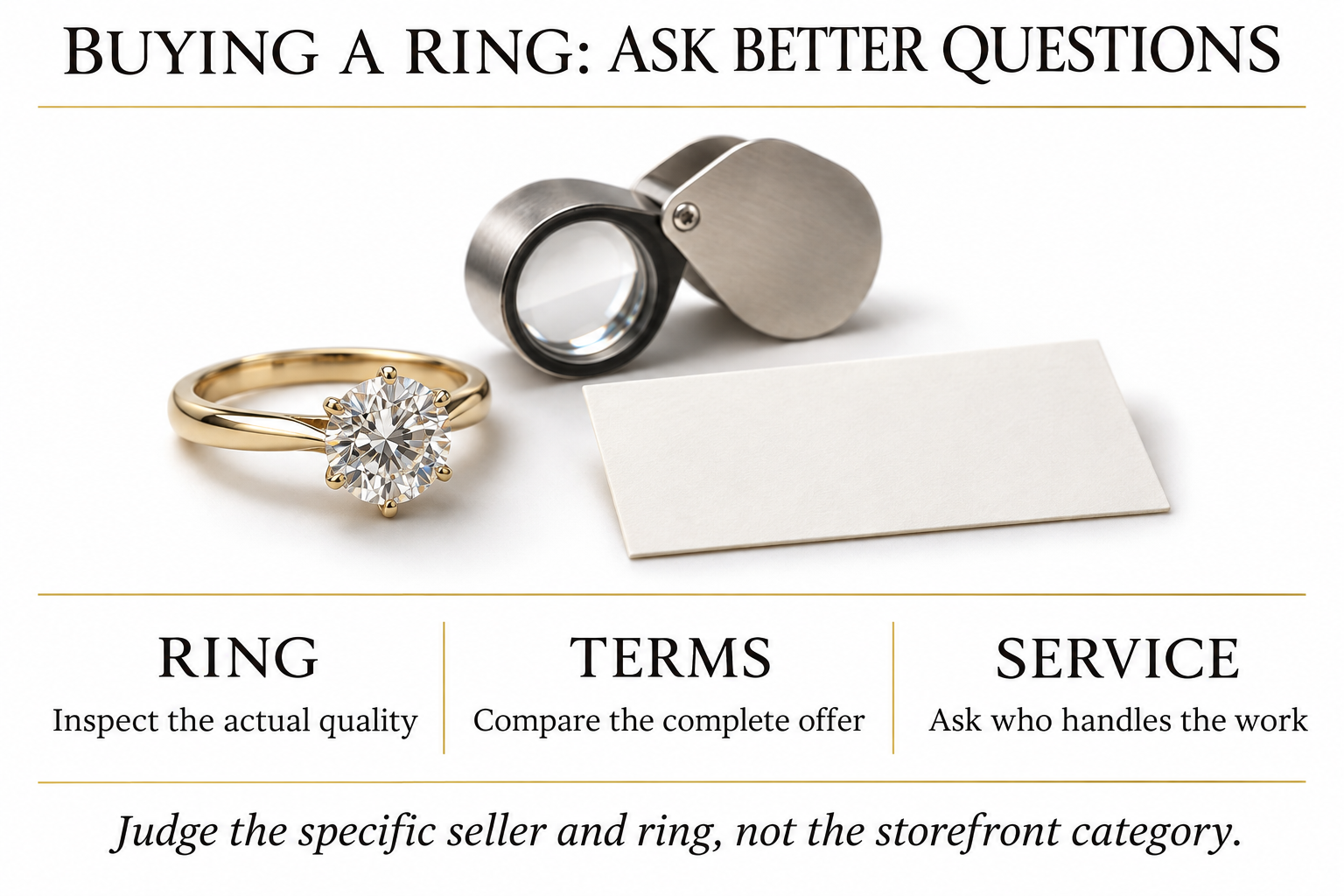
1. Can I inspect the actual quality of the ring?
Look at the finished construction: smooth transitions, a comfortable interior, appropriate support and secure-looking settings. Deliberate texture should be distinguishable from roughness, pits or damage.
An enlarged product image or rendering can help show design but does not establish the condition of the actual ring. Ask what inspection or return opportunity is available.
Compare a specific ready-made ring with actual examples from a custom maker. Avoid assuming that the storefront, brand size or production label determines every aspect of workmanship.
A careful seller should explain what you are seeing and address practical concerns. A convincing story is most useful when the piece and its specification support it.

2. Are the materials and documents clearly described?
Request the metal alloy, any plating, gemstone identity, natural or laboratory-grown status and relevant treatment information in writing.
Read a laboratory report within its scope and verify relevant details through the issuer. Grading, geographic origin and an insurance valuation answer different questions.
If a sourcing claim matters, ask what evidence relates to the actual stone or order. A broad conflict-free, sustainable or hypoallergenic label should be explained rather than treated as a complete guarantee.
Any seller may need to consult a supplier or workshop for a precise answer. What matters is the clarity and evidence of the final response, not a claim that one sales channel always knows more.
3. What is included in the complete price?
Compare equivalent specifications: the center stone, accents, metal weight and construction, design work and applicable charges. An unset diamond and a complete finished ring are different offers.
A custom ring may be competitive in a particular comparison, but it is not guaranteed to cost the same or provide higher quality at every budget.
Ask which services are included and which may cost more later. Engraving, resizing, insurance arrangements, shipping and repairs should not be assumed to be part of one quoted number.
Choose a comfortable budget and identify the most important features. A simpler design or different material can be considered without promising that every change leaves all aspects of quality identical.
4. Will the fit and design suit the wearer?
Measure for the intended width and interior profile, and review the side view as well as the face. A ring should suit the wearer’s preferences and practical needs.
If a wedding band is planned, compare actual clearance and likely contact. Matching metal names or nominal sizes do not guarantee a comfortable pair.
For known sensitivities, request relevant alloy information rather than accepting a universal no-reaction promise. Jewelry should also be removed for unsuitable work, machinery or impact.
A custom brief can address particular preferences, while an available design may already meet them. Neither route guarantees a perfect fit without suitable measurement and review.
5. What does customization actually include?
Ask whether the seller offers an engraving, an adaptation of an available design or a new composition. These involve different decisions and limits.
Changing a stone may require a different setting; not every personalized detail can be added after a ring is finished. Confirm feasibility before relying on a proposed modification.
Agree on approvals, revision scope, timing and current fees. An independent workshop does not necessarily offer unlimited free sketches, and a large retailer may also provide meaningful design options.
A personal detail can come from a story, place or date, but a ready-made ring can also become a valued heirloom. Future meaning is not determined solely by the production route.
6. Who handles care, repair and problems after purchase?
Read current written terms for returns, resizing, refinishing, repairs and any warranty. Ask who carries out the work and where the ring will be sent.
Find out how a concern is reported, what documentation is needed and whether service has costs or exclusions. A friendly conversation does not replace the actual agreement.
Read reviews for specific descriptions of the finished item, communication and issue resolution. An endorsement or one negative account does not establish every customer’s experience.
A local relationship can be useful, while another seller may offer a service arrangement that suits you. Compare the practical access and response rather than assuming cordiality or indifference from business size.
7. Does this seller’s approach fit my priorities?
You may value trying a finished ring immediately, a wide selection, a personal design conversation, local craftsmanship or a particular documented material source.
Supporting a small business can be a personal priority, but it does not automatically prove lower prices, stronger sourcing evidence or better service. Ask the same clear questions of every seller.
At NinaVova, a consultation can explore the wearer’s preferences, available stones and feasible construction, with current terms confirmed for the order. Compare that actual offer with the alternatives you are considering.
The strongest choice is the ring and seller whose quality, materials, complete cost and service you understand. Use the seven questions to reach that decision without relying on a blanket rule about where jewelry should be bought.

Frequently asked questions
Are all mall-store rings lower quality?
No. Assess the actual piece and evidence rather than the storefront category.
Are independent jewelers always cheaper?
No. Compare equivalent complete quotations and included services.
Can a ready-made ring become an heirloom?
Yes. Personal meaning and continued care are not restricted to custom production.
Compare a concrete NinaVova proposal with your alternatives
A consultation can clarify actual stone options, feasible design and current terms so you can evaluate the complete offer.
Book a NinaVova consultation or explore our custom design process.
Continue reading: Custom versus ready-made · Brand values and evidence · Personal design brief.
Sources and further reading
- GIA: Buying an engagement ring
- FTC: Jewelry material descriptions
- NinaVova: Current project and service terms
Confirm the actual materials, condition, evidence and current written terms for the offered ring. Illustrations do not establish identity, provenance, certification or an environmental footprint.