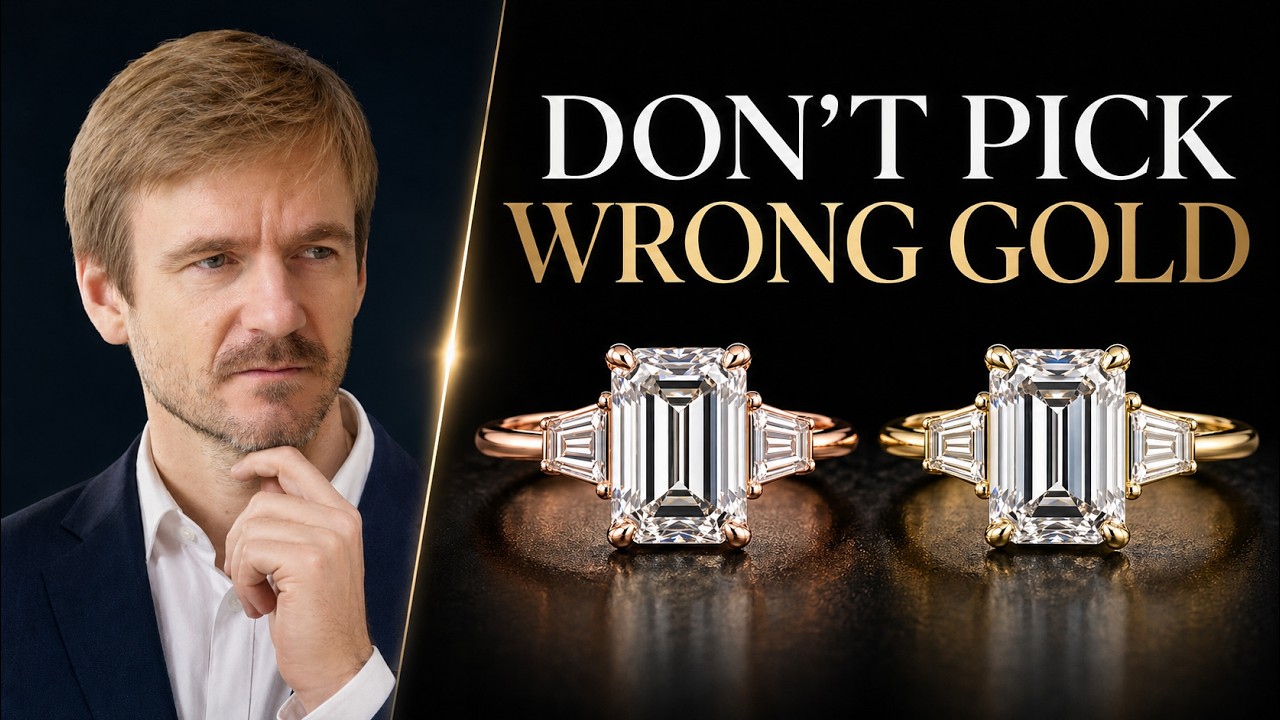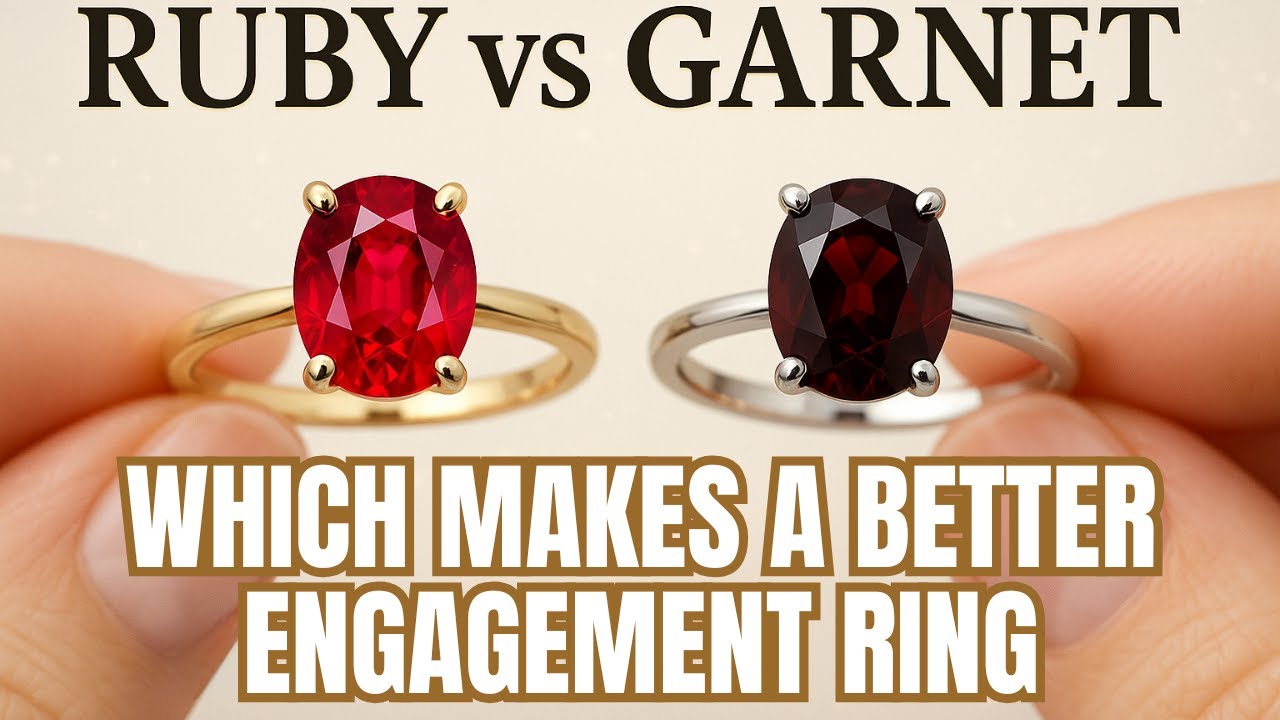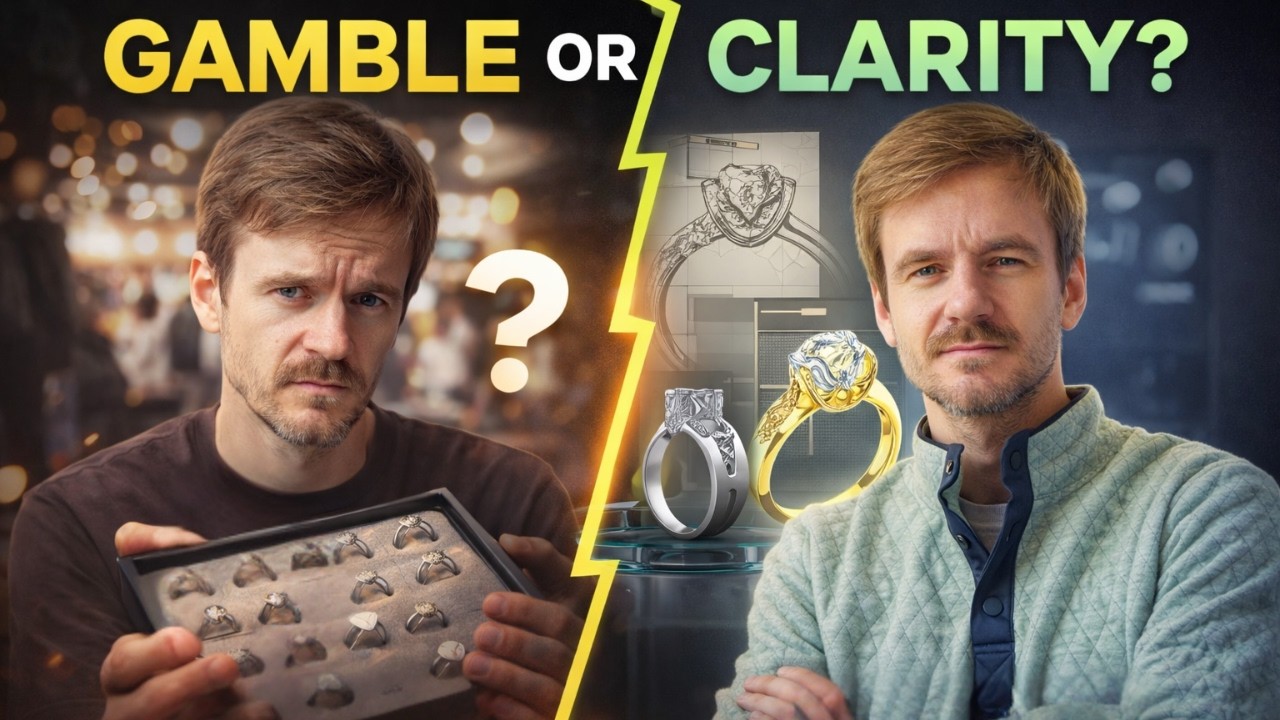

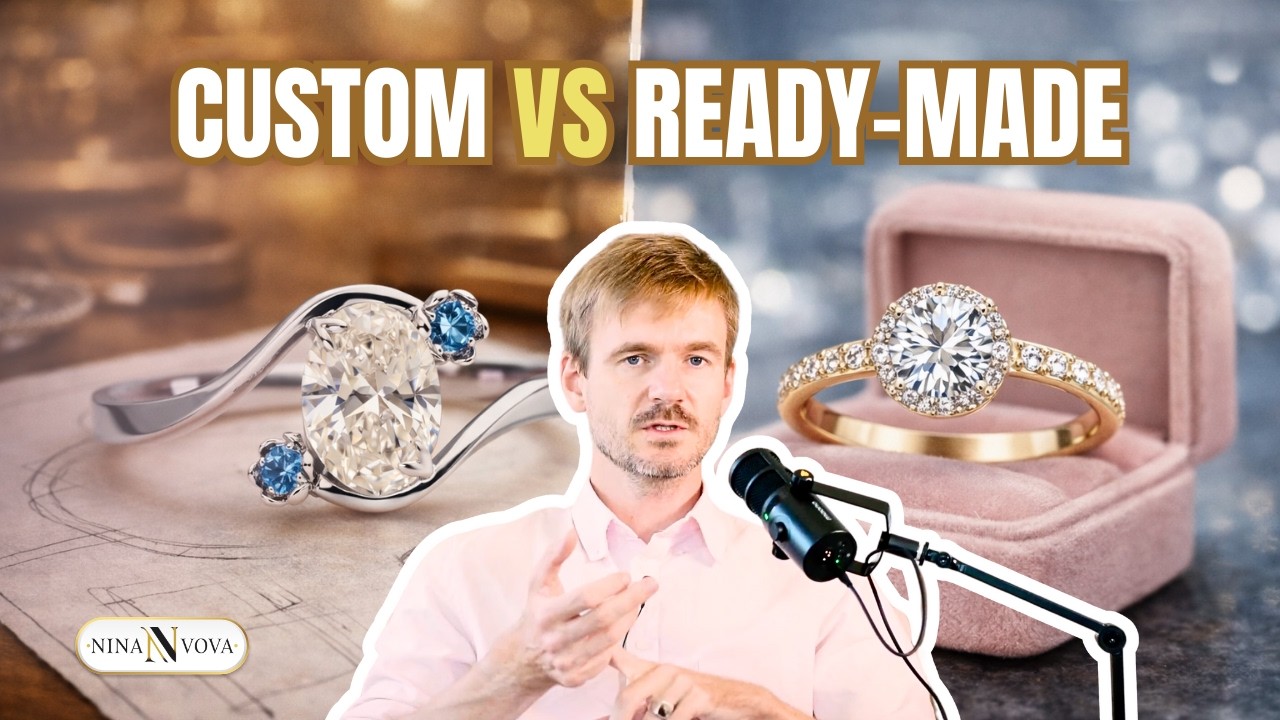
Custom vs Ready-Made Engagement Rings: Options, Risks and Fit

If you’re choosing an engagement ring right now, you’ve probably seen two very different options everywhere:
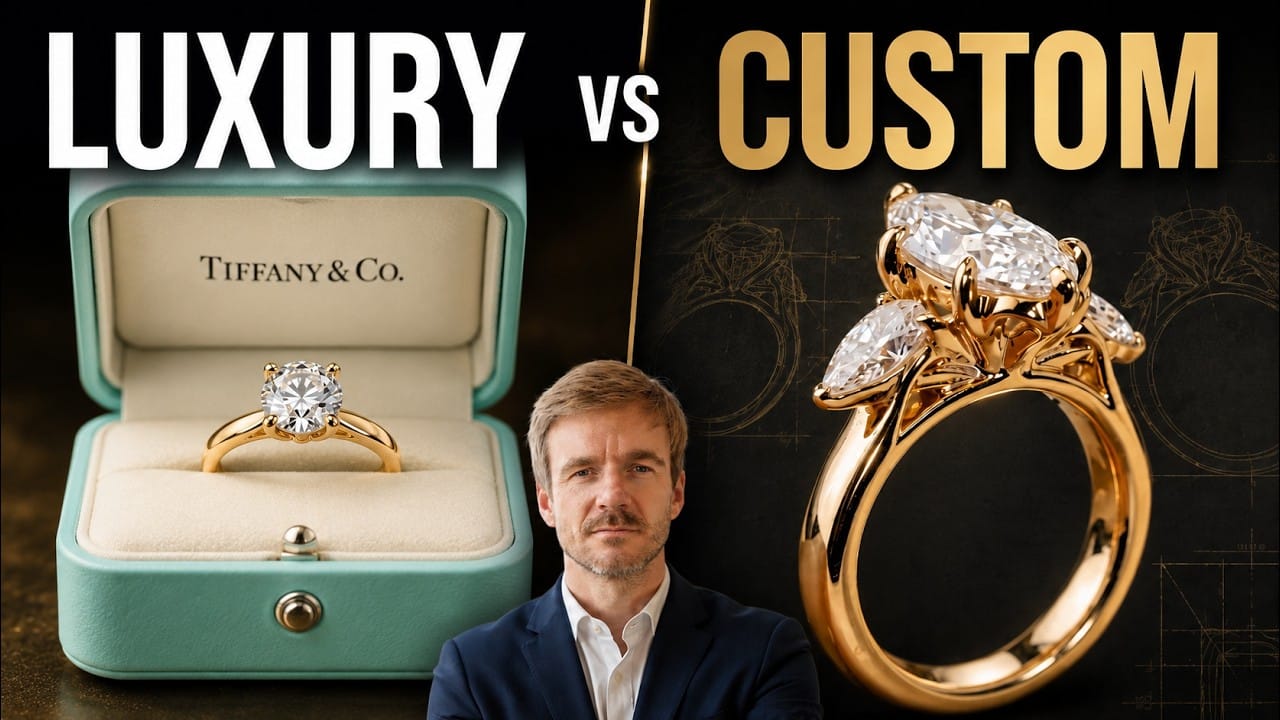
a ready-made ring that may be available promptly… and a custom engagement ring built just for you.
And here’s the truth — neither option is automatically better.
Each one has strengths, each one has limitations.
Here are the practical pros and cons to consider alongside your own timeline, preferences and design brief.
Choose the process that fits the person and project. A finished ring lets you inspect an existing piece; custom allows planned changes and an individual brief. Neither label guarantees superior craftsmanship, lower cost, a safer purchase or the right emotional meaning.
At a glance · What ready-made and custom mean · Visual and personal differences · Durability, fit and daily wear · Ready-made: risks to inspect
Watch the NinaVova discussion
Watch the original NinaVova video on YouTube.
The NinaVova video introduces the topic. Confirm the current written policies and the terms of the actual project.
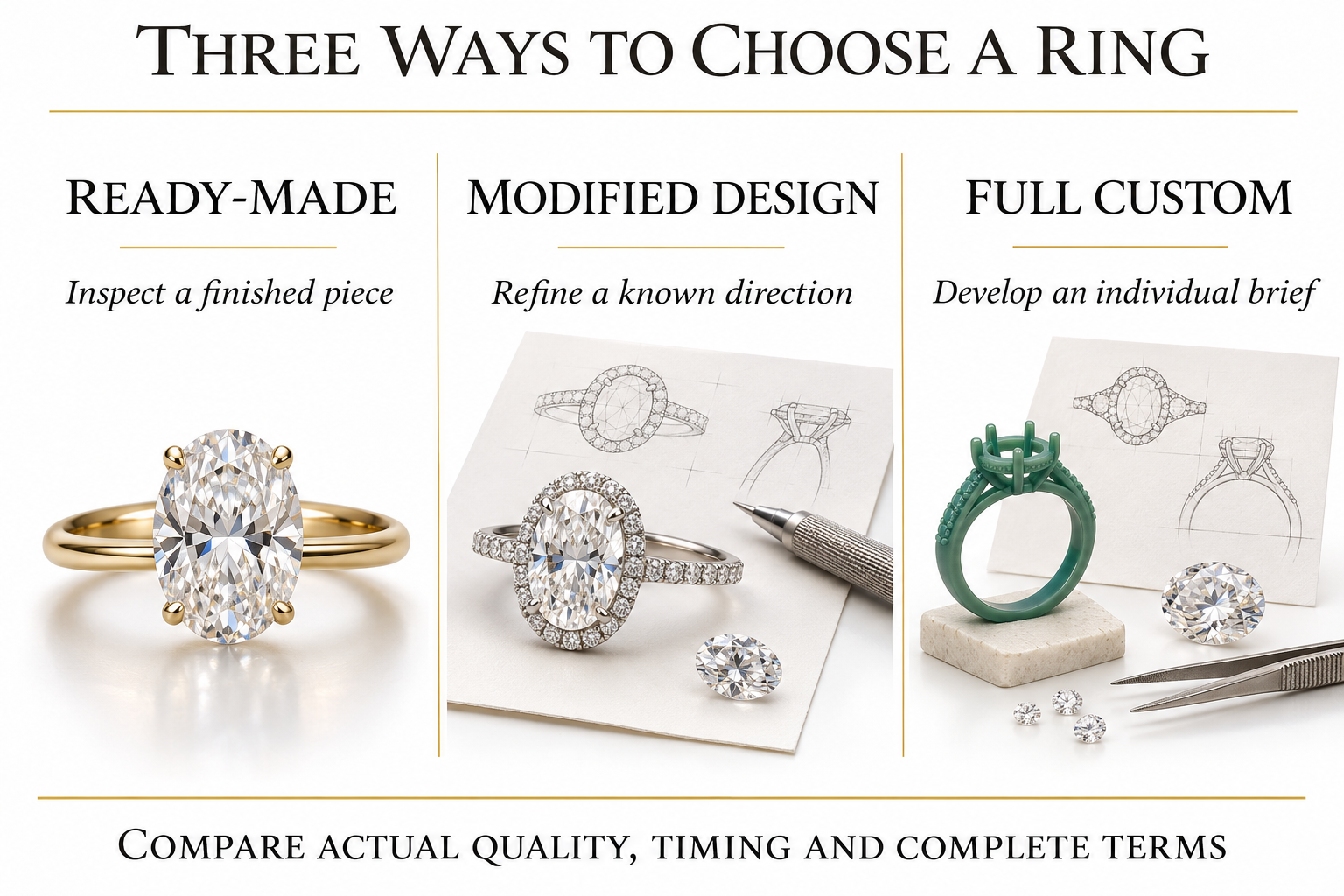
Three routes to a considered ring
| Route | Useful advantage | Question to resolve |
|---|---|---|
| Ready-made | Inspect the finished piece | Does the actual ring fit the wearer and timeline? |
| Modify a design | Build on a known direction | Which changes are feasible and how are they approved? |
| Full custom | Develop an individual brief | Who owns each design, sourcing and construction decision? |
| All three | Choose the actual ring | What are the complete quotation, care and service terms? |
What ready-made and custom mean
A ready-made ring is a finished piece you can see, try on, and, when available and suitable, take home.
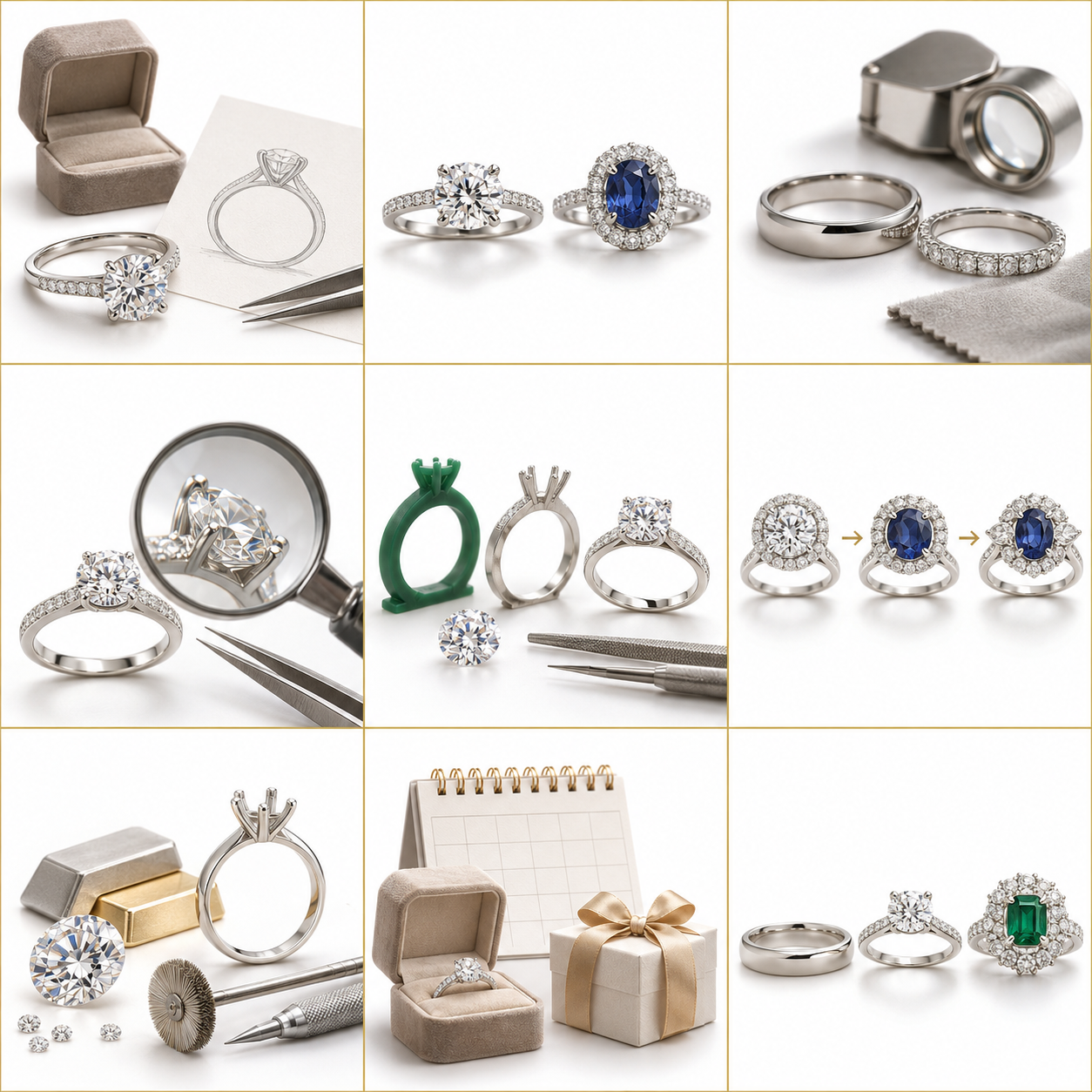
A custom ring is made from scratch based on your ideas — you choose the center stone, the metal, the proportions, all the small details.
A finished ring gives you an existing object to inspect.
Custom gives you scope to plan the details around an individual brief.
Think of the choice as finding an existing home you love or helping develop a home around a personal brief. Some people enjoy the design decisions; others value seeing the finished result. Neither preference makes a relationship more special, and the costs and timelines are not automatically equal. The useful question is which process fits the people, practical needs and budget.
Visual and personal differences
When you look at a ready-made ring, what you see is exactly what you get.
The proportions, the height of the prongs, how the diamond sits on your finger — there’s no guessing. You’re holding the final product.
With a custom ring, the experience is completely different.
Instead of picking from existing designs, you co-create something that has meaning behind it — a favorite shape, a detail from your story, a stone that matches their personality.
You get sketches, a 3D model, sometimes even a render that lets you preview the design before it’s made.
And there’s something else that comes with custom: a story.
You’ll remember how you went through options, how you discussed small changes with the designer, how the ring evolved from an idea into the final piece.
When you propose, you’re not just saying, “I bought this.” You can say, “We designed this for you.”
With most ready-made rings, the story is simpler:
you chose the best option you could find within your budget, from what was available.
That can still be a beautiful choice — it’s just a different kind of story.
If developing an individual brief matters to you, custom offers scope for that conversation; discuss which details can actually be made exclusive.
If you want quick and simple or maybe you value certain brand name — ready-made gives you that clarity on the spot.

Durability, fit and daily wear
A ready-made ring is already polished, assembled, and tested.
You can check comfort fit, height, thickness, and even see how it behaves with your hand movements.
It’s real, right in front of you.
And very honestly, that’s a big reason why people feel safer with ready-made rings.
If you’re afraid something might go wrong — wrong size, wrong proportions, design not matching the photos — it’s comforting to hold the finished ring and know: this is it. Still inspect condition, fit and all terms.
A custom ring, on the other hand, gives you scope to adjust many of those same factors —
but only if the jeweler truly understands proportions.
You can make the band thicker if your partner is active.
You can lower the stone to reduce some snagging risks, while recognizing that no setting is snag-proof.
You can choose claw prongs, double prongs, decorative prongs — whatever feels right for their lifestyle.
The result: a ring designed for their daily habits, around that wearer’s preferences.
If you want maximum personalization, go custom.
If inspecting the finished object matters most, a ready-made ring can offer useful reassurance.
Ready-made: risks to inspect
The biggest risk is compromise.
Maybe the diamond is almost what you want… but the color is slightly off.
Or the setting is nice… but the proportions feel a bit bulky.
Or the ring looks great — but it’s one of thousands made.
Another pitfall: sometimes the “in-store sparkle” hides poor craftsmanship.
Strong lighting can make almost any stone look amazing.
And there’s also the reality of how many ready-made rings are produced.
Ready-made rings can be manufactured in batches or made individually. Production method and scale alone do not establish the quality of a particular piece.
Inspect the actual finish, setting, fit and written warranty. Ready-made status does not prove that no skilled jeweler inspected the ring.
Once in a while there can be small imperfections in the alloy, tiny casting issues, or details that technically pass quality checks but don’t feel very “crafted.”
The useful question is what quality control this particular maker applies, rather than assuming custom always receives better attention.
Custom: risks and process safeguards
With custom, the key is finding the right person to work with.
Custom is as good as the designer and bench jeweler behind it.
A custom workshop’s output varies. Ask who is responsible for design, setting and inspection rather than relying on a universal number of rings per jeweler.
An accountable team should identify issues and explain how changes are handled before the ring is delivered.
Ask who makes and checks the ring, and how the maker handles an issue.
The main thing to watch for is the process, not to be scared, but to feel confident.
A solid custom experience usually looks like this:
sketch → CAD → 3D preview → final ring,
with room for questions and small adjustments until it feels right.
If the jeweler is open, explains how the ring will be built, and walks you through each stage, you’re in good hands.
If everything feels rushed, vague, or you never really see the design before it’s made — that’s just a sign to slow down and ask more questions.
The middle path: modify an existing design
Most people think it’s only these two extremes — buy something off the shelf, or fully design from zero.
But there’s actually a very useful option in between.
Sometimes you see a ring that’s almost perfect.
You love the overall vibe, but a few things are off — maybe the band feels too thin, the prongs are too sharp, or you’d prefer an oval instead of a round stone.
In that case, you don’t have to start from a blank page.
You can take an existing design as a base and tweak a few key details:
make the band slightly thicker, lower the setting, change the stone shape, adjust the side details.
It incorporates your requested changes — but it’s also not necessarily a design developed entirely from the beginning.
You’re working from something you already know you like, and just making it more you.
For a lot of couples, that middle path feels like the most comfortable balance between safe and special.

What the price includes
Ready-made rings follow a simple formula:
materials + labor + store markup.
Custom rings follow:
materials + design time + modeling + craftsmanship.
Custom can cost more — but it can also cost exactly the same as a ready-made piece, depending on the brand, the stone and metal you choose.
Comparable prices can overlap, but there is no universal custom-to-ready-made price relationship. Obtain complete quotations for similar stones, metal, labor, services and terms.
The difference is that you’re choosing where the budget goes:
a better stone, a more meaningful design, or upgraded craftsmanship.
Ready-made can offer availability and direct inspection; custom can offer planned changes. Either route can carry personal meaning.
Timing and delivery planning
Ready-made:
An in-stock ring may be available promptly, but resizing, inspection, stone changes and shipping can add time. Obtain the actual delivery commitment.
Custom:
Custom requires planning for design decisions, sourcing, approvals, manufacturing and delivery. Current NinaVova ordering guidance lists 6–8 weeks unless otherwise agreed; ask where that estimate begins and reserve a delivery buffer.
If you have a surprise proposal date — custom requires a bit more planning.
But the result feels more personal.
Choose the process that fits the wearer
Choose ready-made if:
You’re on a very tight timeline.
The actual finished ring suits your partner’s stated preferences.
You want to see the final design immediately and feel safer with a ring that’s already finished.
You prefer simplicity and speed.
Choose semi-custom (tweaking an existing design) if:
You found a ring that’s very close, but a few things are off.
You like the overall look, but want to adjust the stone shape, height, or band thickness.
You want something more personal than a generic model, without going fully experimental.
Choose full custom if:
You’ve heard words like “something special” or “unique,” or you know your partner loves one-of-a-kind pieces.
Their style doesn’t feel generic at all, and you don’t want their ring to feel that way either.
You have a story you want to turn into a design — feelings, memories, small details you’re actually excited to share and see in the ring.
You care about proportions, stone choice, and symbolic meaning.
You want craftsmanship tailored exactly to daily wear and to your story.
Frequently asked questions
Is custom always higher quality than ready-made?
No. Inspect the actual workmanship, materials and quality-control process. Production scale or a custom label alone does not establish the result.
Can an existing design be modified?
Often some changes can be explored, but feasibility depends on the actual stone, dimensions and structure. Agree on the changes before production.
Is a ready-made ring always available immediately?
No. Availability, sizing, inspection and shipping can affect delivery. Ask for the actual timing rather than relying on the label.
Explore the right level of customization
Bring a finished design you like or a completely new idea. We can discuss which changes matter and what your time and budget allow.
Book a NinaVova consultation or explore our custom design process.
Continue reading: Ring anatomy · Design inspiration and CAD · Complete cost breakdown · Timeline and wedding-band planning.
Sources and further reading
- NinaVova: Original discussion
- NinaVova: Current ordering and service terms
- NinaVova: Manufacturing-defect warranty
- GIA: Settings and construction
Confirm the current written project scope, schedule, price and service terms. Evaluate the actual construction, fit and materials. Generated illustrations are concepts; actual NinaVova photographs are separately captioned.