
Engagement Ring Guides
Custom Engagement Ring Design: Inspiration Photos, CAD and Approval

You find a beautiful engagement ring on Pinterest. You love the gemstone, the proportions, the tiny details. Everything looks perfect.
You send the photograph to a custom jeweler. But when the first design comes back, the band looks heavier, the side stones seem too big, and something about the whole ring feels wrong.
Was the picture misleading? Does the design need to change? Or did the jeweler misunderstand what you wanted?
All 3 can happen. And each calls for a different solution.
At NinaVova, we design and make custom engagement rings. This guide explains how to turn an inspiration photo into a real design, what to check along the way, and when you should question a proposed change.
Because a custom ring can look extremely close to its inspiration. The important thing is understanding which details you're preserving before anyone starts making it.
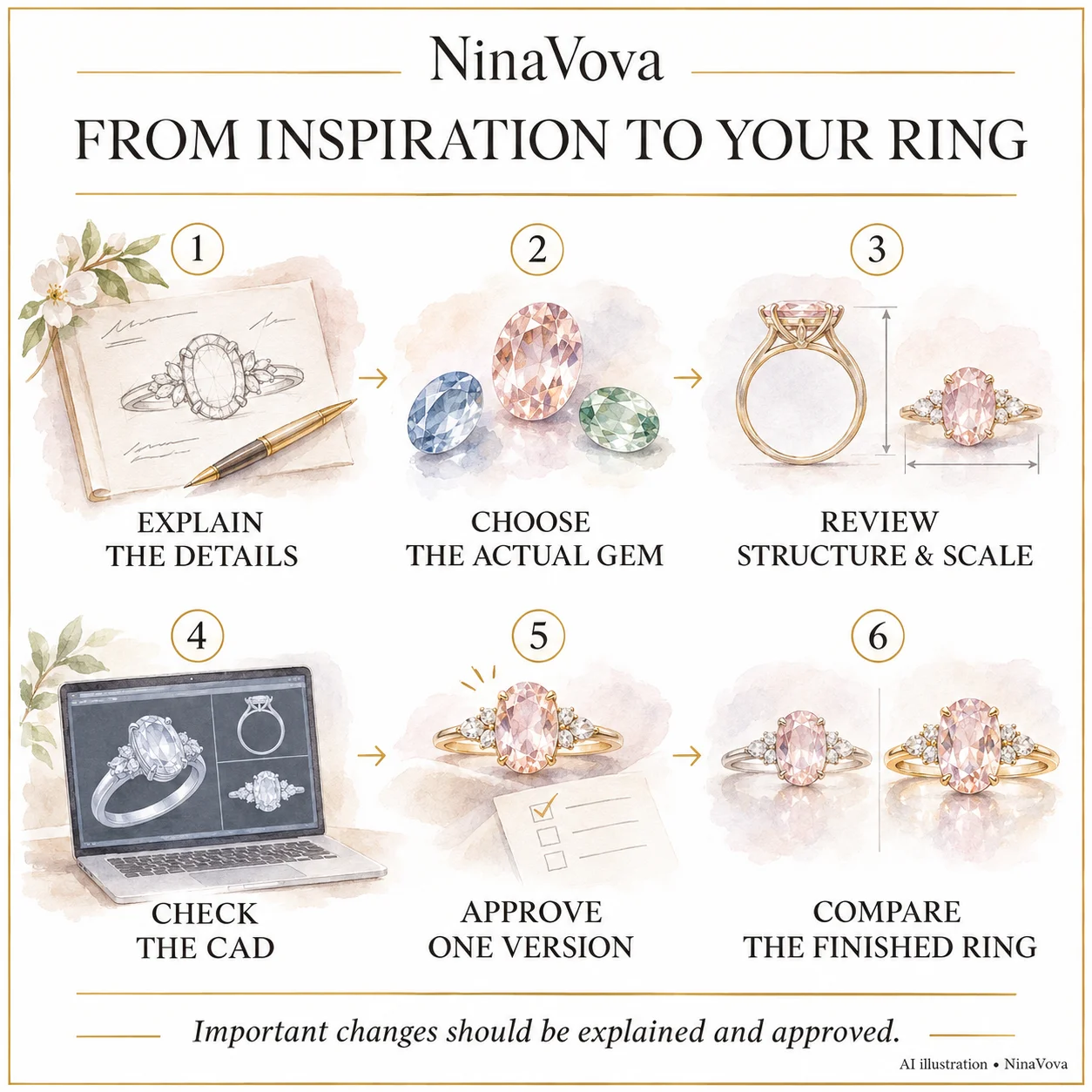
Make the important details explicit before approving production. A reference photograph does not show every dimension or hidden support. Explain what you love, select the actual gem, review top and side views with measurements, and keep one approved design version. Changes can be sensible, but their effects should be clear before the ring is made.
At a glance · What a reference photo leaves out · Explain which details matter · Choose a jeweler for the work · Choose the stone for the design
Watch the NinaVova discussion
Watch the original NinaVova video on YouTube.
Related NinaVova video: our custom-ring process guide explains the project stages. This article consolidates two original scripts about inspiration images, design mistakes and CAD approval; the video is a companion, not the publication of those exact scripts.
From reference image to approved ring
| Decision | What to request | What it resolves |
|---|---|---|
| Reference | Marked details, priorities, dislikes and additional angles | Which parts of the picture you actually want. |
| Gemstone | Actual dimensions, condition, color views and outline | Whether the source stone supports those proportions. |
| Structure | Gallery, support, setting height and wedding-band view | How the unseen parts will work. |
| CAD | Top and side views, finished dimensions and scale | What is geometry and what may change during finishing. |
| Approval | One named version and written material/stone specification | Which design is authorized for manufacturing. |
| Delivery | Matching-angle images and a clear correction process | Whether the finished ring reflects the approved result. |
What a reference photo leaves out
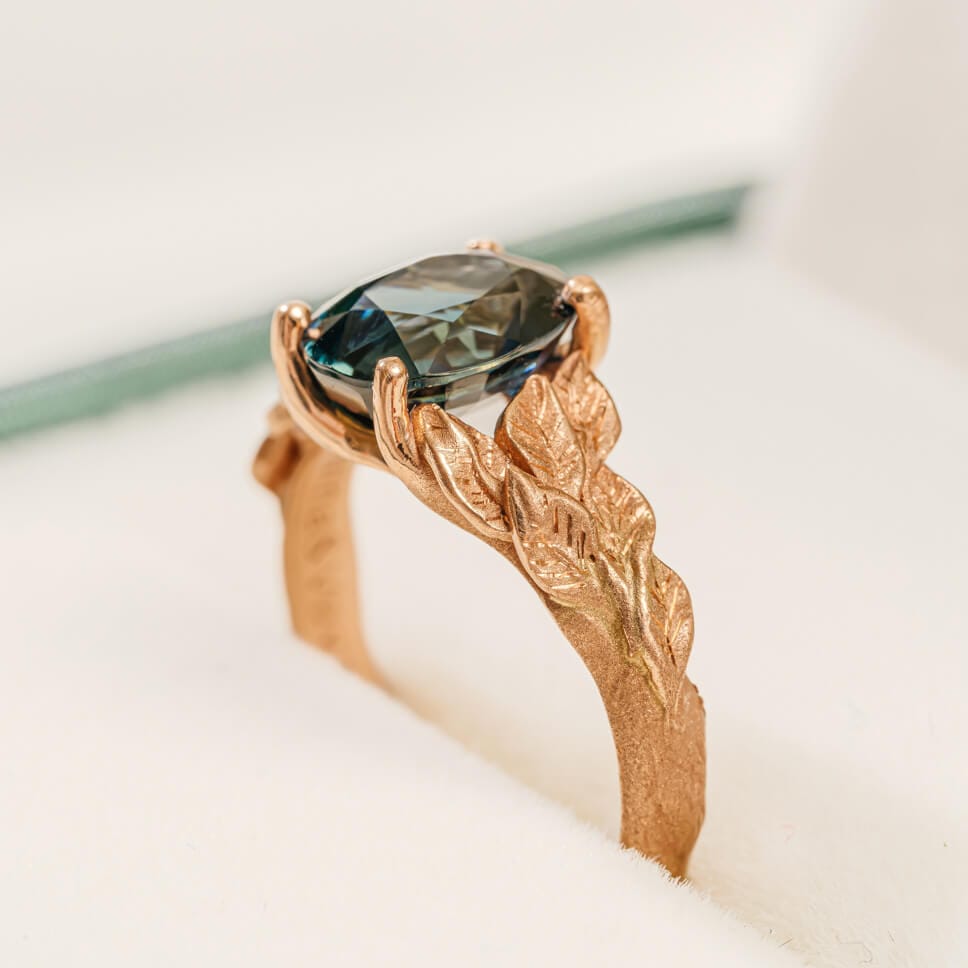
Imagine you send me a picture of an oval sapphire ring with small diamonds and delicate gold leaves along the band.
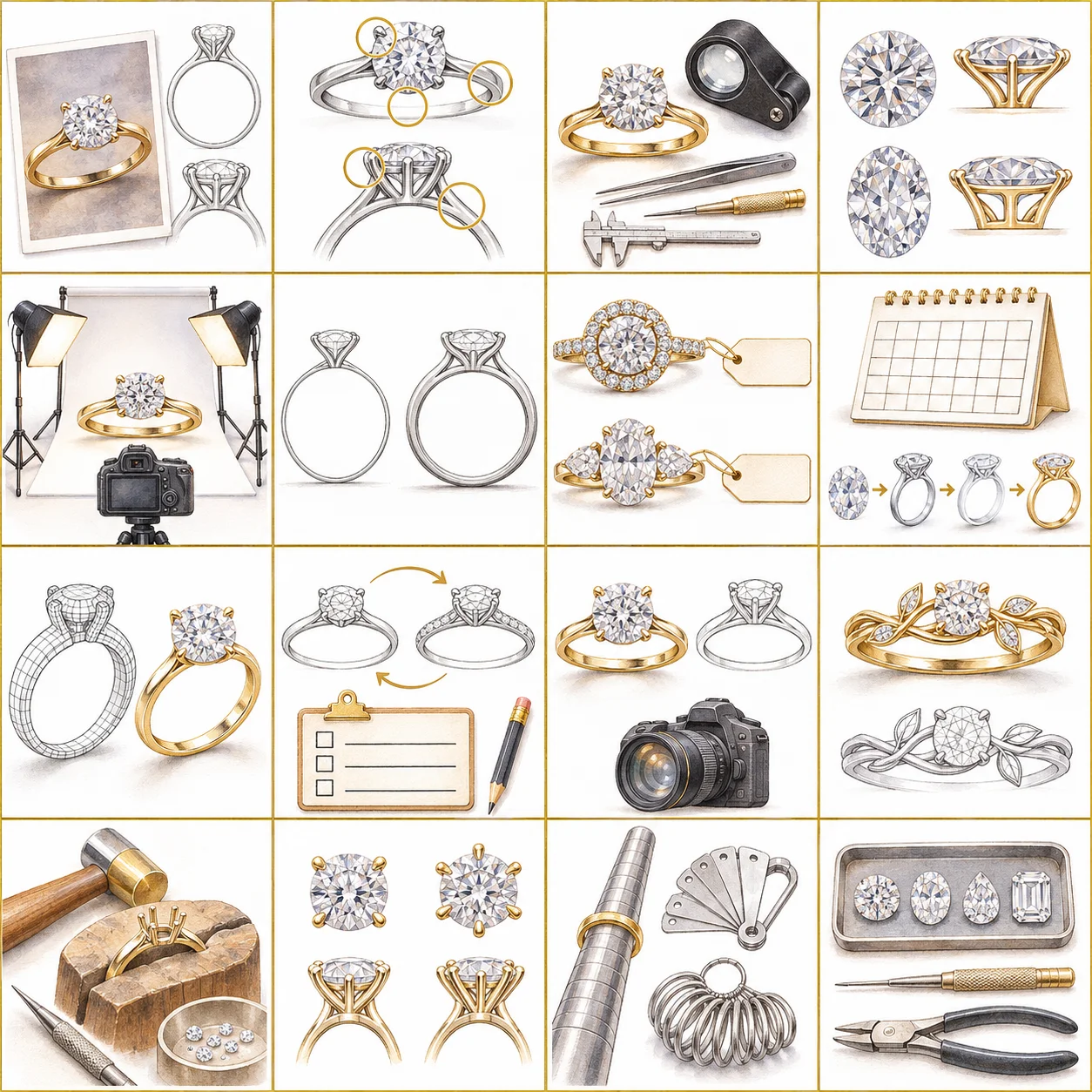
From above, I can see the arrangement of stones and the shape of the leaves. But I might not know how high the sapphire sits, how it's supported underneath, or how the band connects to the center setting.
Even the band can be misleading. It might look extremely narrow from above but have considerable thickness from the side. Those are different dimensions, and both influence the finished ring.
The underside matters too. A gemstone that appears to float may have a supporting gallery hidden behind it. If we can't see that structure, we need to work out how to build it.
That's how 2 jewelers can start with the same reference and produce different rings. They're making different decisions about information that wasn't in the picture.
Before commissioning a recreation, try to find photographs from the side and underneath. The original designer's website often has more useful views than a cropped Pinterest post.
If you can't find them, ask your jeweler to show you how the unseen parts will be constructed. A hidden support isn't automatically a problem. Discovering a much taller setting after the ring is finished certainly can be.
Explain which details matter
A collection of inspiration photos isn't yet a design brief.
You might love the elongated sapphire in one ring, the tapered band in another, and the floral details in a third. Tell the designer which feature comes from which picture.
Then establish priorities. Maybe the leaves are essential, but you're flexible about the smaller diamonds. Or perhaps it's the exact silhouette you're trying to preserve, and the decoration can change.
That becomes important when the available stones, budget, or construction won't accommodate everything exactly as pictured.
Point out what you dislike too. "I don't want the center stone sitting high" is useful. So is "I don't like prongs covering so much of the gemstone." That's clearer than just asking for something elegant.
You don't need jewelry terminology. Circle features in the photos and write a few words explaining what to keep and what to change.
One more distinction: are you asking for a close recreation of a particular ring, or an original design that takes ideas from several references? They require different briefs. Be clear about which details you want to preserve and where you want an original solution.
Choose a jeweler for the work
Before you commit, look at the jeweler's finished work, not just computer renderings.
If you want botanical metalwork, look closely at completed leaves and engraving. Can you see clean details? Do the decorations integrate naturally with the band? If you love delicate prongs, examine how they look on actual finished rings.
Ask to see a CAD alongside photographs of the ring that was eventually made. That tells you far more than a gallery of beautiful renderings.
Also find out who handles your design feedback. The person you speak with may not be the person creating the CAD or setting the stones. There's nothing inherently wrong with that. But there needs to be someone responsible for getting the approved design to the people making the ring.
Ask who checks the finished piece against the approved design before it's delivered.
And if a jeweler hasn't shown anything remotely similar to the work you want, ask whether they have relevant examples. Someone can be excellent at traditional solitaires without being the right choice for intricate floral construction.
You're not looking for a jeweler who agrees with every idea. You're looking for someone who can explain which details will work, show alternatives when they won't, and demonstrate that they can deliver the type of finish you're asking for.
Pay attention to responsiveness. Custom work involves questions, decisions, and revisions. If it's difficult to get a clear answer before you place an order, that should concern you.
And ask who handles communication throughout the project, including CAD feedback and the final quality check. It's normal for designers, setters, and manufacturers to be different people. What's important is that someone coordinates them and takes responsibility for the approved result.
Choose the stone for the design
Let's return to that oval sapphire.
Suppose the center stone in your inspiration measures 10 by 6.5 millimeters. The sapphire you've chosen measures 9 by 7 millimeters.
Both are ovals, but the first is much longer and narrower. The second looks fuller and rounder. Put the same leaves and side diamonds around them, and the proportions change.
A detail that looks balanced around one stone may crowd the other. We can adapt the surrounding design, or keep searching for a sapphire closer to the original outline.
That's why I don't use carat weight alone to match an inspiration. Carat tells us weight. Length and width in millimeters tell us much more about the shape you'll actually see.
Depth matters too. Two stones can have similar measurements from above but extend different distances below their widest point. The deeper one might need more room underneath. That can affect the gallery or setting height, although there may be several ways to accommodate it.
With natural colored gemstones, there's another decision. You might love a particular blue-green sapphire, but finding the same color, proportions, clarity, and size within your budget isn't always realistic.
So decide what takes priority. If color is the main attraction, we can adjust the design around the right-looking stone. If you love the long, elegant outline, we should source closer proportions, even if the color is slightly different.
When I source stones for a client, I'm thinking about how they will look in the finished ring, not just whether they're attractive individually.
Before the final CAD, ask to see the dimensions and video of the actual stone. For colored gems, look at how its appearance changes as it moves and under different lighting conditions. A single listing photograph is not enough to establish that it will match your reference.
I had another client who brought several inspiration images featuring round center stones.
He explained what he liked and didn't like about each design, but wanted his ring to have an elongated oval center instead.
At first glance, changing the center stone might sound like a small adjustment. The overall style is still the same. In reality, it changed quite a lot.
With a round stone, the gallery and the supports beneath it can follow a symmetrical arrangement. An elongated oval changes the space those components occupy, where the prongs need to sit, and how the center setting connects to the band.
It also changes the ring's side profile. We couldn't simply stretch the original setting and expect all the details to look the same.
For that client, the most useful comparison was not round versus oval from above. It was the original gallery idea against the redesigned gallery shown from the side, with the new stone in place. If you're changing a center-stone shape but keeping a particular gallery, ask for exactly that comparison before approving the model.

Read photographs at real scale
Professional jewelry photography controls light, backgrounds, reflections, and camera angles.
That changes what you see. A sapphire may look unusually bright under carefully arranged studio lighting and quite different under ordinary indoor light. Polished gold reflects its surroundings, so its apparent color can change too.
Then there's scale. Most jewelry photographs are extreme close-ups. A tiny engraved leaf might fill your screen even though you'd barely notice it when the ring is worn.
Look at finished-ring photos on a hand to understand scale. Keep finger size in mind as well: the same ring may look substantial on a small finger and more restrained on a larger one.
And check whether your reference is a photograph of a finished ring, a computer rendering, or an Illustrated concept. An AI image can communicate a beautiful idea while leaving out the physical space needed to secure stones or connect metal elements.
Use real finished jewelry to judge proportions and workmanship. Use the actual gemstone to judge color. A rendering can help communicate a design, but it can't replace those checks.
One of my own client projects showed how much a reference image can influence expectations.
Here's a real example from a client we worked with.
He sent me an image from the website of a very famous jewelry brand. He loved the gallery — the structure underneath the center stone — but wanted a completely custom gemstone and several changes to the design.
The brand wouldn't make that combination for him, so we started developing his ring.
During the 3-D modeling stage, he kept comparing our design with the website image and saying that certain details didn't look the same.
I suggested he visit the brand's store and look at the original ring in person. They have stores in major cities, so he could see what the website image actually represented.
He went, and he was extremely surprised. In person, the original ring looked considerably simpler than he had expected.
Later, after receiving the ring we made, he returned to the store to compare them side by side. He told me how shocked he was by how much better our ring looked to him.
The lesson isn't that a famous brand makes a bad ring. It's that the website image had created expectations that changed when he saw the piece in person.
Jewelry photography uses controlled light, reflections, camera angles, and magnification. Those can emphasize small details or change how gemstones and polished metal look.
That is the client's account of his own reaction, not an objective ranking of brands. I cannot establish which photographic or rendering techniques were used for the original website image.
Make structural changes deliberately
Some inspiration rings need adjustments for everyday wear.
Take an extremely delicate band. Strength doesn't depend only on how narrow it looks from above. Thickness, metal, profile, and how the band joins the setting all matter.
Sometimes we can taper the band near the gemstone while keeping more metal in areas that need support. But putting a large, heavy center setting on a very thin band may still be a poor choice.
Small diamonds along the band add another consideration. Making room for their settings removes metal. A pavé band that looks solid before the stones are set may have less supporting metal than you expect.
Now consider decorative leaves extending away from the band. Those edges may catch on clothing or bend if they're exposed. Bringing them closer to the shank or changing their connections can improve durability without losing the botanical character.
Not every delicate-looking ring is fragile, and adding metal everywhere isn't automatically better engineering. The jeweler should be able to identify a particular weakness, not just tell you that delicate designs are bad.
Even a well-made ring should be removed for weightlifting, contact sports, or work where it might be struck, caught, or squeezed. A strong setting isn't protection against every impact.
Wedding-band compatibility is another issue. You might want the center sapphire very low and a straight wedding band fitting flush beside it. But the gallery might occupy the space that band needs.
Possible solutions include changing the gallery, raising the center slightly, accepting a small gap, or using a contoured wedding band. Which one is best depends on what you want to preserve.
If you'll wear both rings together, ask for a side view showing the engagement ring and a wedding band with realistic dimensions. Don't discover the conflict after manufacturing.
Compare the scope and budget
Some rings look simple in pictures but are expensive to make.
Custom-cut or closely matched side stones can require extra sourcing. Intricate engraving adds skilled labor. Multiple metal components and difficult stone settings can increase fabrication time.
If your quote exceeds your budget, ask which features are driving the cost and request specific alternatives rather than a general cheaper version.
Imagine a two-tone platinum-and-yellow-gold ring with diamond-set shoulders. If the separate metal components add substantial fabrication work, using a single metal may preserve the shape while reducing complexity. If the two-tone appearance is essential, perhaps simplifying the shoulders makes more sense.
Ask to see what those options actually look like and what each costs. A compromise isn't useful if it removes the feature you loved in the first place.
Check what's included in each quote: the center stone, side stones, CAD, engraving, setting, and finishing. A lower total doesn't necessarily mean you're comparing equivalent work.
And if a suitable existing setting already achieves most of the look, modest modifications may be more sensible than building an entirely new ring.
Plan enough time
And here's an important mistake that makes every stage harder: starting too late.
People often know a proposal or wedding is coming well before they order the ring. Yet they leave only 4 weeks for a fully custom piece. That's usually a rush, particularly when the center stone needs to be sourced and the design developed around it.
Confirm the current timeline with the jeweler before committing to a proposal date. Sourcing an unusual stone, substantial revisions and manufacturing can take longer than a simple ready-made order. Starting several months ahead leaves room to choose properly instead of accepting whatever can arrive immediately.
A tight deadline can restrict you to stones already held by suppliers in the US or Canada, even when better options exist elsewhere. You may also pay extra for expedited shipping, rush design work, or production priority.
Ask for a realistic sequence of stages: stone sourcing, CAD, your review, revisions, manufacturing, setting, finishing, quality control, and shipping. Those stages don't all take the same amount of time, and not all can be compressed responsibly. Leave a buffer instead of scheduling delivery for the last day before the proposal.
If you're on a limited budget, that money is better spent on the actual ring. Start early enough to compare suitable stones, review the CAD without pressure, and leave room for a correction if needed.
Review the CAD from three directions
Now you receive the CAD. The prongs look enormous. The leaves seem thick. The whole ring looks heavier than the reference.
CAD defines the geometry of the ring: stone positions, measurements, and the metal structure. But some components are shown before setting and finishing.
Prongs are a good example. In many cast settings, they start with extra length and material. The setter cuts a seat for the stone, secures it, then shapes and finishes the prongs. So unfinished prongs can look much larger than the final ones.
But that explanation has limits.
Imagine a reference with an elongated halo and a CAD that looks noticeably rounder because the surrounding diamonds have different sizes or spacing. Correcting that outline requires a design decision, not a promise about polishing.
That's a design issue, not a polishing issue. Polishing doesn't change the sizes or positions of diamonds.
Or imagine you wanted an open, flowing leaf design, but the CAD shows a solid wall of metal behind the leaves. Finishing isn't going to create an opening that was never modeled.
Here's how I recommend checking a CAD.
First, look from above. Compare the outline, the center-to-side-stone proportions, the spaces between elements, and the placement of decoration. If the reference has an unusual halo, check both the sizes and arrangement of the stones. Simply using the same gemstone shapes doesn't guarantee the same result.
Second, look from the side. Check the center-stone height, gallery, prong connections, and any surfaces that might contact a wedding band. A ring that looks perfectly delicate from above might be much taller than you expected.
Third, look at the actual dimensions. A "2 millimeter band" could mean width across the finger or thickness from the inner surface to the outer surface. Those aren't interchangeable, and both may change where the band tapers. Ask whether measurements refer to the finished ring or the model before finishing.
Also confirm the center and side-stone dimensions and the ring size. A beautifully shaded rendering cannot replace that information.
If the scale is difficult to imagine, ask for an approximately life-size view. For intricate designs, a resin prototype can help if the jeweler offers one, although it won't reproduce the final weight or surface finish.
Most importantly, ask which visible details will change during setting and polishing. If the jeweler says the thick prongs will become fine claws, ask for finished examples. If they say a completely different silhouette will somehow improve during polishing, that requires a much more specific explanation.
Keep revisions and approval clear
A complaint I see from buyers is that they feel difficult asking for another revision, even when the CAD still doesn't resemble the reference.
There's an important difference between correcting an agreed requirement and changing your mind about the design.
If you requested small side stones from the beginning and they're still too large, that's a correction worth raising. If you approved an oval and later decide you want an emerald cut, that could mean new stones and substantial redesign work.
Before paying a design deposit, ask how many revisions are included, what counts as a new design request, and when gemstones are ordered and manufacturing begins. The terms vary from jeweler to jeweler.
When something is wrong, send a short numbered list. State what you see, what you want changed, and which reference shows it.
For example: "In the side view, the leaves extend farther from the band than in reference 2. Please bring them closer while preserving their outline."
Ask the designer to acknowledge the points. Then compare the next CAD with the previous one, so a new change doesn't accidentally undo an earlier decision.
Before authorizing production, confirm the final CAD version, metal, ring size, actual gemstones, important finished dimensions, and any details that aren't fully represented in the model. If a particular prong shape or hand-finished texture matters, make sure the intended result is clear.
A proposal deadline is a reason to plan earlier, not to approve a known problem. It's much easier to correct proportions in CAD than after casting and setting.
Ask whether you will see photographs or video of the completed ring before shipping, and how discrepancies will be handled. Keep the final approved drawings and the important decisions together so there is one clear reference.
Check the finished ring against the approved design
When the finished ring arrives, compare it with the approved design, not just your original Pinterest picture.
Hand-finishing can leave small variations. Prongs are shaped individually, and a gemstone can look different under real lighting than in a rendering. But the agreed stone arrangement, essential decorative details, and overall proportions should still be there.
A real construction conflict can arise if the proposed upper setting does not leave room for the intended wedding band. If the manufacturer needs to change that structure, the buyer should see the available options before the change is made.
The problem wasn't that the construction needed adjustment. It was that the customer didn't get to choose between the available solutions.
If your finished ring materially differs from the approved version, take photographs from matching angles, identify the discrepancies, and ask what happened and how it can be corrected.
Some issues can be addressed through refinishing or modifying a component. Others may require remaking part of the setting. Who pays depends on what was agreed and the cause of the problem.
Turn inspiration into a personal ring
Your custom ring doesn't have to be an exact copy to capture what you loved about an inspiration photo. But important differences should be deliberate, explained, and approved.
Choose references that show the details, select gemstones with the design in mind, and check the actual CAD before manufacturing begins. When something needs to change, you should understand why and see what that change will look like.
That's how an inspiration becomes a ring you recognize when you open the box.
Frequently asked questions
Will polishing correct the wrong stone arrangement in CAD?
No. Finishing can refine modeled prongs and surfaces, but it does not automatically change stone sizes, spacing or a fundamentally different silhouette. Resolve those design questions first.
Does the final ring have to be an exact copy of the inspiration?
No. Important details should be chosen deliberately. Gem availability, dimensions, construction and budget can call for changes that you understand and approve.
Make a clear brief for a personal ring
Bring a few useful references and explain the details that matter most. We can compare the stone, proportions, structure and alternatives before you approve the design.
Book a NinaVova consultation or explore our custom design process.
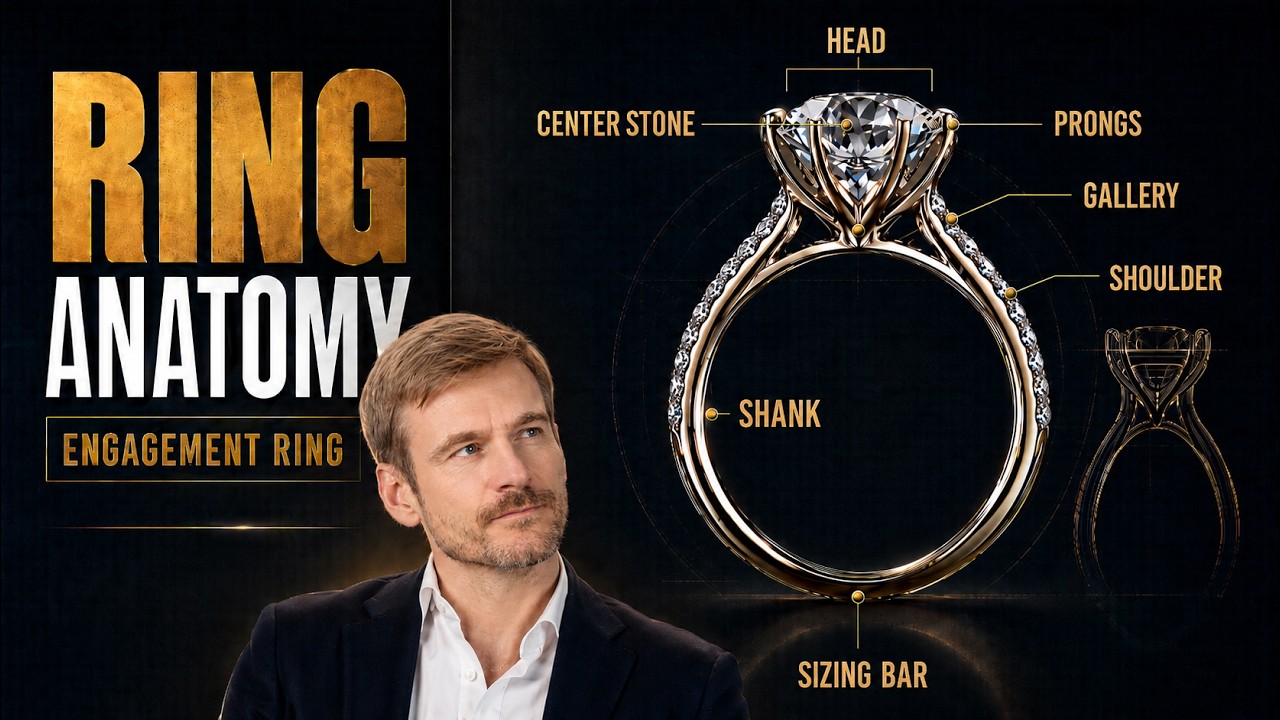
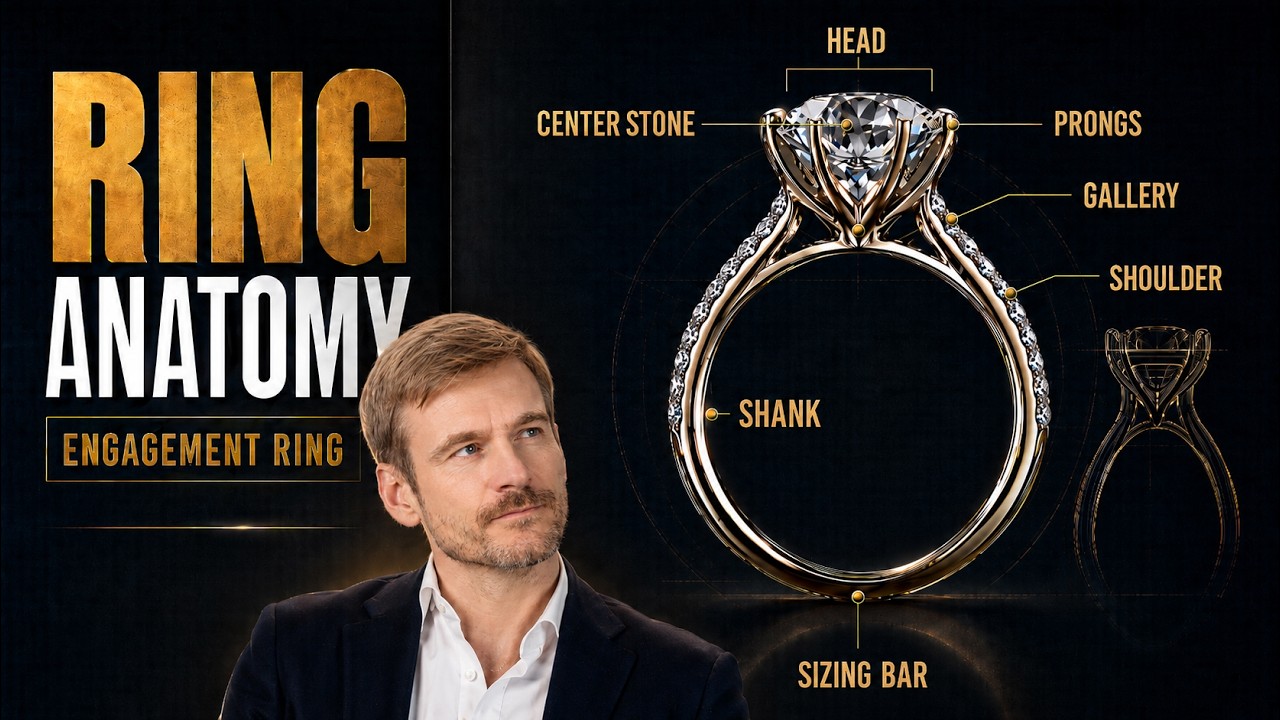
Continue reading: NinaVova custom-ring process discussion · Engagement ring anatomy · Claims to check before paying more.
Sources and further reading
- GIA: Gem and jewelry photography
- GIA: Viewing gems under useful lighting
- GIA: Quality Assurance Benchmarks
- GIA: Engagement ring setting types and styles
- GIA: Protecting a diamond from chipping
Anonymous client accounts reflect the founder’s experience; reactions are personal accounts rather than objective brand rankings. Confirm the current project scope, schedule and terms in writing.
Contact Sergey.
Have a question about ring settings, gemstones, or creating a custom ring? Send me a message and I’ll be happy to help.
Book a time to talk through the ring.
Meet remotely for a focused 30-minute call about your design, stones, timeline, and budget. No jewelry terms needed.
When you schedule the meeting, you can also include a short message before the call — the idea, budget, timeline, saved links, or anything you want us to know first.