
Lab-Grown Colored Diamonds: Colors, Reports and Ring Design

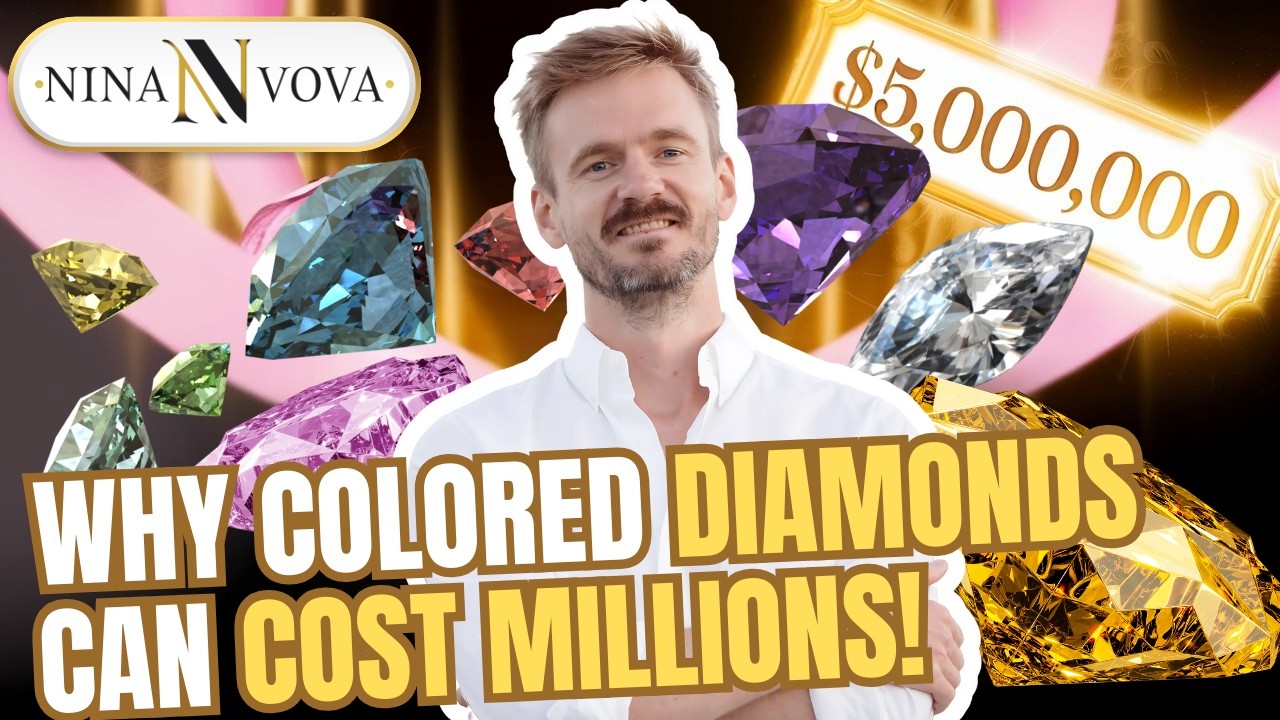
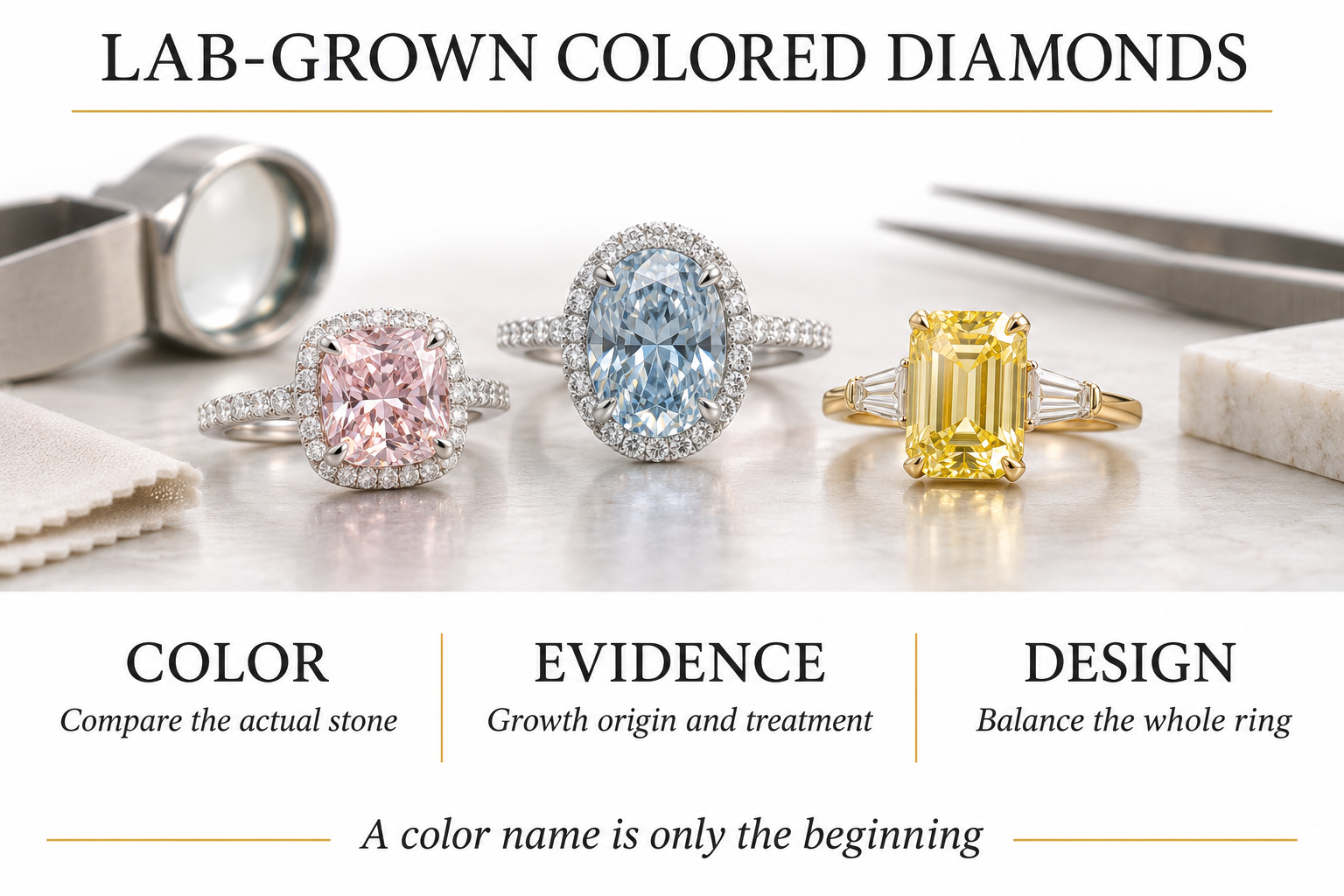
A colored diamond can give an engagement ring a distinctive focus without requiring the budget associated with an exceptional natural pink or blue diamond. Laboratory-grown options open another route to that look. The useful decision still concerns an actual stone: its identity, color, treatment, appearance and the complete design around it.
Choose the actual color with a clear material description. Laboratory-grown diamonds are diamonds, but growth origin, post-growth treatment and color appearance need separate consideration. Compare actual stones and design the setting around the chosen center.
At a glance · Laboratory-grown is a growth origin, not a color grade · Read intensity together with hue and tone · Budget around actual candidates · Yellow: soft warmth or a stronger focal point
Watch the NinaVova discussion
Watch the original NinaVova video on YouTube.
The original NinaVova discussion accompanies this guide. Written explanations distinguish growth origin, color and treatment; older price examples are not current offers.
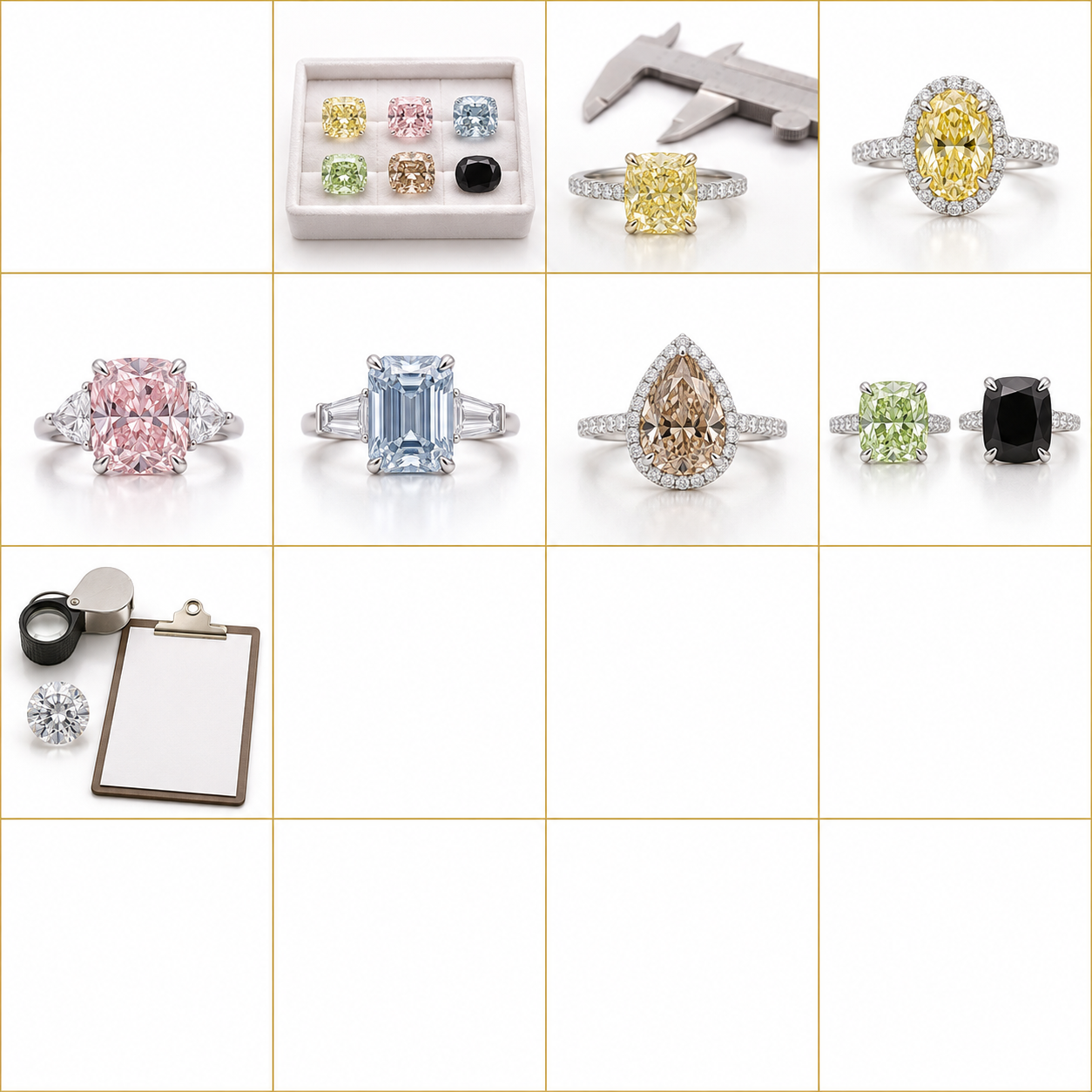
Five color directions, practical questions
| Direction | Explore | Verify |
|---|---|---|
| Yellow | Soft warmth or stronger color | Actual hue and complete description |
| Pink | Blush or saturated color | Real-light views and treatment |
| Blue | Icy, steely or deeper | Light pattern and hue |
| Earth tones | Champagne-like or brown | Exact report terminology |
| Green and black | Contrasting or opaque looks | Identity, growth and treatment |
Laboratory-grown is a growth origin, not a color grade
Laboratory-grown diamonds are diamonds, with essentially the same chemical composition, crystal structure and basic optical and physical properties as natural diamonds. They are different from diamond simulants such as cubic zirconia or moissanite, which are other materials.
Their growth history is different, and specialized testing can identify growth-related features. Describing them as identical in every respect would hide the very distinctions a laboratory uses to separate natural and laboratory-grown material.
A colored appearance does not establish growth origin. Nor does laboratory-grown automatically mean untreated: post-growth processes can alter color. Ask for the complete description and relevant independent evidence rather than relying on a photograph or an attractive name.
A natural-color rarity and a laboratory-grown alternative have different supply and market contexts. Choose the latter for its actual appearance, budget fit and personal meaning rather than a promise that it shares the resale behavior of a rare natural stone.

Read intensity together with hue and tone
Hue names the color and any modifiers. Tone concerns relative lightness or darkness, while saturation concerns color strength. Together they explain why two diamonds described as pink can look very different.
Fancy Light can suggest a delicate pastel direction, while Fancy Intense or Fancy Vivid can describe stronger color. The exact terms depend on the report and the stone. This is not a single ladder on which every darker diamond is automatically better or more valuable.
A light color is not evidence that a diamond is natural, and a vivid color is not evidence that it is laboratory-grown. Both growth origin and any post-growth treatment need their own supporting information.
Compare the actual face-up impression in useful ordinary lighting. Screens, stock photographs, white balance and metal reflections can change your expectations. Ask for moving views of the specific candidate rather than choosing from a color word alone.
Budget around actual candidates
Laboratory-grown colored diamonds can offer a more accessible route to a particular appearance than an exceptional natural-color counterpart. That does not create one standard discount, a fixed price by hue or a guaranteed affordable result for every brief.
Color, dimensions, clarity, cutting, available supply, documentation and seller terms can all enter a quotation. A Fancy Vivid stone is not necessarily more expensive than every Fancy Light stone of the same weight; compare the actual candidates and complete descriptions.
Color may develop through conditions during growth, subsequent treatment or a combination. It is too simple to assume that every yellow is made one way, or that every pink and blue necessarily requires more costly production.
Budget for the complete ring: center, accents, metal, design work, setting and relevant documentation. Ask about current availability and written terms. Neither a red-carpet comparison nor an older thumbnail price is a current offer.
Yellow: soft warmth or a stronger focal point
Yellow can range from a delicate warm impression to stronger color. Canary and sun-drenched are evocative descriptions, but they should not replace the actual laboratory terminology and moving views.
A yellow center can look striking against white metal or blend into yellow gold. Neither pairing is compulsory. Try the actual combination, including the prongs and any backing that may influence the way the color appears.
The center can be a substantial visual statement without requiring a complicated setting. If you enjoy detailed work, use a clear hierarchy so that the setting and gemstone support the same direction rather than competing for attention.
Pink: choose the actual shade in ordinary light
Pink may feel romantic, whether the impression is soft blush or a more saturated tone. Actual stones can have modifiers, uneven color or a lighter appearance than a strongly edited product image suggests.
Rose gold can be an appealing combination, while white and yellow metals offer other contrasts. Do not assume one metal will make every pink diamond look its best. Review the chosen stone and proposed setting together.
Request the growth-origin and treatment description. A report is useful evidence, but it does not replace deciding whether you enjoy the particular hue and saturation when the stone moves outside studio lighting.
Blue: color and light pattern need a joint review
A blue direction can be pale and icy, steely or deeper. The words alone do not tell you whether the diamond will look bright, muted, grayish or dark in the conditions where you will wear it.
Look at the light pattern, transparency and persistent dark areas as well as color. A stone that looks appealing in a single bright photograph may give a different impression in ordinary indoor lighting.
Do not demand the same appearance from every transparent colored diamond or assume that colorlessness is the objective. Color and light behavior should be considered together, according to the specific stone and the look you enjoy.
Earth tones: champagne, cognac and brown
Warm brown directions can suit vintage-inspired, restrained or nature-inspired designs. Champagne and cognac are marketing descriptions rather than a substitute for the exact report and material disclosure.
A soft warm center may work with a simple yellow-gold setting; a deeper tone can become the main visual contrast. These are design possibilities, not rules assigning a style or personality to the wearer.
Compare the actual color distribution and appearance. A brown label alone does not establish a bargain, an origin or an investment case, and a generated illustration cannot demonstrate what a particular stone will look like.
Green and black: verify the material being offered
Green can suggest a pale mint, olive or deeper impression, with very different effects in a ring. An Art Deco composition or botanical design can be explored around the actual stone rather than a generic screen color.
For green or black options, confirm that the actual product offered is laboratory-grown diamond if that is your intended purchase. Colored natural diamonds, treated natural diamonds and other dark or green materials can appear in similar searches.
Black material may be opaque and will not behave like a transparent blue or yellow diamond. Assess its surface appearance, condition and the way the complete setting wears, rather than expecting the same internal light return.
Ask for treatment disclosure and suitable care and repair advice. Do not infer a production method, stable color or commercial availability from a generated concept image.
Reports and three buying pitfalls
The three practical pitfalls are disappointing light behavior, an unwanted hue and a design that loses focus. A report helps with identification and description, but it cannot make those decisions for you.
For evidence, check the report with its issuer and have its details matched to the actual stone. GIA currently lists separate colored laboratory-grown services: a fuller assessment with a plotted clarity diagram and a color-identification option. Their scopes differ; the Premium or Standard service is for colorless to near-colorless material.
For appearance, request the actual candidate in useful moving views. For design, agree on proportions, height, accents and metal before production. A highly detailed ring can still work well when its elements are coordinated; simplicity is a preference rather than a universal quality rule.
A published report number does not by itself establish that the stone in hand is the one described. Ask which important questions the report answers and which need further evaluation.
Build the stone and setting as one composition
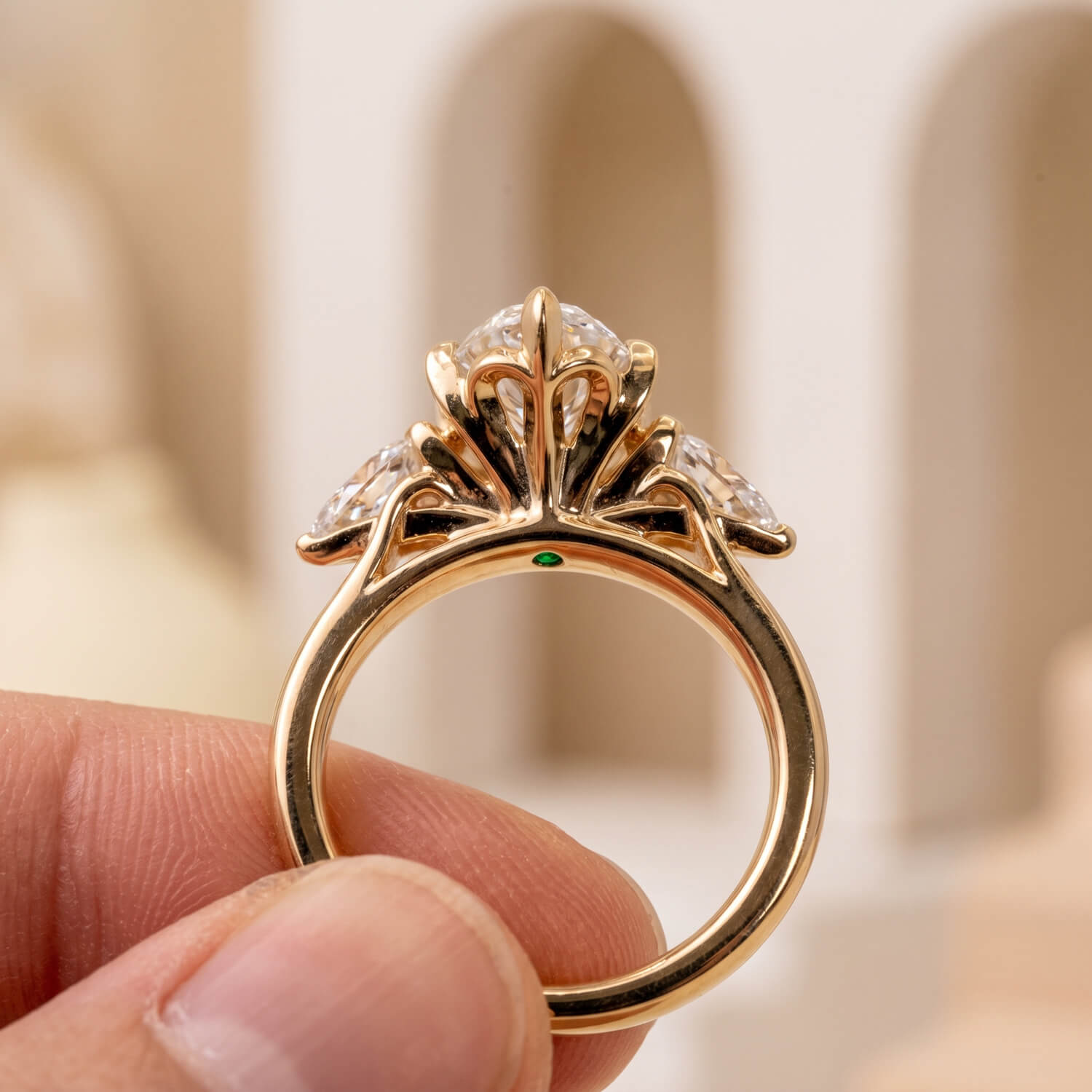
At NinaVova, the custom conversation connects the chosen stone with the setting from the beginning. We discuss the wearer’s taste, routine and budget, then consider proportions and practical details in a 3D design.
The goal is a balanced ring around the actual center, rather than treating the setting as an afterthought. A rendering helps review dimensions and design decisions; it does not reproduce every real-world optical or wearing effect.
Confirm the stone selection, design approvals and written project terms before production. If a family stone or an existing setting is involved, its suitability and condition need their own assessment.
A laboratory-grown colored diamond can express a color you love, a personal memory or a bold visual direction. Choose it with clear evidence and a complete design you are comfortable wearing and maintaining.
Frequently asked questions
Are laboratory-grown colored diamonds simulants?
No. Laboratory-grown diamond is diamond; simulants such as moissanite and cubic zirconia are other materials.
Does laboratory-grown mean untreated color?
No. Ask about growth origin and any post-growth treatment separately.
Does a report guarantee I will like the color?
No. Verify the report and compare actual-stone moving views in useful ordinary lighting.
Design around the actual colored center
Bring the colors you enjoy and a comfortable complete budget. We can discuss actual candidates, evidence, proportions and the setting as one composition.
Book a NinaVova consultation or explore our custom design process.
Continue reading: Natural fancy-color diamonds · HPHT and CVD growth · Understanding gemstone reports.
Sources and further reading
- NinaVova: Original colored laboratory-grown diamond discussion
- GIA: Current laboratory-grown colored report services
- GIA: Laboratory-grown products and identification research
- GIA: Color-treatment overview
Based on NinaVova’s original writing and discussion, with supporting references below. Actual material descriptions, project terms and appropriate care take precedence over broad comparisons.