
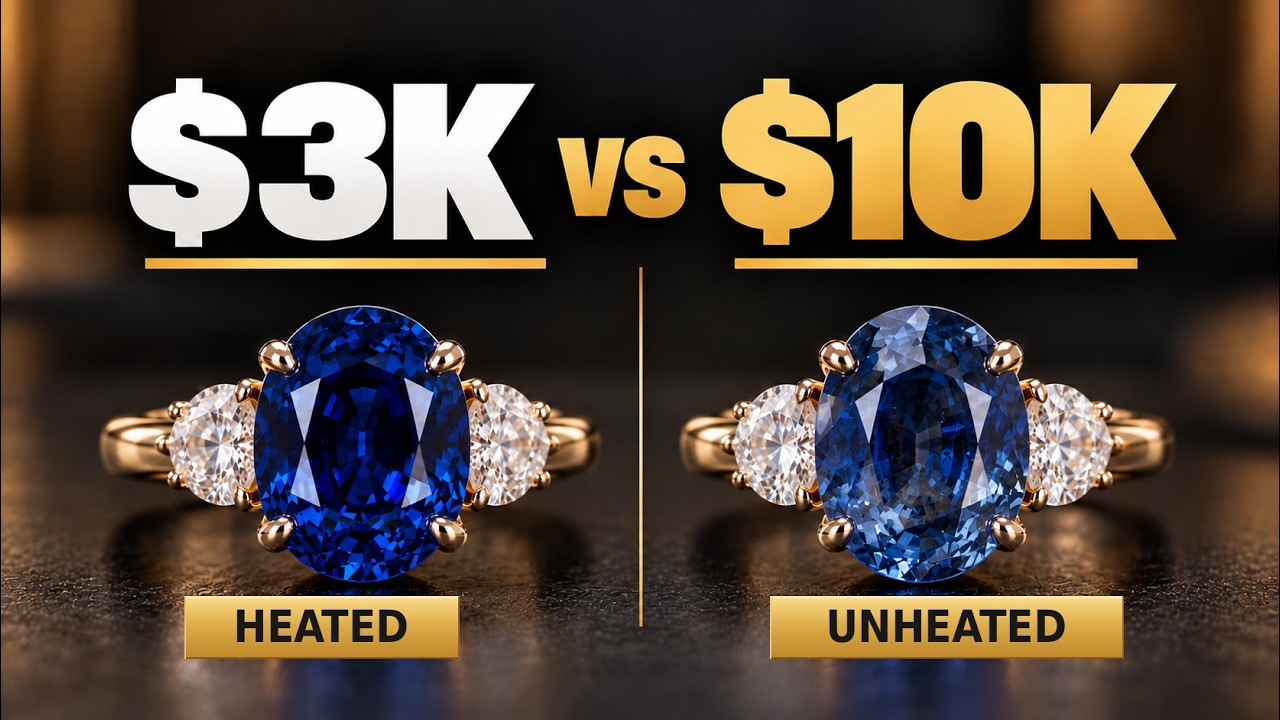
Heated vs Unheated Sapphire: Color, Value and What to Verify

Heat, inclusions, crystal chemistry, laboratory testing, pricing and the auction market all affect how I evaluate a sapphire. If you are buying a natural sapphire, especially an expensive one, understanding these differences helps you decide what is actually worth paying for.
Because heated versus unheated is not simply cheaper versus better. For many engagement-ring buyers, a heated sapphire is actually the smarter purchase. But as the quality and price increase, that calculation changes, and unheated status can become an important part of what you are paying for.
A good heated sapphire can be a better choice than an unheated stone you do not enjoy looking at. Conventional heating is accepted and stable under normal wear. No-heat status can add rarity and value when the stone is already fine, but it is not a beauty grade or a promise of future resale profit.
At a glance · What Heat Treatment Actually Does · What Is Happening Inside the Sapphire? · High-Temperature and Low-Temperature Heating · What the Laboratory Report Should Tell You
Watch the NinaVova discussion
Watch the original NinaVova video on YouTube.
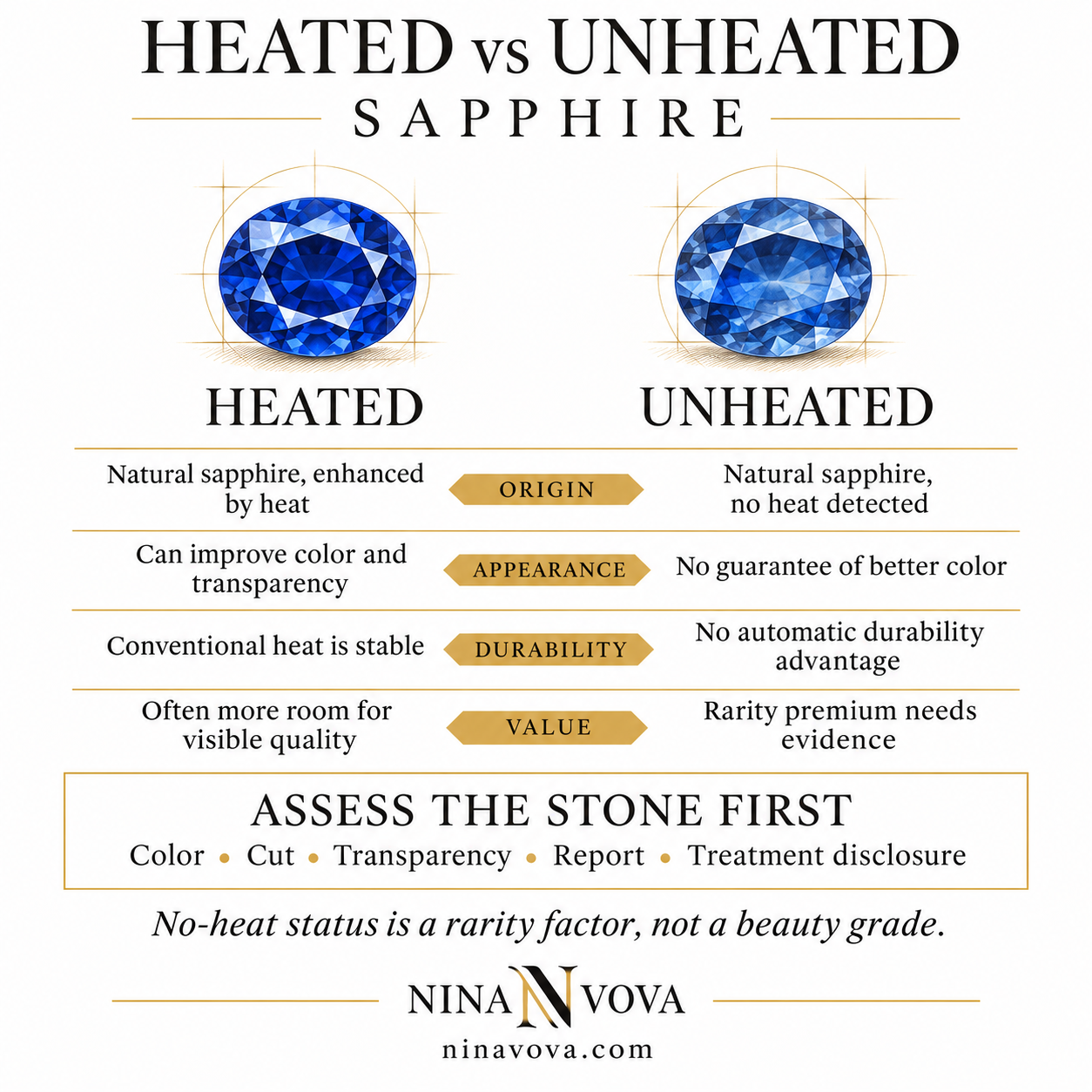
Heated vs unheated sapphire at a glance
| What matters | Conventionally heated sapphire | Sapphire with no heat detected |
|---|---|---|
| Material identity | Still natural sapphire; enhanced after mining. | Natural sapphire with no indications of heating found by the laboratory. |
| Appearance | Heat can alter color, transparency and inclusions. | No-heat status does not guarantee brighter color or a better cut. |
| Durability | Conventional heat is generally stable under normal wearing conditions. | No automatic everyday durability advantage solely from avoiding heat. |
| Documentation | Read the complete treatment findings, including any other enhancement. | An independent report matters when a no-heat premium is part of the price. |
| Budget | May leave more of the budget for visible quality and size. | Rarity premiums depend on quality, size, origin and documentation. |
| Resale | A retail price is not a resale offer. | Collector preference does not guarantee a quick sale or recovery of the purchase price. |
What Heat Treatment Actually Does
Heating is an enhancement performed after mining; the sapphire itself is still natural. Heat treatment is very common in the sapphire trade. The important question is which treatment the individual stone has received and whether it is disclosed clearly.
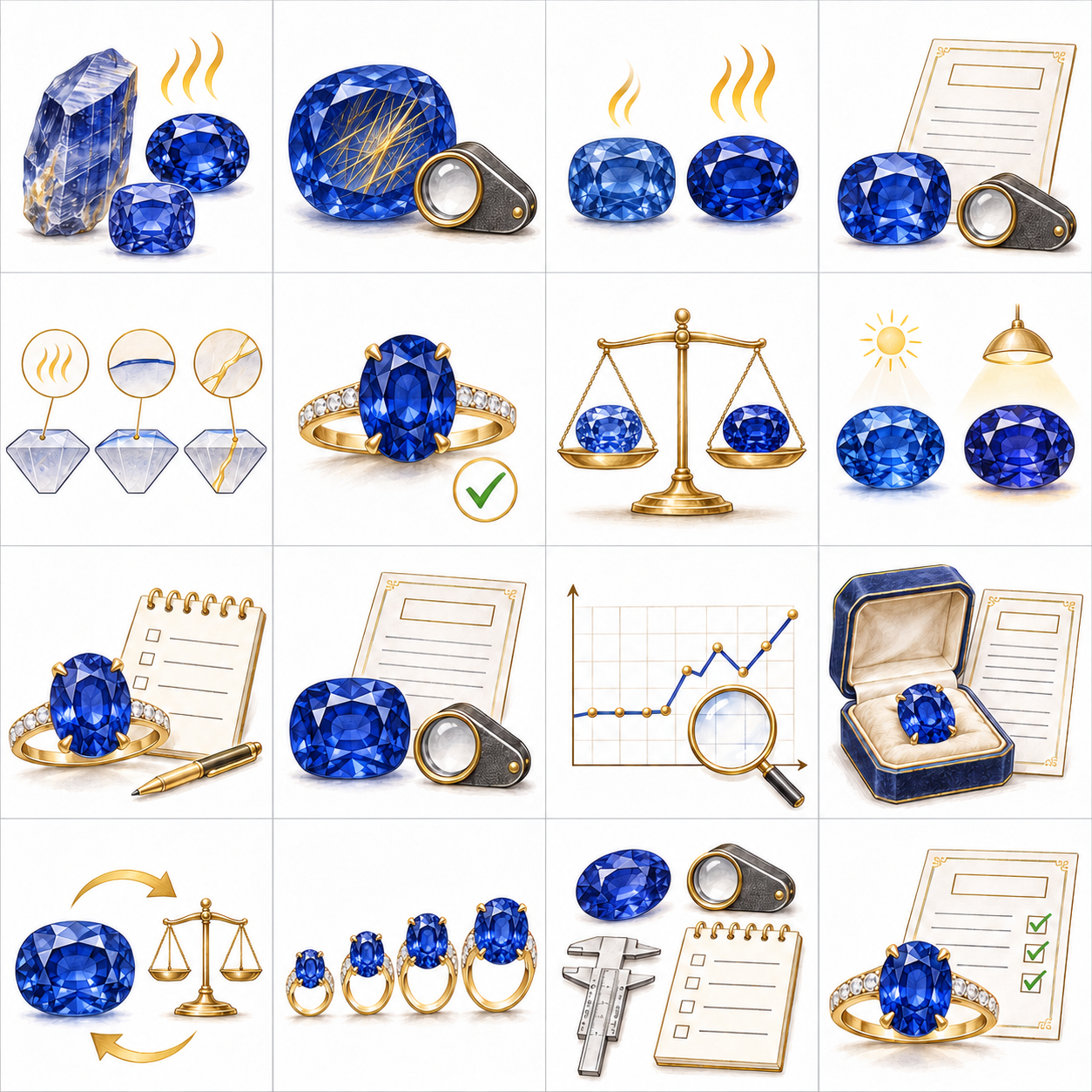
A lot of sapphire rough does not come out of the ground looking like the finished stone people want to wear. Heat can improve transparency, reduce color zoning, alter saturation or secondary colors, and make unattractive material much more desirable.
But heat does not simply take a pale sapphire and make it darker blue.
Depending on the sapphire’s chemistry, temperature, furnace atmosphere, and treatment conditions, heating can intensify color, modify an unwanted color component, or even make an overly dark sapphire lighter. GIA has documented dark blue Madagascar sapphire becoming lighter after relatively low-temperature heating.
A good historical example is Sri Lankan geuda — cloudy, pale, or grayish sapphire rough that was once considered low-value material. Once treaters learned how strongly some geuda could respond to controlled heating, the stone could become more transparent and develop much more attractive blue color. Material that previously had limited commercial value could suddenly become important gem-quality sapphire.
What Is Happening Inside the Sapphire?
Sapphire is corundum. Pure corundum is essentially colorless. Its color comes from trace elements and defects in the crystal structure.
In blue sapphire, iron and titanium are especially important. One major blue-color mechanism comes from iron-titanium interactions that change which wavelengths of visible light are absorbed.
Many sapphires also contain microscopic needles of rutile, which is titanium dioxide. Gemologists call these needles silk.
At sufficiently high temperatures, some rutile can begin dissolving into the surrounding sapphire. That changes the titanium available inside the crystal and, in suitable material, can strengthen the mechanism responsible for blue color. Removing some microscopic needles can also reduce light scattering and improve transparency.
So saying heat simply “melts the inclusions away” is wrong. Rutile can partially dissolve, mineral inclusions can alter, and fractures can heal or change at their surfaces.
And silk is not automatically bad. Fine silk can create the soft, velvety appearance prized in some exceptional sapphires. It can also preserve clues that help laboratories determine geographic origin. Strong heating can alter or destroy some of those clues.
So with sapphire, cleaner does not automatically mean better.
High-Temperature and Low-Temperature Heating
“Heated” is not one single furnace recipe.
Higher-temperature treatment can visibly alter rutile, mineral inclusions, fractures, and internal textures, sometimes leaving strong microscopic evidence.
Lower-temperature treatment can be much harder to identify. SSEF has published research on corundum heated roughly in the 700°C to 1100°C range where color can change without dramatically altering the inclusions normally used to recognize treatment.
That is why laboratories may combine microscopy with FTIR, Raman, UV-Vis-NIR, fluorescence, and chemical analysis. GIA and SSEF continue researching low-temperature heating because some cases are genuinely difficult.
If someone is charging me a serious premium because a sapphire is supposedly unheated, I want that conclusion from a serious independent laboratory.
What the Laboratory Report Should Tell You
A major laboratory may state “No indications of heating” or “Indications of heating.” The lab is reporting what its examination found.
Read the entire treatment section. A report can separately disclose diffusion, fissure filling, glass filling, flux-related residues, or other enhancements. “No indications of heating” is not a blanket statement that absolutely nothing else has been done to the stone.
If an important geographic origin is contributing significantly to the price, I want the origin evaluated too. For exceptional sapphires, origin itself can create a major premium.
In the United States, the FTC Jewelry Guides say gemstone treatment should be disclosed when it is not permanent, creates special-care requirements, or significantly affects value. Disclosure is not simply a courtesy.
Conventional Heat Is Not the Same as Diffusion, Filling, or Other Treatments
Conventional heating uses temperature to modify characteristics of the sapphire. It is widely accepted in the trade, and the result is generally stable under normal wear.
Diffusion treatment is different. Heat is used together with elements introduced during treatment to alter color. With titanium diffusion, added blue color can be concentrated relatively close to the surface. Other processes, including beryllium diffusion, can penetrate much deeper.
That does not make diffusion automatically dangerous. It is a different value category because the color was produced differently; GIA notes it is generally less valuable than sapphire treated only by conventional heating.
Shallow diffusion can also matter if a stone needs significant recutting, because part of the treated color can potentially be removed.
Fissure filling or glass filling is different again because another material is present in fractures or cavities. That can create additional care and repair considerations.
And some fancy-color corundum has also been treated by irradiation. That is a separate treatment category again, with its own disclosure and stability questions.
So “treated sapphire” is not enough information. Conventional heating, diffusion, filling, and irradiation have different implications for price and care.
Does Conventional Heat Make Sapphire Worse for an Engagement Ring?
No.
If we are talking about a conventionally heated sapphire, durability is not a reason I would pay more for unheated. Sapphire is an excellent gemstone for daily wear, and ordinary heat treatment is considered stable and permanent under normal conditions. A properly heated sapphire is not expected to gradually lose its color because someone wears it every day.
So the premium for unheated is not buying better everyday durability. It is buying rarity.
Is Unheated Sapphire Actually Better?
If two sapphires are genuinely comparable in beauty and quality, yes, I would rather have the unheated one. It is rarer, the market values that rarity, and at the high end it has stronger collector demand.
But visually, unheated does not automatically mean better.
An unheated sapphire can be too dark, pale, grayish, badly zoned, poorly cut, or heavily included. A heated sapphire can have exceptional color and be the stone I would rather look at every day.
Color is the dominant value factor, but “color” means hue, secondary colors, saturation, tone, brightness, and evenness. A sapphire with an obvious gray or green modifier is a very different buying proposition from a vivid blue or slightly violetish blue sapphire, even if both are unheated.
So no heat is a rarity characteristic. It is not a beauty grade.
What I Actually Look at When Choosing a Sapphire
Treatment is only one part of the evaluation.
First I look at hue and secondary colors. Then saturation and tone: does the stone look rich without becoming so dark that it loses brightness?
Then I look at it in different lighting. Sapphire can change noticeably between daylight, office lighting, and warm indoor light.
I look for color zoning, extinction, where areas go very dark, and windowing, where part of the stone becomes visually transparent instead of returning light.
Then transparency and inclusions. Are clouds making the stone sleepy? Is silk producing beautiful softness or just haze? Are there crystals or fractures that concern me? Does anything reach the surface in a vulnerable place?
Then the cut. Is the shape balanced? Does it return light well? Was the rough oriented intelligently to manage color and pleochroism? How large does it look face-up for its carat weight? That entire picture matters before I get excited about the words heated or unheated.

Why Heated Sapphire Often Makes More Sense at a Normal Budget
You have one budget, and that money can buy stronger color, larger size, better transparency, better cutting, prestigious origin, or an unheated premium. You usually cannot maximize everything.
So if paying for no heat means accepting weaker color, a smaller stone, or something I simply find less beautiful, I would usually choose the better heated sapphire.
Heating gives buyers access to combinations of natural sapphire, attractive color, and useful size that would cost substantially more if the same quality could be found unheated. When treatment is properly disclosed and the price reflects it, that is real value.
When Unheated Starts Making More Sense
This is where the economics change.
If a heated sapphire gives you noticeably better color, size, or transparency for the same money, I would usually buy the heated stone. But once both options are already excellent, the no-heat premium starts buying something real: scarcity.
There is no universal multiplier, but the premium can be substantial. Sotheby’s gives examples of unheated Ceylon sapphires commanding around twice the price of heated counterparts, especially when the no-heat status is supported by a respected laboratory report.
That does not mean every unheated sapphire is worth 2 times more. The premium becomes strongest when several rarity factors stack together: exceptional color, strong transparency, larger size, desirable origin, and no heat.
A beautiful heated sapphire can still be worth more than a mediocre unheated one. But when two stones are genuinely comparable in visible quality, the unheated stone is rarer, and the market usually prices that rarity accordingly.
So I would not pay a large premium just to avoid heat. I would pay it when the sapphire is already exceptional enough that not needing heat is part of what makes it rare.
How to Interpret Sapphire Price-Growth Claims
Fine unheated sapphire can be scarce, particularly when strong color, transparency, larger size and desirable origin are all required together. That scarcity can support a substantial premium, but the premium is not the same thing as a measured investment return.
Selected auction results and dealer comments describe particular stones and particular moments. They do not establish a universal growth rate for all unheated sapphires, and an exceptional auction jewel is not a direct comparable for an ordinary engagement-ring center.
I would ask for dated, genuinely comparable offers and examine what is included in each price. Size, color, cut, treatment, origin and documentation have to be considered together before treating a price difference as evidence of a broader trend.
A no-heat report can support a rarity claim. It cannot promise what a future buyer will offer or how long a resale will take.
What Happens at the Serious Collector Level?
Look at major auctions and the preference becomes very clear.
Sotheby’s reported that since 2024, 19 of its top-performing sapphire jewels sold for a combined $12 million, 169% above their combined high estimates of $4.5 million. Many of the top-performing Ceylon examples it highlighted were unheated, including stones over 20 ct.
No heat did not cause every result; quality, size, signed jewelry, provenance, and estimates all matter. But it repeatedly appears among the sapphires collectors compete for.
The Blue Belle of Asia is a useful example of how seriously treatment is documented at this level. The 392.52 ct Ceylon sapphire has reports from AGL, Gübelin, and SSEF, all agreeing that there is no evidence or indication of heat treatment.
Auction houses absolutely do sell heated sapphires. But among the rarest, most expensive stones, no-heat status repeatedly becomes part of the rarity package alongside exceptional color, size, origin, and provenance.
Does Unheated Make the Sapphire Easier to Sell?
Documented no-heat status can make an already fine sapphire more appealing to collectors who specifically seek untreated material. It is one part of the complete stone’s marketability, alongside color, size, cut, origin, condition and provenance.
That does not make every unheated sapphire easy to sell. A seller still needs a suitable buyer, and an asking price is different from an executable offer. The qualities valued in an engagement-ring purchase may also differ from the priorities of a dealer or collector.
I would not assume that stronger collector interest guarantees recovery of a retail purchase price or a profit. Dealer margins, selling fees, commissions and the time needed to find a buyer all affect the result.
If resale materially affects the decision, obtain advice and real offers appropriate to that purpose. Buy the ring primarily for the stone and design you want to own and wear.
My Practical Budget Examples
These are not hard price rules. They are examples of how I would allocate the budget.
If I had around $3,000 for the sapphire, I would usually prioritize a beautiful heated stone. I want as much of that money as possible going into color, cut, transparency, and useful size.
Around $5,000, my thinking is still similar. I would look at unheated options, but if no heat forces me into noticeably weaker color, smaller face-up size, or a stone I simply like less, I am probably buying heated.
Around $10,000, I start taking unheated much more seriously. There is a better chance of getting strong visible quality and natural rarity without making such a large compromise. But I still buy the sapphire first and the report second.
If I were spending $50,000 on the sapphire itself, my thinking changes substantially. I would strongly prefer an exceptional unheated stone unless the heated alternative had something genuinely extraordinary about it. At that price, treatment status, scarcity, documentation, collector demand, historical price pressure, and future marketability become meaningful parts of what I am purchasing.
And as you move beyond that into major collector sapphires, no heat becomes increasingly difficult to ignore.
What I Would Verify Before Buying
For a heated engagement-ring sapphire, I want proper disclosure and I want to know whether we are talking about conventional heat, diffusion, filling, irradiation, or another enhancement.
Then I evaluate the actual sapphire: hue, secondary colors, saturation, tone, zoning, behavior in different lighting, extinction, windowing, transparency, clouds, silk, crystals, fractures, cut quality, face-up size, and overall beauty.
For an unheated sapphire carrying a serious premium, I want an independent laboratory report confirming no indications of heating. If geographic origin is a meaningful part of the price, I want that evaluated too.
At very high values, confirmation from more than one respected laboratory can make sense. When a significant part of the price depends on treatment and origin, verification is inexpensive compared with getting either one wrong.
Final Decision
So, heated or unheated?
If you are buying a sapphire for an engagement ring on a practical budget, I would usually prioritize the best sapphire you can actually see. If conventional heat lets you get substantially better color, transparency, cut, or size, I have no problem choosing it.
If the sapphire is already exceptional and your budget allows you to add rarity without sacrificing beauty, then I would prefer unheated.
And once we get into serious collector money, I become increasingly reluctant to pay a very large amount for heated sapphire because no-heat status now affects scarcity, the premium collectors are willing to pay, price pressure, and how desirable the stone is likely to be if it returns to the secondary market.
Unheated is not automatically better simply because nobody heated the stone. It becomes better when the sapphire is already good enough that not needing heat is part of what makes it exceptional.
I hope this answered some of the important questions you should understand before buying a sapphire. Now you are not just guessing — you know what you are paying for and why.

Frequently asked questions
Is heated sapphire still natural?
Yes. Conventional heating is an enhancement performed after mining. Laboratory-grown sapphire is a separate identity category and should be described as such.
Does unheated mean more beautiful?
No. No-heat status is a rarity characteristic. The actual stone still needs to justify its price through appearance, condition, cut and documentation.
Choose visible quality before a label
We can help you compare the actual sapphire, its treatment information and the proposed setting, so the design and the buying decision support the same priorities.
Book a NinaVova consultation or explore our custom design process.
Continue reading: Sapphire engagement ring guide · Custom vs ready-made engagement rings.
Sources and further reading
- GIA: How heat treatment affects sapphire value
- GIA: Sapphire quality factors
- SSEF: Sapphire reports and treatment findings
- GIA: Low-temperature heating experiments on Madagascar sapphire
- FTC: Advertising diamonds, gemstones and pearls
- Sotheby’s: Ceylon sapphires collector guide
- Sotheby’s: Selected top-performing Ceylon sapphires
Auction examples concern selected historical jewels and are not an index of returns for ordinary ring stones. Budget examples describe buying priorities, not guaranteed current quotes or resale outcomes.