
Emerald Wedding Bands: Color, Treatment and Practical Care

An emerald wedding band offers a green color accent and can carry a personal association with growth or a meaningful place. Emerald’s scratch resistance does not make it immune to chips or fractures, and treatments can affect care. Select the actual stones and construction with realistic expectations for wear, cleaning, band pairing and future service.
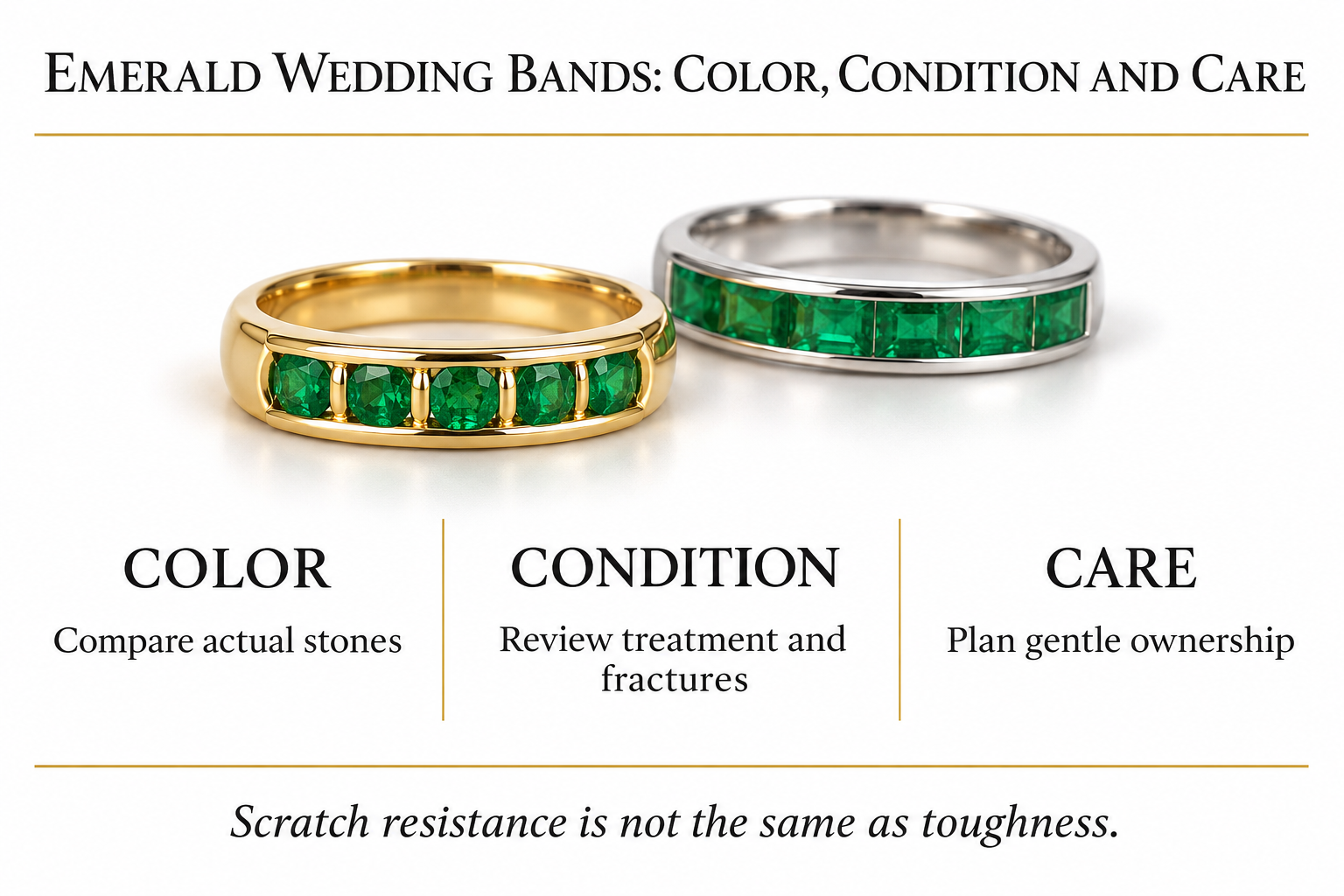
Balance the green color you enjoy with realistic care. Emerald’s scratch resistance does not remove fracture and treatment concerns. Review actual stones, setting coverage, band contact and appropriate cleaning before choosing.
At a glance · Keep color symbolism personal and historical claims specific · Compare the actual stones for color and consistency · Confirm identity, treatment and report scope · Consider toughness as well as scratch resistance
Watch the NinaVova discussion
Watch the original NinaVova video on YouTube.
The NinaVova gemstone-comparison discussion is a related companion for weighing color and wearing needs. This guide focuses on emerald wedding bands and their care requirements.
Emerald wedding bands: color with practical care
| Decision | Review | Confirm |
|---|---|---|
| Color | Actual stones in realistic views | Matching expectations across the band |
| Identity | Natural or laboratory-grown emerald | Relevant documentation |
| Treatment | Known fracture filling and condition | Appropriate care |
| Construction | Coverage and exposed areas | Impact and contact considerations |
| Pairing | Actual engagement-ring clearance | Rubbing and combined fit |
| Ownership | Cleaning and future work | Alteration and replacement limits |
Keep color symbolism personal and historical claims specific
Green may suggest a landscape, renewal or another memory to the wearer. These associations are personal or cultural rather than a guarantee of harmony, fertility or prosperity.
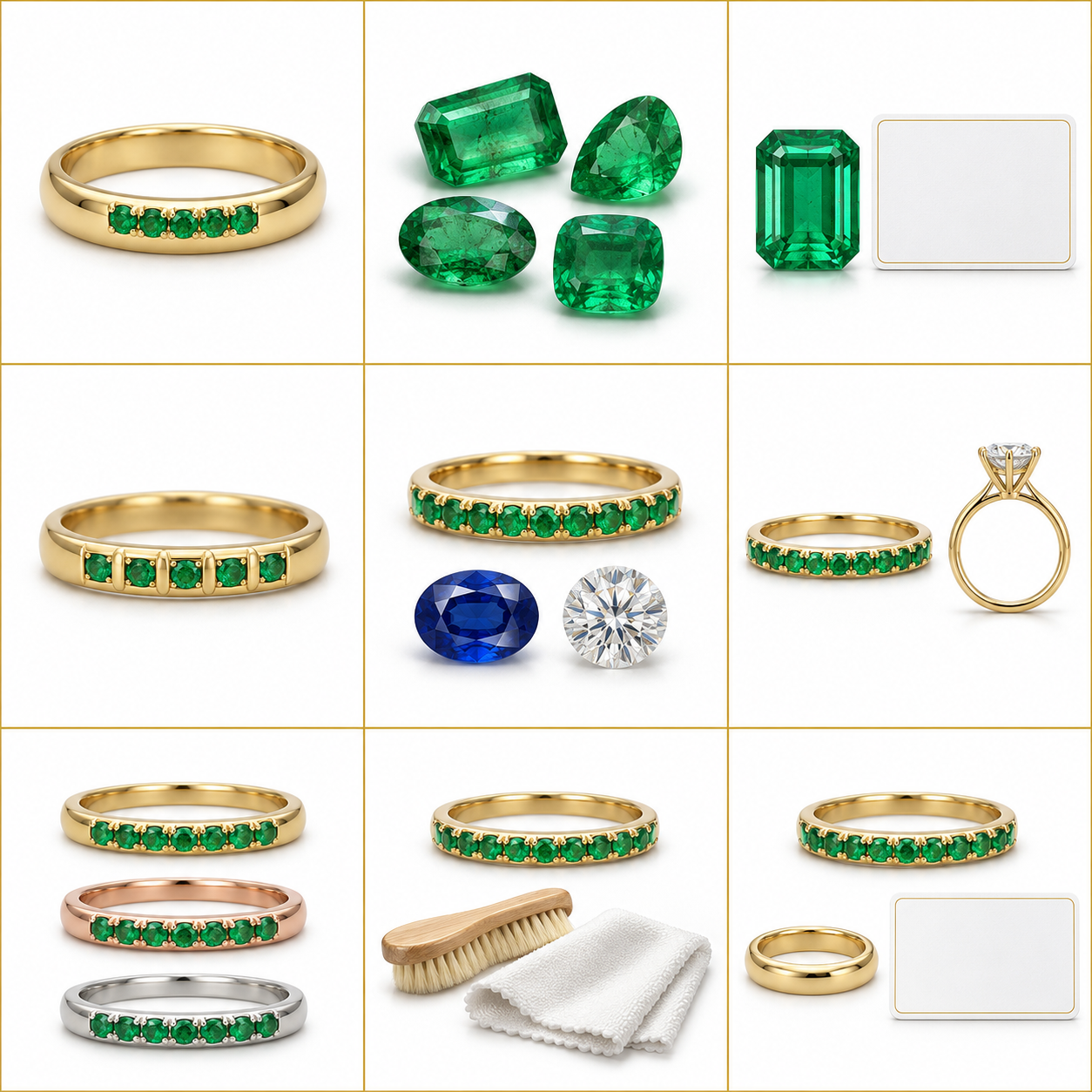
Emerald has a long history in jewelry, but a broad historical story does not establish the source or age of stones in a modern band.
Choose the color because you enjoy it. A wedding band does not need an assigned symbolic meaning to become important through daily life.
The word emerald describes a gemstone material here. It should not be confused with an emerald-cut diamond or another green stone.
Compare the actual stones for color and consistency
View the offered emeralds rather than assuming every vivid green photograph represents the same quality. Color, transparency and inclusions can vary among stones.
In a multi-stone band, decide how closely the stones should match. Small variations may be acceptable or intentional, but should not be hidden by a heavily edited image.
Dimensions and cutting affect the visual rhythm across the band. Ask for realistic views of the complete layout.
No color label guarantees value, and a darker stone is not automatically better. Compare the actual appearance and description with your preference and budget.
Confirm identity, treatment and report scope
Establish whether the emeralds are natural or laboratory-grown and what relevant treatment is known. A green color alone cannot provide those facts.
Fracture filling is common in natural emerald, and disclosure matters for care and interpretation. Ask what is known about the actual offered stones.
Where a report is supplied, read what it identifies and what it does not establish. Not every small accent in a band necessarily has an individual report.
A source claim, treatment statement and quality description answer different questions. Keep those distinctions clear in the order specification.
Consider toughness as well as scratch resistance
Emerald requires more care in wearing than ruby or sapphire, particularly where fractures or treatments affect the stone. A high position on a hardness scale is not a promise of impact resistance.
Inspect condition and discuss the intended setting with the jeweler. Metal coverage may reduce some exposure but cannot make a vulnerable stone indestructible.
A band with stones extending around the underside can receive contact during gripping and work. Consider the actual wearing pattern before selecting continuous coverage.
Remove the band for impact, heavy work and other unsuitable activities. If a stone moves or the ring is struck, arrange inspection.
Compare other colored-stone options honestly
Green sapphire, tsavorite and other materials offer different appearances and care requirements. They should be named accurately rather than sold as interchangeable emeralds.
Ruby and sapphire have their own durability advantages, while opal and pearl introduce different vulnerabilities. Choose according to the actual stone and intended use.
Laboratory-grown alternatives can provide other price and appearance choices, but they do not automatically establish zero environmental impact or universal ethical sourcing.
If emerald is the preferred material, accept its specific care rather than expecting every alternative’s properties in the same green stone.
Check clearance beside the actual engagement ring
A solitaire, halo or three-stone engagement ring can be paired visually with a colored band, but actual gallery height and contact determine how the pieces sit together.
Review rubbing near emeralds, settings and metal edges. A pleasing front photograph does not show every potential contact point.
A shaped band, deliberate gap or separate wearing arrangement may be more suitable than forcing a flush fit.
Check the combined width during sizing. Comfort and service access matter alongside the balance of color and proportions.
Choose metal and coverage with service in mind
Yellow, rose and white tones frame green differently. Specify the actual alloy, finish and any plating rather than choosing from color alone.
Prong, channel and bezel-related treatments need dimensions and execution suitable for the actual stones. A style label alone is not a protection guarantee.
Partial coverage can leave a plain sizing area, while continuous coverage may limit alteration. Confirm what can be resized or repaired in the particular design.
Replacement stones may not exactly match the original color. Ask about practical service options before approving a tightly matched layout.
Use gentle care appropriate to treatment and construction
GIA cautions against steam and ultrasonic cleaning for emeralds because fractures and fillers can be affected. Heat and chemicals also require care.
Ask for instructions specific to the actual band. Gentle cleaning with suitable water and mild soap may be appropriate, but other components and treatments still matter.
Avoid home attempts to refill fractures, polish stones or tighten settings. Changes in appearance should be assessed before applying aggressive cleaning.
Keep the gemstone and treatment records for future service. Suitable care supports ownership without guaranteeing the stones can never be damaged.
Approve a green band with realistic expectations
Compare actual stones, construction, dimensions and included service in the current quotation. A broad rarity claim does not establish the value of a particular band.
Ask NinaVova about current emerald availability and design feasibility. Educational illustrations here are concepts rather than photographs of a confirmed emerald-band collection.
Confirm final material descriptions, care, timing and alteration or return terms in writing. A rendering does not certify a stone or predict every real-life view.
An emerald wedding band can be meaningful through its color and personal story when that appeal is balanced with thoughtful construction and the care the wearer is prepared to give it.
Frequently asked questions
Does hardness make emerald impact-proof?
No. Scratch resistance and toughness are different considerations.
Can emeralds be cleaned in an ultrasonic cleaner?
GIA advises against ultrasonic and steam cleaning because fractures and fillers may be affected. Follow guidance for the actual ring.
Does green color prove environmental credentials?
No. Environmental or sourcing claims need separate evidence.
Discuss the actual green stones and band design
We can review current emerald availability and practical design options, with attention to condition, care and the neighboring ring.
Book a NinaVova consultation or explore our custom design process.
Continue reading: Personalized wedding bands · Bezel settings · Design consultation.
Sources and further reading
- GIA: Emerald care and cleaning
- GIA: Durability testing of filled emeralds
- GIA: Emerald fracture-filler report scope
- GIA: Ultrasonic cleaners and gems
- GIA: Accurate ring sizing
Confirm the actual materials, condition, evidence and current written terms for the offered ring. Illustrations do not establish identity, provenance, certification or an environmental footprint.