


Recycled Gold Jewelry: Content, Traceability and Environmental Claims

Recycled gold jewelry uses gold recovered from earlier material streams, but the phrase needs a precise definition and supporting records. It can be a useful part of a sourcing brief without making a ring automatically impact-free, traceable to one previous owner or ethically verified in every other respect.
Ask exactly what is recycled and what proves it. A recycled-content statement needs a definition, scope and supporting documentation. It does not by itself establish zero impact, gemstone origin or every ethical aspect of a finished ring.
At a glance · Define the recycled-content claim · Pre-consumer and post-consumer sources · Refining, alloying and finished quality · Documentation, certification and scope
Watch the NinaVova discussion
Watch the original NinaVova video on YouTube.
Related NinaVova gold-metal discussion helps with appearance and practical selection. It does not certify recycled content; the article explains the separate evidence to request.
Questions behind a recycled-gold claim
| Question | Evidence to request | Do not infer |
|---|---|---|
| What content? | Percentage and components covered | The entire ring is recycled |
| Which definition? | Named standard and material category | Every use of the term is identical |
| Whose records? | Supplier and applicable documentation | A ledger independently verifies input |
| Certification scope? | Entity, standard and valid scope | Every item is certified |
| Environmental comparison? | Boundaries, energy and comparison | The ring has zero impact |
| Heirloom reuse? | Direct reuse, refining or credit terms | The same atoms will be returned |
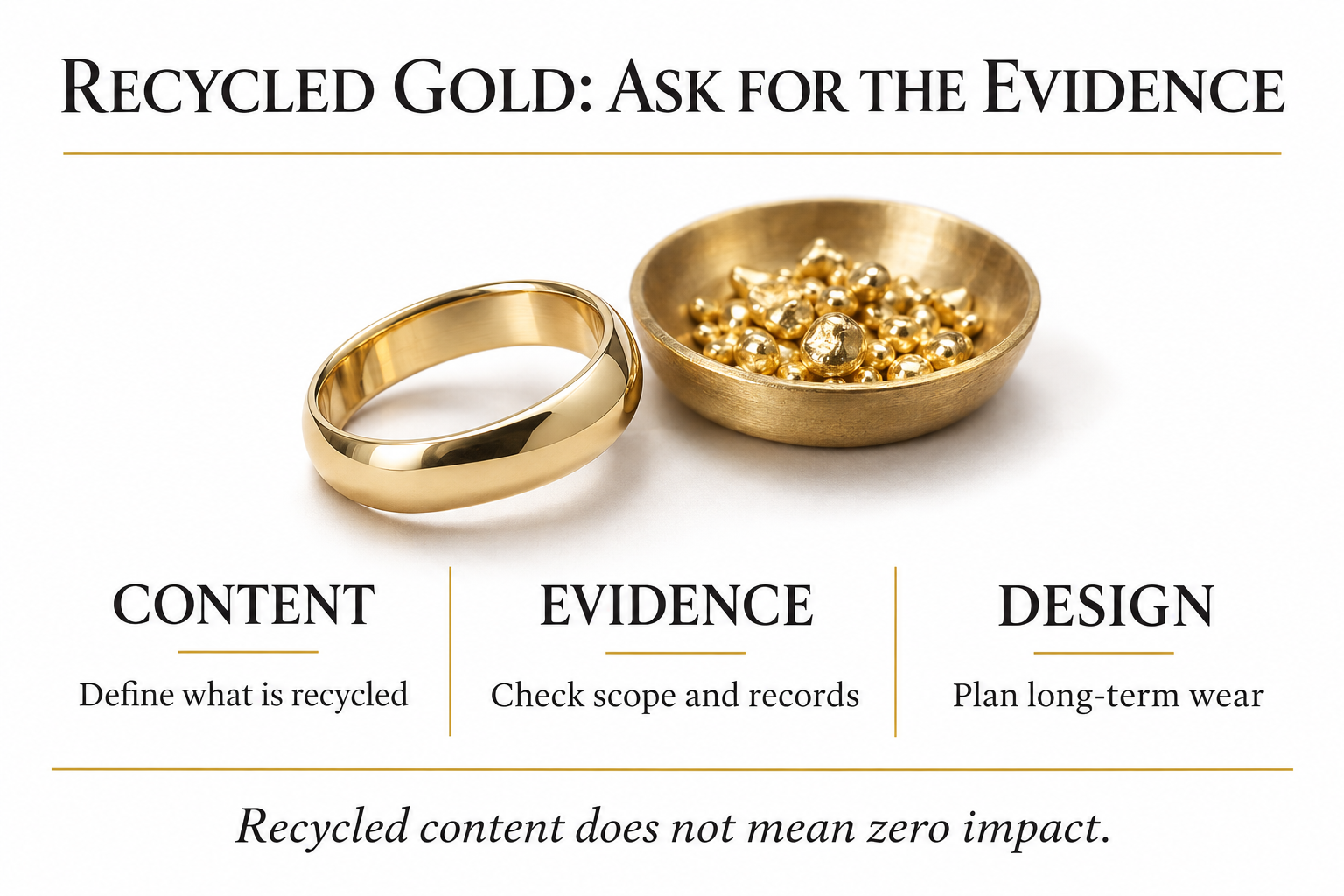
Define the recycled-content claim
Begin with the exact claim about the item: which metal is recycled, what proportion is being described and which definition is being used? “Made with recycled gold” can leave important questions unanswered.
Ask whether the percentage refers to the gold content or the entire alloy, and whether findings, solder and other components are included. A stone-set ring contains more than its primary metal.
Recycled content does not describe the gemstone’s origin, labor conditions throughout manufacture or the environmental footprint of the complete finished piece.
At NinaVova, request current project-specific sourcing information rather than assuming every photograph or gold design carries the same recycled-content claim.

Pre-consumer and post-consumer sources
Industry definitions distinguish pre-consumer material associated with manufacturing from post-consumer material recovered after end use. The precise eligibility rules depend on the named standard.

CIBJO’s recommended definition published in 2025 distinguishes these categories and specifically addresses manufacturing scrap and investment-form gold. This is why the definition used by a supplier matters.
A phrase such as “old gold” does not identify a documented recycled stream on its own. Ask what records support the classification and whether the supplier describes a mixture of eligible sources.
Gold from a particular heirloom is a different question again. A recycled-content statement does not establish that the atoms in the final ring came from one personally supplied object.
Refining, alloying and finished quality
Recovered gold may be refined and alloyed to the specification needed for a new piece. The fact that the gold has been used before does not itself determine its final color, fineness or workmanship.
A finished 18K gold alloy contains 75 percent gold by weight; the balance affects properties and appearance. A recycled-content claim and a fineness description answer different questions.
Request the actual alloy and finish, relevant metal markings and information about known sensitivities. Avoid promises that a precious-metal label makes any ring universally hypoallergenic.
Assess the finished construction separately: suitable dimensions, a smooth interior, sound settings and a realistic service plan. Recycled origin is not a substitute for checking these details.
Documentation, certification and scope
Ask who supplied the metal, which claim is documented and how records connect the material to the order. A vague certificate logo without a scope or reference may tell you little about the actual ring.
The Responsible Jewellery Council’s Chain of Custody framework includes requirements for eligible material and documentation. Membership, a company-level audit and an item-specific claim should not be assumed to mean the same thing.
If certification is cited, check the entity, standard, scope and applicable period. Do not infer that every product sold by a business is covered simply because its name appears in an industry organization.
A digital ledger can record information, but it does not independently prove that an initial declaration was true. Reliable input, controls and an intelligible chain of records still matter.
Environmental comparisons need defined boundaries
Recovering existing gold can reduce reliance on newly extracted material within a particular supply chain. It does not establish that buying one ring prevents a measured amount of mining elsewhere.
Collection, transport, refining and fabrication still involve resources and impacts. Broad descriptions such as “zero impact,” “guilt-free” or “completely green” should be avoided without the evidence and precise qualification those claims require.
If a seller gives a carbon-saving number, ask what process, location, energy supply, comparison and period it covers. A percentage taken from one study is not automatically valid for every recycled-gold ring.
The FTC Green Guides caution against broad environmental benefit claims that cannot be substantiated. A narrow, documented recycled-content statement is generally clearer than an unlimited promise about the whole product.
Design freedom and the complete ring
Recycled gold does not require one visual style. Subject to the actual alloy and fabrication plan, a design can be minimal, sculptural, geometric or inspired by an earlier period.
Choose the stone and metal together, taking account of setting height, support, band width and comfortable wear. A drawing still needs review against the actual materials and dimensions.
Identify the gemstones separately and disclose relevant treatments. Pairing a documented metal with an unidentified stone leaves an important part of the purchase unexplained.
A personal inscription or a remembered detail can add meaning, but it does not make a sourcing claim stronger. Keep the emotional story and the evidence clear in their own terms.
Reusing a family jewel or remodeling an heirloom
Before dismantling a family piece, consider its sentimental, historic and design value. Photograph it and establish what will be retained, altered or returned.
Ask whether the workshop can reuse the particular metal directly, needs refining or will instead provide a metal-value credit against different material. These are different arrangements and should be written down.
Old alloys, solder, wear and repairs can affect feasibility. Reusing every component may not produce the construction or finish required for the new design.
If the goal is to keep a specific stone or recognizable detail, state that first. A workable redesign may preserve the meaning without promising that all original material can be retained.
Technology helps a process; it does not prove sustainability
Digital design, printed models, laser work and improved recovery methods can support manufacturing. None guarantees that the finished project has a lower total environmental footprint.
Ask what a technique changes in this order: accuracy, material recovery, production steps or the ability to repair a component. Specific explanations are more useful than an impressive equipment list.
Printed models and casting can still involve supports, consumables, rejects and finishing. Avoid describing a process as using only the exact final amount of material unless that has actually been established.
Technology and handwork can complement each other. Judge the quality and the sourcing evidence for the complete piece rather than treating either approach as automatically superior.
Plan for a long useful life
Choose proportions and materials appropriate to the wearer, arrange periodic condition checks and remove rings for activities that can cause impact or damage. Follow care instructions for the most sensitive component.
Ask about resizing limits, likely repairs, refinishing and replacement components before purchase. A design that can be maintained may serve the wearer better than an inconvenient piece bought on a broad green claim.
Keep the invoice, material description and sourcing documents together. They can support later repairs and a more accurate history if the jewelry is passed on.
A responsible recycled-gold decision combines a defined claim, usable evidence, a suitable design and realistic care. The aim is an informed purchase rather than a promise that any material has no consequences.

Frequently asked questions
Is recycled gold automatically lower quality?
No. Evaluate the actual fineness, alloy and finished construction.
Does recycled content prove no environmental impact?
No. Collection, refining and manufacture still have impacts.
Does a gold photo prove recycled origin?
No. Source claims need documentation for the item or order.
Build a sourcing brief alongside the design
Discuss the actual metal, documentation available for the order, gemstones and ownership needs before approving a project.
Book a NinaVova consultation or explore our custom design process.
Continue reading: Ethical sourcing questions · Gold alloy choices · Remodeling an heirloom.
Sources and further reading
- CIBJO: Recommended definition for recycled gold
- Responsible Jewellery Council: Chain of Custody
- FTC: Environmental claims and Green Guides
- FTC: Gold and precious-metal descriptions
Confirm the actual materials, condition, evidence and current written terms for the offered ring. Illustrations do not establish identity, provenance, certification or an environmental footprint.