Skip to navigation Skip to main content
  • Design Process
    • Create a Custom Engagement Ring for Your Partner
    • Design an Engagement Ring Together
    • Create Your Own Custom Engagement Ring
    • Forest-Inspired Sapphire Ring Story
  • Ring Gallery
  • Diamonds
    • Natural diamonds
    • Lab-grown diamonds
    • Round
    • Oval
    • Cushion
    • Emerald
    • Pear
    • Radiant
  • Gemstones
    • Sapphire
    • Ruby
    • Emerald
    • Spinel
    • Aquamarine
    • Tourmaline
    • Tanzanite
    • Morganite
NinaVova
  • About
    • Education
  • NinaVova Reviews
  • Book Consultation
0 items / $0.00
Menu
NinaVova home
0 items
Original NinaVova video thumbnail: Topaz Is Hard to Scratch—but One Strike Can Split It #shorts
Engagement Ring Guide

Topaz Engagement Rings: Color, Treatment and Practical Care

Posted by author-avatar Sergey Degtyarenko
04.11.2026
On 15.09.2023

By Sergey Degtyarenko, founder of NinaVova
Adapted from NinaVova’s original video script with AI-assisted editing.

Topaz can bring pale blue, inky blue, colorless, pink or warmer tones to a ring. Its range is appealing, but a thoughtful buying decision must account for treatment and poor toughness as well as color, clarity and design.

The short answer

Topaz’s color is appealing, but its poor toughness needs a realistic wearing plan. Mohs 8 describes scratch resistance, not protection from splitting. Compare the actual stone, treatment, protective setting and selective-wear requirements before choosing.

At a glance · Blue, white and pink topaz · Choosing color, clarity and cut · Treatment, identification and documentation · Design with protection in mind

Watch the NinaVova discussion

Watch the original NinaVova video on YouTube.

This related NinaVova Short highlights a practical topaz consideration; the written guide develops the broader buying comparison.

What to assess before ordering

Identity, appearance and practical care are separate decisions.
QuestionWhat to checkWhy it matters
MaterialClear identity and origin disclosureA similar look is not identification
AppearanceActual color, cut, clarity and movementA name is not a beauty grade
DimensionsLength, width, depth and proportionsCarat alone does not describe visible size
TreatmentKnown treatment and conditionCare can vary
Wearing planCleavage and selective wearThe complete ring must fit the wearer
ValueCurrent written complete-ring quotationOlder examples are not current offers
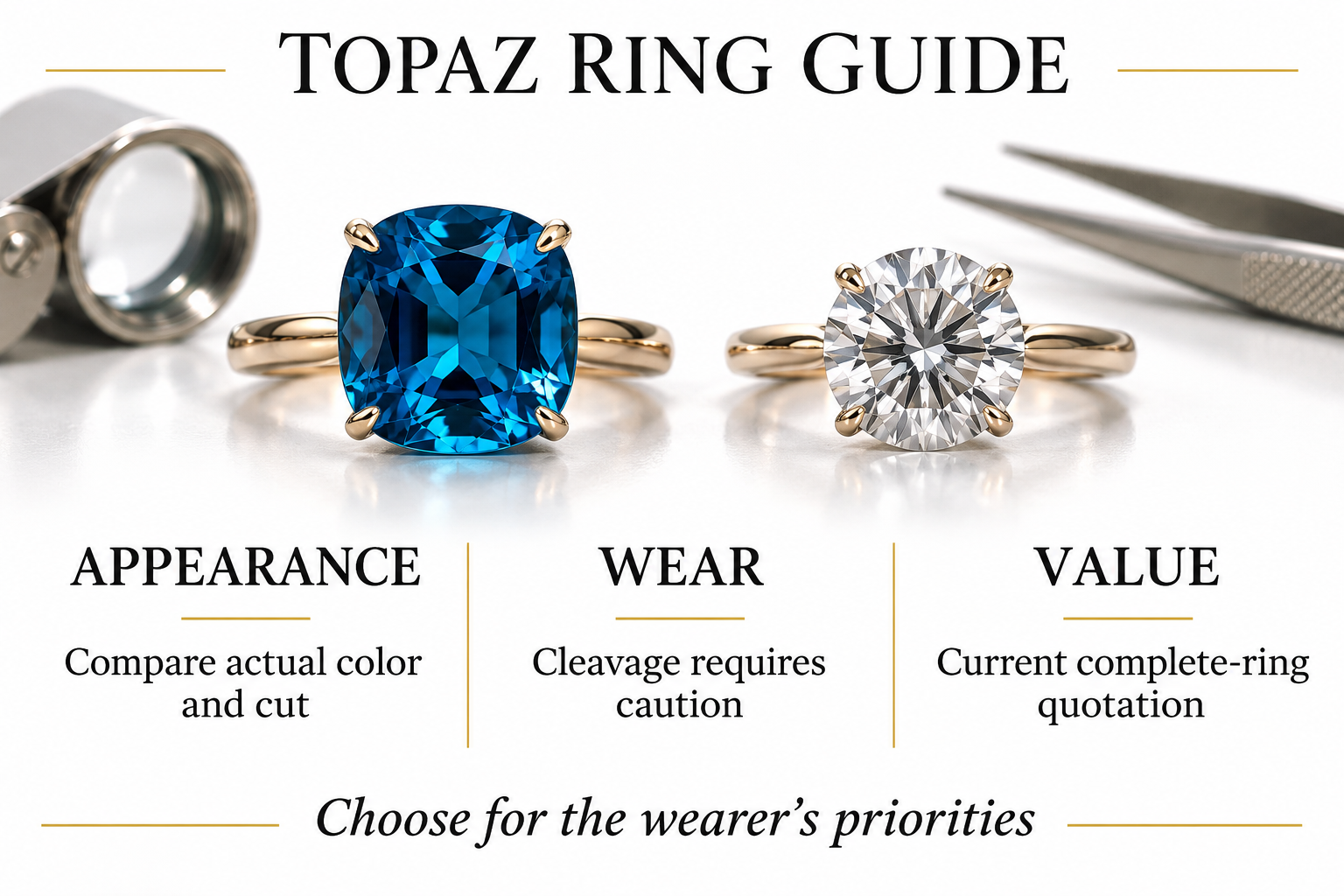
NinaVova educational overview: Topaz Engagement Rings: Color, Treatment and Practical Care
AI-generated educational comparison. These are conceptual gemstones and settings, not actual inventory or evidence of identity, treatment or origin. Open at full size.

Blue, white and pink topaz

Blue topaz ranges from pale shades to deeper trade colors such as London blue. Strong blue material commonly receives irradiation followed by heat treatment. London blue describes a color in trade; it is not a guarantee of geographic origin.
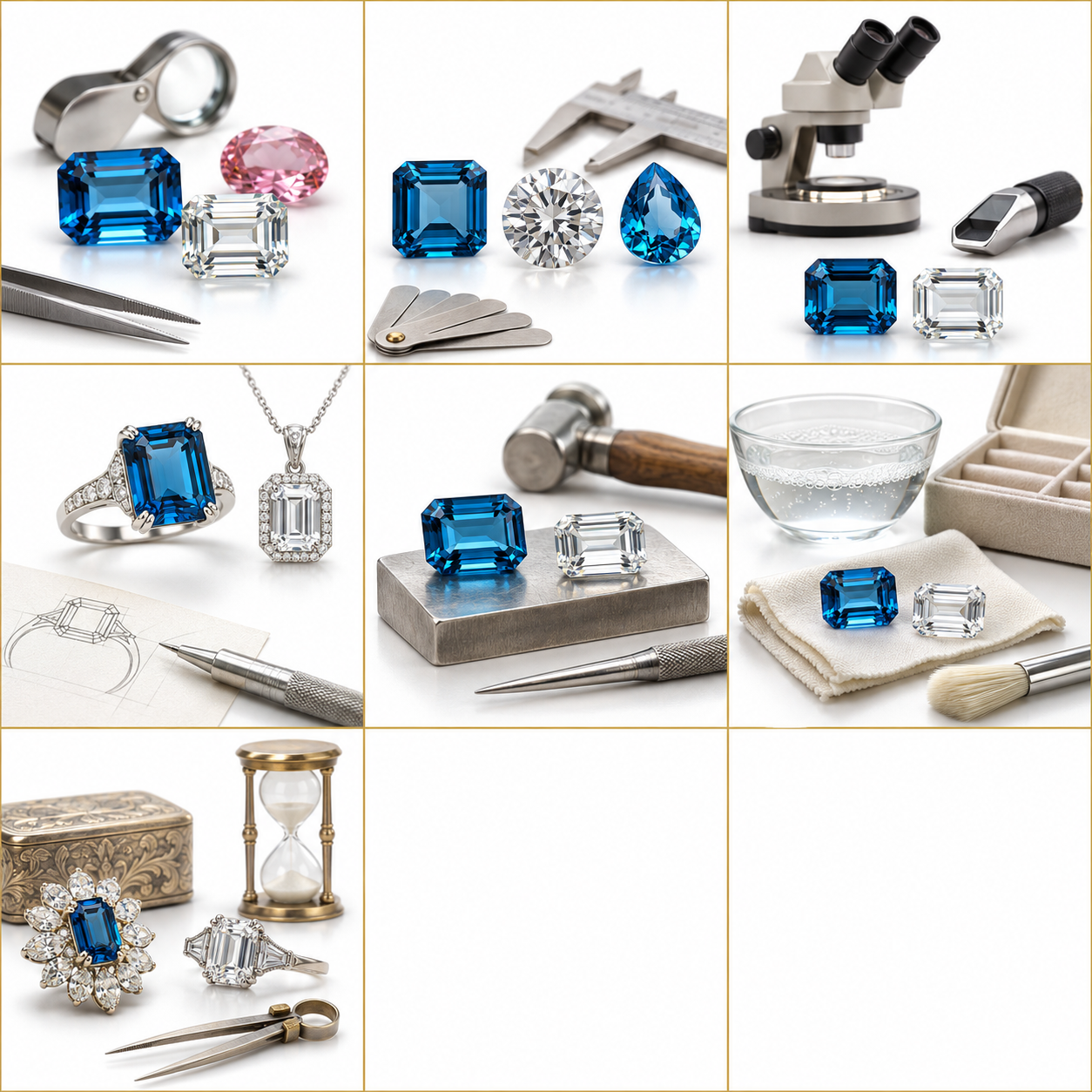
Blue, white and pink topaz
AI illustration: Blue, white and pink topaz.

White or colorless topaz offers a different appearance and budget from diamond. It should be appreciated as topaz rather than sold as an identical replacement for diamond’s fire or wear characteristics.

Pink and warmer colors require their own questions about origin of color, treatment and stability. Natural color rarity, a trade name and an attractive photograph are not interchangeable evidence. Coated material, including some mystic-topaz effects, needs particular attention to surface durability.

Choosing color, clarity and cut

Look for a color you enjoy and inspect its distribution in the actual stone. A darker blue is not automatically more valuable than every lighter example: size, cutting, treatment, color origin and the market for the particular material also matter.

Choosing color, clarity and cut
AI illustration: Choosing color, clarity and cut.

Many topazes are relatively clean-looking, but inspect visible inclusions, surface damage and the condition around the girdle or corners. Eye-clean appearance is useful information, not a guarantee that the stone has no structural vulnerability.

Oval, round, emerald and other cuts can offer different patterns and proportions. Check face-up brightness, windows and dark areas as the stone moves. A familiar shape name or a single depth percentage does not establish the quality of every cut.

Treatment, identification and documentation

Ask what is known about irradiation, heating, coating or other treatment and whether it affects care. Treated natural topaz is still topaz; treatment should not be confused with a glass imitation or automatically described as fake.

Treatment, identification and documentation
AI illustration: Treatment, identification and documentation.

If identity or treatment is uncertain, seek evidence appropriate to the value and question. GIA can identify topaz and detectable treatments, but it does not issue a quality grade for topaz. A report should be read for what it actually establishes rather than treated as a guarantee of beauty, price or future value.

Get the material description, treatment information and return terms in writing. Compare dated quotations for actual stones and the complete ring. Claims about a fixed percentage of fake topaz on the market require evidence rather than repetition.

Design with protection in mind

A solitaire can keep the topaz’s color and outline at the center of the design. A halo adds a surrounding composition, vintage-inspired details add texture, and a three-stone arrangement can express a personal story through its proportions and chosen materials.

These styles can be adapted, but topaz’s cleavage makes protection a central design issue. Consider a lower profile and structures that reduce exposed edges, while recognizing that no setting eliminates damage risk.

Discuss the wearer’s activities honestly. If the engagement ring must tolerate frequent impact or demanding daily work, a tougher alternative may be more appropriate, with topaz reserved for selective wear.

Actual NinaVova blue-green sapphire ring with botanical gold details
Actual NinaVova blue-green sapphire ring illustrates color placement and setting proportions. It is sapphire, not topaz, and is included as a design reference. Photograph: NinaVova.

Hardness is not toughness

Topaz ranks 8 on the Mohs scratch-hardness scale, yet it has poor toughness and can split along a cleavage direction. It should not be presented as automatically suitable for unrestricted everyday wear just because its hardness number sounds high.

Hardness is not toughness
AI illustration: Hardness is not toughness.

A hard knock, abrupt temperature change or unsuitable repair procedure can damage it. The particular stone’s condition and treatment add further considerations. Remove a topaz ring for activities involving impact, substantial pressure or rough handling.

If you choose topaz, agree on realistic wearing habits, setting protection and aftercare before ordering. The attractive color needs to fit your routine as well as your preferred design.

Cleaning and storage

Use warm, mildly soapy water when suitable for the complete ring, and avoid ultrasonic and steam cleaning for topaz. Coatings or other vulnerabilities may need additional precautions. Ask the jeweler for instructions for the actual stone and its treatment.

Cleaning and storage
AI illustration: Cleaning and storage.

Avoid harsh chemicals, sudden heat and careless contact with other jewelry. Some colors may be affected by prolonged heat or light, so confirm any color-stability concerns. Separate storage helps reduce scratching and accidental knocks.

History and meaning

Topaz has a long history of admiration and symbolic associations. GIA describes the Greek name Topazios as one major explanation for its name, linked to an island historically associated with a different gem, peridot. Some scholars propose a Sanskrit connection instead; a single definitive fire-origin story oversimplifies the uncertainty.

Historical beliefs about healing, protection or emotional balance belong to cultural history, not demonstrated physical benefits of wearing a topaz. Imperial topaz also has a history associated with nineteenth-century Russia.

You can give a topaz ring personal meaning without relying on a famous-jewel identification or a royal ownership story that has not been documented. The relevant choice is an actual stone whose color, condition and practical needs you understand.

Side view of NinaVova blue-green sapphire botanical ring
Another view of the actual NinaVova sapphire design shows its structure. This photograph does not identify topaz or establish its treatment. Photograph: NinaVova.

Frequently asked questions

Does a high hardness number mean a stone cannot break?

No. Scratch hardness is different from toughness. Cleavage, fractures, treatment, setting and the actual wearing routine also matter.

Does a clean appearance establish identity or origin?

No. Clear disclosure and, when useful, appropriate professional examination are more reliable than identifying a gemstone from its photograph.

Should I use older price ranges as current offers?

No. Compare dated quotations for the actual candidates and complete rings, including their materials, dimensions, design and services.

Find the stone and setting that fit your routine

Bring the appearance you enjoy, your budget and your wearing habits. We can compare actual candidates and a considered design with clear material and treatment disclosure.

Book a NinaVova consultation or explore our custom design process.

Continue reading: Colored gemstone choices · Sapphire and diamond compared.

Sources and further reading

  • NinaVova: Related topaz Short
  • GIA: Topaz care and cleaning
  • GIA: Topaz history and lore
  • GIA: Topaz identification and grading
  • GIA: Gem treatment information

Based on NinaVova’s original writing, with gemological references linked above. Compare actual stones and current written quotations; generated concepts and actual NinaVova photographs are identified in their captions.
Custom Engagement RingsGemstone Buying AdviceGemstone Treatments
Newer
Meteorite Engagement Rings: Construction, Gemstones and Care
Back to list
Older Turquoise Engagement Rings: Identity, Treatment, Design and Care

Related Posts

NinaVova video thumbnail for Heated vs Unheated Sapphire: Color, Value and What to Verify
05 Nov
Engagement Ring Guide, Gemstones

Heated vs Unheated Sapphire: Color, Value and What to Verify

Posted by author-avatar Sergey Degtyarenko
04.11.2026
Compare heated and unheated natural sapphires: learn how treatment affects appearance, rarity and value, and what to verify on an independent laboratory report.
Continue reading
NinaVova video thumbnail for Which Two-Color Gemstones Are Actually Good for Engagement Rings?
04 Nov
Engagement Ring Guide, Gemstones

Bi-Color and Color-Change Gemstones: 20 Options for Engagement Rings

Posted by author-avatar Sergey Degtyarenko
04.11.2026
Compare 20 bi-color and color-change gemstones for engagement rings, including parti sapphire, alexandrite and tourmaline, with practical buying advice.
Continue reading
NinaVova video thumbnail comparing luxury designer and custom engagement rings
03 Nov
Engagement Ring Guide

Designer vs Custom Engagement Rings: Value, Quality & Fit

Posted by author-avatar Sergey Degtyarenko
03.11.2026
Compare designer and custom engagement rings, including stone quality, design freedom, pricing and aftercare, to choose what matters most to you.
Continue reading
Original NinaVova video thumbnail: Sapphire Engagement Ring Guide (No Regrets) – Real Prices, Origins & What to Avoid
23 Jun
Engagement Ring Guide

Natural Sapphire Engagement Ring Guide: Quality, Origins and Reports

Posted by author-avatar Sergey Degtyarenko
04.11.2026
Choose a natural sapphire through actual color, cut, treatment, six source profiles, laboratory-report scope, useful videos and a considered ring design.
Continue reading
Original NinaVova video thumbnail: Moissanite vs Lab Diamond: Don’t Buy Before Watching This
22 Jun
Engagement Ring Guide

Moissanite vs Lab-Grown Diamond: Appearance, Settings and Lasting Value

Posted by author-avatar Sergey Degtyarenko
04.11.2026
Compare moissanite and lab-grown diamond appearance, cutting, metal settings, durability, documentation and complete-ring value without treating moissanite as temporary.
Continue reading
Original NinaVova video thumbnail: The Rise of Rose Gold: From Tsars to Engagement Rings #shorts
22 Jun
Gemstones

The History of Rose Gold: Fabergé, Art Deco and Modern Rings

Posted by author-avatar Sergey Degtyarenko
04.11.2026
Follow rose gold from colored-gold craftsmanship and Fabergé through Cartier’s Trinity, wartime Retro jewelry and modern ring design.
Continue reading
Original NinaVova video thumbnail: Rose Gold or Yellow Gold? How to Choose the Right Metal
22 Jun
Engagement Ring Guide

Rose Gold vs Yellow Gold: Color, Alloys and Everyday Wear

Posted by author-avatar Sergey Degtyarenko
04.11.2026
Compare rose and yellow gold color, alloy content, gemstone pairings, wear, maintenance and wedding-band matching without fixed skin-tone rules.
Continue reading
Original NinaVova video thumbnail: Ruby vs Garnet: The REAL Differences You Must Know Before Buying
22 Jun
Engagement Ring Guide

Ruby vs Garnet for Engagement Rings: Identity, Color and Care

Posted by author-avatar Sergey Degtyarenko
04.11.2026
Compare ruby and garnet through mineral identity, two-light color checks, treatment evidence, cut and practical ring care, without judging identity from a photograph.
Continue reading
Original NinaVova video thumbnail: Custom vs Ready-Made Engagement Rings: The Honest Pros & Cons
22 Jun
Engagement Ring Guide

Custom vs Ready-Made Engagement Rings: Options, Risks and Fit

Posted by author-avatar Sergey Degtyarenko
04.11.2026
Compare ready-made, modified and fully custom engagement rings through actual quality, fit, risk, complete price and realistic delivery planning.
Continue reading
Original NinaVova video thumbnail: Don’t Gamble on a Custom Engagement Ring
22 Jun
Engagement Ring Guide

Custom Engagement Ring Process: Five Steps and Clear Approvals

Posted by author-avatar Sergey Degtyarenko
04.11.2026
Follow NinaVova’s five-step custom ring process, from the first brief and stone selection to CAD approval, craftsmanship, delivery and realistic aftercare.
Continue reading
Original NinaVova video thumbnail: The Ultimate Lab Sapphire Guide: How They’re Made, Prices, and What to Avoid
22 Jun
Engagement Ring Guide

Lab-Grown Sapphire Engagement Rings: Growth Methods and Buying Advice

Posted by author-avatar Sergey Degtyarenko
04.11.2026
Compare flame-fusion, flux, hydrothermal and other laboratory sapphire processes through actual stones, with realistic clarity, budget, disclosure and care advice.
Continue reading
Original NinaVova video thumbnail: Which Feels More Like Her: Halo or Hidden Halo?
22 Jun
Engagement Ring Guide

Halo vs Hidden Halo: Appearance, Fit and Construction to Check

Posted by author-avatar Sergey Degtyarenko
04.11.2026
Compare visible and hidden halos by face-up appearance, height, wedding-band clearance, accent-stone color and actual construction.
Continue reading
    YouTube
    Shop Book Virtual Consultation About Ethics + Sustainability Lifetime WarrantyEmail Sergey
    Ordering + Shipping Resizing + Returns Reviews Financing FAQ

    Love defines
    our journey.

    NinaVova logo
    © 2026, NinaVova®
    Custom pieces currently take 6–8 weeks unless otherwise stated. Rush orders must be requested before ordering.

    © 2026 NinaVova. All rights reserved

    payments
    • Home
    • Ring Gallery
    • Create a Custom Engagement Ring for Your Partner
      • Create a Custom Engagement Ring for Your Partner
      • Design an Engagement Ring Together
      • Create Your Own Unique Engagement Ring
    • Forest-Inspired Sapphire Ring Story
    • NinaVova Reviews
    • Contact NinaVova
    • Engagement Ring Guides
    • About NinaVova
    • Custom Engagement Ring FAQs
    Shopping cart
    Close