
Turquoise Engagement Rings: Identity, Treatment, Design and Care

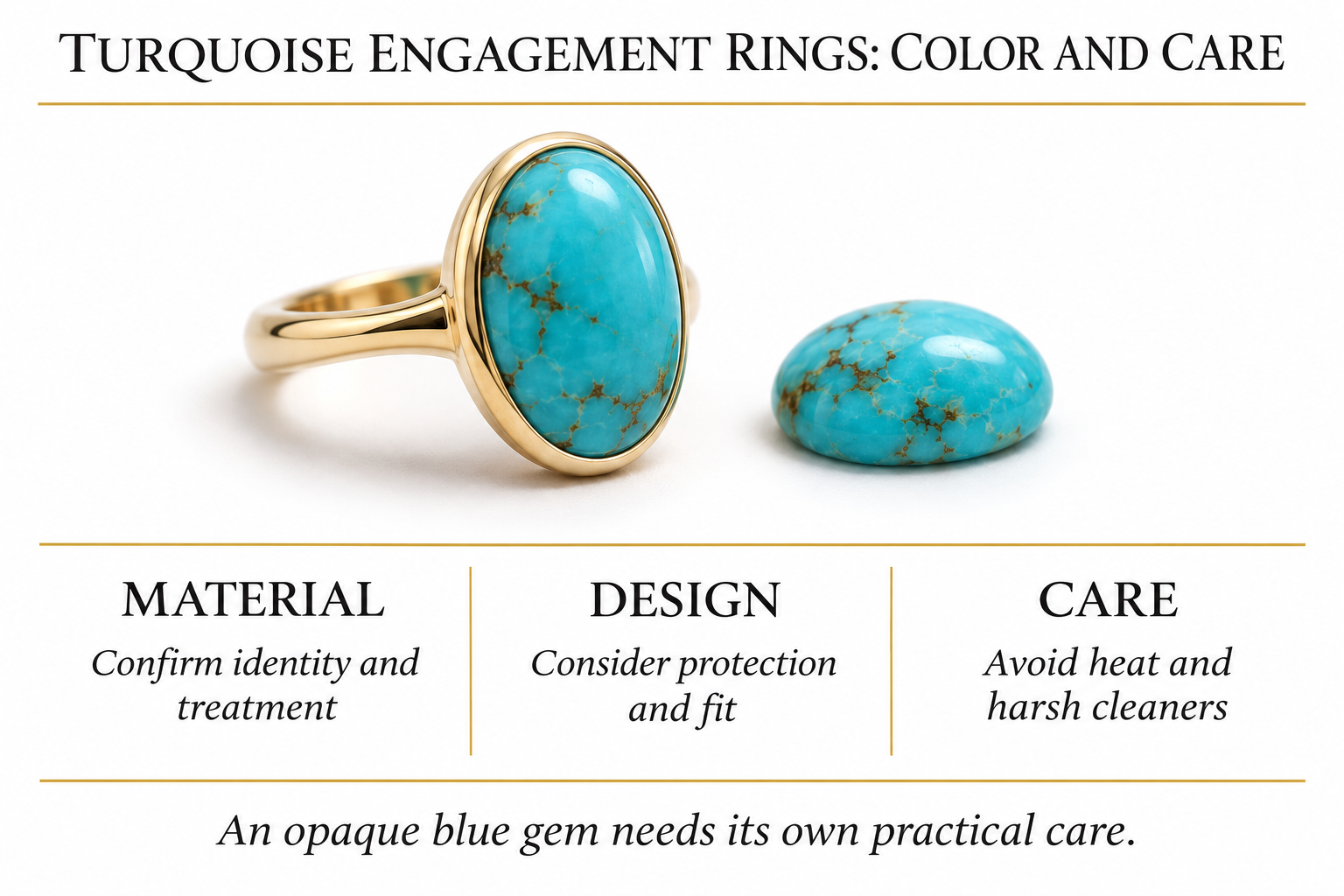
Turquoise engagement rings offer an opaque blue-to-green palette that is quite different from a transparent faceted diamond. Choosing one calls for clear material and treatment information, a considered setting and realistic care. The color can be personally meaningful without implying that turquoise is suitable for every activity or has proven healing properties.
Choose the material and wearing plan together. Confirm the actual turquoise and its treatment, assess its condition and use a suitable setting. Care must account for scratches, heat, chemicals and any treated surface.
At a glance · Decide how the ring will be worn · Compare color, texture and matrix · Ask about identity, treatment and construction · Treat origin and cultural meaning with context
Watch the NinaVova discussion
Watch the original NinaVova video on YouTube.
The related NinaVova gemstone-comparison discussion supports weighing appearance and ownership needs across different gems. This article supplies the turquoise-specific checklist.
Turquoise ring: information before design approval
| Feature | Ask about | Ownership question |
|---|---|---|
| Identity | Turquoise, imitation or composite | What is stated in writing? |
| Treatment | Stabilization or color modification | How does it affect care? |
| Appearance | Color, texture, matrix and condition | Which actual stone is included? |
| Origin | Evidence for a named source | What does the record establish? |
| Setting | Protection, support and proportions | How will it be worn? |
| Cleaning | Complete material and treatment | Which gentle method is appropriate? |
Decide how the ring will be worn
Begin with the wearer’s affection for turquoise and the practical demands on the ring. A piece used selectively can face different conditions from jewelry worn through daily hands-on work.
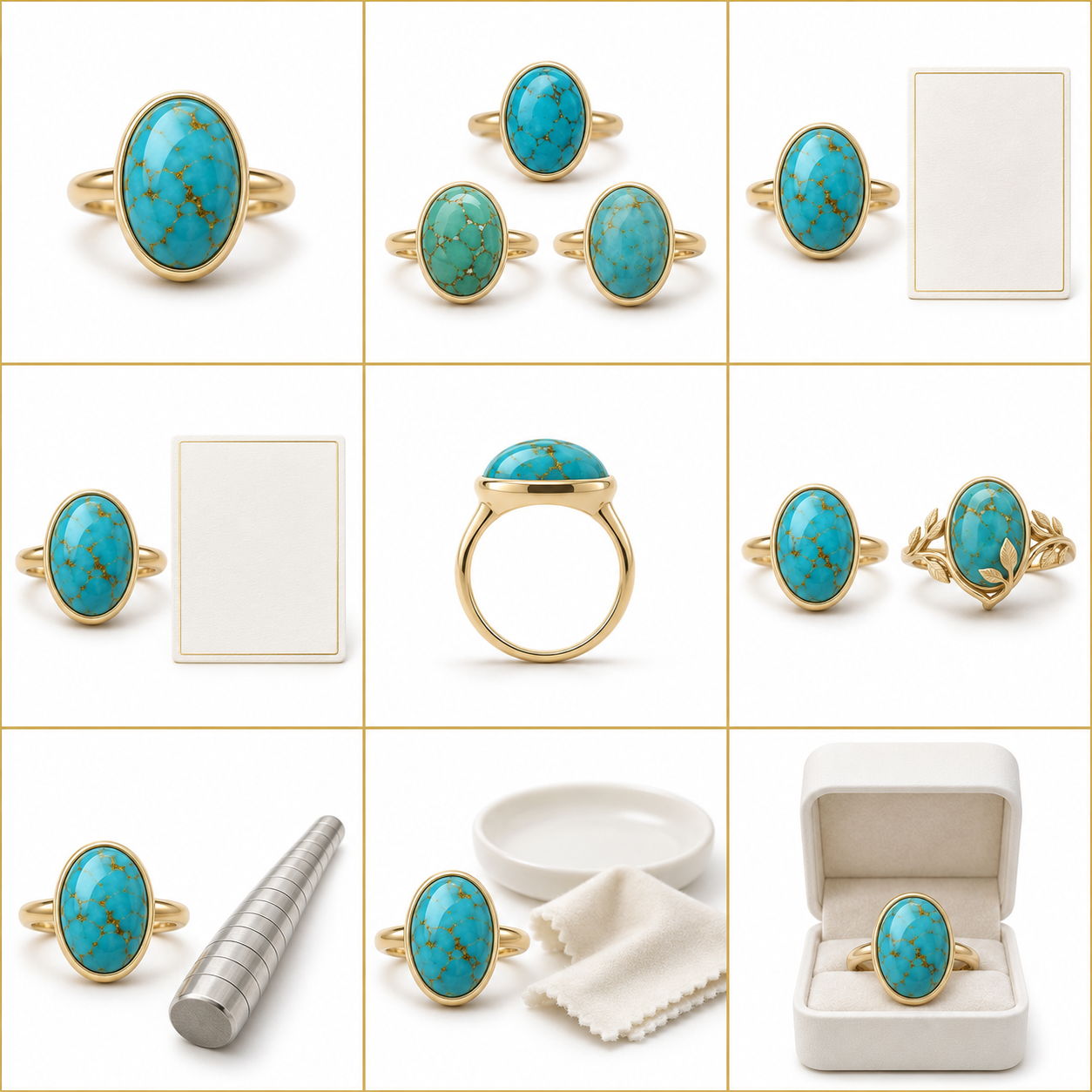
A bright cabochon can be a strong focal point in a simple design. A personal connection with its color need not depend on a claim that it will always stay unchanged.
GIA lists turquoise at 5 to 6 on the Mohs scale. Scratches, damage and surface changes need consideration when choosing it for an engagement ring.
Discuss the actual stone and construction with the jeweler before committing. If the planned use is unsuitable, a different stone or an occasional-wear interpretation may fit the brief better.
Compare color, texture and matrix
Turquoise is evaluated through color, texture and matrix rather than a diamond’s clarity framework. Some buyers prefer an even blue, while others enjoy blue-green color or a visible pattern.
Matrix can form a distinctive contrasting appearance, but it should be assessed in the actual piece. A dramatic pattern is not proof of identity or a particular mine.
Cabochons are common, with the dome and outline influencing how the color is presented. Compare the surface, proportions and condition from realistic views.
Choose the appearance you actually enjoy rather than a universal promise that one color is always more meaningful or suitable. Photographs can differ with lighting and processing.
Ask about identity, treatment and construction
Ask whether the offered material is turquoise and what treatments are disclosed. Stabilization, color modification and other descriptions need explanation rather than being hidden behind the word natural.
Imitations and composite products should be described accurately. A blue surface with dark lines cannot reliably identify the material from a photograph.
Request the relevant written description and ask what documentation is appropriate for the purchase. A commercial quality label is not a universal grading certificate.
Treatment information also matters for later care. Keep it with the invoice so a future repair or cleaning decision can use the actual specification.
Treat origin and cultural meaning with context
A named mine or region can be part of a turquoise description, but the claim needs supporting evidence. Color and matrix alone should not be treated as conclusive proof.
Turquoise appears in important cultural traditions, each with its own history. Avoid compressing distinct communities and periods into one universal story about protection or the heavens.
If a specific design draws on a living tradition, seek reliable contextual sources and describe the reference respectfully. A generic symbol chart is not an adequate basis for a cultural attribution.
The wearer can choose a personal meaning connected with a place, color or memory. That interpretation does not require claims that the gemstone treats anxiety or guarantees good fortune.
Choose protection without promising invulnerability
A smooth, well-supported setting may reduce some exposure of the stone’s edges. A bezel is an option to discuss, but it does not make turquoise immune to impact or chemicals.
Assess the dome height, thickness and side profile with the actual stone. A thin or vulnerable section should not be ignored because the outline looks attractive.
Look for comfortable transitions and a finish that will not catch. A protective-looking rendering cannot by itself establish the quality of the completed setting.
Remove the ring for unsuitable tasks and impacts. Thoughtful construction and sensible wearing habits need to work together.
Develop a personal design and metal combination
A restrained cabochon, geometric frame or botanical detail can give turquoise a distinct design language. Choose the reference the wearer enjoys instead of assuming the gem belongs to one fashion category.
Yellow, rose and white metal colors offer different contrasts. Confirm the actual alloy and finish, particularly if matching an existing piece or addressing known sensitivities.
Accents can add a second color or sparkle when feasible, but they bring separate identity, setting and care questions. The properties of an accent diamond do not transfer to the turquoise.
Engraving or a quiet hidden detail can carry personal meaning where there is suitable space. Confirm legibility and the effect of future alteration.
Review fit, band pairing and complete cost
Measure for the intended width and interior profile. A broad stone or decorative shoulders can change the ring’s feel beside neighboring fingers.
If a wedding band is planned, compare the actual side profiles and potential contact. A shaped band or deliberate gap may be preferable to a forced flush arrangement.
Ask about resizing limits and the service implications of the chosen setting. Not every stone can be safely removed and reset as a routine alteration.
Compare a complete quotation for the actual turquoise, metal, setting and work. A gemstone type is not a guaranteed price bracket, and a ring should not be treated as a promised investment.
Use care appropriate to turquoise and its treatment
Turquoise can be discolored by chemicals, cosmetics and skin oils. Heat may damage the material or a treated surface, so avoid exposure that could alter it.
GIA recommends warm soapy water for turquoise and advises against steam or ultrasonic cleaning. Confirm the method for the treatment and complete ring before proceeding.
Put jewelry on after cosmetics where practical, remove it before household cleaning and avoid abrasive polishing methods. Store pieces separately to reduce rubbing.
If a color or surface change occurs, request an assessment rather than trying stronger solvents or heat. Keep treatment records available for the jeweler.
Confirm a ring whose story and ownership fit together
At NinaVova, discuss the desired palette and intended use, then confirm whether suitable actual material and construction are available for the project.
Keep the final stone description, alloy, dimensions, approvals and service terms in writing. A conceptual illustration is a design reference rather than a current material offer.
Turquoise can express a personal connection with color and place without a health or protection claim. Its meaning need not depend on an unsupported legend.
A considered turquoise engagement ring combines the wearer’s preferences with accurate material information, practical design and a care routine appropriate to the actual piece.
Frequently asked questions
Does a blue stone with matrix prove a specific mine?
No. Identity and source claims need their own evidence.
Can turquoise be steam or ultrasonic cleaned?
No. GIA advises against both; use care suitable to the treatment and complete piece.
Does turquoise treat anxiety or guarantee protection?
No. Personal symbolism should not be presented as a health or protection guarantee.
Make the blue palette a considered personal design
We can discuss the desired appearance and intended use, then confirm suitable actual materials and feasible construction.
Book a NinaVova consultation or explore our custom design process.
Continue reading: Gemstone alternatives · Opal wedding rings · Design consultation.
Sources and further reading
- GIA: Turquoise buying guide
- GIA: Turquoise care and cleaning
- GIA: Turquoise buying and care reference
- NinaVova: Current project terms
Confirm the actual materials, condition, evidence and current written terms for the offered ring. Illustrations do not establish identity, provenance, certification or an environmental footprint.