

Black Wedding Rings: Materials, Coatings, Sizing and Care

Black wedding rings are a color choice available through different materials and surface treatments. Two similar-looking bands may have very different wear, repair and sizing limits. Before choosing, establish the ring’s body material, how the dark surface is produced and what the maker offers if your size or the finish changes.
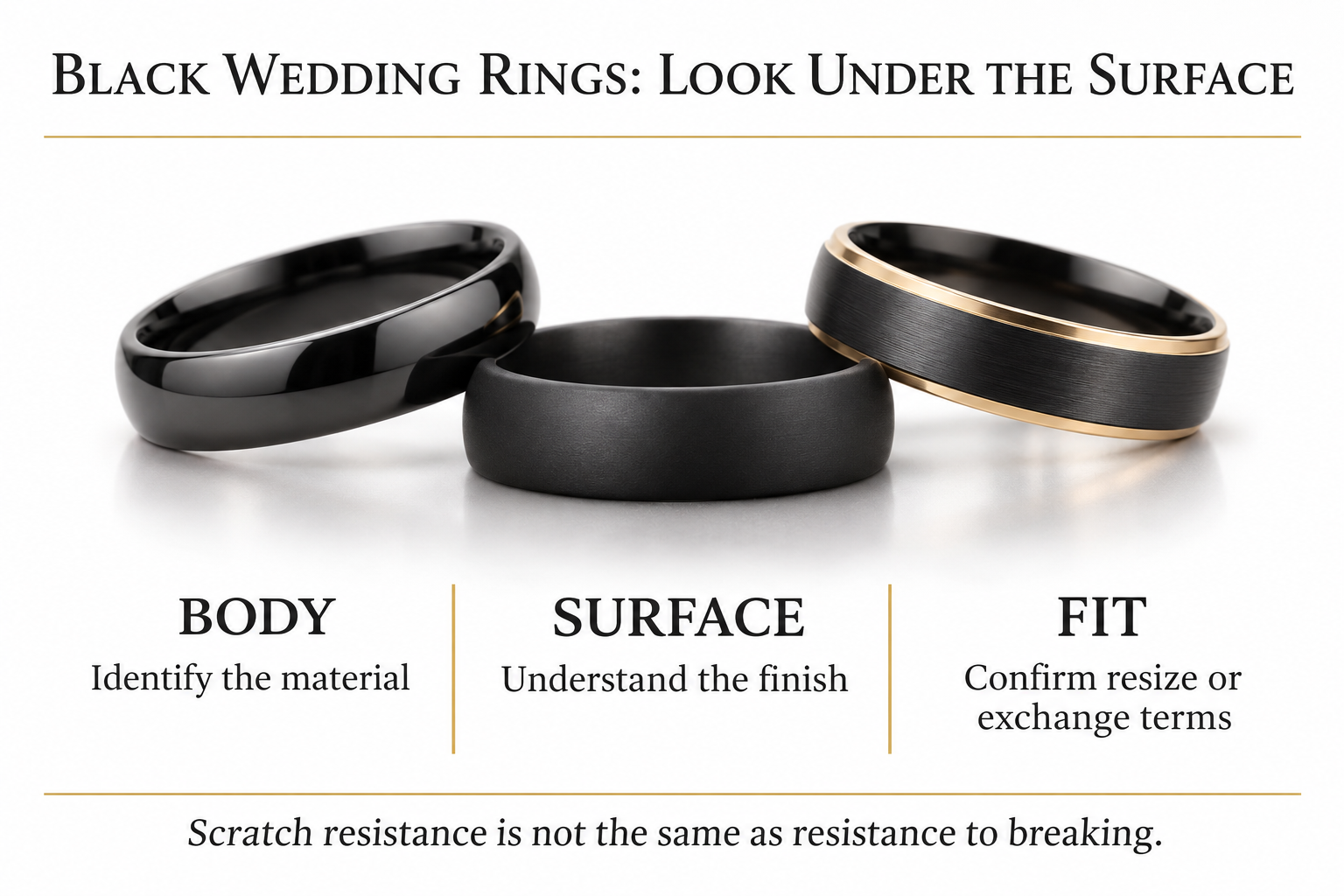
Identify both the ring body and its dark surface. Similar black bands can have different coatings, hardness, brittleness and sizing limits. Confirm the actual construction and the maker’s service or exchange terms.
At a glance · Choose the color for your own reasons · Identify the body material and the dark surface · Tungsten carbide: hardness and coating are separate questions · Ceramic: confirm the actual material and construction
Watch the NinaVova discussion
Watch the original NinaVova video on YouTube.
Related NinaVova active-lifestyle discussion supports knowing when rings should be removed and how design affects practical wear. This is a companion to the material-specific guide.
Black wedding ring: identify the complete construction
| Description | What to clarify | Practical question |
|---|---|---|
| Black tungsten carbide | Body and surface treatment | How is coating wear handled? |
| Ceramic | Actual material and through-color claim | What happens after chipping or fracture? |
| Black zirconium | Oxide surface and contrast areas | Can alteration change the finish? |
| Black titanium | Color process and components | Which service is available? |
| Inlays and stones | Every additional material | What care suits the full ring? |
| Sizing | Measured width and maker’s policy | Resize, exchange or replacement? |
Choose the color for your own reasons
Black can feel understated, graphic or highly contrasted, depending on the profile and finish. It is a design preference rather than evidence of a particular personality or relationship.
There is no universal rule that a black wedding band symbolizes strength, independence, fertility or mourning. The people choosing it can explain their own meaning.
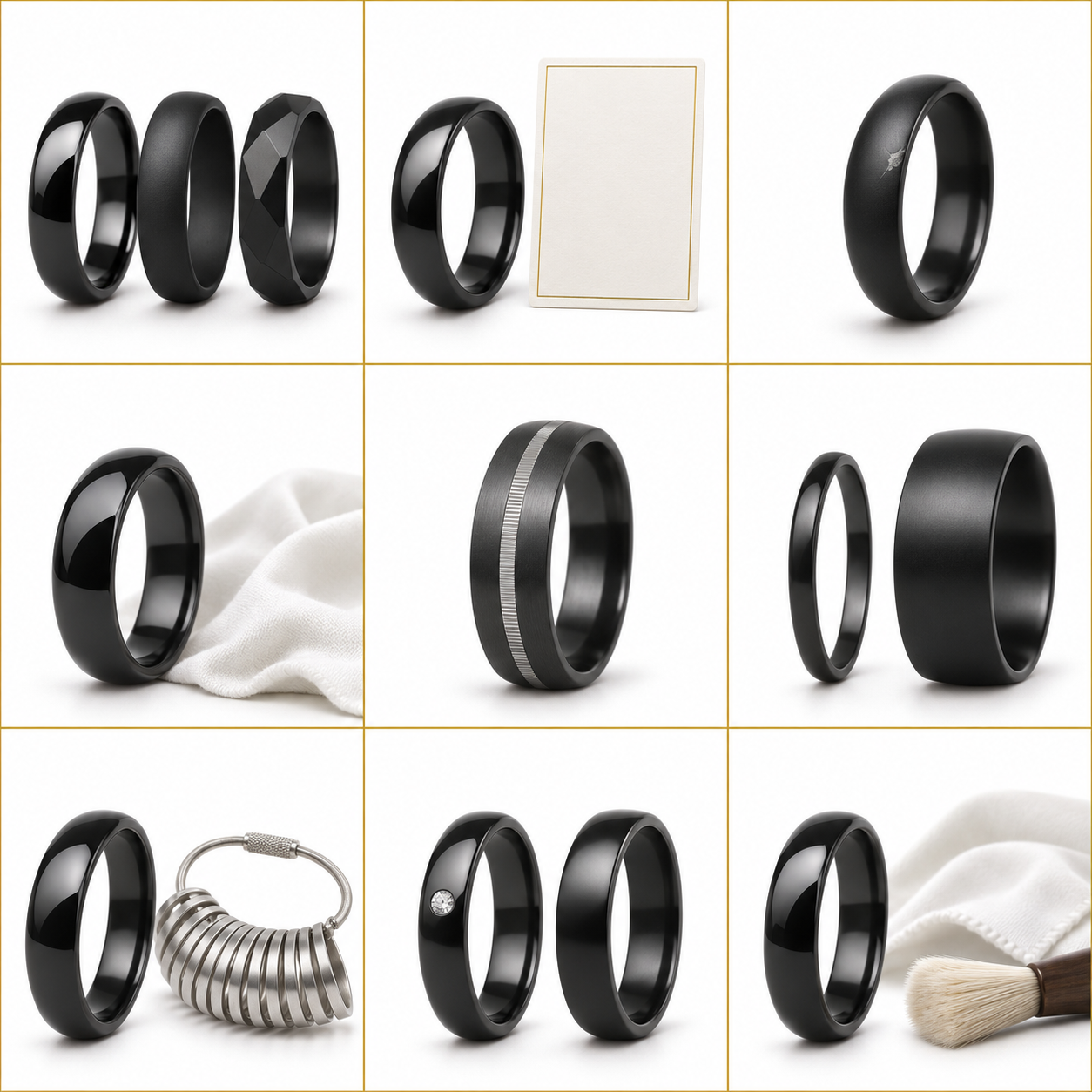
Polished, matte, textured and two-tone versions can look very different on the hand. Compare realistic images and the actual dimensions where possible.
A dark ring need not be more or less formal than a traditional gold band. Choose an appearance the wearer enjoys with practical expectations about its surface.
Identify the body material and the dark surface
Ask whether the band is tungsten carbide, titanium, zirconium, ceramic, a precious-metal alloy or a composite construction. Color alone does not identify any of them.
Then ask how the black appearance is achieved: a coating, an oxide surface, a through-colored material or another process. A trade name may not explain the construction.
The interior, edges, inlays and gemstones may use different materials. Care and service need to account for the whole ring rather than only the outer band.
Keep the written specification. It is more useful for comparison and later service than a broad promise that a ring is “black metal.”
Tungsten carbide: hardness and coating are separate questions
Tungsten-carbide bands can offer substantial weight and high scratch resistance, but the material can be brittle. Hardness should not be confused with resistance to breaking under impact.
A product called black tungsten may obtain its color from a surface treatment. Ask whether wear can reveal a different-colored underlying material and how refinishing is handled.
Do not assume that a scratch-resistant body makes the coating equally resistant or that either is completely scratch-proof. Construction and treatment differ between products.
Conventional resizing is often unavailable for these bands. Confirm the maker’s actual size-exchange or replacement terms before ordering, particularly for personalized pieces.
Ceramic: confirm the actual material and construction
Jewelry ceramic is different from simply calling a band black metal. Ask about the material used and whether the color runs through it or depends on another finish.
A hard ceramic surface may resist ordinary scratching while still being vulnerable to chipping or fracture. A polished appearance is not a promise of indestructibility.
Inlays, liners and stone settings can change the care and repair needs. A composite ring should not be described as if every component behaves like the outer ceramic.
Ask how fit changes and damage are handled. Exchange or replacement can be more relevant than traditional resizing or repair.
Black zirconium: understand the oxide surface
Black zirconium typically involves a dark oxide layer created on zirconium metal. It should be distinguished from zircon gemstones and cubic zirconia, which are different materials.
The underlying metal can have a different color from the dark surface. Machining, deep marks or later alteration can affect the intended appearance.
Makers may offer contrasting milled areas or other surface details. Clarify which contrast is intentional and what normal wear may change.
Resizing and surface restoration depend on the design and maker’s process. Confirm the actual policy instead of assuming a conventional local adjustment will be possible.
Titanium and other coated or composite designs
Titanium can provide a relatively light ring, but a black appearance needs its own process description. Do not infer a permanent through-color from the underlying metal name.
Coated precious-metal and other bands also require clear disclosure of the surface and body. Ask about expected wear, restoration and any exposed interior areas.
An alternative material is not automatically suitable for every person with sensitive skin. Request the relevant composition and discuss known sensitivities with an appropriate professional.
If a ring includes wood, meteorite, resin or another inlay, ask about those components separately. The outer band’s properties do not describe the complete construction.
Measure carefully and settle sizing options first
Try a measurement that reflects the actual width and interior profile. A wide band can feel different from a narrow sample or another ring in the same nominal size.
Ask which fit options exist before adding engraving or another non-returnable detail. Understand the exchange window, conditions and any applicable costs.
Limited resizing does not mean every band has the same replacement policy. Keep the maker’s terms with the order records rather than relying on an informal general statement.
Remove rings for unsuitable work, machinery and impact. In any situation requiring urgent removal, tell the professionals the actual material; do not attempt to break or cut the ring yourself.
Personalize within the design’s limits
Engraving, contrasting areas, small stones and inlays may be feasible depending on the material and construction. Ask what the proposed process will change on the surface.
An exterior engraving can reveal a different tone or require a separate finish. Confirm the intended result rather than expecting it to match a rendering exactly.
For stones, establish identity, treatment and setting support. A black band does not remove the care requirements of a diamond or colored gemstone.
Partners can coordinate one detail while choosing different materials or colors. Matching bands are an option rather than a requirement for a shared meaning.
Compare ownership, care and complete cost
Ask for cleaning instructions for all components and avoid abrasive household methods or attempts to restore a coating without the maker’s advice.
Compare the complete purchase and likely service costs, including any exchange, refinishing or replacement arrangements. A low initial price may not cover every future change.
At NinaVova, discuss whether the desired material and surface are available and suitable for the project. A conceptual illustration is not a current offer or proof of a workshop process.
A black wedding ring can be a strong visual choice when the body, surface, fit and service terms are understood. Clear information is more useful than a promise that any dark band will last unchanged forever.
Frequently asked questions
Does scratch-resistant mean unbreakable?
No. Hard materials can still chip or fracture.
Is every black ring black throughout?
No. Some depend on a coating or an oxide surface.
Can a black ring always be resized?
No. Confirm the actual maker’s resize or exchange terms before ordering.
Choose a dark design with clear practical expectations
Discuss the intended appearance and wearing needs, then confirm whether the desired materials and surfaces are available and suitable for the project.
Book a NinaVova consultation or explore our custom design process.
Continue reading: Active-lifestyle ring design · Ring sizing · Personal design consultation.
Sources and further reading
- Tungsten World: Material and care information
- Staghead Designs: Material-specific sizing policies
- Titan Jewellery: Black zirconium material guide
- Lashbrook: Current maker-specific service information
Confirm the actual materials, condition, evidence and current written terms for the offered ring. Illustrations do not establish identity, provenance, certification or an environmental footprint.