
Nature-Inspired Engagement Rings: Your Story, Made Wearable

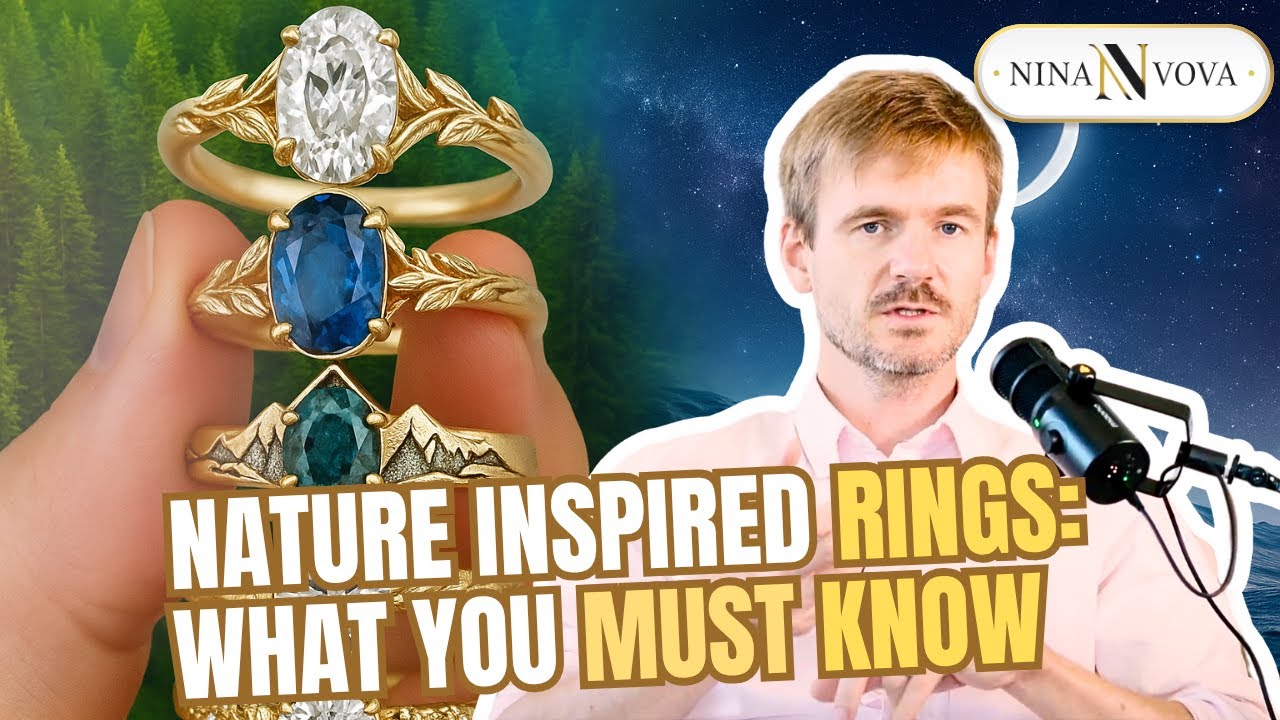
A nature-inspired engagement ring can begin with a memory rather than a finished sketch. A forest path, a river, a mountain or a particular season can suggest its lines, color and hidden details. The aim is to turn something meaningful to you into a ring that also works on your hand.
Start with a meaningful memory, then make the design work on the hand. Choose one or two natural references that belong to your story. Review comfort, stone security, cleaning, resizing and suitable materials alongside the appearance.
At a glance · Begin with the story you want to carry · Botanical rings: leaves, vines and petals · Woodland rings: branches, bark and trees · Mountains, landscapes and shared journeys
Watch the NinaVova discussion
Watch the original NinaVova video on YouTube.
The original NinaVova discussion accompanies this written guide. Follow the written guidance on actual materials, evidence and care.
From natural inspiration to a design brief
| Inspiration | Possible expression | Detail to review |
|---|---|---|
| Botanical | Leaves, petals and restrained vines | Smooth tips and sound support |
| Woodland | Bark or branching texture | Cleaning and resizing |
| Mountains | Engraved contour or side silhouette | Readable detail at ring scale |
| Water | Flowing line and blue-green color | Comfort and actual gemstone care |
| Sky | Crescents or hidden stars | Accent setting and service |
| Season or wildlife | Surface texture or personal engraving | Meaning and practical proportions |
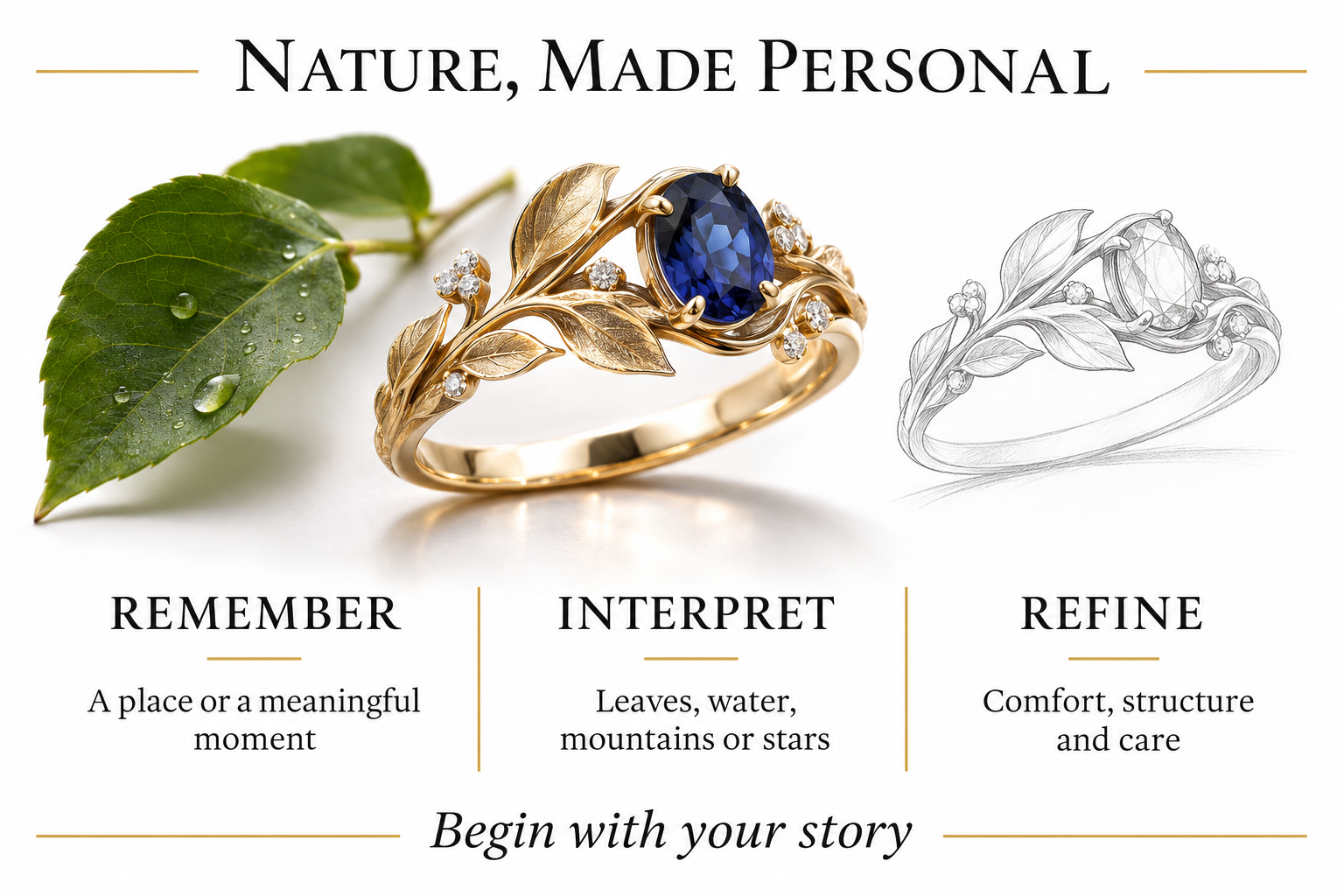
Begin with the story you want to carry
You do not need a polished drawing to begin a custom conversation. Bring a place, a photograph you own, a texture or a feeling you associate with your relationship. Explain what you want to remember when you look at the ring.
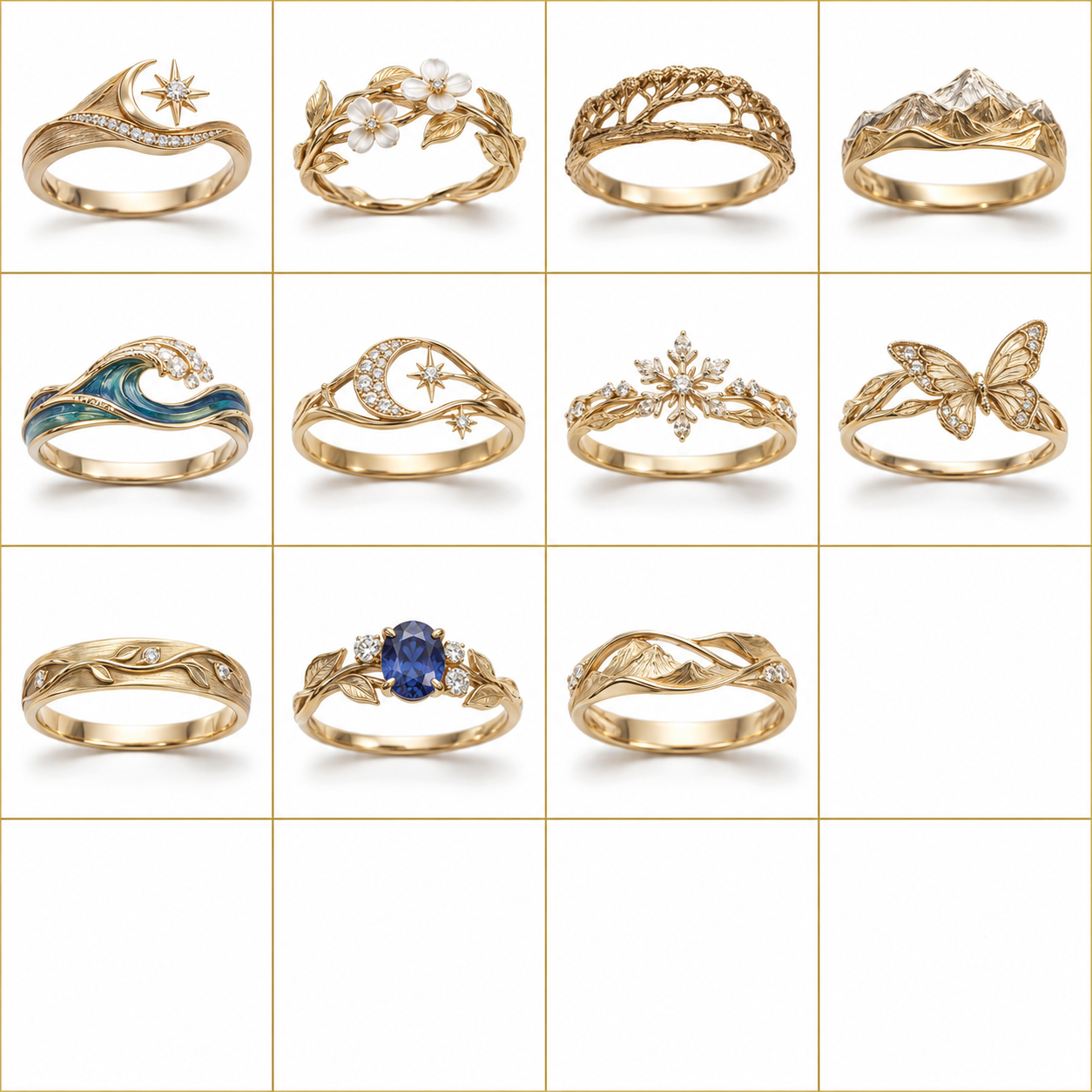
A quiet woodland walk might suggest restrained leaf details. A winter memory could suggest a frosted surface or snowflake-like geometry. A river might become a flowing shoulder rather than a literal landscape wrapped around the whole band.
These are design possibilities. Choose the elements that belong to your story, rather than collecting every motif into one complicated ring. An apparently simple design can carry meaning through proportion, a hidden engraving or one carefully chosen color.
Botanical rings: leaves, vines and petals
Leaves, vines and petals can frame the center, follow the shoulders or appear beneath the setting. A botanical design can be delicate in appearance while still using sufficient metal and workable connections.
A favorite flower may recall a garden, an anniversary or a person. Roses, lilies, lotus forms and wildflowers offer very different outlines. Symbolic associations vary by culture and individual experience, so your own reason for choosing the flower is more useful than a universal dictionary of meanings.
Marquise-shaped accents can suggest leaves without a literal sculpture. Petal-like supports can be visible only from the side. Think about whether the wearer wants a recognizably floral ring or a quieter reference to the natural world.

Woodland rings: branches, bark and trees
A twig outline, a bark-like surface or a subtle branching gallery can evoke a woodland place. A birch texture might recall a picnic spot; an oak-inspired leaf might suggest strength to the couple choosing it.
Natural texture should be translated into jewelry with care. Deep recesses can collect dirt, thin branches may bend and sharp tips can catch clothing. A branch-like surface does not need the fragility of an actual twig.
Ask how the motif will continue around the band and what happens if resizing is needed. A maker may use carving, casting, engraving or a combination; the finished comfort and construction matter more than the romance of the technique.
Mountains, landscapes and shared journeys
Sculpted peaks, an engraved mountain range or a contour-like line can recall a meaningful place. It might be a major climb, a local trail or the view where you became engaged. The scale of the landscape does not determine its personal importance.
A mountain can be a small shoulder detail, a hidden engraving or a silhouette beneath the stone. Keeping the reference in one location can make it clearer and easier to wear than a large raised scene.
Consider what is recognizable at ring scale. A simplified outline may survive translation into metal better than a detailed photograph. Review the proportions in the design stage, including the side view and how the ring will sit beside a wedding band.

Water, rivers and ocean colors
Wave-like bands, rippled surfaces and flowing asymmetry can suggest water. Blue, green or teal gemstones may reinforce the connection, but an ocean theme does not require a particular mineral.
Aquamarine, sapphire and other materials can have very different care needs even when their colors are similar. Choose the actual stone for its condition, treatment and intended wear, alongside the color that feels right.
A flowing design should still feel stable on the hand. Ask whether the curves create pressure points, difficult cleaning areas or gaps beside another ring. The visual sense of movement need not make the structure awkward.
Sky, moon and stars
Crescents, engraved stars and small accents can create a celestial direction. Some wearers want an obvious moon shape; others prefer a few stars hidden inside the band or beneath the center.
A meaningful number of stars can refer to dates, wishes or shared experiences. Decide what you want visible to others and what is intended to stay private. A hidden detail can preserve the personal connection without dominating the design.
Diamond and moissanite can both contribute bright accents, but they are different materials and should be described accurately. Select the size and setting of those accents with future cleaning and servicing in mind.
Weather and the character of a season
Frosted gold, restrained snowflake geometry or a storm-gray center can recall winter. A warmer color and botanical detail may evoke autumn or summer. These are possible visual associations, not rules assigning one gemstone to each season.
A winter-inspired ring can rely on texture rather than many sharp snowflake points. A satin surface will also change with wear, so discuss how it can be maintained and whether you enjoy the character it may develop.
Think about the feeling you want the ring to retain. One carefully chosen surface and color combination may communicate the memory more clearly than many competing symbols.
Wildlife and personal symbols
A bird, butterfly, bee or another animal can inspire an engraving, wing-like line or hidden detail. Mythical creatures are another direction when they hold meaning for you.
An animal need not be sculpted literally around the finger. The pattern of a wing or the movement of a feather can offer a quieter interpretation. Avoid projecting a fixed personality onto the wearer based on an animal symbol.
Where the motif involves a loved one or a cultural tradition, explain the meaning in your own words. That conversation helps distinguish a personal reference from a decorative image copied without context.
Make the setting work in ordinary life
Nature-inspired jewelry needs the same practical design work as a clean solitaire. Check whether leaves catch on fabric or hair, whether openwork has adequate support and whether decorative prongs are suitable to secure the actual center.
Review the underside, finger comfort and balance rather than approving only a face-up image. Ask about cleaning access, repairs, resizing and the way a wedding band will meet the ring.
No design can promise decades without maintenance. Remove rings for rough activity and follow advice for the actual construction. Custom design gives an opportunity to address your brief, but the result still depends on sound proportions and workmanship.
Choose gemstones and metals with the motif
Gemstone color can support a nature theme: green for foliage, a blue-green center for water or pink for a flower. Sapphire, spinel, diamond, tourmaline, aquamarine and morganite offer different appearances and care requirements.
The Mohs scale describes scratch resistance, not immunity to chipping. A threshold of seven does not make every material equally suitable for everyday wear. Consider toughness, treatment, inclusions, exposed areas and whether you are willing to wear a more delicate stone selectively.
Gold alloys and platinum can translate natural shapes into a practical setting. Karat describes gold proportion, while alloy and finish affect color and performance. Ask about sensitivity and maintenance rather than assuming a color or karat guarantees comfort.
A nature motif does not establish environmental or labor performance. If sourcing matters to your choice, ask for specific traceability and supporting information about the materials. A laboratory identity report alone does not certify the complete supply chain.
An enduring vocabulary, interpreted personally
Nature has a long presence in jewelry. The V&A describes early adornments made from shells, stone and bone, as well as later botanical decoration. Art Nouveau provides a familiar example of flowing natural forms in jewelry design.
That history offers inspiration, not a guarantee you will love every detail in fifty years. Choose what feels connected to you, with a level of ornament you enjoy wearing now. A personal motif can also be expressed in a restrained, contemporary ring.
Bring your ideas to a design conversation and ask which features can be made practical. Sketches and a considered three-dimensional review can help clarify the whole composition before production, while actual NinaVova examples show how color, form and personal detail can work together.
Frequently asked questions
Do I need a sketch before starting?
No. A meaningful place, texture, photograph you own or a clear account of your preferences can begin the conversation.
Are botanical rings automatically sustainable?
No. A nature motif does not establish sourcing or environmental performance; ask for specific evidence about the materials.
Can nature-inspired rings be understated?
Yes. A hidden engraving, one leaf detail or a subtle surface can carry the idea without a highly sculptural design.
Bring the place or memory that matters
You can begin with a feeling, a photograph you own or a natural detail. We can explore how to translate it into a considered ring design.
Book a NinaVova consultation or explore our custom design process.
Continue reading: Gemstone colors and personal meaning · The custom design process · Active-lifestyle ring choices.
Sources and further reading
- NinaVova: Nature-inspired ring design
- V&A: A history of jewellery
- GIA: Gem durability and care
- FTC: Precious-metal descriptions
Based on NinaVova’s original writing, with supporting references below. Ask for current details about the actual stone, treatment, complete design and service terms.