

Raw Diamond Rings: Identification, Setting and Sourcing Checks

A raw diamond ring uses a rough or incompletely fashioned diamond rather than a conventionally faceted center. The texture can appeal to someone who enjoys an irregular crystal form, but an unpolished appearance does not prove natural origin, ethical sourcing or lower impact. Establish the actual material and condition, then assess whether its shape can be supported comfortably and securely.
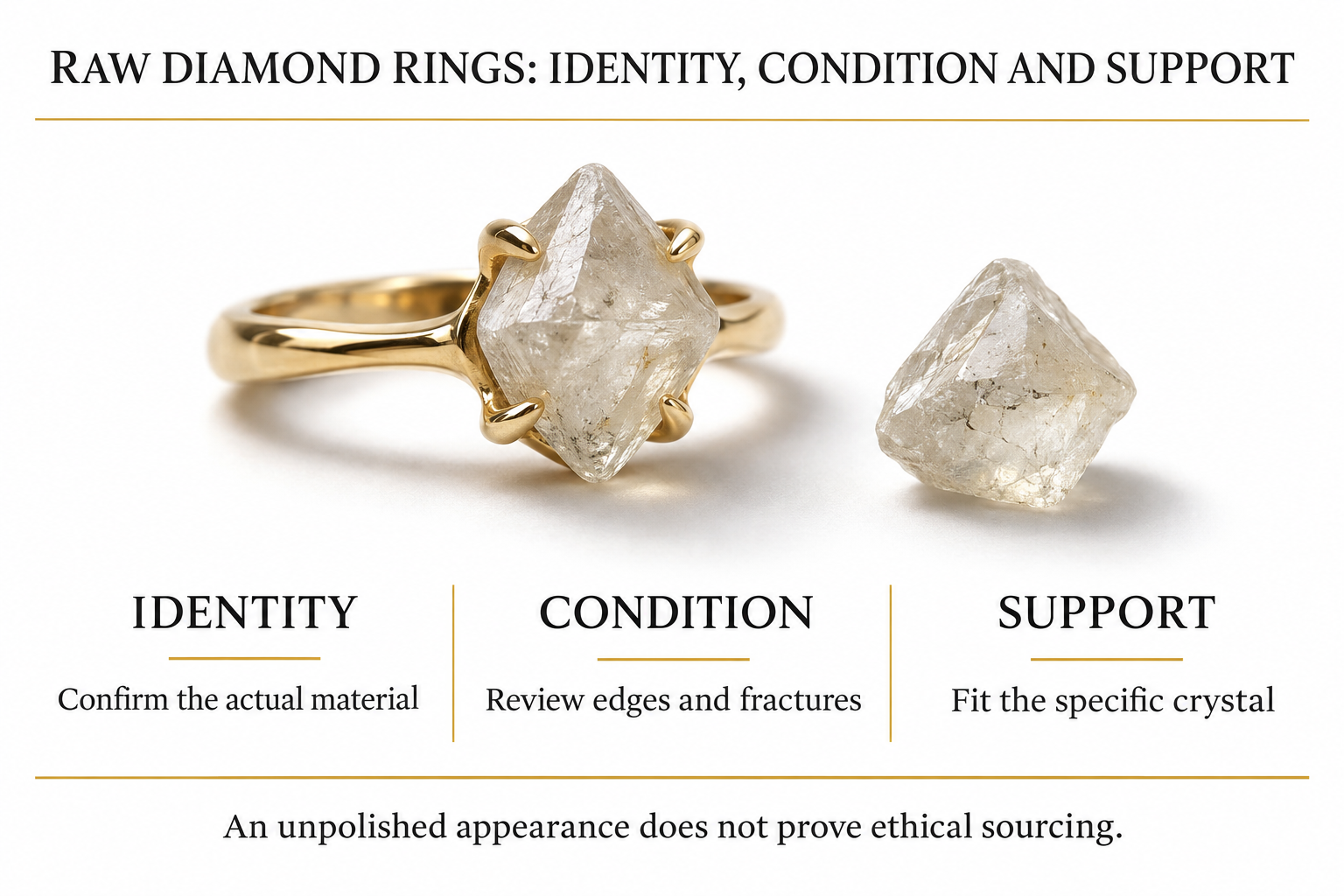
An unpolished appearance is a starting point, not proof. Confirm the actual material and condition, then assess a setting made for the specific crystal. Raw appearance does not establish natural origin, lower impact or ethical sourcing.
At a glance · Clarify what raw means in the actual offer · Establish identity and the scope of documentation · Compare texture, color and actual condition · Expect different optics from a faceted diamond
Watch the NinaVova discussion
Watch the original NinaVova video on YouTube.
The NinaVova buying-claims discussion is a related companion for questioning identification and sourcing claims. It is not a raw-diamond identification demonstration.
Raw diamond rings: the evidence and practical checks
| Question | Evidence or assessment | Why it matters |
|---|---|---|
| Raw means what? | Description of actual shaping or treatment | Clear scope of the offer |
| Material identity? | Appropriate identification | Appearance alone is insufficient |
| Condition? | Edges, inclusions and damage | Suitable support and wear |
| Documentation? | Current rough-service scope | Not every crystal has a standard report |
| Sourcing? | Records connected to the stone | Finish does not prove ethics |
| Ownership? | Fit, care and service terms | Realistic long-term expectations |
Clarify what raw means in the actual offer
Raw and rough are used in sales descriptions, but the precise amount of cleaning, shaping or other work may vary. Ask what has been done to the offered stone.
The word raw should not automatically be expanded into untouched, untreated, naturally mined and fully traceable. Those are separate claims.
A crystal-like form alone does not establish diamond identity. Other materials and laboratory-grown crystals can also have unpolished appearances.
Choose the texture because the wearer enjoys it rather than assuming it represents a more authentic relationship than a polished gem.
Establish identity and the scope of documentation
Ask how the actual stone has been identified and what natural or laboratory-grown status is supported. A small seller card may not answer every question.
Laboratory services for rough material differ from familiar polished-diamond grading. Confirm current eligibility and scope with the issuing laboratory rather than assuming a standard grading report is available.
GIA explains that its rough analysis is primarily linked to its Diamond Origin Program and later polished assessment. That is not a universal retail certificate for every raw ring center.
Do not perform scratch, heat or other destructive home tests. Seek suitable identification guidance where the description remains unclear.
Compare texture, color and actual condition
Rough diamonds can show different crystal forms, surface textures, colors and transparency. A distinctive appearance can be part of the attraction.
Inclusions and surface features should still be assessed for condition and potential vulnerability. Calling every characteristic natural beauty does not establish that it is structurally harmless.
Review realistic views from more than one angle. A dramatic close-up can conceal edges or make a small crystal seem more substantial on the hand.
Keep known damage and treatment information clear. The intended rustic look should not become a reason to omit relevant facts.
Expect different optics from a faceted diamond
Conventional faceting is designed to create particular light behavior. An unpolished crystal should not be purchased with a promise of identical sparkle.
Compare the actual stone in ordinary light and motion. Some people prefer the quieter texture, while others will miss the bright pattern of a faceted gem.
Carat still measures weight rather than comfortable visible size. Irregular dimensions and depth can affect the complete profile.
A polished diamond can be individual too. The choice concerns appearance and practical suitability rather than a universal ranking of naturalness or meaning.
Fit the setting to the particular crystal
An irregular stone needs support appropriate to its actual contact points, edges and condition. A standard setting may not fit it simply because the weight is similar.
Prongs, a bezel-related structure or another feasible approach should be assessed by the jeweler. A style name alone cannot establish retention or protection.
Diamond’s high scratch resistance does not make it immune to chipping or splitting. Exposed edges and inclusions can remain relevant in an uncut stone.
Review catching, skin contact and the underside profile. Remove the ring for impact and other unsuitable activities.
Evaluate sourcing claims separately from the finish
An unpolished diamond can still have a complex supply chain. Less visible finishing does not establish conflict-free recovery, fair working conditions or a measured footprint.
Ask for evidence that connects the particular stone with the claimed source. A generic statement about natural materials is not traceability.
The Kimberley Process concerns international trade in rough diamonds within its defined scope. It should not be presented as a complete assessment of every ethical or environmental issue.
Compare specific claims consistently across rough and polished choices. Do not use an aesthetic preference as a substitute for supporting records.
Compare the complete price and service
A raw appearance does not guarantee a lower total price. The actual material, identification, condition, construction and custom work affect the offer.
Compare the finished ring specification rather than only the loose-crystal price. An irregular stone can require additional design or fabrication.
Ask what repair, stone replacement and alteration options are available. An exact matching crystal may not be found if the original is lost.
A distinctive shape does not establish investment value or a guaranteed resale market. Choose with clear purchase terms and realistic expectations.
Plan care and comfort for the assembled ring
Use care appropriate to the actual diamond, treatment and other materials. Unusual textures can collect residue and require suitable access for gentle cleaning.
Ask before using steam, ultrasonic equipment or aggressive chemicals. A raw label is not a complete cleaning instruction.
Check for movement, damaged supports or edges that catch, and arrange professional inspection if the condition changes. Do not tighten the setting with household tools.
If a wedding band is planned, consider clearance and rubbing alongside the irregular profile. Comfort should be assessed for the complete arrangement.
Use the crystal as a specific design reference
An irregular crystal can guide a restrained or sculptural design if the material and construction are suitable. It need not be combined with every rustic surface or decorative feature.
Ask NinaVova about current raw-diamond availability and feasibility before assuming a commission is offered. The educational illustrations here are concepts, not confirmed inventory.
Keep identity, relevant treatments, condition, dimensions and approvals in the order record. A rendering does not certify a crystal’s origin.
A considered raw-diamond ring combines a texture the wearer enjoys with clear identification, suitable support and an ownership plan grounded in the actual piece.
Frequently asked questions
Does raw prove untreated natural diamond?
No. Material, growth origin and any treatment need separate support.
Is a rough diamond immune to chipping?
No. Diamond can chip or split despite high scratch resistance.
Is every rough stone eligible for a standard GIA grading report?
No. Confirm current service eligibility and scope with the laboratory.
Discuss a specific crystal and feasible construction
Bring the material details and visual reference. Current raw-diamond availability and specialized setting feasibility need confirmation before commissioning.
Book a NinaVova consultation or explore our custom design process.
Continue reading: Ethical material evidence · Bezel settings · Design consultation.
Sources and further reading
- GIA: Rough identification service scope
- GIA: Diamond chipping considerations
- Kimberley Process: Defined rough-diamond scope
- FTC: Environmental claims
Confirm the actual materials, condition, evidence and current written terms for the offered ring. Illustrations do not establish identity, provenance, certification or an environmental footprint.