
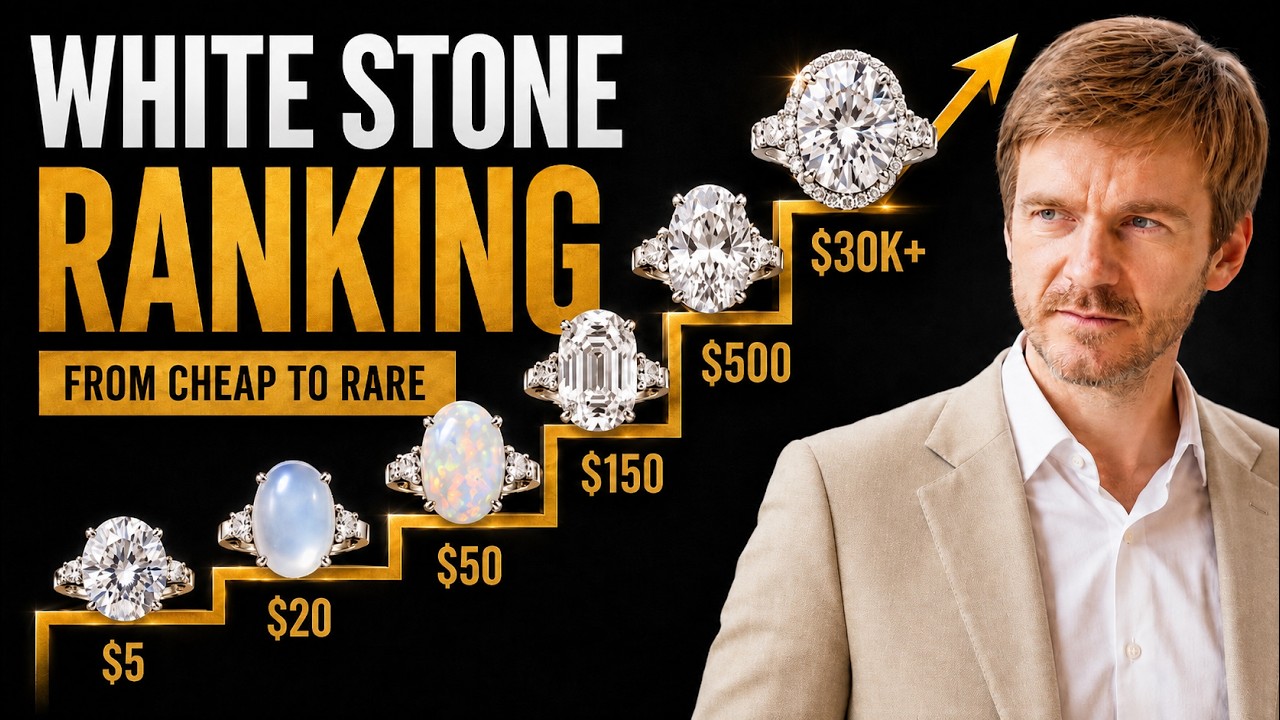
22 White and Colorless Gemstones for Engagement Rings

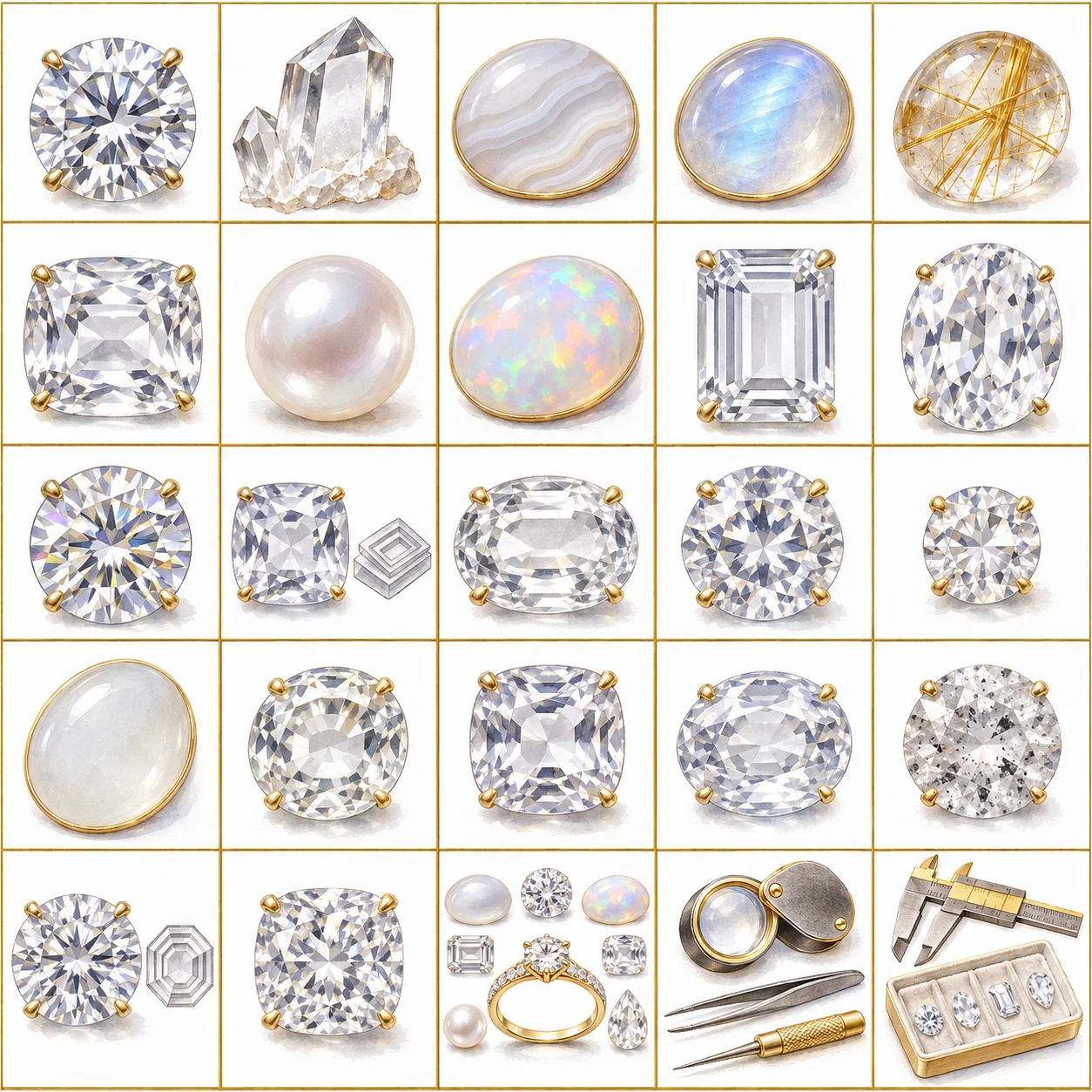
Most people think white engagement rings basically mean diamond. But white and colorless stones are a much bigger category than most buyers realize. Some are clear and inexpensive. Some are soft and romantic. Some are durable but don’t have sharp sparkle. Some are natural gems almost nobody talks about. And some are diamonds, just with very different price logic. This guide compares 22 white and colorless choices, from accessible alternatives to materials that can command a substantial premium. The order is a conversation guide, not a fixed current price ranking: quality, size, origin, treatment and seller can change the cost dramatically.
Not just diamond alternatives. White stones as a full category. Because when you remove color, everything else becomes more obvious: transparency, scratches, inclusions, sparkle, and how the stone ages. Mohs hardness describes scratch resistance. Toughness, cleavage, treatments and setting design also matter, so no one number divides all gems into suitable and unsuitable choices.
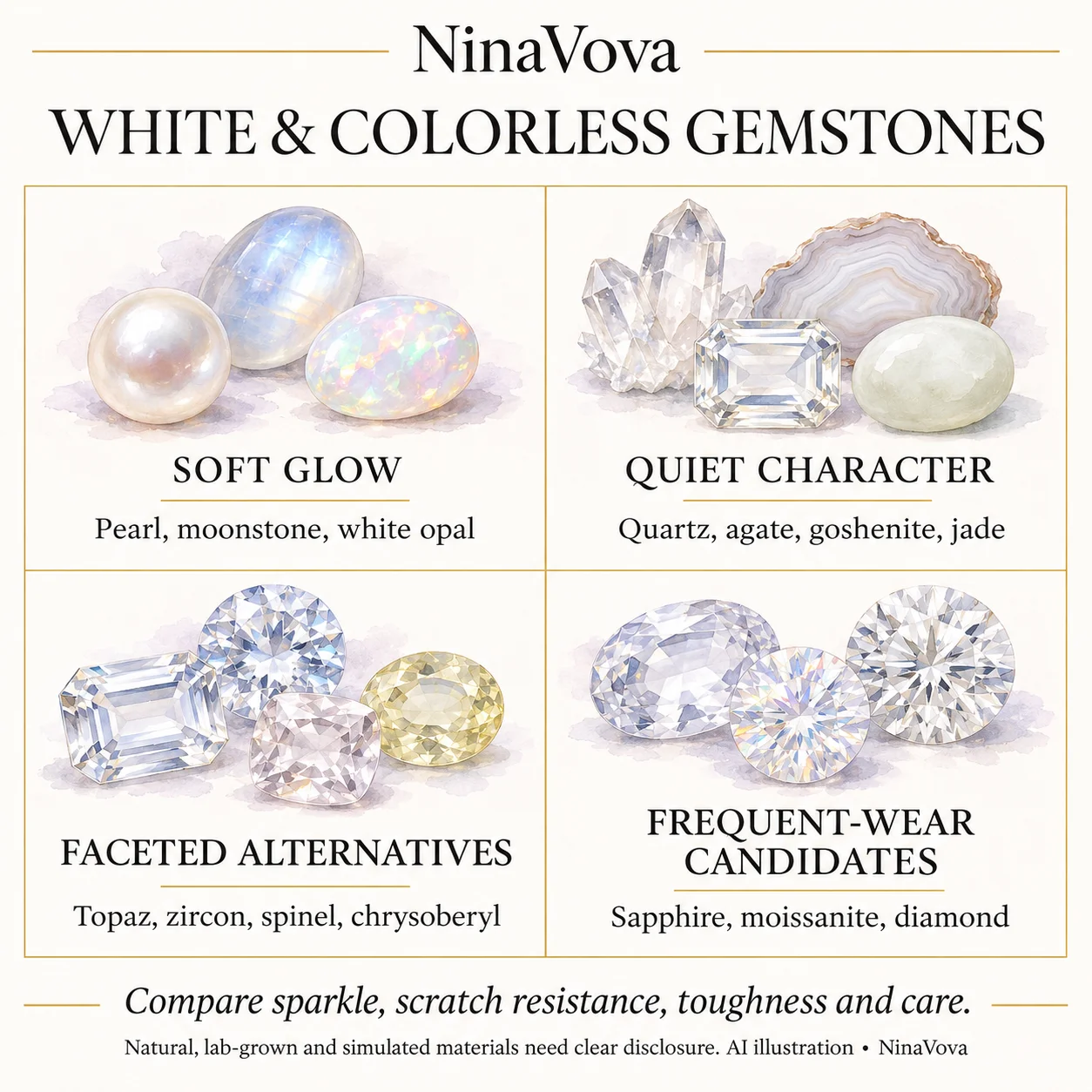
Start with the look you want, then compare care and the actual material. White does not mean diamond. Pearl, moonstone and opal offer glow; quartz and jade offer quieter character; sapphire, moissanite and diamond bring different kinds of durability and sparkle. Hardness is only one part of the decision, and natural, lab-grown and simulated materials need clear disclosure.
At a glance · Cubic Zirconia · Rock Crystal / Clear Quartz · White Agate / Milky Agate · White Moonstone / Rainbow Moonstone
Watch the NinaVova discussion
Watch the original NinaVova video on YouTube.
White and colorless choices at a glance
| Direction | Examples | What to check |
|---|---|---|
| Soft glow | Pearl, moonstone, white opal | Scratch sensitivity, cleavage, heat and the specific care routine. |
| Quiet character | Quartz, agate, goshenite, jade | Transparency, texture, toughness and actual material identification. |
| Faceted alternatives | Topaz, danburite, zircon, tourmaline, garnet | Cut, condition, cleavage where applicable, and care. |
| Less familiar clear gems | Chrysoberyl, spinel | Availability, natural vs synthetic identity and appropriate documentation. |
| Strong scratch resistance | Sapphire, moissanite, diamond | Different optical effects; condition, treatments and construction still matter. |
| Included character | Salt-and-pepper or icy diamond | Visible inclusions can be attractive, but assess surface-reaching fractures. |
Cubic Zirconia
Cubic zirconia is the classic affordable diamond simulant. It became popular because it can look clean, white, and sparkly for very little money. And because of that, many buyers naturally compare it to other white stones when they first start shopping. For temporary rings, travel rings, costume jewelry, or a very tight budget, CZ can make sense. The important thing is knowing what you are buying.
It gives you the look at the lowest price, but it does not age like the stronger white stones later in this list. Over time, it can scratch and lose that crisp clean appearance.
Rock Crystal / Clear Quartz
Rock crystal is clear quartz. It has a watery, glassy, ancient look. The beauty is quiet, not explosive. Quartz has been used in carvings, seals, crystal balls, and jewelry for thousands of years. But for engagement rings, the tradeoff matters. Quartz is around 7 on Mohs. It can work, but it still needs reasonable care. It will not have intense fire or feel like a high-brilliance stone.
I would see rock crystal as artistic and historical, not as a daily-wear recommendation for most buyers.
White Agate / Milky Agate
White agate is related to quartz, but visually it is different. Rock crystal is transparent. White agate is usually opaque, cloudy, banded, or milky. The appeal is not sparkle. It is pattern. Some white agates look like fog, smoke, or snow moving through the stone. That can be beautiful in a calm, minimal ring. But I would not use it for someone who wants a bright faceted center stone.
Agate works better as an earthy, sculptural choice.
White Moonstone / Rainbow Moonstone
Moonstone is where white stones start to feel more emotional. The famous effect is adularescence. That soft light seems to float under the surface. It does not sparkle aggressively. It glows. That glow helped make moonstone important in Art Nouveau jewelry, especially with designers like René Lalique. Buyer note: what many stores sell as “rainbow moonstone” is often actually white labradorite, so the name can be confusing.
For the buyer, the practical point is the same. You are buying glow and flash, not sharp brilliance. Moonstone can be beautiful in a protected setting. But for daily wear, it needs more care.
Rutilated Quartz
Rutilated quartz is clear quartz with needle-like inclusions inside. Those inclusions are the whole reason to buy it. Some stones have golden threads, silver-looking needles, or something like frozen lightning inside the crystal. Here, inclusions are not a defect. They are the feature. Most white stones are judged by how clean they are. Rutilated quartz is the opposite. It is for visible character, not perfect clarity.
White Topaz
White topaz is one of the most common affordable clear gemstones. On paper, it sounds better than it often is. It has Mohs 8, which sounds strong. But topaz has cleavage. That means it can split or break if it takes a hard hit in the wrong direction. Hardness and toughness are not the same thing. So even though white topaz resists scratches better than quartz, I would still be careful with it in a daily engagement ring.
White Pearl
Pearl is different from almost everything else here. It is organic. It is soft. And it is usually sold by millimeter size, not carat weight. So I’m using a 6 to 7 mm loose pearl, close to the visual size many people associate with a 1 ct round center stone. Pearls have long bridal history. They feel soft, romantic, and classic. For a pearl ring, choose the wearing plan as carefully as the design. Public photographs of a celebrity cannot establish how frequently they wear a ring or how they care for it. A delicate ring may be better enjoyed for selected occasions.
Pearl is one of the highest-care choices here. Protect pearl from scratches, abrasive cleaning and chemicals such as perfume. Use pearl-specific care instructions; gentle wiping is different from soaking, steam or ultrasonic cleaning. So a pearl engagement ring can be beautiful. But I would treat it as delicate jewelry, not as a hard-wearing everyday stone.
White Opal
White opal is one of the most magical white stones. The body color can be milky and soft. Then flashes of green, blue, orange, or red move through it. That play-of-color is what makes opal special. But structurally, opal needs respect. It is softer than most classic engagement-ring stones. It does not like harsh cleaning, heat, or rough wear. A white opal ring can be beautiful.
But I would want a protective setting, usually a bezel. I would not treat it like a low-maintenance everyday ring.
Goshenite / White Beryl
Goshenite is the colorless variety of beryl. And beryl is a famous gemstone family. Emerald is green beryl. Aquamarine is blue beryl. Morganite is pink to peach beryl. Goshenite is the colorless version. That makes it more interesting than most people realize. It has clean, quiet elegance. For someone who wants a loud white stone, I would choose something else. For someone who likes the beryl family and wants subtlety, goshenite makes sense.
Danburite
Danburite is one of those stones most buyers have never heard of. But it deserves a place here. It can be clean, colorless, and bright. It was first identified in Danbury, Connecticut, which is where the name comes from. For engagement rings, danburite is not mainstream. But it is more wearable than many obscure collector stones. At around Mohs 7 to 7.5, I would still use care.
This is also where I would mention phenakite. Phenakite can be colorless and hard enough for jewelry, but it is mostly a collector or metaphysical stone.
Moissanite
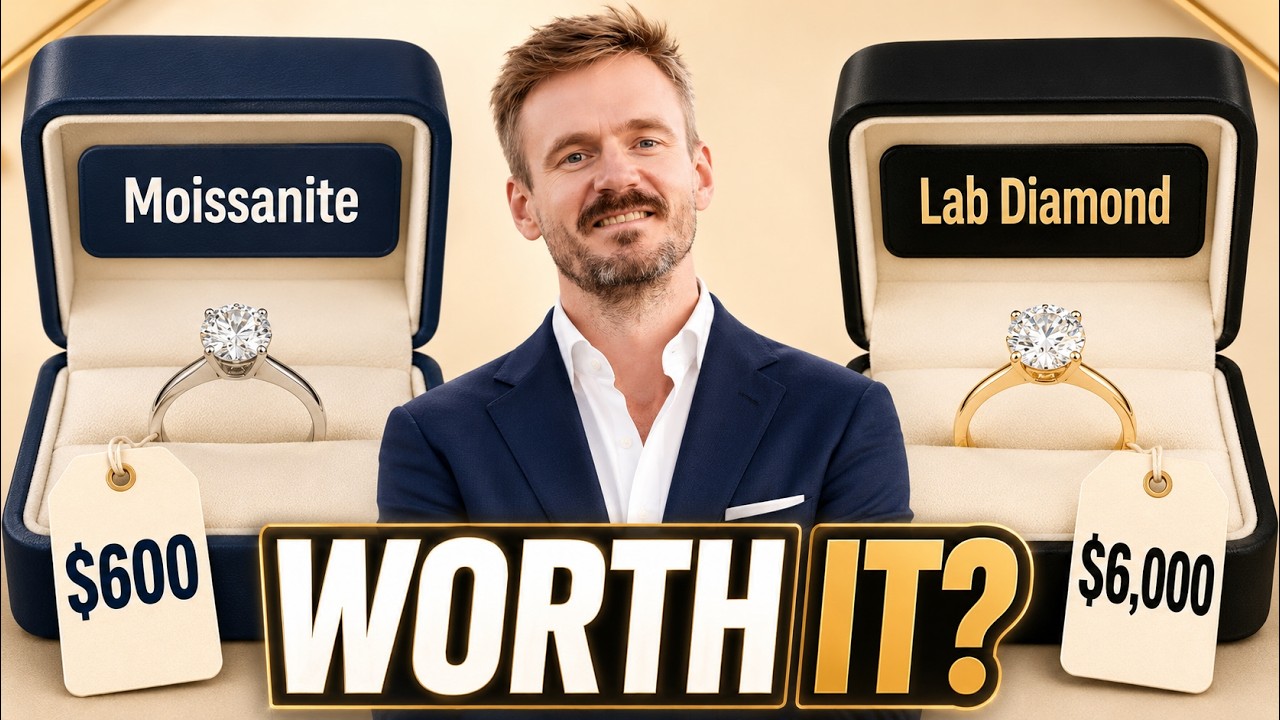
Moissanite used in jewelry is generally laboratory-grown silicon carbide, with very strong optical performance. It is a distinct material, not a laboratory-grown diamond. It is hard, durable, and much more sparkly than most buyers expect at this price. The main thing to understand is the type of sparkle. Moissanite often shows strong rainbow flashes. Some buyers love that bright, modern look. Other buyers feel it looks too flashy or too artificial.
So I would not choose moissanite just because it is affordable. I would choose it only if the buyer specifically likes that sharp, colorful sparkle.
Lab White Sapphire
Lab white sapphire is real sapphire grown in a lab. That means it is the same mineral family as natural sapphire and ruby: corundum. The big advantage is durability. Sapphire is 9 on the Mohs scale, so for daily wear, this is one of the stronger white stones in the list. Lab growth also makes clean, colorless material much easier to find at a reasonable price.
So you can often get a larger, very clean white sapphire without paying natural sapphire prices. The look is usually clean, bright, and slightly glassier than diamond. That is not automatically bad. It is just a different kind of white-stone look. So lab white sapphire makes sense for someone who wants the durability of sapphire, but is comfortable with lab-grown origin and wants a clean white stone at a lower price.
White Tourmaline / Achroite
Colorless tourmaline is called achroite. Most people think of tourmaline as green, pink, watermelon, blue, or Paraiba. White tourmaline feels like the missing version of the family. That makes it interesting. But tourmaline is not as worry-free as sapphire, spinel, chrysoberyl, moissanite, or diamond. It has decent hardness, but I would still place it in a moderate-care category. If someone loves tourmaline and wants something unusual, it makes sense.
But I would not make it the first white engagement-ring recommendation.
White Zircon
White zircon is one of the most misunderstood stones in jewelry. First: zircon is not cubic zirconia. Natural zircon is a real gemstone. White zircon can have beautiful fire, strong brilliance, and pronounced double refraction. That gives it a very active, almost vibrating sparkle. Zircon is also one of the oldest minerals on Earth. Tiny zircon crystals helped scientists study the early history of the planet.
So this is not a fake stone. It is an ancient natural gem with real optical life. For engagement rings, I like zircon more than many people expect. But I would still use care, because facet edges can abrade over time.
White Garnet
White garnet sounds strange because most people think of garnet as red. But garnet is a large gemstone family. Some garnets are orange, green, purple, or even colorless. This is not common in engagement rings. Most buyers will never be shown one. White garnet is more of a collector gem for someone who likes a rare colorless member of a familiar family. The hardness depends on the type, usually around 6.5 to 7.5.
So I would keep it in the moderate-care category.
White Jade
White jade is completely different from the faceted stones in this list. It is not about sparkle. It is about texture, smoothness, and cultural meaning. Jade has been valued for thousands of years, especially in Chinese art and jewelry. Jade is not extremely hard. But good jade can be very tough because of its interlocking structure. That is why it has been carved into bangles, seals, and ceremonial objects for so long.
For an engagement ring, white jade would be an artistic choice. A smooth cabochon. A low profile. A protective setting. Not a sparkle stone. Not a typical bridal look. But for the right person, it can feel calm, sculptural, and meaningful.
Colorless / White Chrysoberyl
Chrysoberyl is not beryl. Even though the names sound similar, it is a different gem species. From a durability standpoint, it is excellent. It sits at Mohs 8.5. That gives it strong scratch resistance compared with many other colorless gem options, though hardness alone cannot describe every risk in a ring. The famous varieties are alexandrite and cat’s-eye chrysoberyl. But colorless or white chrysoberyl exists too.
The problem is not wearability. The problem is availability. Most buyers will never see one in a normal jewelry store. If someone wants a durable natural white gem that almost nobody else has, chrysoberyl is one of the smartest obscure options.
Colorless / White Spinel
White spinel is another underrated serious choice. Spinel is durable, has good toughness, and is usually not heavily treated. Spinel has a clean, sharp look. It does not show the same doubled facet reflections you can see in zircon. And it does not have the strong rainbow fire of moissanite. Its appeal is quieter: clean brightness, good durability, and understated sharpness. Colorless spinel is not common, so it can be difficult to source in the right size and quality.
This is also the right place to mention synthetic colorless spinel. Synthetic spinel exists and has been used historically as a simulant material. So if someone is paying natural spinel prices, documentation matters.
Natural White Sapphire
Natural white sapphire is one of the major white engagement-ring stones. The durability is excellent. Sapphire is 9 on Mohs, so it handles daily wear much better than most softer stones here. But the look is where buyers need to be realistic. White sapphire can look beautiful, clean, and elegant. But it does not have the same crisp brilliance, contrast, and fire that people expect from diamond.
Buyers often compare the price and think they found a perfect replacement. Sometimes yes. Sometimes no. If you love a softer, cleaner, more understated white stone, natural white sapphire can be a great choice.
Salt and Pepper / Icy Diamond
Salt and pepper diamonds changed the way many buyers think about inclusions. Instead of hiding them, these stones make inclusions part of the design. Some look gray. Some look icy white. Some look translucent. Some have black specks. Some feel almost stormy. That is why I would keep salt and pepper, icy, gray-white, and included diamonds in one section. The buyer is usually not asking:
“Is this the cleanest stone?” They are asking: “Does this stone have character?” Because these are diamonds, the hardness is excellent. But not every included diamond is equally durable. Large surface-reaching fractures can still be a problem. A beautiful salt and pepper diamond can feel personal and modern. A bad one can just look dirty or damaged.

Lab Diamond
Lab diamond is one of the most common engagement-ring choices today. It gives buyers the diamond look, strong durability, and more size for the money. The main difference is origin. Instead of forming naturally underground, the diamond is grown in a controlled lab environment. For many buyers, that trade makes sense. They can put more of the budget toward size, cut, and overall appearance. The main tradeoff is resale value.
Do not buy on the assumption that the purchase price will be recoverable later. Resale depends on the stone, market and buyer; neither laboratory-grown nor natural origin guarantees a return. But if the goal is beauty, durability, and value in the ring itself, lab diamond can be a very practical modern option.
Natural Diamond
And finally, natural diamond. This is still the benchmark for white engagement rings. Part of that is tradition. Part of it is marketing. But part of it is also real gem performance. Diamond is the hardest natural gemstone. It has strong brilliance, strong fire, and excellent durability for daily wear. It also has the most developed grading system in jewelry. Cut, color, clarity, and carat weight give buyers a structured way to compare stones.
But the certificate should not replace your eyes. This is where buyers can overpay. A higher color grade does not always make the ring look better. A higher clarity grade does not always matter once the stone is eye-clean. And a larger carat weight does not help if the stone is poorly cut. A well-cut diamond with slightly lower color or clarity can look better on the hand than a higher-grade diamond with weak light performance.
That is why natural diamond stays at the end of this list. Not because every natural diamond is automatically the best choice. But because it is still the main reference point for durability, sparkle, grading, and tradition in white engagement rings.
Choose the material for the person and design
These materials offer very different routes to a white or colorless ring. The better question is not only which white stone is best. The better question is: which one fits the person and the design? In a custom engagement ring, the stone is not just a material. It becomes part of the design language. It should fit the lifestyle, the setting, and the personality of the person wearing it.
That is why I would not choose only by price, hardness, or popularity. Those things matter. But they are not the whole decision. Choose the stone that makes sense for the ring you are actually creating. Before you buy, learn how that specific material behaves in real life. Because white gemstones can all look similar in a simple chart. But on the hand, they wear differently, sparkle differently, age differently, and create very different rings.

Frequently asked questions
Is zircon the same as cubic zirconia?
No. Zircon is a natural gem species; cubic zirconia is a different manufactured material commonly used as a diamond simulant. Similar names do not establish similar properties.
Does Mohs 8 make topaz as tough as every lower-hardness gem?
No. Mohs concerns scratching. Topaz has cleavage and needs protection from blows; toughness is a separate part of durability.
Choose your version of a white ring
We can compare a bright, glowing, patterned or understated center and develop a setting around the actual material, its care needs and the person’s style.
Book a NinaVova consultation or explore our custom design process.
Continue reading: Engagement ring anatomy · Lab-grown gemstone comparison.
Sources and further reading
- GIA: Gem encyclopedia
- GIA: Moonstone care
- GIA: Pearl care
- GIA: Opal care
- GIA: Topaz care
- GIA: Zircon care
- GIA: Jade
- GIA: Spinel buyer’s guide
- GIA: Sapphire care
- FTC: Diamond and gemstone disclosure
Compare individual stones and current written seller terms. AI illustrations are educational concepts; actual NinaVova photographs are separately identified.